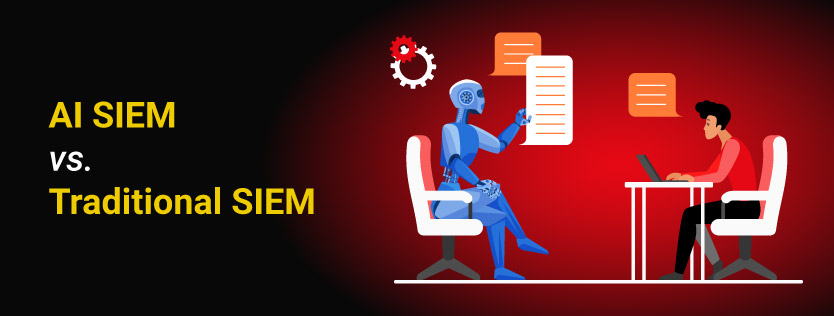
AI SIEM vs. Traditional SIEM
Quick Insights:
Traditional SIEM relies on predefined rules and correlation logic, making it effective for known threats but weak against unknown attacks. AI SIEM uses machine learning and behavioral analytics to detect anomalies and unknown threats in real time. AI reduces alert fatigue by filtering noise and prioritizing meaningful alerts. Traditional SIEM requires manual tuning and analyst intervention, slowing response time. AI SIEM enables automation, predictive detection, and faster incident response, shifting SOCs from reactive to proactive.
In today’s AI-driven world, staying ahead of attackers is more crucial and harder than ever. In fact, 66% of security professionals say their job is more stressful now than five years ago, and 81% blame an increasingly complex threat landscape. Significant data breaches keep getting costlier, too: the average breach in 2023 was $4.45 million. To cope, most organizations deploy a SIEM (Security Information and Event Management) system. But not all SIEMs are equal. Traditional on-prem SIEMs, heavy, signature-based platforms, can buckle under today’s data deluge and miss stealthy attacks. By contrast, new AI-driven SIEMs (sometimes called next-gen SIEMs) promise more intelligent analytics, automation, and real-time threat hunting. Let’s unpack how these two SIEM approaches compare so you can choose the one that best strengthens your security posture.
What Is Traditional SIEM?
Traditional SIEM solutions emerged years ago to collect logs and generate alerts. They excel at log aggregation and basic event correlation across on-premises servers, networks, and applications. For example, a legacy SIEM might aggregate firewall logs and alert on obvious rule matches or known signature patterns. This visibility helps with compliance reporting and forensic investigations.
But conventional SIEMs come with major drawbacks. They typically generate massive alert volumes that overwhelm Analysts. Because they rely on static rules and known signatures, they often miss novel threats like zero-days or multi-stage attacks. Analysts have to sift through countless logs, often “flying blind” due to outdated technology.
Enter AI-Driven SIEM
The limitations of legacy tools have given rise to AI-driven SIEMs, which some vendors call next-gen or AI-native SIEM platforms. Far from a mere enhancement, AI SIEM represents a strategic evolution in cybersecurity, redefining how organizations detect, analyze, and respond to threats in real time. AI SIEM integrates machine learning, behavior analytics, and even generative AI into the monitoring process. It can ingest streaming data (flows, logs, identity info) from on-premises and cloud environments, and apply advanced algorithms to spot subtle threat patterns.
Where traditional SIEM is log-centric, AI SIEM is data-centric and proactive. It continuously learns from past incidents to predict and catch new attack types. For example, machine learning models can distinguish normal user behavior from anomalies, identifying insider threats or lateral movement that rule-based engines would miss.
AI SIEM vs. Traditional SIEM
| Feature | AI-Driven SIEM | Traditional SIEM |
| Deployment and Setup | Cloud-based or hybrid; fast deployment, minimal on-premises hardware. | On-premises hardware; lengthy setup with high maintenance. |
| Data Sources and Visibility | Ingests logs from on-premises, cloud, containers, and endpoints; provides a unified view across different environments. | Mainly on-premises logs; integrating cloud/SaaS data is complex. |
| Scalability | Elastic cloud scaling: handles surges in data without new hardware. | Scaling requires buying/installing new hardware (slow, costly). |
| Threat Detection | ML/AI-based; learns patterns and finds unknown threats (APTs, zero-days). | Rule-based; relies on known signatures and manual tuning. |
| False Positives (Noise) | Advanced analytics and UEBA drastically reduce false positives. | High false alerts; Analysts must triage manually. |
| Response Time | Automated IR playbooks enable faster containment, shorter time to resolution. | Manual investigation and response; long dwell times. |
| Maintenance | Cloud SIEM updates are automatic; vendor handles patching and scaling. | Requires regular patches and manual updates on servers. |
| Cost Model | Subscription/OPEX model; pay-for-what-you-use, reducing capital spend. | High upfront CAPEX (hardware, licenses) plus ongoing support. |
Making the Right Choice for Your Organization
So, which SIEM approach is better for your organization? In most modern contexts, an AI-driven SIEM has clear advantages. It’s designed for today’s explosive data volumes and sophisticated attack tactics. AI SIEM can greatly enhance your security posture if your team is struggling with alert fatigue, understaffing, or a mix of cloud and on-prem workloads. Automating data normalization, alert triage, and even some threat response lets your Analysts focus on real threats and strategy (instead of drowning in logs).
SOC Analyst Hands-on Training with InfosecTrain
If your organization aims to build a more proactive, efficient security operation, an AI-driven SIEM is hands down the smarter long-term investment. It analyzes vast data in real time, scales effortlessly, and pinpoints real threats without overwhelming your SOC with false positives.
But here’s the deal: tools alone aren’t enough. To truly harness the power of AI SIEM, you need skilled Analysts who understand how to interpret advanced analytics, fine-tune threat detection models, and respond with precision.
That’s exactly where SOC Analyst Training Course bridges the gap. This course equips aspiring and seasoned Analysts with practical, real-world skills to work with next-gen SIEM platforms — including behavioral analytics, alert triage, automation workflows, and incident response. You’ll gain firsthand experience with AI-driven tools, cloud log ingestion, threat hunting, and everything today’s SOCs demand.

Frequently Asked Questions
What is the difference between AI SIEM and Traditional SIEM?
The key difference lies in how threats are detected: 𝗧𝗿𝗮𝗱𝗶𝘁𝗶𝗼𝗻𝗮𝗹 𝗦𝗜𝗘𝗠: Uses static rules and predefined patterns 𝗔𝗜 𝗦𝗜𝗘𝗠: Uses machine learning to detect anomalies and unknown threats Traditional SIEM is reactive, while AI SIEM is adaptive and predictive, capable of evolving with new attack patterns.
Why is AI SIEM better for modern security operations?
AI SIEM is better suited for modern SOCs because it: Detects zero-day and unknown threats, reduces false positives, automates incident triage and response, and handles massive data volumes in real time. This makes security operations faster, smarter, and less dependent on manual analysis.
What are the limitations of Traditional SIEM?
Traditional SIEM struggles with: high alert noise and false positives, heavy manual rule tuning, limited ability to detect advanced or unknown threats, and slow response due to human dependency.
How does AI reduce alert fatigue in SIEM?
AI SIEM reduces alert fatigue by: Filtering irrelevant alerts using behavioral analysis, assigning risk scores to prioritize threats, and automating repetitive investigation tasks.
Should organizations replace Traditional SIEM with AI SIEM?
Not necessarily replace, but evolve. Traditional SIEM still works well for compliance and known threats. AI SIEM enhances it with automation, intelligence, and scalability. Best approach: Hybrid or next-gen SIEM (AI + traditional capabilities) for maximum effectiveness.