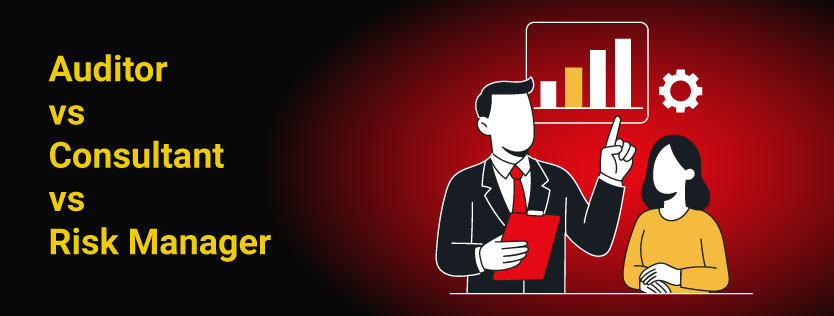
Auditor vs Consultant vs Risk Manager
Quick Insights:
Auditors verify compliance and identify gaps against standards such as ISO 27001 and NIST. At the same time, consultants design and implement solutions to address those gaps, and risk managers identify and manage threats based on business impact and risk tolerance. Together, they ensure compliance, improve security, and protect business objectives by combining validation, execution, and strategy to build a strong, resilient, and well-governed organization.
Imagine a company launching a new banking app to handle millions of transactions. Each expert plays a vital role in making sure the launch is a success:
- The Auditor: They act as the unbiased judge, checking system logs to verify that security measures and legal requirements are being followed as promised.
- The Consultant: They act as the architect, designing the app’s security by setting up strong encryption and multi-factor authentication to keep hackers out.
- The Risk Manager: They act as the strategist, weighing the cost of a potential data breach against the budget to decide which threats warrant the greatest investment.
In short, the Auditor verifies the locks, the Consultant builds the vault, and the Risk Manager decides what is valuable enough to protect inside.
What Does an Auditor Do?
An auditor acts as a professional quality checker, verifying that an organization adheres to its own rules and legal requirements. They serve as an unbiased observer, looking for gaps between what a company says it does and what it actually does.
Key Responsibilities of an Auditor
- Review Security Controls: They test systems against recognized global standards, such as ISO 27001 or NIST, to assess the strength of defenses.
- Examine Evidence: Instead of just taking someone’s word for it, they look at logs, screenshots, and documents to prove that security steps are being followed.
- Conduct Different Audit Types: They may perform Internal Audits (to help the company improve from within) or External Audits (to provide official certification to outside stakeholders).
- Identify and Report Risks: They create detailed reports that highlight findings in specific areas where the company is failing to meet a standard.
- Verify Remediation: After a gap is identified, they return to check whether the company actually fixed the issue as promised.
What Does a Consultant Do?
A consultant is a specialist advisor or hired expert who steps in to help a company solve a specific problem. While an auditor checks the rules, a consultant helps you build the system from the ground up. They are the architects who design the security plan and the coaches who help the team execute it.
Key Responsibilities of a Consultant
- Problem Identification: They analyze a company’s current setup to identify exactly where security leaks are and what needs to be fixed first.
- Design and Architecture: They create blueprints for security frameworks, write policies, and select the technical tools (such as firewalls or encryption) the company needs.
- Hands-on Implementation: They don’t just give advice; they often help install the software, implement ISO 27001 standards, and ensure everything is running correctly.
- Process Improvement: They examine how a team works and propose better, faster, and more secure ways to handle daily tasks.
- Gap Remediation: If an auditor identifies a problem, the consultant is the person the company hires to fix that specific gap.
What Does a Risk Manager Do?
A risk manager is the company’s Strategic Guardian. Their job is not to stop every single threat (which is impossible), but to decide which threats are dangerous enough to spend money on. They act like a ship’s navigator, constantly scanning the horizon for storms so the company can stay on course.
Key Responsibilities of a Risk Manager
- Risk Assessments: They look at every part of the business and ask, “What could go wrong here?” and “How much would it cost us?”
- Business Impact Analysis (BIA): It determines which parts of the company are most critical. For example, if the website goes down, how many thousands of dollars are lost every hour?
- Setting the Risk Appetite: They work with top bosses to decide how much risk the company is willing to take. (Example: We are okay with a small chance of a minor bug, but we have zero tolerance for a data breach.)
- Mitigation Strategy: They decide whether to avoid the risk, reduce it (by adding security), transfer it (by buying insurance), or accept it.
- Continuous Monitoring: Unlike a one-time project, risk management never stops. They use frameworks such as NIST or COSO to maintain a live Risk Register of all active threats.
Auditor vs Consultant vs Risk Manager
| Feature | Auditor | Consultant | Risk Manager |
| Primary Goal | Verification & Compliance | Problem-Solving & Strategy | Prevention & Mitigation |
| Perspective | Backward-looking (Did you do it?) | Forward-looking (How do we fix it?) | Ongoing/Real-time (What’s the threat?) |
| Independence | Must be independent (Unbiased) | Collaborative (Partner) | Integrated (Part of the team) |
| Key Output | Audit Report / Findings | Recommendations / Roadmaps | Risk Registers / Dashboards |
| Ideal Mindset | Skeptical & Detail-Oriented | Creative & Solutions-Driven | Strategic & Analytical |
Conclusion
Mastering GRC requires a mindset that balances rigorous compliance with strategic business goals. InfosecTrain’s GRC IT Auditor Practical Approach training transforms technical professionals into high-value audit experts.
- Strategic Leadership: Move beyond technical bug-fixing to influence high-level executive decisions through the three lines of defense: Auditing, Consulting, and Risk Management.
- Practical Execution: Gain hands-on experience in full audit lifecycles, technical domain testing, and evidence validation using NIST and COBIT.
- Future-Ready Skills: Master the complexities of auditing modern Cloud and AI environments to stay ahead of tightening global regulations.
Build the strategy, don’t just check the boxes. Become a practical GRC expert with InfosecTrain!

TRAINING CALENDAR of Upcoming Batches For GRC Auditor Training
| Start Date | End Date | Start - End Time | Batch Type | Training Mode | Batch Status | |
|---|---|---|---|---|---|---|
| 26-Sep-2026 | 31-Oct-2026 | 19:00 - 23:00 IST | Weekend | Online | [ Open ] | |
| 30-Jan-2027 | 28-Feb-2027 | 19:00 - 23:00 IST | Weekend | Online | [ Open ] |
Frequently Asked Questions
Can one person perform all three roles simultaneously in a company?
In smaller organizations, duties often overlap, but in larger enterprises, the roles are strictly separated to maintain independence. Specifically, an Auditor should never audit their own work (e.g., a Consultant should not audit a system they designed) to avoid a conflict of interest.
Which role is best for someone who enjoys problem-solving?
The Consultant role is ideal for problem-solvers. While Auditors identify issues and Risk Managers analyze their impact, Consultants are the ones who get hands-on to design and implement the actual fixes and security architectures.
What is the main difference between an Internal and an external auditor?
An Internal Auditor is a company employee who helps the organization improve its processes from within. An External Auditor is an independent third party hired to verify compliance for stakeholders and regulators, or to issue official certifications.
Does a Risk Manager try to eliminate all risks?
No. Eliminating all risk is impossible and often too expensive. A Risk Manager’s job is to define the Risk Appetite, the level of risk a company is willing to accept, and decide whether to reduce, transfer (via insurance), avoid, or accept the remaining risks.
How does InfosecTrain’s GRC IT Auditor (Practical Approach) help in these roles?
This training bridges the gap between theory and practice. It teaches you the Auditor's skill in evidence collection, the Consultant's ability to remediate gaps, and the Risk Manager's strategic use of frameworks such as NIST and COBIT, making you a versatile GRC expert.