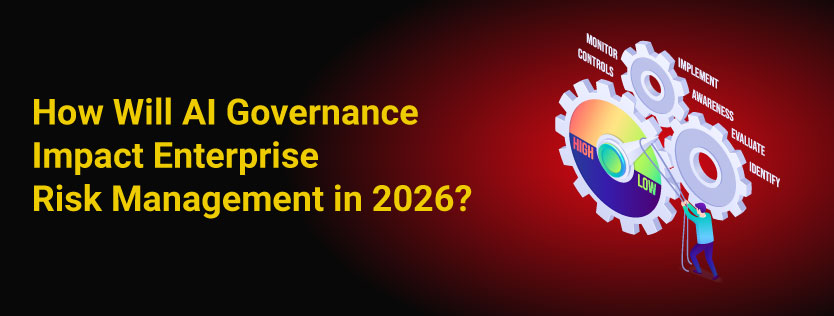
How Will AI Governance Impact Enterprise Risk Management in 2026?
Quick Insights:
AI governance is transforming ERM from periodic reviews into continuous, real-time monitoring. Organizations must prioritize transparency and accountability, especially amid evolving regulations such as the EU AI Act, while addressing risks from shadow AI and third-party use. Ethical AI is now directly tied to financial performance and brand reputation. Modern ERM also includes adversarial testing and human-in-the-loop oversight, along with a strong focus on data sovereignty and localized governance for global compliance.
In 2026, a single AI hallucination could cost a corporation millions, turning a high-tech advantage into a sudden financial disaster. Without strict governance, AI is like a high-performance race car without a driver; it offers incredible speed but carries the constant risk of a total wreck. This reality is forcing risk management to evolve, moving beyond human oversight to the active policing of autonomous digital minds. Governance serves as the essential safety tether, keeping companies from sliding into costly legal battles or ethical scandals. Ultimately, these rules are what transform AI from a high-stakes gamble into a reliable, predictable engine for business success.
How Will AI Governance Impact Enterprise Risk Management?
1. From Annual Audits to Continuous Monitoring
Traditional risk management relies on periodic reviews, but AI behavior can change in minutes due to Model Drift, where a model’s performance decays as it encounters new, real-world data.
- The Impact: ERM is transitioning from point-in-time snapshots to Real-Time Risk Tracking.
- The Change: Companies are deploying automated watchdog AI to monitor production models 24/7. These systems flag errors, bias, or performance drops the moment they occur, preventing a small glitch from becoming a massive failure.
2. Algorithmic Transparency and Legal Liability
With the full enforcement of global regulations like the EU AI Act in 2026, companies are now legally and financially responsible for Black Box decisions.
- The Impact: The excuse the algorithm made the choice is no longer a valid legal defense in court.
- The Change: ERM now mandates the use of Explainable AI (XAI) frameworks. Whether an AI rejects a loan, sets an insurance premium, or filters a job applicant, the governance layer must provide a clear, human-readable audit trail to explain the why behind every outcome.
3. Combatting the Rise of Shadow AI
Just as Shadow IT plagued the previous decade, Shadow AI, the unauthorized use of Generative AI tools by employees, is a top enterprise threat in 2026.
- The Impact: Unregulated AI can inadvertently leak proprietary source code, trade secrets, or customer data into public training sets.
- The Change: ERM has expanded to include Third-Party AI Risk Management (TPARM). Organizations now require a Software Bill of Materials (SBOM) for AI, ensuring they know exactly what data was used to train any vendor-provided software.
4. Ethical Integrity as a Financial Metric
In 2026, an ethical slip-up by an AI (such as a biased customer service bot) can cause a company’s stock price to tumble within hours due to viral social pressure.
- The Impact: Ethics has moved from a soft HR topic to a Hard Financial Metric tracked by investors.
- The Change: Corporate risk heat maps now include Ethical Alignment as a core category. This ensures that AI behavior not only meets legal standards but also aligns with the brand’s specific values and social responsibilities.
5. Resilience Against Adversarial AI Attacks
As AI becomes the backbone of enterprise operations, it becomes the primary target for hackers. Adversarial attacks such as Data Poisoning or Prompt Injection can flip an AI from a helpful assistant to a corporate spy.
- The Impact: A single successful attack on a core AI model can paralyze an entire supply chain or lead to massive data exfiltration.
- The Change: ERM now incorporates Adversarial Robustness Testing. Security teams perform red teaming specifically on AI models to find vulnerabilities in the logic, ensuring the digital brain can withstand attempts at manipulation.
6. Solving the AI Talent Gap and Countering Automation Bias
As AI handles increasingly complex tasks, businesses face a new psychological threat: Automation Bias. This is the dangerous habit of humans assuming the AI is always right, leading them to stop double-checking its work.
- The Impact: When teams stop questioning the digital brain, small errors can go undetected, eventually snowballing into massive failures that threaten a company’s finances or its brand.
- The Change: ERM now mandates Human-in-the-Loop (HITL) protocols. Risk leaders use Competency Mapping to transform employees from passive users into expert Auditors. These staff members are trained to recognize when an AI is overstepping and are empowered to hit the emergency brake when needed.
7. Managing Data Sovereignty and Digital AI Borders
In 2026, data is not just in the cloud; it is tied to specific geography. Moving an AI model from one country to another can now be a legal minefield, as data used to train a model in one region may be considered illegal in another.
- The Impact: Organizations struggle with Compliance Fragmentation. An AI system that passes every test in the U.S. might face crippling fines in the EU or India due to strict local laws governing where data is stored and processed.
- The Change: Modern ERM uses Localized AI Governance. By implementing geographic fencing, companies ensure that their AI models and training data remain within legal boundaries. This maintains Model Sovereignty, allowing global companies to run AI across different countries without breaking local privacy laws.
CISSP Training with Infosectrain
In 2026, AI governance is a core pillar of Enterprise Risk Management, moving beyond simple compliance to protect a company’s reputation and resilience. Early adopters use structured oversight to drive innovation, while those who wait face enterprise-wide business threats. Leading this shift requires the CISSP Certification, the global gold standard for designing and managing secure architectures. InfosecTrain’s CISSP program builds the technical and leadership skills needed to align these security standards with business goals. Ultimately, combining elite certification with strong governance turns AI risks into a powerful competitive advantage.

TRAINING CALENDAR of Upcoming Batches For CISSP Training
| Start Date | End Date | Start - End Time | Batch Type | Training Mode | Batch Status | |
|---|---|---|---|---|---|---|
| 17-Oct-2026 | 29-Nov-2026 | 10:00 - 14:00 IST | Weekend | Online | [ Close ] | |
| 26-Oct-2026 | 01-Dec-2026 | 20:00 - 22:00 IST | Weekday | Online | [ Open ] | |
| 14-Nov-2026 | 20-Dec-2026 | 19:00 - 23:00 IST | Weekend | Online | [ Open ] | |
| 07-Dec-2026 | 25-Dec-2026 | 07:00 - 12:00 IST | Weekday | Online | [ Open ] | |
| 12-Dec-2026 | 24-Jan-2027 | 10:00 - 14:00 IST | Weekend | Online | [ Open ] | |
| 09-Jan-2027 | 14-Feb-2027 | 19:00 - 23:00 IST | Weekend | Online | [ Open ] | |
| 13-Feb-2027 | 21-Mar-2027 | 09:00 - 13:00 IST | Weekend | Online | [ Open ] | |
| 13-Mar-2027 | 18-Apr-2027 | 19:00 - 23:00 IST | Weekend | Online | [ Open ] |
Frequently Asked Questions
How is AI changing traditional risk management?
AI is shifting risk management from periodic audits to continuous monitoring, as AI systems can rapidly adapt their behavior based on real-time data.
Why is algorithmic transparency important in AI governance?
Transparency enables organizations to explain AI decisions, which is essential for legal compliance and for building trust with stakeholders.
What is Shadow AI, and why is it risky?
Shadow AI refers to unauthorized use of AI tools by employees, which can lead to data leaks, compliance issues, and exposure of sensitive information.
How do organizations manage risks from AI-driven cyberattacks?
They implement adversarial testing and red teaming to identify vulnerabilities and strengthen AI systems against manipulation and attacks.
What role does human oversight play in AI risk management?
Human-in-the-Loop (HITL) ensures that humans validate AI decisions, reducing the risks of automation bias and improving accountability.