AI Powered Course
Advanced Threat Hunting Digital Forensics & Incident Response (DFIR) Training
Detect, Investigate, Respond Faster with AI-Powered DFIR
 23 May




Program Highlights
InfosecTrain’s AI-powered Advanced Threat Hunting DFIR Training offers 40 hours of live, instructor-led sessions. The course is designed to be highly interactive and dynamic, combining lectures with AI-integrated hands-on labs that simulate real enterprise scenarios. Participants will tackle capstone challenges, apply investigative skills in practical exercises, and gain exposure to advanced malware, memory, disk, and network analysis techniques using AI. Learners also receive access to recorded sessions, extended post-training support, and personalized career guidance and mentorship, ensuring they can confidently apply their skills and advance in DFIR and cybersecurity roles.
 40 hours Instructor-led Training
  Learn from Industry Experts
  Highly Interactive and Dynamic Sessions
  20+ AI-driven Hands-On Labs
  Learn with Real-World Scenarios
  Capstone Challenges
  Career Guidance and Mentorship
  Extended Post Training Support
  Access to Recorded Sessions
Training Schedule
- upcoming classes
- corporate training
- 1 on 1 training
| Start - End Date | Training Mode | Batch Type | Start - End Time | Batch Status | |
|---|---|---|---|---|---|
| 23 May - 21 Jun | Online | Weekend | 19:00 - 23:00 IST | BATCH OPEN |
Why Choose Our Corporate Training Solution
- Upskill your team on the latest tech
- Highly customized solutions
- Free Training Needs Analysis
- Skill-specific training delivery
- Secure your organizations inside-out
Why Choose 1-on-1 Training
- Get personalized attention
- Customized content
- Learn at your dedicated hour
- Instant clarification of doubt
- Guaranteed to run
Can't Find a Suitable Schedule? Talk to Our Training Advisor!

The AI-powered Advanced Threat Hunting, Digital Forensics, and Incident Response (DFIR) Training equips security professionals with elite skills to detect, investigate, and respond to sophisticated cyber threats across enterprise environments. Participants learn core DFIR competencies, including persistence, lateral movement, and credential abuse hunting, memory and disk forensics, malware analysis, and network-based C2 detection.
What sets this course apart is the integration of AI-accelerated workflows, enabling analysts to handle massive datasets, automate repetitive tasks, and generate actionable reports faster, while retaining full control over investigative judgment, hypothesis testing, and evidence interpretation. By combining hands-on labs, real-world scenarios, and portable AI techniques, learners gain practical experience that applies to any enterprise environment, preparing them to deliver precise, executive-ready investigations efficiently and confidently.
- Module 1: Advanced Security Operations
- SOC Metrics and KPIs
- Purple Team Integration
- Detection Engineering Methodology
- SIEM and SOAR Optimization
- Implementing MITRE ATT&CK Framework
- AI for DFIR: realistic use cases, limitations, and validation requirements
- Lab: Set up your AI workflow environment (Ollama OR API keys + basic CLI/integration)
- Module 2: Persistence Threat Hunting
- Advanced Registry Analysis Techniques
- WMI Event Subscription Detection
- COM Hijacking and DLL Search Order
- Scheduled Task Analysis and Anomaly Detection
- Multi-Log Correlation for Persistence Hunting
- AI for query generation (natural language → platform-specific syntax)
- Lab: Detecting Advanced Persistence Mechanisms
- Module 3: Lateral Movement Analysis
- Pass-the-Hash and Pass-the-Ticket Detection
- Detecting Authenticated Remote Execution
- RDP/VPN Access Analysis
- WMI and PowerShell Remoting Abuse
- Kerberos Protocol Analysis
- AI for evidence mapping (correlate events across systems, analyst validates chains)
- Lab: Lateral Movement Investigation
- Module 4: Network-Based Threat Hunting
- Statistical Approaches to Traffic Analysis
- Beacon Pattern Detection in Network Traffic
- DNS and HTTP Tunneling Identification
- TLS/SSL Inspection Strategies
- Network Timeline Reconstruction
- AI to generate Python anomaly detection code (you review, run, interpret results)
- Lab: Network Traffic Analysis for C2 Detection
- Module 5: Credential Theft Investigation
- Windows Authentication Mechanisms (In-depth)
- Detecting Credential Dumping Operations
- Kerberoasting and AS-REP Roasting Detection
- DPAPI Analysis for Credential Extraction
- Domain Controller Authentication Log Analysis
- AI-assisted log correlation for credential abuse
- Lab: Credential Abuse Incident Response
- Module 6: Malware Analysis Techniques
- Static Analysis with Binary Analysis Tools
- Dynamic Analysis in Isolated Environments
- Memory Dumping and Analysis for Malware
- Anti-Analysis Technique Identification
- Process Injection and Hollowing Detection
- Natural-language malware analysis with GHIDRA / IDA / Radare2 (extract IOCs, behaviors, key functions, configs)
- Lab: Analyzing Real-World Malicious Samples
- Module 7: Memory Forensics
- Memory Acquisition Methods and Challenges
- Process, DLL, and Driver Analysis
- Detecting Rootkits and Bootkits
- Finding Injected Code and Hidden Processes
- Analyzing Malware Artifacts in Memory
- AI to rank suspicious entries from Volatility output (you validate and extract)
- Lab: Memory Analysis for Hidden Threats
- Module 8: Disk Forensics
- Analysis for Proof of Execution
- Analysis for Proof of File / Folder Access
- Extracting Windows Event Logs for Offline Analysis
- Extracting Windows Registry for Offline Analysis
- MFT Analysis for File System Artifacts
- Advanced File System Artifact Analysis
- Timeline Creation and Analysis
- Super Timeline Creation and Analysis
- AI to filter timeline noise and draft incident narrative (you verify against artifacts)
- Lab: Disk-Based Investigation and Evidence Recovery
- Module 9: Final Challenge
- Perform Threat Hunting, Incident Response, Malware Analysis and Forensics, and Solve and Answer Questions
- Apply what you learnt so far
- Optional: build your personal AI-assisted DFIR workflow (portable stack + report deliverable)
Lab Contents
- Core DFIR Labs (Traditional Skills + AI-Accelerated Options)
- Detection Engineering Lab Setup
- Hands-on writing windows detection (traditional + AI query generation comparison)
- Hands-on writing complex multi-source detection
- Proactive Hunt for confirming the presence of adversary
- Hunt for credential abuse (manual correlation + AI-assisted pivot suggestions)
- Hunt for evidence of adversary across Persistence points
- Hunt for advanced persistence techniques
- Evidence identification for Lateral Movement
- Hunt for the detection of Lateral Movement
- Credential Tracking for Lateral Movement Hunting
- Malware Analysis Labs (AI-Driven Investigation)
- Malware Analysis Lab Setup (radare2 + MCP integration, safe workflow, structured output capture) Static Malware Analysis (natural language → functions/strings/IOCs extraction) Natural-language reverse engineering lab (radare2 MCP tool calls: triage sample → extract IOCs/behaviors → draft capability report)
- Dynamic Malware Analysis (behavior capture → LLM-assisted IOC + behavior summary, analyst validated)
- Hunting for Malware via YARA rules (LLM-assisted rule drafting + false-positive review)
- Network & Forensics Investigation Labs
- Network Hunting for Malware Beacons
- Network Hunting for DNS Exfiltration
- Network Hunting for Domain Fronting Techniques
- Hands-on Hunting Report Writing with Hand off to Incident Response Teams
- Forensics Evidence Acquisition
- Analysing Disk Image
- Analysing Memory Image
- Analysing Filesystem Image
- Writing Threat Intel Reports
Capstone Challenge
- Final Exercise Challenge: To be completed by students, apply everything learnt so far and solve enterprise scale breach, write reports at the end
This training is ideal for:
- SOC Analysts (Tier 2+) seeking to advance beyond alert triage to proactive hunting
- Incident Responders looking to enhance investigation techniques and efficiency
- Security Engineers responsible for building detection engineering capabilities
- Digital Forensic Analysts expanding into threat hunting methodologies
- Penetration Testers who want to understand defensive detection techniques
- Security Architects responsible for designing security monitoring solutions
Required Technical Knowledge
- Windows Systems (Essential)
- Windows Event Log analysis (Security, System, Application logs)
- Registry structure and common keys related to security
- Windows authentication mechanisms and security tokens
- PowerShell fundamentals and security-related cmdlets
- Windows services, scheduled tasks, and startup mechanisms
- Networking Fundamentals (Essential)
- TCP/IP protocol stack operations
- Common protocols and their security implications (HTTP/S, DNS, SMB, RDP)
- Basic packet analysis concepts
- Network traffic patterns and anomaly identification
- Security Concepts (Essential)
- Common attack vectors and techniques
- Basic log analysis and correlation
- Security monitoring principles
- Malware behavior fundamentals
- Additional Skills (Highly Recommended)
- Basic Linux command-line operations (can use an OS without GUI)
- Virtualization experience (VMware/VirtualBox/Hyper-V/Docker)
- Basic scripting and decent programming abilities (PowerShell/Bash/Python/C/C++)
- Understanding of Applied Statistical Analysis (Maths and Stats)
- Familiarity with MITRE ATT&CK framework
- Willingness to experiment with AI tools during hands-on labs (we teach this from scratch – no prior LLM experience required)
- Required Experience Level
- Professional: Minimum 1 year in an IT security role OR
- Hands-on: Demonstrable equivalent experience through labs, CTFs, or personal projects
- Note: This is a technically rigorous course. Participants without these prerequisites will struggle significantly with the pace and depth of the material.
- Technical Requirements
- Laptop with 8GB+ RAM (16GB recommended) for running VMs and analysis tools AI Setup (choose one):
- Local-only (Free): Ollama + local models on your laptop (slower but private)
- API-based (~$5-20 total): OpenAI/Groq/Gemini credits for faster responses
- All course materials, datasets, and setup guides provided
- Labs work with either setup – you choose based on your privacy/performance preference
- Laptop with 8GB+ RAM (16GB recommended) for running VMs and analysis tools AI Setup (choose one):
Upon successful completion of the training, participants will be able to:
- Hunt persistence, lateral movement, and credential abuse
- Perform memory, disk, and malware forensics effectively
- Analyze network traffic for C2 and anomalies
- Apply AI to accelerate investigative workflows
- Generate executive-ready and legally defensible incident reports
- Correlate multi-source logs for advanced threat detection
- Design and execute enterprise-scale threat hunting exercises
- Develop portable DFIR skills across tools and environments

How We Help You Succeed

Vision

Goal

Skill-Building

Mentoring

Direction

Support

Success

Career Transformation
Projected increased roles related to Threat Hunting over the next decade.
Incident Response Efficiency in companies with Digital Forensics trained professionals
Organizations plan to hire professionals skilled in Threat Hunting for various cybersecurity operations.
Organizations committed to training existing staff on Threat Hunting and Incident Response best practices using the DFIR framework.

Technology

Healthcare

Retail

Government

Manufacturing

Finance


Our Expert Course Advisors

8+ Years of Experience
Words Have Power

This course provided a great learning experience with Infosectrain. Initially, I was unfamiliar with threat hunting concepts, but now I’ve gained valuable knowledge. I’m confident that this course, along with the guidance from the trainer, will propel my career forward.

Great learning session with Infosectrain! Special thanks to the trainer for their expertise, especially in the Threat Hunting course.

Overall, the training provided by Infosectrain, including the Threat Hunting sessions, was beneficial. Special thanks to the trainer for their expertise.

The Threat Hunting course by Infosectrain was very informative, and the trainer’s expertise made it enriching. I highly recommend it for anyone looking to enhance their cybersecurity skills.

It was an excellent training session facilitated by Infosectrain. The instructor displayed patience in addressing all our queries, ensuring a comprehensive learning experience. This course provided valuable skill development opportunities. I also recommend considering the Threat Hunting course offered by Infosectrain for further skill enhancement.

I completed the Threat Hunting Professional course from InfosecTrain. I must say it was a great experience with a very knowledgeable trainer and engaging course content.
Success Speaks Volumes

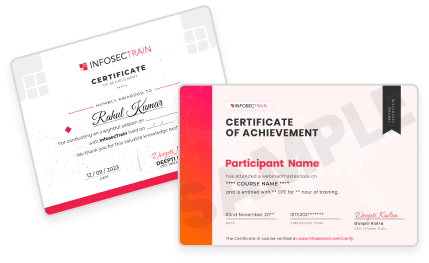
Get a Sample Certificate
Frequently Asked Questions
What is Advanced Threat Hunting and DFIR Training?
The Advanced Threat Hunting and DFIR Training teaches sophisticated methods for identifying and handling cybersecurity events. You will learn how to identify compromised systems, pinpoint the exact moment and method of a breach, comprehend the items that attackers took or altered, and effectively contain and resolve issues. In the event of a security breach, participants will get knowledge on how to effectively handle the incident response process and aggressively search for risks within a network.
Who should enroll in the Advanced Threat Hunting and DFIR Training course?
The Advanced Threat Hunting and DFIR training course is best suited for:
- Malware Analysts
- Digital Forensic Investigators
- Cyber Security Analysts
- Network Security Engineers
- Red Team Members/Penetration Testers
- Incident Response Team Members
What topics are covered in the Advanced Threat Hunting and DFIR Training course?
The Advanced Threat Hunting and DFIR training course covers Detection Engineering, MITRE Frameworks, Malware Analysis, Threat Hunting on Windows Logs, Advanced Persistence Hunting, Memory and Disk Forensics, Incident Response Strategies, Threat Intelligence, and Hands-on Attack Chain Reconstruction through real-world scenarios.
How long is the Advanced Threat Hunting and DFIR Training course?
The Advanced Threat Hunting and DFIR Training course is 40 hours long.
What are the prerequisites for enrolling in the DFIR Training course?
The prerequisites for enrolling in the Advanced Threat Hunting and DFIR training course are:
- Familiarity of Window and Linux at log level
- Comprehensive understanding of Information Security and its terms
- Basics of Networking
- Experience in Cyber Security is highly recommended
What certificate will I receive upon completing the Advanced Threat Hunting and DFIR Training?
InfosecTrain provides you with a 40 CPE certificate of achievement after completion of this course.
How can this Advanced Threat Hunting and DFIR Training course benefit my career?
In order to ensure that organizations can protect themselves from cyber attacks, the Advanced Threat Hunting and DFIR Training is essential to determining the specifics of cyber incidents. This training will upskill your career and provide you with a better position in an organization.
Are there hands-on labs included in the DFIR Training course?
Yes, this course includes labs for:
- Simulating and detecting cyberattacks
- Conducting malware analysis and reverse engineering
- Ransomware Investigation
- Practical Threat Hunting Scenarios
Is Advanced Threat Hunting and DFIR Training available online?
Yes, the Advanced Threat Hunting and DFIR Training is available online.
Is AI required to complete the course?
No. Traditional DFIR methods are taught fully. AI components show how to accelerate workflows but are not mandatory for certification.
What if my employer doesn't allow AI tools?
Skills transfer. The structured thinking (hypothesis → evidence → validation) works with or without AI assistance.
Will using AI make me look less capable or hurt my career?
No. Using AI for mechanical tasks (parsing logs, drafting docs, running tool queries) while you focus on threat logic and evidence validation is exactly what senior analysts do. Companies want analysts who can handle 10 investigations, not analysts who manually parse one investigation for 3 days. This course teaches you to be the analyst who delivers results AND explains how you got there—that's what gets promoted.
Will AI replace DFIR analysts?
AI can't form hypotheses about attacker behavior, can't testify in court, can't explain "why this evidence matters" to executives, and can't make containment decisions under pressure. This course teaches you to stay valuable by focusing on judgment, strategy, and communication - the parts AI can't do - while automating the repetitive parts AI handles well.