What Recruiters Really Look for in Cybersecurity Candidates?
Quick Insights:
Recruiters in information security prioritize strong problem-solving abilities over memorized knowledge, as they value candidates who can think critically in real-world scenarios. Communication skills are equally important as technical expertise, enabling professionals to effectively convey risks and solutions. Hands-on experience through labs, projects, and simulations is often preferred over purely theoretical learning. However, common red flags in resumes include listing generic skills without proof of work, lacking practical experience, and presenting unclear or unfocused information.
If you have ever wondered why some cybersecurity candidates get shortlisted instantly while others, despite certifications, get ignored, here is the truth: recruiters are not just hiring skills; they are hiring mindset, problem-solving ability, and real-world readiness.
Today’s cybersecurity hiring landscape demands professionals who can:
- Think like attackers
- Communicate like consultants
- Act like defenders
What Recruiters Value More Than Certifications
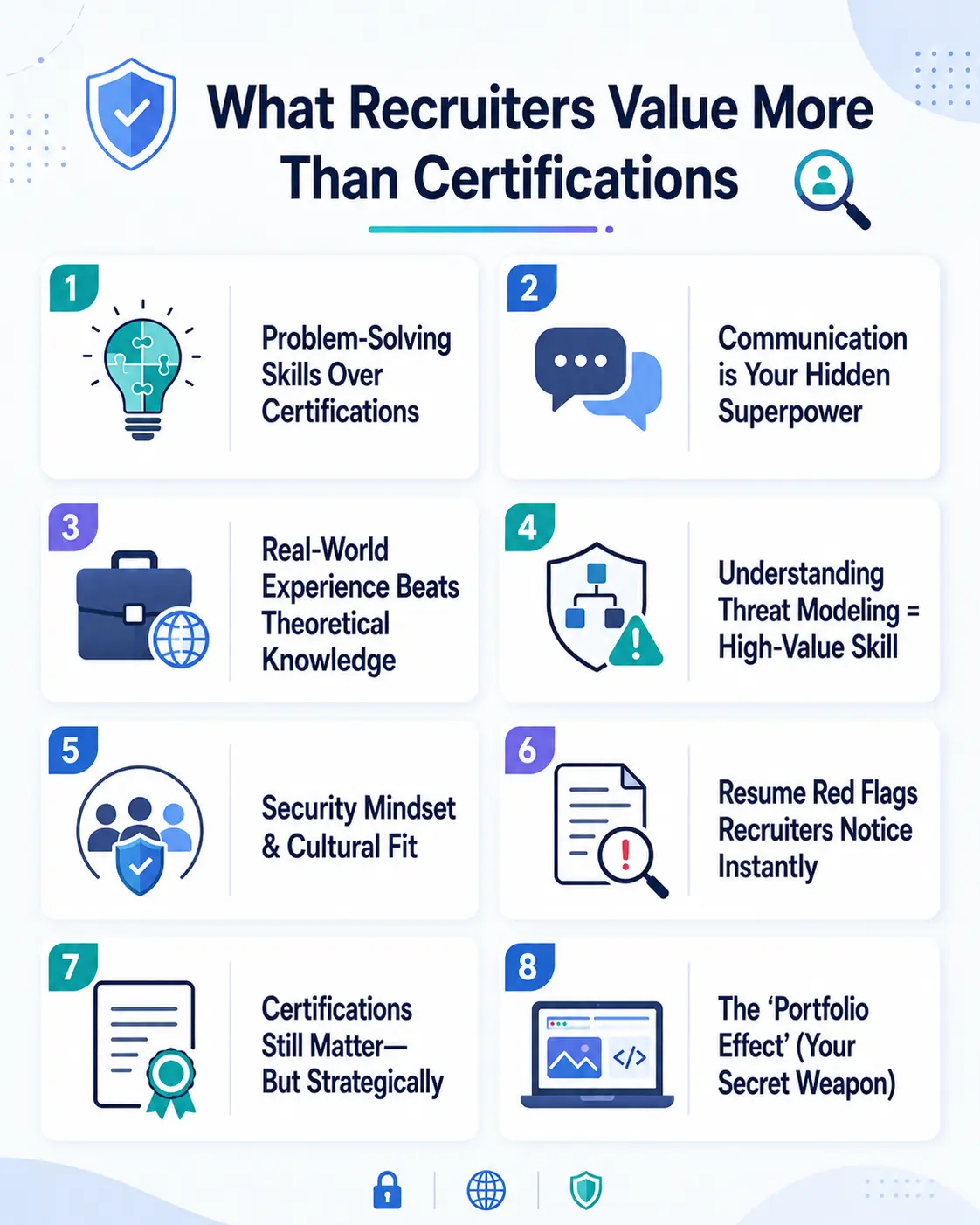
1. Problem-Solving Skills Over Certifications
Certifications like Security+, CEH, or CISSP are valuable, but recruiters often ask:
“Can this person actually solve a security problem in a real-world scenario?”
What They Are Looking For:
- Ability to break down a security incident step-by-step
- Understanding of attack paths and defensive strategies
- Experience with SIEM tools, EDR, firewalls, and log analysis
- Practical exposure to incident response workflows
- Knowledge of frameworks like MITRE ATT&CK, OWASP
For example:
Weak Answer: Familiar with SIEM tools
Strong Answer: Investigated 50+ SIEM alerts, identified false positives, and escalated brute-force attack patterns using log correlation.
Insight: Recruiters scan for evidence of thinking, not tool names.
2. Communication is Your Hidden Superpower
One of the most underrated in-demand soft skills for security professionals is communication.
Cybersecurity is no longer isolated to IT teams. You’ll interact with:
- Developers
- Compliance teams
- Executives (yes, even CISOs)
Recruiters Evaluate:
- Can you explain complex risks in simple terms?
- Can you write clear incident reports?
- Can you justify security decisions to non-technical stakeholders?
Reality Check:
A candidate with 70% technical skill + strong communication often beats a 90% technical candidate who can’t explain.
3. Real-World Experience Beats Theoretical Knowledge
This is where most candidates fall short.
Recruiters are increasingly skeptical of:
- Resume-heavy certifications
- No hands-on exposure
- Generic “completed training” statements
What Stands Out Instead:
- Personal labs (TryHackMe, Hack The Box)
- GitHub projects (scripts, tools, detection rules)
- Capture The Flag (CTF) participation
- Simulated incident response exercises
Pro Tip:
Even if you’re a beginner, document your learning journey:
- Built a home lab to simulate phishing attacks
- Performed vulnerability scans using Nmap and analyzed results
Insight: Recruiters want proof that you can apply knowledge, not just pass exams.
4. Understanding Threat Modeling = High-Value Skill
This is where candidates separate from the crowd.
Most applicants focus on tools. Top candidates understand why attacks happen.
Recruiters Look For:
- Knowledge of frameworks like STRIDE
- Ability to think like an attacker
- Risk-based decision-making
Why it Matters:
Organizations don’t just want reactive defenders; they want proactive thinkers.
5. Security Mindset & Cultural Fit
This is subtle, but powerful.
Recruiters Often Assess:
- Curiosity (Do you explore beyond your job role?)
- Ethical mindset (Do you understand responsible disclosure?)
- Adaptability (Can you learn new threats quickly?)
What Signals a Strong Security Mindset:
- Following cybersecurity news & CVEs
- Active in communities (Reddit, LinkedIn, Discord)
- Writing blogs or sharing insights
What Signals a Weak Mindset:
- Only studying for exams
- No interest beyond job requirements
Insight: Curiosity is often a stronger signal than certifications.
6. Resume Red Flags Recruiters Notice Instantly
Let’s talk about recruiter red flags in InfoSec resumes.
These are silent deal-breakers.
Common Mistakes:
- Listing tools without context
- Copy-paste job descriptions
- No measurable achievements
- Overloading with buzzwords (“AI-powered blockchain security expert”)
- No GitHub / project links
What Works Instead:
- Action-based statements
- Real impact (numbers, outcomes)
- Clean, structured format
- Tailored resume for each role
Example Upgrade:
Instead of answering: Worked on vulnerability scanning.
Answer: Conducted vulnerability scans using Nessus, identified 30+ critical issues, and reduced risk exposure by 40%.
7. Certifications Still Matter – But Strategically
Let’s be clear, certifications are NOT useless.
But recruiters expect:
- Relevant certifications aligned to your role
- Ability to explain concepts practically
Smart Strategy:
- Beginner → CompTIA Security+
- SOC Role → SOC Analyst / SIEM-focused training
- Governance → ISO 27001 / Risk management
- Cloud → CCSP / Cloud Security
Insight: Certifications open doors. Skills keep them open.
8. The “Portfolio Effect” (Your Secret Weapon)
Here’s what most candidates ignore:
Recruiters LOVE candidates who show their work.
What You Can Build:
- GitHub repository with scripts
- Blog explaining attack scenarios
- Case study: “How I detected a phishing attack”
- LinkedIn learning posts
Why it Works:
It answers the recruiter’s biggest question:
“Can this candidate actually do the job?”
In Conclusion
Cybersecurity hiring is evolving. It’s no longer about what you know. It’s about how you think, how you communicate, and how you apply knowledge under pressure. If you can demonstrate that, you won’t just get hired. You’ll stand out.
Ready to Become the Candidate Recruiters Actually Want?
Knowing what recruiters look for is just the first step. The real advantage comes from building those skills with the right guidance, hands-on labs, and real-world scenarios.
At InfosecTrain, you don’t just learn theory, you:
- Practice with real-world cybersecurity scenarios
- Gain hands-on experience with tools used in the industry
- Learn from seasoned professionals & CISOs
- Get guidance aligned with actual hiring expectations
Explore these High-Impact training programs:
- Ethical Hacking (CEH v13 AI) Training
- AI-Powered SOC Analyst Training
- Threat Hunting & Incident Response Training
- CompTIA SecAI+ Certification Training
- ISO 27001:2022 Lead Auditor Certification Training and more.
Because in 2026, skills + proof + mindset = hiring success.

TRAINING CALENDAR of Upcoming Batches For CEH v13 AI Training
Start Date
End Date
Start - End Time
Batch Type
Training Mode
Batch Status
21-Nov-2026
20-Dec-2026
09:00 - 13:00 IST
Weekend
Online
[ Open ]
12-Dec-2026
24-Jan-2027
19:00 - 23:00 IST
Weekend
Online
[ Open ]
16-Jan-2027
21-Feb-2027
09:00 - 13:00 IST
Weekend
Online
[ Open ]
20-Feb-2027
28-Mar-2027
19:00 - 23:00 IST
Weekend
Online
[ Open ]
13-Mar-2027
18-Apr-2027
09:00 - 13:00 IST
Weekend
Online
[ Open ]

TRAINING CALENDAR of Upcoming Batches For SOC Analyst Training
Start Date
End Date
Start - End Time
Batch Type
Training Mode
Batch Status
29-Nov-2026
23-Jan-2027
19:00 - 23:00 IST
Weekend
Online
[ Open ]
23-Jan-2027
07-Mar-2027
09:00 - 13:00 IST
Weekend
Online
[ Open ]
20-Mar-2027
02-May-2027
19:00 - 23:00 IST
Weekend
Online
[ Open ]
Frequently Asked Questions
Is cybersecurity still a good career in 2026?
Absolutely. Demand continues to outpace supply across domains like SOC, cloud, and AI security.
Do recruiters prefer certifications or experience?
Experience wins. Certifications help you get noticed, but skills get you hired.
Should I list personal security projects on my resume?
Absolutely. In fact, projects often matter more than certifications for entry-level roles. They demonstrate initiative and practical skills.
What do recruiters value more: tools or concepts?
Concepts. Tools change. Core security principles (networking, risk, threat analysis) stay relevant.
How do I stand out without job experience?
Build labs, document learning, participate in CTFs, and share insights online. This creates a “proof of skill” portfolio.
What are the mistakes candidates make in interviews?
Giving textbook answers, not explaining the thought process, no projects, and poor communication.