Cyber Kill Chain: 7 Stages, Framework, Benefits & Limitations
Quick Insights:
The Cyber Kill Chain is a seven-stage framework that explains how a cyberattack may progress from initial reconnaissance to the attacker’s final objective. It helps security teams understand attack progression, detect suspicious activity earlier, prioritize defensive controls, and disrupt threats before serious damage occurs. However, modern attacks may skip, repeat, or combine stages, so the framework is most effective when used alongside threat intelligence and incident-response processes.
Cyberattacks usually involve a sequence of connected activities rather than a single malicious action. An attacker may research a target, prepare the required infrastructure, gain access, establish persistence, communicate with compromised systems, and finally steal data or disrupt operations. The Cyber Kill Chain helps security teams examine these activities as stages and identify opportunities to detect or stop an intrusion before the attacker achieves their objective.
Lockheed Martin created a Cyber Kill Chain process for detecting and preventing cyber intrusion attacks and tracking such attacks. Many businesses employ the Cyber Kill Chain approach to protect themselves against data breaches and phishing attempts.
In this article, we will look at what a Cyber Kill Chain is and how Cyber Kill Chain works.
What is a Cyber Kill Chain?
Cyber Kill Chain is a concept that allows the organization to understand how an attacker intends to penetrate or destroy the target’s system or network. It also helps businesses understand how to protect, detect, respond to, and locate an attacker’s techniques or strategies for infiltrating target systems. The term “Kill Chain” comes from the military and refers to the method that an enemy uses to strike a target. The Kill Chain method identifies seven steps that an attacker goes through, each of which provides an opportunity to detect and react, which cover:
- Identification of the target
- Force dispatch toward the target
- Attacking the goal decision and order
- Destruction of the target
Seven Stages of the Cyber Kill Chain
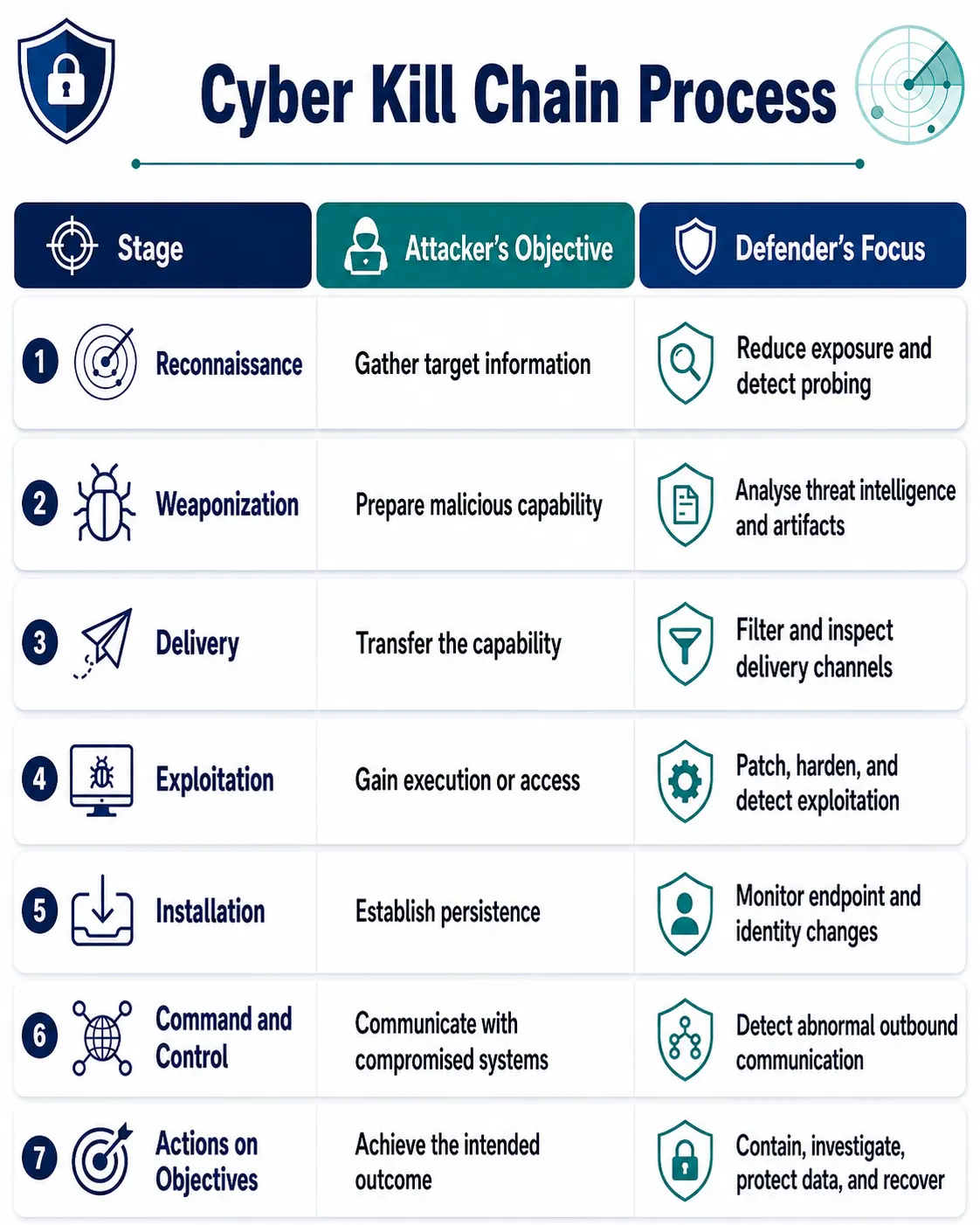
The phases of the Cybersecurity Kill-Chain process are divided into seven parts, each of which is explained in detail below.
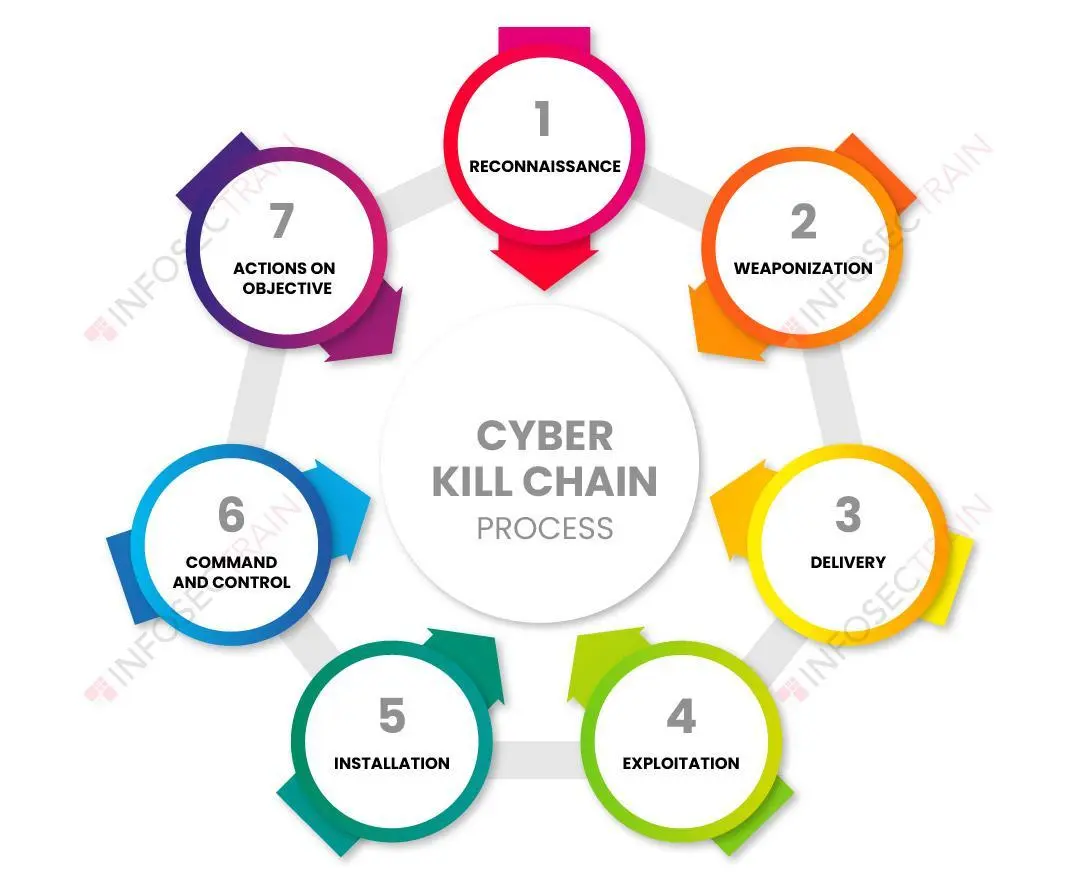
1. Reconnaissance
Reconnaissance is the information-gathering stage. Before launching an attack, the attacker studies the target to understand its employees, systems, technologies, business relationships, and potential security weaknesses.
Reconnaissance can be:
Active Reconnaissance: In which the attacker collects publicly available information without directly interacting with the target. Sources may include company websites, social media, job postings, domain records, public cloud resources, leaked credentials, and employee email addresses.
Passive Reconnaissance: In which the attacker directly interacts with the organization’s infrastructure. This may involve scanning internet-facing systems, identifying open ports, detecting running services, enumerating applications, or searching for exposed vulnerabilities.
Read detailed blog here: Active vs Passive Reconnaissance: Key Differences
The information collected during this stage helps the attacker select a target and plan the next steps of the operation.
Defensive Opportunities
- Reduce unnecessary public exposure of systems and employee information
- Monitor internet-facing assets and external attack surfaces
- Detect suspicious scanning, probing, and enumeration activity
- Secure DNS records, cloud resources, and exposed services
- Monitor leaked credentials and compromised accounts
- Train employees to avoid oversharing sensitive information online
2. Weaponization
In this phase, the attacker creates cyber weapons such as tools, infrastructure, and malicious content required to carry out the attack. Payloads are developed based on vulnerabilities discovered during the reconnaissance phase. In modern attacks, it may also include:
- Creating a malicious document or executable file
- Developing or modifying malware
- Building a fake login or phishing page
- Preparing scripts to exploit a vulnerability
- Registering deceptive domains
- Configuring attacker-controlled servers
- Creating convincing social-engineering content
Defensive Opportunities
- Monitor newly registered domains that resemble the organization’s domain
- Use threat intelligence to identify emerging malware and attacker infrastructure
- Analyze suspicious files and links in secure sandbox environments
- Patch known vulnerabilities before an attacker can exploit them
- Detect malicious documents, scripts, and payload patterns
- Share indicators of compromise with relevant security teams
3. Delivery
In this phase, the attacker transfers the prepared malicious content, exploit, or access method produced in the previous stage to the target machine. Common delivery methods include:
- Spearphishing emails
- Malicious links or attachments
- Compromised websites
- Cloud file-sharing services
- Messaging and collaboration platforms
- Removable USB devices
- Fake software updates
- Malicious advertisements
- Supply-chain compromises
Defensive Opportunities
- Implement advanced email and spam filtering
- Scan links and attachments before allowing user access
- Use attachment sandboxing and content-disarm technologies
- Block malicious or low-reputation domains and websites
- Restrict unauthorized USB devices and removable media
- Provide regular phishing and social-engineering awareness training
4. Exploitation
In this phase, the attacker exploits a vulnerability, misconfiguration, stolen credential, or user action to gain unauthorized access or execute malicious code.
Exploitation does not always involve a software vulnerability. It may occur when:
- A user opens a malicious file
- A user enters credentials into a phishing page
- An attacker exploits an unpatched application
- A stolen password is used to access an account
- An exposed API is abused
- Excessive permissions are misused
- An authenticated session or access token is hijacked
Defensive Opportunities
- Maintain an effective vulnerability and patch-management program
- Perform regular vulnerability assessments and penetration testing
- Apply secure coding practices during application development
- Use web application firewalls and endpoint protection
- Restrict unnecessary permissions and administrative access
- Monitor suspicious login attempts and abnormal code execution
5. Installation
Once the target machine has been successfully exploited for vulnerabilities, the attacker attempts to establish a lasting foothold in the compromised environment. This allows continued access even after a system is restarted, a user logs out, or the original vulnerability is fixed.
An attacker may:
- Install malware or a remote-access tool
- Create a new user account
- Add scheduled tasks or services
- Deploy a web shell
- Modify startup settings
- Create cloud access keys
- Register a malicious OAuth application
- Change authentication settings
- Install browser extensions or plugins
- Modify system configurations to maintain persistence
However, modern attackers do not always install traditional malware. They may use legitimate administrative tools, built-in scripts, cloud services, or memory-only techniques to avoid introducing an easily detectable malicious file.
Defensive Opportunities
- Monitor new software, services, scheduled tasks, and startup entries
- Detect unauthorized user-account creation and privilege changes
- Restrict application installation through application allowlisting
- Monitor cloud access keys, OAuth applications, and identity changes
- Detect unusual use of administrative tools and scripts
- Use endpoint detection and response solutions to identify persistence
6. Command and Control
In this stage, the attacker establishes communication with compromised systems. They acquire access to privileged accounts and use brute force attacks, password searches, and permission changes to obtain control. After that, a channel is established between the attacker and the target. The communication channel allows the attacker to:
- Send instructions
- Run commands
- Download additional tools
- Upload or modify files
- Collect information from the system
- Coordinate activity across compromised devices
- Maintain remote control of the environment
Attackers may hide C2 communication inside normal-looking web, DNS, email, or cloud-service traffic. They may also encrypt the communication or use compromised infrastructure to make it more difficult to identify its true destination.
Defensive Opportunities
- Monitor DNS, proxy, firewall, and outbound network traffic
- Detect unusual or repeated communication patterns
- Block communication with known malicious domains and IP addresses.
- Apply egress filtering to restrict unnecessary outbound traffic
- Analyze suspicious encrypted communication and certificate activity
- Segment networks to limit attacker movement and communication
7. Action on object
When attackers gain continued access to a target, they proceed to achieve goals and objectives. The objective will depend on the attacker’s motivation. It may include:
- Stealing sensitive information
- Exfiltrating customer or financial data
- Conducting espionage
- Deploying ransomware
- Encrypting or destroying files
- Manipulating business information
- Disrupting operations
- Committing financial fraud
- Maintaining long-term access
- Using compromised systems to attack other organizations
Defensive Opportunities
- Monitor unusual access to sensitive files and databases
- Detect large, unexpected, or unauthorized data transfers
- Monitor privilege escalation and lateral movement
- Detect mass file encryption, modification, or deletion
- Protect and isolate critical backups from production systems
- Apply data loss prevention controls to sensitive information
- Investigate suspicious credential use and administrative activity
- Contain affected systems and preserve forensic evidence
- Activate incident-response and business-recovery procedures
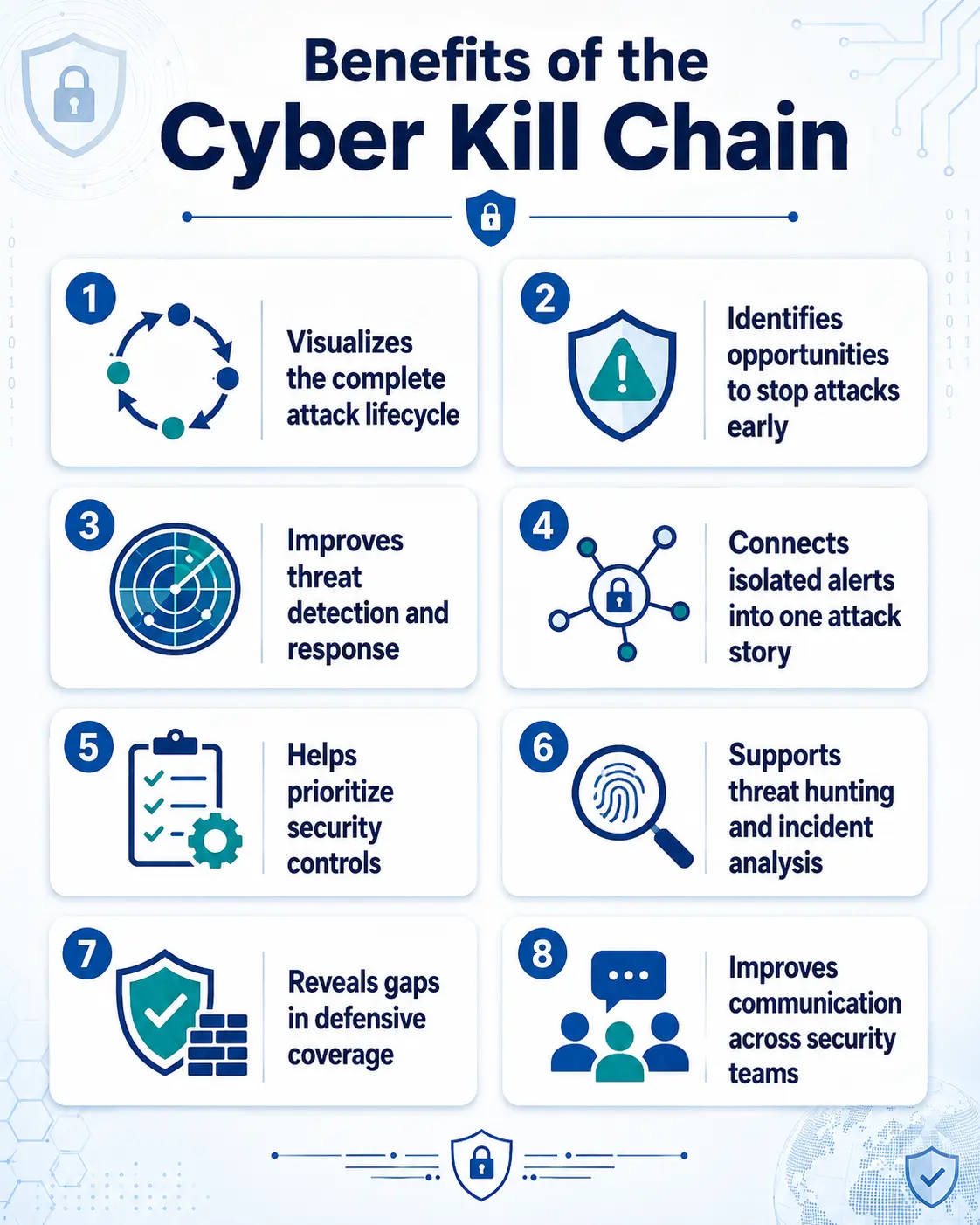
Role of the Cyber Kill Chain in Cybersecurity
The framework can help organizations:
- Understand how intrusions progress
- Identify defensive opportunities at multiple stages
- Connect isolated alerts into a broader attack narrative
- Prioritize detection and response controls
- Structure threat-intelligence analysis
- Improve incident timelines
- Conduct tabletop and purple-team exercises
- Identify gaps in security monitoring
- Communicate attack progression to non-technical stakeholders
Limitations of the Cyber Kill Chain
- Linear structure: Real-world attacks may skip, repeat, combine, or reorder stages.
- External attack focus: It may not fully represent insider threats or attacks originating within the organization.
- Limited cloud coverage: Identity-, SaaS-, token-, and cloud-based attacks may not follow traditional stages.
- Broad activity grouping: Credential theft, lateral movement, exfiltration, and impact are not shown as separate stages.
- Installation is not always required: Attackers may use legitimate tools, scripts, or memory-based techniques without installing malware.
- Command and Control may remain hidden: Attackers can disguise malicious communication within trusted or encrypted services.
- Weak supply-chain representation: Compromises introduced through vendors or software updates may bypass earlier stages.
- Limited technical detail: The model does not describe specific adversary techniques or detection methods.
- Risk of false confidence: Blocking one stage does not guarantee that the entire attack has been stopped.
Conclusion
The Cyber Kill Chain provides a clear way to understand how attackers plan, deliver, and execute cyberattacks. By examining each stage, organizations can identify defensive opportunities, improve threat detection, and respond more effectively.
However, the framework should not be treated as a complete representation of every modern attack. Cloud, identity-based, insider, and supply-chain attacks may not follow a linear path. Therefore, organizations should use the Cyber Kill Chain as a high-level model alongside more detailed frameworks and modern security controls.
CEH v13 AI Training with InfosecTrain
Understanding the Cyber Kill Chain provides a useful foundation for analyzing how attacks progress and identifying opportunities to disrupt them. InfosecTrain’s CEH v13 AI Training covers the Lockheed Martin Cyber Kill Chain along with reconnaissance, scanning, enumeration, system hacking, malware threats, social engineering, and practical attack-analysis concepts. The training helps learners understand attacker behavior and strengthen their ability to detect, investigate, and respond to cyber threats.
How can InfosecTrain help you?
The Cyber Kill Chain is mainly utilized for defense purposes. Enroll in InfosecTrain’s MITRE ATT&CK Training to advance your cyber security knowledge and learn how to defend against various cyber threats. In the MITRE ATT&CK training course, you will learn the Cyber Kill Chain process in detail.

Frequently Asked Questions
Who created the Cyber Kill Chain?
Lockheed Martin developed the Cyber Kill Chain framework to help security teams understand and disrupt cyber intrusion campaigns.
At which stage should defenders stop an attack?
An attack can be disrupted at any stage. However, detecting it during Reconnaissance, Delivery, or Exploitation can reduce the risk of persistence, data theft, and operational damage.
Can the Cyber Kill Chain be used for ransomware attacks?
Yes. It can help map how ransomware operators identify targets, gain access, establish persistence, communicate with compromised systems, steal data, and encrypt files.
Is Command and Control always required?
Not always. Some attacks use stolen accounts, trusted cloud services, or automated scripts without maintaining a traditional Command and Control channel.
How do SOC teams use the Cyber Kill Chain?
SOC teams use it to connect alerts, build attack timelines, identify the attacker’s current stage, and determine which systems or activities require immediate investigation.
Is the Cyber Kill Chain still relevant today?
Yes, but it is best used as a high-level framework. Modern security teams often combine it with MITRE ATT&CK, threat hunting, incident response, and detection engineering.