Top 5 Documentation Mistakes That Will Break Your EU AI Act Compliance
Quick Insights:
The EU AI Act goes live for high-risk systems on August 2, 2026, and imposes strict documentation rules. Many companies treat compliance docs as an afterthought, a single report or blog post, instead of building continuous, structured documentation. Missing key elements (system design, training data, testing, risk management, monitoring) or failing to keep records (logs, change history) can trigger fines up to €35M (7% of turnover). In short, if your technical dossier is incomplete, outdated, or inconsistent with Annex IV, you are not compliant. Start by inventorying your AI systems and mapping existing materials (model cards, architecture docs, training logs, etc.) to Annex IV sections to spot gaps. Then build robust processes to update docs as part of development, not just for lawyers.
The EU AI Act is forcing AI teams to rethink documentation as infrastructure, not an after-the-fact deliverable. Trends show only ~12% of companies feel ready to manage AI risks, and 42% lack basic AI policies. With August 2026 looming, regulators will audit the documentation itself, not just the AI code. If your docs only live in email threads or PowerPoint slides, you could instantly fall out of compliance. In this article, we unpack the top five doc blunders that will sink your AI Act compliance.
Top 5 Documentation Mistakes for EU AI Act Compliance
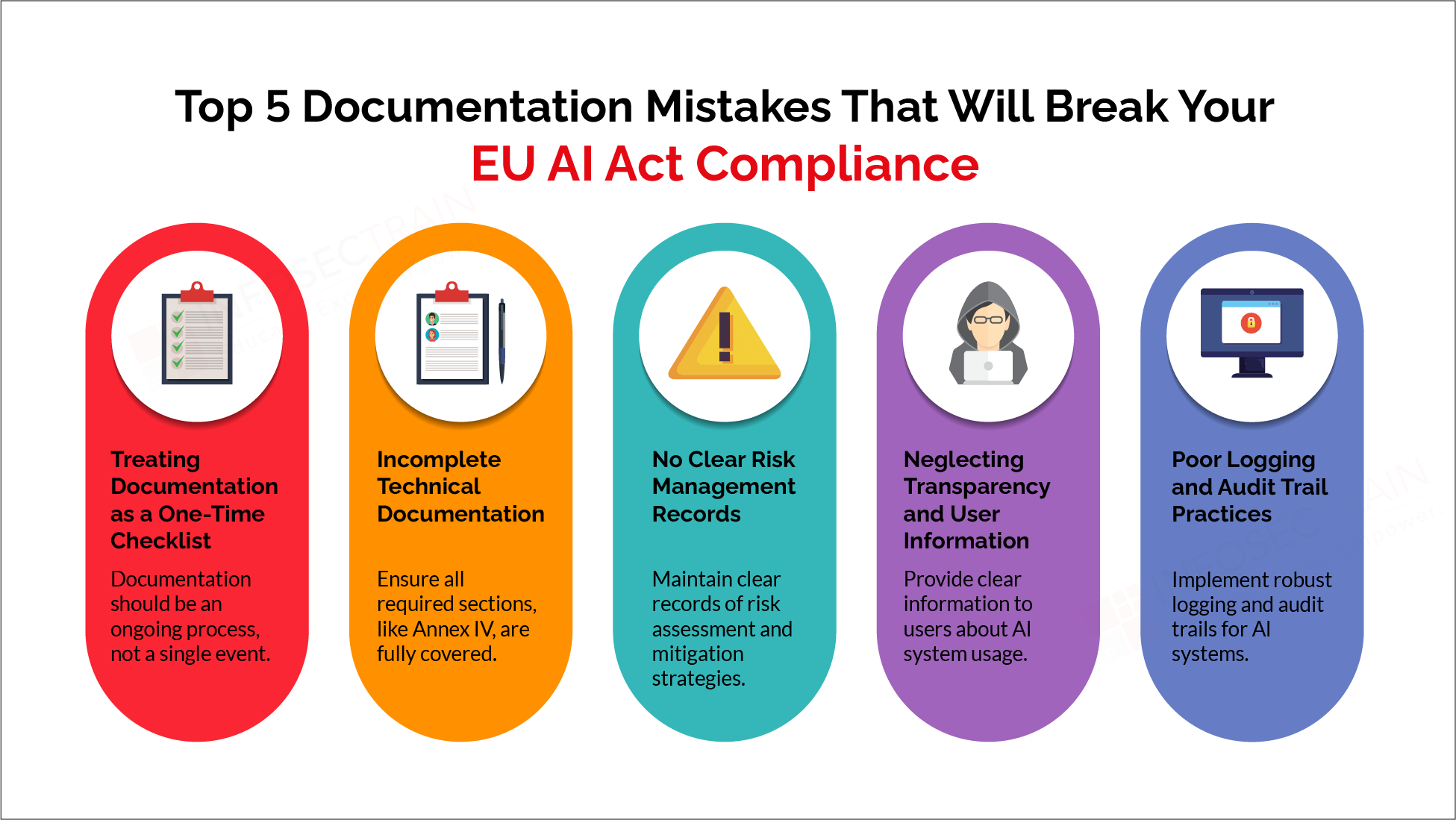
1. Treating Documentation as a One-Time Checklist
One huge mistake is filling out a template once and then forgetting it. The AI Act explicitly requires documentation to be prepared before a high-risk system is put on the market and kept up-to-date throughout its lifecycle. In practice, that means documentation must evolve whenever you retrain the model, change algorithms, update data sources, or fix bugs. Simply writing a report post-development or attaching a hastily done model card and never revisiting it will not satisfy the law. Technical documentation “must be prepared before [the system] is placed on the market or put into service” and “updated regularly.” It must be “clear, comprehensible and complete” and cover all Annex IV items.
2. Incomplete Technical Documentation (Missing Annex IV Coverage)
Another fatal mistake is leaving out essential details from Annex IV. The EU AI Act’s Annex IV spells out exactly what to document for high-risk systems. This goes well beyond a product brochure or a blog post. It requires a structured dossier covering:
- System description and purpose: Clearly state what the AI system does, its intended use case, how it interfaces with hardware/software, user interface elements, and instructions for deployers.
- Development process: Document your model’s design specifications and algorithmic logic: what problem it solves, key design choices and assumptions, architecture and hardware requirements, optimization targets, etc. Include any pre-trained models or third-party tools integrated.
- Data details: Describe every dataset used (training, validation, testing), including its provenance, scope, cleaning and labeling procedures, and any bias or quality assessments performed.
- Testing and validation: Keep records of your tests (logs and reports) demonstrating accuracy, robustness, and security. Annex IV expects dated, signed test reports for all metrics.
- Risk management: You must document identified risks, mitigation measures, and their effectiveness.
- Post-market monitoring: Provide a plan for monitoring the system in real-world use, as required by Article 72.
- Change history: Crucially, any changes (retraining, new versions) must be documented and traceable.
3. No Clear Risk Management Records
The Act mandates a formal risk management system, and failing to document it is a compliance killer. Article 9 requires providers to “establish, implement, document, and maintain” a continuous risk management process for high-risk AI. In other words, you must record every step: identifying and assessing known and foreseeable risks (to health, safety, fundamental rights, discrimination, etc.), evaluating their severity, and detailing the mitigation measures you put in place. Annex IV explicitly asks for a “detailed description of the risk management system” in line with Article 9.
Common mistakes include only doing a one-time risk assessment or leaving risk registers scattered in emails. For example, your risk log should specify which hazards (e.g., bias against a protected group, potential misuse) you found and what technical or organizational controls (e.g., pre- and post-deployment bias tests, human-in-the-loop safeguards) you implemented to address them. Annex IV requires you to show how you identify and mitigate risks throughout the AI lifecycle. Missing this documentation or keeping it informal (like a slide that says “we did risk analysis”) will break compliance.
- FRIA (Fundamental Rights Impact Assessment)
This is one of the most overlooked yet critical areas of compliance, where many organizations fail without realizing it. A Fundamental Rights Impact Assessment (FRIA) evaluates how your AI system affects individuals and society, including risks related to bias, discrimination, privacy violations, and broader societal consequences. If your AI system influences real-world decisions, such as hiring, credit scoring, or healthcare outcomes, FRIA becomes essential. It is not just a best practice; it must be clearly documented to demonstrate that your AI is fair, accountable, and aligned with fundamental rights.
4. Neglecting Transparency and User Information
The AI Act demands that deployers (and sometimes end-users) get clear transparency information. A big mistake is not logging or sharing critical transparency details. Article 13 forces high-risk systems to be “sufficiently transparent” so deployers can interpret outputs, and to provide clear instructions. In practice, this means your documentation (and user manuals) must spell out the system’s capabilities and limitations. For example, you must disclose the intended purpose, expected accuracy (with metrics), potential weaknesses, and any foreseeable risks when used improperly. You should also describe how input data was chosen, and how the system explains its outputs (e.g., attention maps, confidence scores).
Failing to include this transparency information is a common pitfall. If you only give vague marketing claims (“state-of-the-art classifier”), that violates the Act. Instead, follow best-practice checklists: explicitly state model behavior in your docs. Providers must “disclose model capabilities, limitations, and integration instructions”. Make sure your documentation is written in clear, non-technical language where possible; it has to be accessible to deployers (who might be business users, not just devs).
5. Poor Logging and Audit Trail Practices
Finally, inadequate logging and record-keeping will violate the AI Act’s audit requirements. Article 12 is clear: every high-risk AI system “shall allow for the automatic recording of events (logs) over the lifetime of the system”. Logs must capture things like when and how the system was used, any maintenance or updates performed, and any anomalies or incidents. For certain AI (e.g., biometric ID systems), the Act even lists specific log fields (usage times, reference databases, user identities, etc.). The goal is full traceability of the model’s decisions and changes.
Yet many teams skimp on logging or do it informally. A common mistake is relying on generic IT logs or manual notes rather than a structured, tamper-resistant audit trail. Remember, the Act expects logs to support post-market monitoring and to flag new risks. For compliance, your logs should be queryable (who did what, when) and ideally immutable (so regulators trust them). In short, your documentation is not done if you have not captured the process as well as the content.
- Log management (audit-ready systems): Strong log management is the backbone of audit-ready AI compliance. Your system logs should clearly capture who did what, and when, along with detailed records of model updates, system usage, incidents, and anomalies. More importantly, these logs must be structured, tamper-resistant, and easily queryable to ensure full traceability. Regulators expect to see a clear audit trail that explains how decisions were made and how the system evolved over time. If your logs cannot provide this level of transparency, compliance can fail instantly.
- Conformity assessments: Before any high-risk AI system is deployed, it must pass a Conformity Assessment, which acts as a formal validation of your compliance readiness. This process evaluates whether your risk management system is properly implemented, your documentation is complete and aligned with regulatory requirements, and your transparency and monitoring mechanisms are in place. It proves that your AI system is safe, governed, and compliant. Without proper documentation and structured processes, you cannot pass this assessment, meaning no approval, no deployment, and no access to the market.
Conclusion
If any of the above sound familiar, you are not alone; these failures are rampant across the industry. The EU even calls for “comprehensive, continuously updated documentation”, not checkboxes on a to-do list. Remember, these rules are enforceable: failing to document properly can lead to huge fines. Under Article 99, companies face penalties up to €15M or 3% revenue for high-risk violations, and up to €35M or 7% for prohibited AI breaches.
AIGP Training with InfosecTrain
Reading about EU AI Act compliance is one thing.
Implementing it in real-world AI systems? That’s where most professionals struggle.
And that’s exactly where the InfosecTrain AIGP (AI Governance Professional) Training comes in.
If you look closely at the mistakes we discussed:
- Missing Annex IV documentation
- Weak risk management records
- No transparency frameworks
- Poor audit trails
These are not just documentation issues. These are AI governance failures.
And the EU AI Act is built entirely around governance, risk, and compliance (GRC).
What will you learn in InfosecTrain’s AIGP training?
This is not theory-heavy training. It is designed for real-world implementation:
- How to map EU AI Act requirements to actual AI systems
- Build Annex IV–ready documentation frameworks
- Design risk management systems (Article 9 aligned)
- Implement AI transparency & explainability practices
- Create audit-ready logs, monitoring, and lifecycle governance

TRAINING CALENDAR of Upcoming Batches For AIGP Training
| Start Date | End Date | Start - End Time | Batch Type | Training Mode | Batch Status | |
|---|---|---|---|---|---|---|
| 14-Nov-2026 | 29-Nov-2026 | 09:00 - 13:00 IST | Weekend | Online | [ Open ] | |
| 05-Dec-2026 | 20-Dec-2026 | 19:00 - 23:00 IST | Weekend | Online | [ Open ] | |
| 09-Jan-2027 | 24-Jan-2027 | 19:00 - 23:00 IST | Weekend | Online | [ Open ] | |
| 06-Feb-2027 | 21-Feb-2027 | 09:00 - 13:00 IST | Weekend | Online | [ Open ] | |
| 06-Mar-2027 | 21-Mar-2027 | 19:00 - 23:00 IST | Weekend | Online | [ Open ] |
Frequently Asked Questions
What technical documentation is required under the EU AI Act? High-risk?
AI providers must prepare a full technical dossier as specified in Annex IV. This includes system purpose, architecture, and design logic, datasets and training details, validation and testing results, risk management measures, change history, and post-market monitoring plans.
When must AI documentation be prepared and updated?
Documentation must be prepared before a high-risk AI system is placed on the market or put into service, and then kept up-to-date throughout the system’s lifecycle. In other words, document as you develop, and update for every major change.
Why is risk management documentation critical for compliance?
Article 9 requires a documented risk management system for high-risk AI, covering identification, analysis, and mitigation of risks to health, safety, and fundamental rights. Annex IV explicitly demands details of this risk management process. Without clear records of risk analyses and controls, you cannot prove compliance.
What transparency information must be provided about high-risk AI?
Providers must supply deployers with clear instructions detailing the AI’s capabilities, limitations, accuracy metrics, intended purpose, and potential misuse scenarios. This includes explaining how to interpret outputs and any data specifications. In short, be upfront about what the AI can and cannot do.
What are the penalties for non-compliance with documentation requirements?
Fines are stiff: up to €15 million or 3% of global revenue for failing to meet high-risk AI obligations, and up to €35 million or 7% for serious violations such as mislabeling a prohibited AI. These fines target precisely the areas covered by documentation, so accurate, complete records are your first line of defense.