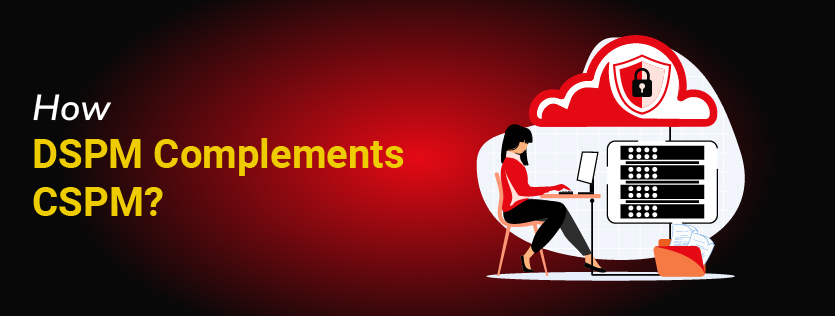
How DSPM Complements CSPM?
The partnership between DSPM and CSPM is vital for securing complex cloud systems.
- DSPM focuses on the data itself, which is crucial since 83% of experts lack clear visibility into their data.
- CSPM (a $5.75 billion market) locks down the basic cloud settings and infrastructure.
- With 75% of companies planning to adopt DSPM soon, this combined security strategy provides complete protection.
- This dual method is necessary for managing risks, protecting information, and efficiently meeting compliance rules in multi-cloud spaces.
What is DSPM?
DSPM stands for Data Security Posture Management. It is a cybersecurity approach that is data-centric, focusing on the protection, visibility, and governance of sensitive data itself, rather than just the underlying network or infrastructure. It is designed to continuously monitor, assess, and improve an organization’s security posture for data across multi-cloud, SaaS, and on-premises environments.
Key Functions (Capabilities) of DSPM
The primary functions of DSPM solutions are to gain comprehensive control over an organization’s data assets and minimize data risk:
1. Data Discovery and Classification:
- Function: Automatically scans all environments (cloud, SaaS, on-prem) to locate all data assets, including shadow data. It then classifies data based on its sensitivity (e.g., PII, financial, confidential) and regulatory requirements (e.g., GDPR, HIPAA).
- Goal: Establish complete visibility into “What data is where?” and “How sensitive is it?”
2. Risk Assessment and Prioritization:
- Function: Continuously evaluates the data’s security posture by looking for vulnerabilities like misconfigurations, data flow issues, and security policy violations. It then prioritizes risks based on the sensitivity of the exposed data.
- Goal: Identify which sensitive data is most at risk and needs immediate attention.
3. Data Access Governance (Least Privilege Enforcement):
- Function: Provides granular visibility into who has access to what data. It detects excessive or unused access permissions (over-entitlements) and helps enforce the principle of least privilege.
- Goal: Minimize the attack surface by ensuring that users and applications have only the necessary access to sensitive data.
4. Compliance Assurance and Auditing:
- Function: Automatically maps security settings and data practices to regulatory requirements (like GDPR, CCPA, PCI-DSS). It generates audit reports and documentation to simplify compliance and prevent costly fines.
- Goal: Ensure the organization consistently adheres to all applicable data privacy and security regulations.
5. Remediation and Prevention:
- Function: Provides actionable recommendations or automated workflows to fix identified vulnerabilities, such as revoking excessive permissions or enforcing encryption on exposed data stores.
- Goal: Proactively reduce the data attack surface and prevent data breaches.
What is CSPM?
CSPM stands for Cloud Security Posture Management. It is an automated cybersecurity solution designed to continuously monitor, assess, and manage the security risks and compliance of an organization’s entire cloud infrastructure and services. The primary focus of CSPM is to prevent accidental data breaches and exposure caused by cloud misconfigurations.
CSPM solutions are essential because, under the shared responsibility model, the cloud customer (the organization) is responsible for properly configuring the cloud services they use (the infrastructure, network, and access policies).
Key Functions of CSPM Solutions
CSPM tools operate by providing a single, unified security view across multi-cloud and hybrid environments (IaaS, PaaS, and often SaaS). Its key functions are:
1. Discovery and Visibility (Asset Inventory):
- What it does: Automatically discovers and catalogs all cloud assets, resources, and services (like virtual machines, storage buckets, network configurations, and identity settings) across all connected cloud providers (AWS, Azure, GCP).
- Purpose: To give security teams a complete, real-time inventory and map of their entire cloud footprint, eliminating ‘shadow IT’ and unknown components.
2. Risk Prioritization and Contextualization:
- What it does: Assesses the severity of detected misconfigurations and vulnerabilities based on contextual factors like:
- Whether the resource is internet-facing.
- The sensitivity of the data involved.
- The potential attack path an adversary could use to exploit the risk.
- Purpose: To help security teams focus their limited resources on the most critical threats that pose the highest risk of a breach.
3. Automated and Guided Remediation:
- What it does: Provides detailed guidance and/or automated workflows to fix identified issues. Many CSPM solutions can automatically correct simple, common misconfigurations without human intervention (known as “auto-remediation”).
- Purpose: To reduce human error, speed up response times, and prevent configuration drift (unintended policy deviations) in a dynamic cloud environment.
4. Continuous Compliance Monitoring:
- What it does: Automatically maps the cloud environment’s configurations against regulatory standards (like GDPR, HIPAA, PCI DSS, etc.) and industry frameworks. It generates compliance reports and alerts for violations.
- Purpose: To ensure the organization remains compliant at all times and to simplify audit preparation.
5. DevSecOps Integration:
- What it does: Integrates into development workflows (CI/CD pipelines) to identify insecure configurations in Infrastructure as Code (IaC) templates before they are deployed to the production environment.
- Purpose: To shift security left, preventing security issues from ever reaching the cloud infrastructure in the first place.
How DSPM Complements CSPM?
DSPM and CSPM are highly complementary, creating a unified, holistic security strategy that protects both the cloud container and the data within it.
1. Context-Aware Risk Prioritization:
- CSPM detects an infrastructure misconfiguration (e.g., an S3 bucket is publicly exposed).
- DSPM provides the critical context by classifying the data inside the bucket (e.g., it contains 10,000 PII records). The CSPM alert instantly escalates from a general issue to a critical, high-priority data breach risk, based on the sensitivity of the data.
2. Granular Access Governance (Least Privilege):
- CSPM ensures Identity and Access Management (IAM) roles are not overly broad on the service level (e.g., an IAM role has permission to access the storage service).
- DSPM enforces the principle of least privilege directly on the data, tracking who is actually accessing the sensitive PII records and identifying excessive permissions that CSPM misses.
3. Holistic Threat Detection:
- CSPM monitors for suspicious activity on the infrastructure level (e.g., an unauthorized configuration change on a virtual machine).
- DSPM monitors for threats on the data level (e.g., an unusual volume of sensitive data exfiltration or anomalous access patterns), creating a multi-layered defense to catch complex attack paths.
4. Full-Stack Compliance Coverage:
- CSPM verifies compliance with industry standards (e.g., CIS Benchmarks) for the cloud infrastructure (e.g., whether encryption-at-rest is enabled on the database).
- DSPM ensures compliance with data privacy regulations (e.g., GDPR, HIPAA) by managing and enforcing controls directly on sensitive data (e.g., is PHI located in an unauthorized region?). Together, they cover both the platform and the information.
5. Environment Coverage Extension:
- CSPM focuses primarily on IaaS/PaaS cloud environments.
- DSPM extends this protection to the data layer across all environments (multi-cloud, SaaS applications, and on-premises data stores), ensuring consistent data-centric policies regardless of where the data resides.
CCSP Training with InfosecTrain
DSPM and CSPM are essential, interconnected cloud security tools. CSPM protects the infrastructure foundation, while DSPM secures the core of sensitive data. Their combined synergy provides holistic protection and risk context, skills that are highly valued and demonstrated by professionals holding the CCSP certification. Aspiring professionals seeking to master comprehensive security strategies can enroll in the CCSP Certification Training Course, offered by leading providers such as InfosecTrain. This training equips participants with the expertise to design, manage, and protect cloud data and applications, thereby advancing their careers in the critically important field of cloud security.

TRAINING CALENDAR of Upcoming Batches For CCSP Training
| Start Date | End Date | Start - End Time | Batch Type | Training Mode | Batch Status | |
|---|---|---|---|---|---|---|
| 27-Sep-2026 | 28-Nov-2026 | 09:00 - 13:00 IST | Weekend | Online | [ Open ] |