CEH Module 17: Hacking Mobile Platforms
With the advancement of mobile technology, mobile devices have become an essential part of our daily lives, giving ease and fast connectivity at our fingertips. From accessing the Internet, checking emails, and navigating with GPS to storing sensitive data like passwords and making financial transactions, smartphones and tablets have revolutionized the way we live. However, this reliance on mobile technology comes with its unique security challenges.
The “CEH Module 17: Hacking Mobile Platforms” dives into the vulnerabilities associated with mobile devices, focusing on the methods attackers use to exploit these weaknesses. This module provides an insightful exploration of the various attack vectors targeting mobile platforms, shedding light on the importance of mobile device security.
Why Mobile Devices Are a Big Deal for Hackers?
Mobile devices, like smartphones and tablets, offer endless ways to connect to the Internet, whether it’s through 4G/5G, Wi-Fi, or even Bluetooth. This connectivity is excellent for us, but it’s also a treasure trove for hackers looking to steal sensitive information. The more we rely on these devices, the more attractive they become to those with malicious intent.
The Sneaky Ways Hackers Target Your Phone
Hackers have a toolkit full of tricks to exploit the vulnerabilities in our mobile devices. Here’s a rundown of the most common methods:
1. Device-Based Attacks: Going Straight for the Hardware
- Phishing and Fake Websites: Have you ever been tempted to click on a link in an email or text message? That is a typical attempt at phishing. It deceives you into providing credit card data or passwords on a fake website.
- Malware: Sometimes, hackers sneak malicious software onto your device, which can intercept sensitive data like OTPs for banking.
- Buffer Overflow and Data Caching are fancy terms for exploiting glitches in your device’s data storage, which can lead to unauthorized access.
- SMiShing: This is like phishing but via SMS. You get a message that looks legit, but it’s actually trying to scam you.
2. App-Based Attacks: The Danger Lurking in Your Downloads
- Data Storage Issues: Some apps store sensitive info without proper encryption, making it easy for hackers to pick it up.
- Weak Encryption: If an app doesn’t properly secure your data, it can be intercepted and read by others.
- Runtime Manipulation: This involves tampering with how an app runs, which can allow hackers to bypass security measures and steal data.
3. Network-Based Attacks: The Risks of Staying Connected
- Wi-Fi Vulnerabilities: Public Wi-Fi is a hotbed for hackers. Without proper encryption, they can eavesdrop on your online activities.
- Rogue Access Points: These are fake Wi-Fi networks set up to intercept your data. Always be cautious about which networks you connect to.
- Man-in-the-Middle Attacks: In these, hackers intercept communication between you and the websites you visit, often without your knowledge.
4. Data Center/Cloud Attacks: It’s Not Just Your Phone at Risk
- Platform Vulnerabilities: Even the cloud services we rely on can be exploited. Hackers look for weaknesses in server software to access sensitive information.
- SQL Injection: This is a method where attackers manipulate databases to steal or alter data.
Common Attack Vectors and How They Work?
1. Malware and Data Theft
Hackers often use malware, such as viruses and rootkits, to infiltrate mobile devices. These malicious programs can modify the operating system, alter applications, or even steal data. For example, malware can extract information from data streams or emails, capturing everything from your passwords to sensitive business data.
2. Application Modifications and Data Tampering
Another common attack vector involves tampering with legitimate applications. Hackers can modify an app to bypass security checks or insert malicious code. This can lead to undetected tampering, allowing attackers to manipulate data or functions within the app.
OWASP Mobile Top 10 Mobile Attacks (2024):
- Improper Credential Usage: Hardcoded credentials, insecure storage of API keys, or improper handling of secrets.
- Inadequate Supply Chain Security: Use of vulnerable third-party libraries, SDKs, or plugins that introduce security risks into the application.
- Insecure Authentication / Authorization: Weak or missing authentication mechanisms that allow unauthorized access to app functions or data.
- Insufficient Input/Output Validation: Failing to validate user input or output correctly, which can lead to injection, XSS, or logic-based attacks.
- Insecure Communication: Lack of encryption or use of insecure protocols, exposing data in transit.
- Inadequate Privacy Controls: Insufficient measures to protect user privacy, leading to unauthorized data access or sharing.
- Insufficient Binary Protections: Lack of protections against reverse engineering or tampering of the app’s binary.
- Security Misconfiguration: Improper configuration of security settings, such as unnecessary permissions or exported activities.
- Insecure Data Storage: Storing sensitive data without proper encryption or in accessible locations.
- Insufficient Cryptography: Use of weak or outdated cryptographic algorithms or improper encryption implementation.
3. OS Modifications and Data Loss
Hackers can gain deeper access to a device by modifying the operating system. This might include copying data to an external device or disabling security features. Jailbreaking or rooting a device, for instance, removes the manufacturer’s security restrictions, making it easier for attackers to install harmful software.
Vulnerabilities in Mobile Platforms
Mobile devices come with their own set of unique vulnerabilities. Let’s break down some of the key risks:
- Malicious Apps in Stores: Not all apps in app stores are safe. Some are specifically designed to steal data or compromise device security.
- Mobile Malware: Similar to computer viruses, mobile malware can infect devices, leading to data theft or unauthorized access.
- App Sandboxing Vulnerabilities: Apps are typically isolated in a “sandbox” environment for security. However, flaws in this system can allow malicious apps to access data from other apps.
- Weak Encryption: Insufficient data encryption can allow attackers to intercept sensitive information more easily.
- OS and App Update Issues: Failing to update the operating system or apps can leave devices vulnerable to known security flaws.
- Jailbreaking and Rooting: While some users jailbreak or root their devices for customization, this also disables essential security features, making the device more susceptible to attacks.
- Mobile Application Vulnerabilities: Poorly designed apps can have security flaws that hackers exploit.
- Privacy Issues (Geolocation): Many apps request access to your location, which can be misused to track your movements or gather personal information.
Common Mobile Attacks and How They Work?
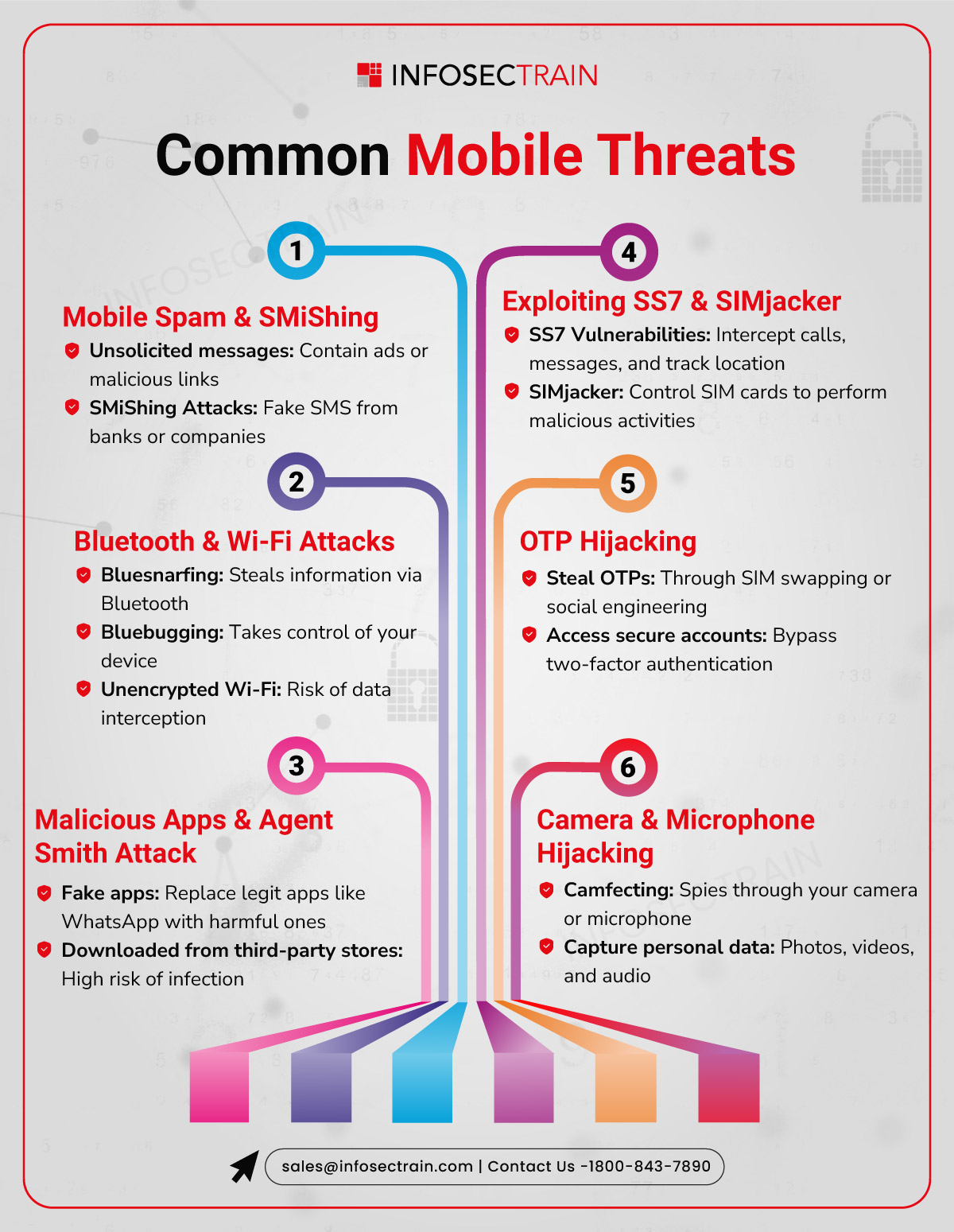
1. Mobile Spam and SMiShing
Mobile spam involves unsolicited messages, usually containing advertisements or malicious links. A more dangerous form of this is SMiShing (SMS phishing), where attackers send fake messages to trick you into revealing personal information. These messages might look like they’re from your bank or a trusted company, urging you to click a link or call a number. Once you do, your data could be stolen or your device infected with malware.
2. Bluetooth and Wi-Fi Attacks
Connecting your device to open Bluetooth or Wi-Fi networks can be risky. Hackers can intercept data or install malware on your device through these connections. Techniques like Bluesnarfing and Bluebugging involve stealing information or taking control of your device via Bluetooth. Similarly, unencrypted Wi-Fi networks are breeding grounds for cyber attacks, allowing hackers to intercept your communications.
3. Malicious Apps and Agent Smith Attack
Sometimes, even apps that seem safe can be harmful. An attack known as the Agent Smith Attack involves malicious apps that replace legitimate apps on your device, like WhatsApp or SHAREit, with infected versions. These malicious versions can bombard you with ads or, worse, steal sensitive information. This usually happens when you download apps from third-party app stores, which are less secure than official stores.
4. Exploiting SS7 and SIMjacker Vulnerabilities
SS7 (Signaling System 7) is a protocol used by mobile networks to exchange information. Unfortunately, it has vulnerabilities that hackers can exploit to intercept calls and messages, track your location, and even bypass two-factor authentication. Similarly, the SIMjacker attack involves sending a specially crafted SMS that can control your SIM card, allowing hackers to make calls, send texts, or track your device.
5. OTP Hijacking and Two-Factor Authentication Weaknesses
One-time passwords (OTPs) are often used for secure logins. However, hackers can hijack these OTPs using techniques like social engineering or SIM swapping, an issue that eSIM USA options aim to minimize by eliminating traditional SIM vulnerabilities. In this method, a hacker convinces your mobile provider to move your phone number to a new SIM card that they control, allowing them access to your messages and OTPs.
6. Camera and Microphone Hijacking
Ever worried about someone spying on you through your phone’s camera or microphone? This isn’t just the stuff of spy movies. Hackers can use malicious apps or remote access tools to take control of your device’s camera and microphone. This type of attack, known as camfecting, can be used to capture photos, videos, or audio without your knowledge.
To be Continued…
Master CEH with InfosecTrain
Ethical hacking is a sophisticated, multi-phase process that demands extensive knowledge and security certifications. Professionals can enhance their security assessment and network architecture skills by enrolling in ethical hacking courses, such as the Certified Ethical Hacker (CEH v13) training offered by InfosecTrain. This comprehensive training equips individuals with the crucial skills and techniques necessary to conduct authorized hacking activities within organizations.

TRAINING CALENDAR of Upcoming Batches For CEH v13 AI Training
| Start Date | End Date | Start - End Time | Batch Type | Training Mode | Batch Status | |
|---|---|---|---|---|---|---|
| 21-Nov-2026 | 20-Dec-2026 | 09:00 - 13:00 IST | Weekend | Online | [ Open ] | |
| 12-Dec-2026 | 24-Jan-2027 | 19:00 - 23:00 IST | Weekend | Online | [ Open ] | |
| 16-Jan-2027 | 21-Feb-2027 | 09:00 - 13:00 IST | Weekend | Online | [ Open ] | |
| 20-Feb-2027 | 28-Mar-2027 | 19:00 - 23:00 IST | Weekend | Online | [ Open ] | |
| 13-Mar-2027 | 18-Apr-2027 | 09:00 - 13:00 IST | Weekend | Online | [ Open ] |