AI-Powered Attackers vs. AI-Enabled Defenders: The New Cybersecurity Arms Race
Quick Insights:
AI is rapidly changing the cybersecurity landscape by empowering both attackers and defenders. Cybercriminals are now using AI to launch faster, more adaptive attacks through polymorphic malware, automated exploitation, deepfakes, and AI-driven phishing campaigns. At the same time, security teams are using AI-driven threat detection, predictive analytics, automated response, and AI-powered SOC capabilities to identify and respond to threats faster. The real challenge in this new cybersecurity arms race is balancing speed, accuracy, control, and human oversight. Organizations that embrace AI-powered next-gen security will be better equipped to identify risks early, stop emerging threats, and respond faster to modern cyberattacks.
Cybersecurity has moved beyond a battle between human attackers and security teams. It has entered a new phase where artificial intelligence is being used on both sides of the battlefield. Attackers are using AI to launch faster, smarter, and more evasive attacks, while defenders are using AI to detect threats, automate responses, and strengthen security operations in real time. This shift has created a new cybersecurity arms race where speed, intelligence, and adaptability matter more than ever. Organizations that fail to understand this change may struggle to keep up with AI-powered threats that can learn, scale, and operate continuously.
The Rise of AI-Powered Attackers
Think of traditional cyberattacks like manual lockpicking. Now imagine a robot that can try millions of combinations per second, learn from failures, and evolve instantly. That’s what AI-powered attackers bring to the table.

The New Attack Playbook: How Cybercriminals Weaponize AI
1. Polymorphic Malware: Attacks That Keep Changing
Polymorphic threats use AI to constantly change their code, making them harder to detect using traditional security tools.
Example: Same malware, different “appearance” every time it runs
Impact:
- Signature-based detection becomes less effective
- Real-time adaptation bypasses traditional tools
- Increased dwell time inside systems
Result: Detection delays + higher breach success rate
2. Adversarial Machine Learning: Turning AI Against Security
Adversarial machine learning is where attackers manipulate AI models themselves.
Example: A slight manipulation in input data can make an AI model misclassify malware as safe.
Impact:
- Reduced threat detection accuracy
- Compromised AI-based defenses
- Exploiting trust in automation
Result: Security systems become unreliable and can be turned into attack vectors
3. Automated Attack Campaigns
AI enables attackers to automate large-scale cyberattacks, reducing the need for manual intervention.
Example: AI systems scan thousands of networks simultaneously and launch phishing campaigns with human-like messaging.
Impact:
- Massive increase in attack scale and speed
- Reduced dependency on skilled attackers
- Faster exploitation of vulnerabilities
Result: Mass-scale attacks with minimal human effort
4. Deepfake & Social Engineering Attacks
AI-generated content, such as voices, videos, and emails, is used to impersonate real individuals and manipulate victims.
Example: A deepfake voice call impersonating a CEO to authorize fraudulent transactions.
Impact:
- Human verification and trust-based approval processes become easier to manipulate
- Increased success of social engineering attacks
Result: Trust is exploited, making social engineering one of the most effective attack vectors
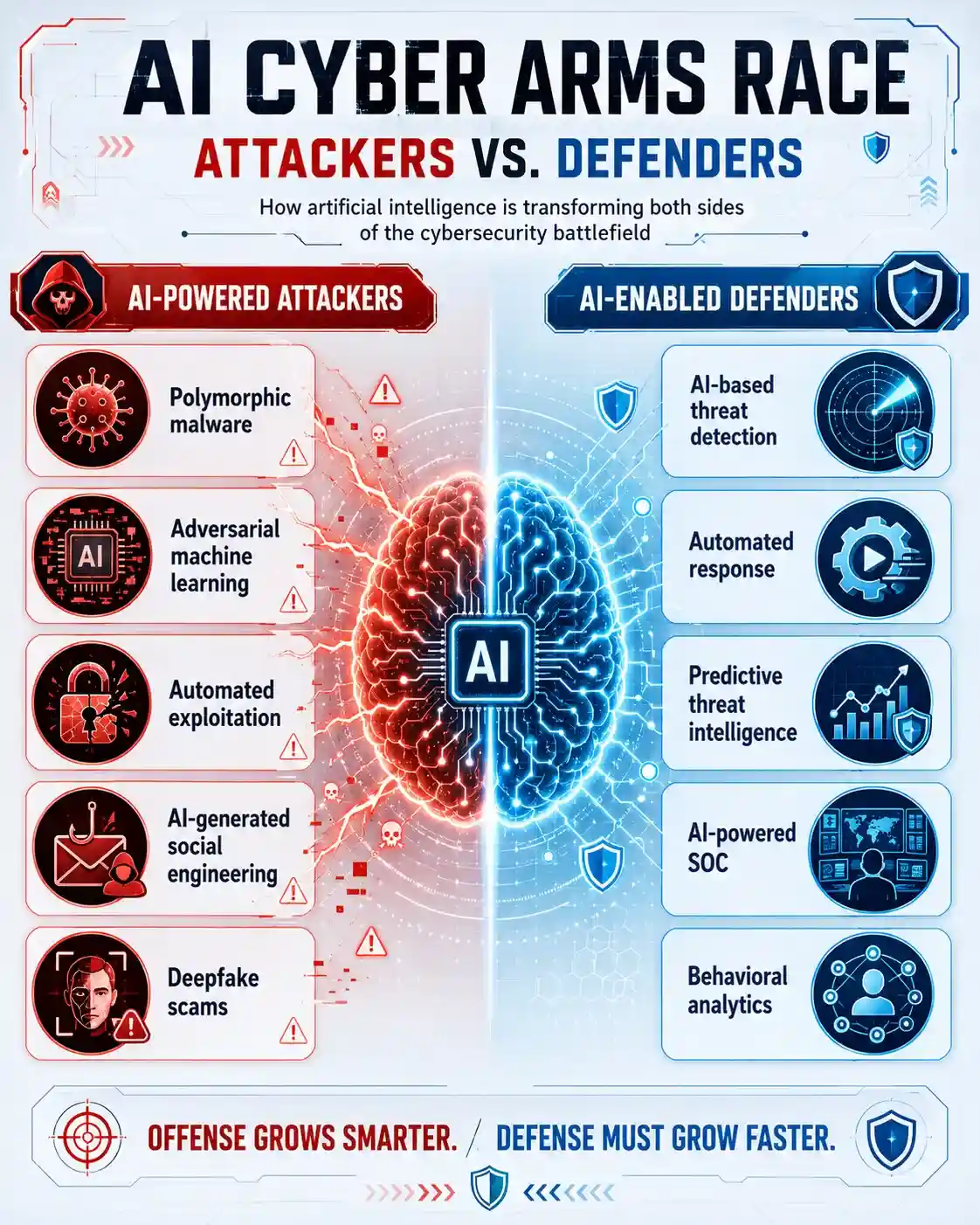
The Rise of AI-Enabled Defenders
If attackers are using AI to scale attacks, defenders must use AI to scale protection. This is where AI in cybersecurity becomes critical.
The Modern Defense Playbook: How Security Teams Use AI
1. AI-Driven Threat Detection (Speed + Accuracy)
AI-powered systems analyze huge volumes of data to detect anomalies and identify potential threats in real time.
Example: Monitoring network traffic, user behavior, and endpoint activity to detect unusual patterns that indicate an attack.
Impact:
- Improved threat detection accuracy
- Ability to detect unknown and zero-day threats
- Reduced reliance on manual monitoring
Result: Faster identification and mitigation of threats before they escalate
2. Automated Defense & Response
AI systems automatically respond to detected threats with minimal human intervention.
Example: Isolating infected endpoints, blocking suspicious IP addresses, and triggering incident response workflows instantly.
Impact:
- Significant reduction in response time
- Minimized damage during active attacks
- Enhanced operational efficiency
Result: Reduced response time from hours → seconds
3. Predictive Threat Intelligence
AI leverages historical and live threat signals to predict future cyber threats and vulnerabilities.
Example: Identifying emerging attack patterns and forecasting potential vulnerabilities before attackers exploit them.
Impact:
- Shift from reactive to proactive security
- Better risk prioritization
- Strengthened overall security posture
Result: Organizations anticipate and prevent attacks instead of reacting to them
4. AI-Powered SOC (Security Operations Center)
AI enhances Security Operations Centers by automating analysis and assisting human analysts in decision-making.
Example: Filtering false positives, prioritizing alerts, and providing actionable insights to SOC teams.
Impact:
- Reduced alert fatigue
- Improved analyst productivity
- More accurate and faster decision-making
Result: Continuous, intelligent, and efficient security monitoring
AI-Powered Attackers vs. AI-Enabled Defenders
| Aspect | AI-Powered Attackers | AI-Enabled Defenders |
| Objective | Exploit vulnerabilities and bypass security | Detect, prevent, and respond to threats |
| Approach | Offensive, adaptive, and evasive | Defensive, predictive, and analytical |
| Speed | Extremely fast (automated large-scale attacks) | Fast but controlled (requires validation) |
| Key Technology | Adversarial machine learning, automation tools | AI in cybersecurity, behavioral analytics |
| Threat Type | Polymorphic threats, deepfakes, and AI phishing | AI-driven threat detection and anomaly detection |
| Scalability | High, can target thousands simultaneously | High, monitors large environments in real time |
| Learning Capability | Learns from successful breaches | Learns from attack patterns and anomalies |
| Human Involvement | Minimal (mostly automated attacks) | Required for strategy, tuning, and response decisions |
| Adaptability | Rapidly evolves to bypass defenses | Continuously improves detection models |
| Risk Factor | High impact, unpredictable attacks | Reduces risk through early detection and automation |
| Weakness | Can be countered with strong AI defenses | Can be fooled by adversarial inputs if not secured |
| End Goal | Data theft, disruption, and financial gain | Protection, resilience, and compliance |
In Conclusion: Adapt or Be Outpaced
The cyber arms race between AI-powered attackers and AI-enabled defenders is only accelerating. Attackers are becoming faster, smarter, and more scalable, using AI to automate reconnaissance, bypass traditional security controls, manipulate trust, and exploit vulnerabilities at speed. This means organizations can no longer rely only on conventional tools or manual security processes.
The way forward is not just to fight AI with AI, but to combine AI-driven defense with skilled human judgment, strong governance, continuous monitoring, and modern security practices. Organizations that invest in next-gen security, AI-powered SOC capabilities, automated response, and trained cybersecurity professionals will be better positioned to stay resilient. Those that fail to evolve may find themselves outpaced in a world where machines are increasingly being used to attack machines.
Stay Ahead of AI-Powered Threats
Don’t wait for an AI-powered attack to test your defenses. Build practical AI security skills with InfosecTrain’s AI-Powered SOC Analyst Certification Training and Certified AI Governance Specialist Training. Learn how to detect AI-driven threats, strengthen automated defense, understand adversarial machine learning, and prepare for the next generation of cyber risks.

TRAINING CALENDAR of Upcoming Batches For SOC Analyst Training
| Start Date | End Date | Start - End Time | Batch Type | Training Mode | Batch Status | |
|---|---|---|---|---|---|---|
| 26-Sep-2026 | 15-Nov-2026 | 09:00 - 13:00 IST | Weekend | Online | [ Open ] | |
| 29-Nov-2026 | 23-Jan-2027 | 19:00 - 23:00 IST | Weekend | Online | [ Open ] | |
| 23-Jan-2027 | 07-Mar-2027 | 09:00 - 13:00 IST | Weekend | Online | [ Open ] | |
| 20-Mar-2027 | 02-May-2027 | 19:00 - 23:00 IST | Weekend | Online | [ Open ] |

TRAINING CALENDAR of Upcoming Batches For CAIGS
| Start Date | End Date | Start - End Time | Batch Type | Training Mode | Batch Status | |
|---|---|---|---|---|---|---|
| 09-Nov-2026 | 17-Dec-2026 | 19:30 - 22:00 IST | Weekday | Online | [ Open ] | |
| 01-Feb-2027 | 04-Mar-2027 | 19:30 - 22:00 IST | Weekday | Online | [ Open ] |
Frequently Asked Questions
What is AI in cybersecurity?
AI in cybersecurity refers to using machine learning and automation to find, prevent, and respond to cyber threats faster and more accurately.
What are polymorphic threats?
Polymorphic threats are malware that continuously change their code to evade detection systems.
What is the biggest AI-driven risk in cybersecurity?
The biggest threat is automation on a scale. AI allows attackers to launch faster, smarter, and more adaptive attacks than traditional defenses can handle.
What is next-gen security?
Next-gen security uses AI, automation, and advanced analytics to defend against modern, evolving cyber threats.
How does AI improve threat detection accuracy?
AI analyzes large datasets and identifies patterns and anomalies that humans or traditional tools might miss.
What industries are most at risk from AI-driven cyberattacks?
Finance, healthcare, and critical infrastructure are most vulnerable due to high-value data and operational impact.
Are traditional security tools still effective?
Traditional tools alone are no longer sufficient. They must be integrated with AI-based systems to handle modern threats.
How can organizations prepare for AI-based threats?
By adopting AI-powered security tools, continuous monitoring, and skilled professionals trained in modern frameworks.
