How to Prepare for the CCSP Exam: Complete Study Guide
Quick Insights:
Preparing for the CCSP exam requires a structured study plan, a strong understanding of all six cloud security domains, and the ability to apply concepts to real-world scenarios. With the updated 2026 exam format, candidates should prioritize the latest ISC2 exam outline, master shared responsibility, practice scenario-based questions, and strengthen their knowledge through hands-on experience. Reliable study resources, regular revision, and exam-focused practice can help build confidence and improve preparation.
Cloud security looks straightforward until you are responsible for it. Moving workloads to AWS, Azure, or Google Cloud does not make traditional security principles disappear. It changes where the boundaries sit, who owns which controls, how data moves, and how organizations manage risk. This is exactly the kind of thinking the Certified Cloud Security Professional (CCSP) exam expects.
If you are preparing for the CCSP exam, structured learning through CCSP Certification Training can help you build a clear understanding of the concepts and domains you need to master. Memorizing hundreds of definitions alone is unlikely to be enough. You need to understand cloud security well enough to look at a scenario, identify the risk, understand the responsibilities of each party, and select the most appropriate security response.
This CCSP study guide explains what to study, how to build an effective preparation strategy, how to use practice questions, and how to approach revision and exam day.
What is the CCSP Certification?
The Certified Cloud Security Professional (CCSP) is an advanced cloud security certification from ISC2. It validates knowledge and skills across cloud architecture and design, data security, platform and infrastructure security, application security, security operations, and legal, risk, and compliance considerations.
CCSP is designed for professionals responsible for securing cloud environments and applying security principles across cloud technologies, services, and operating models.
CCSP Exam Format in 2026
An important point before you begin studying: the CCSP exam outline changed effective August 1, 2026.
Candidates preparing with older blogs, videos, notes, or study plans should therefore compare those resources against the latest official exam outline.
Under the current outline, the CCSP exam uses Computerized Adaptive Testing (CAT). Candidates have three hours to complete 100 to 150 items, which can include multiple-choice and advanced item types. The minimum passing score is 700 out of 1,000.
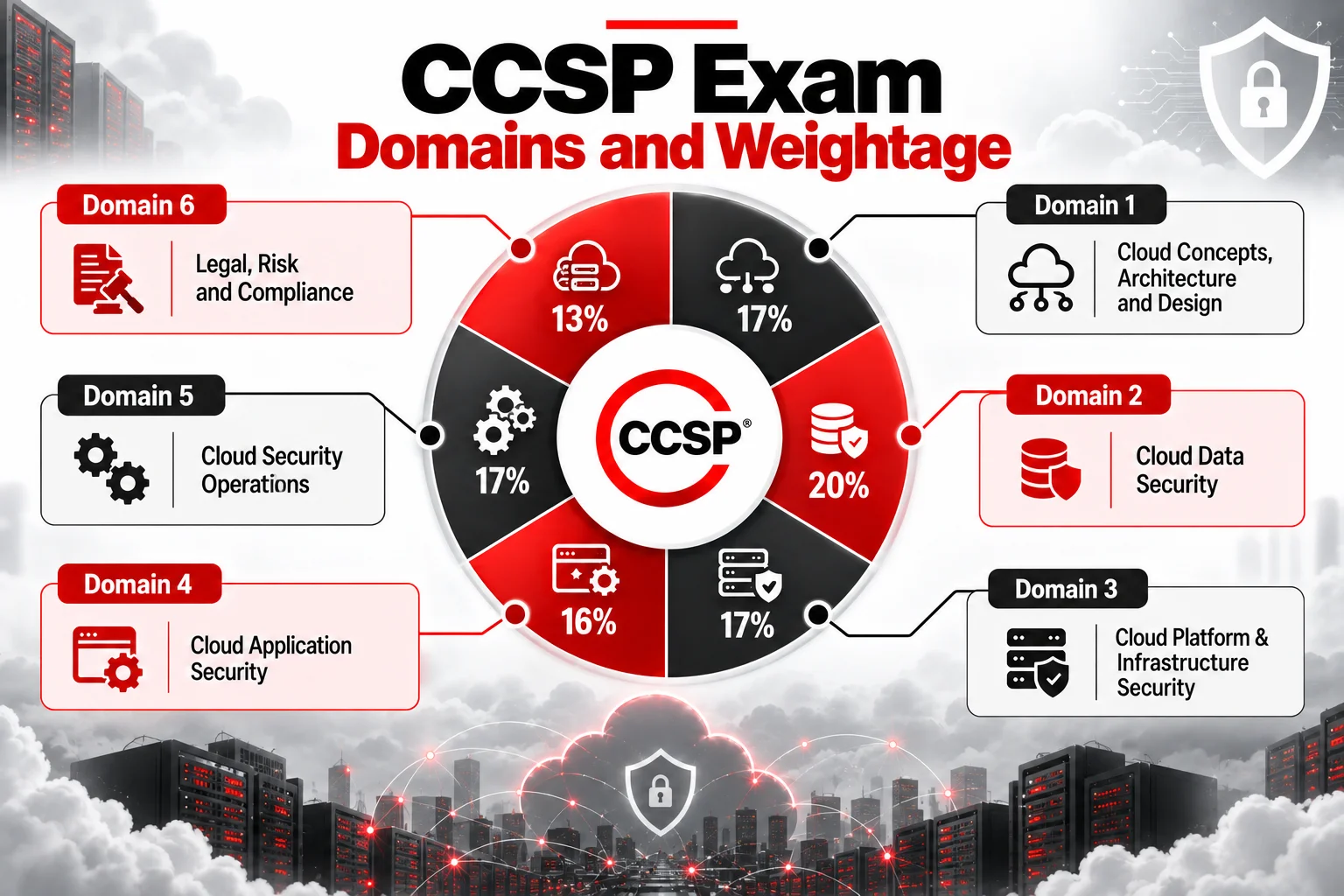
Current CCSP Exam Domains You Need to Prepare
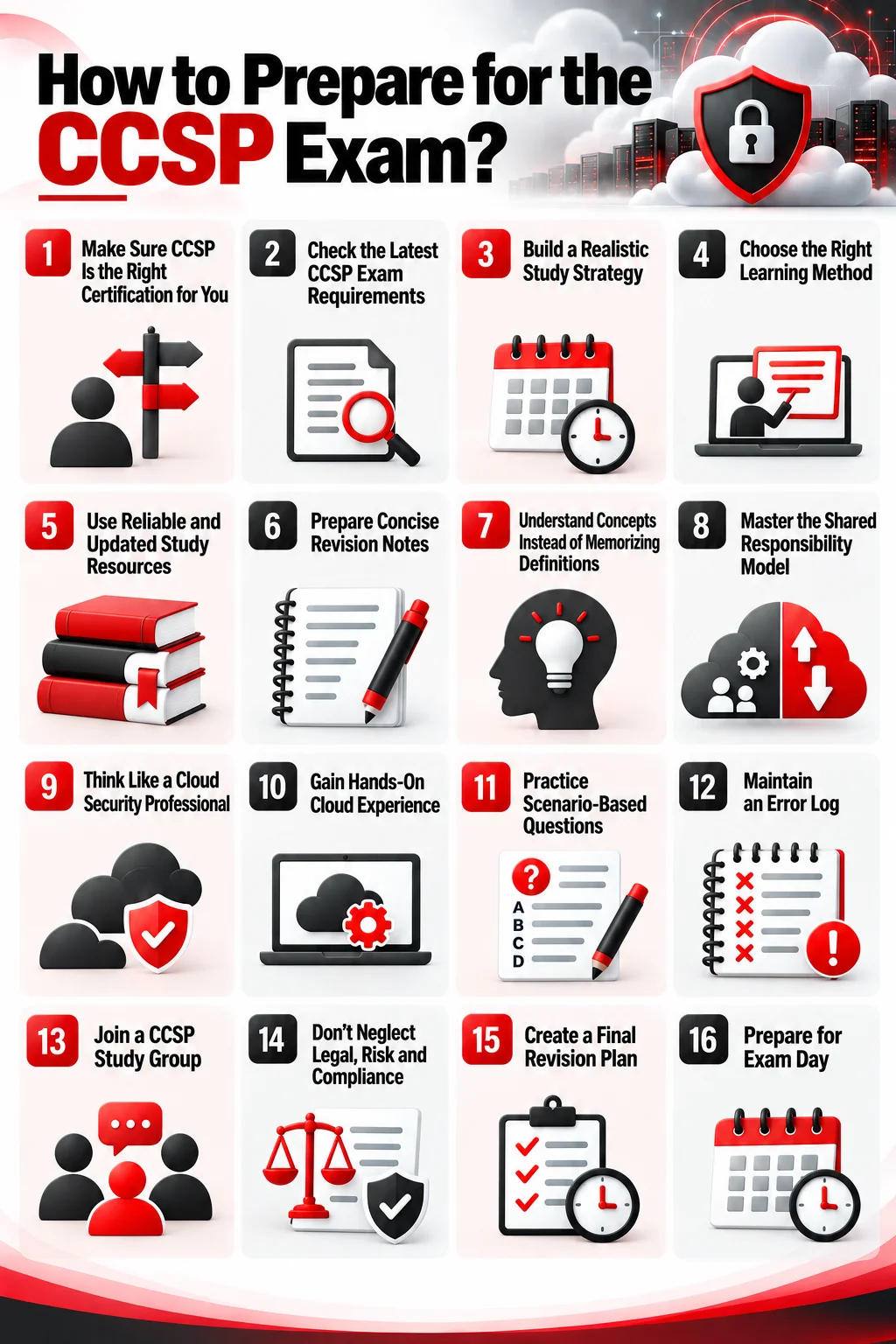
How to Prepare for the CCSP Exam
Preparing for CCSP requires more than covering the syllabus. You need a structured CCSP study plan, reliable resources, practical understanding of cloud security concepts, and regular practice with scenario-based questions. The following steps can help you organize your preparation effectively.
1. Make Sure CCSP Is the Right Certification for You
Before investing time and effort, consider why you want to earn the CCSP. Does it align with your current role or the cloud security career you want to build?
CCSP is particularly relevant to professionals looking to strengthen or validate their knowledge of cloud architecture, data security, application security, security operations, risk, and compliance. Having a clear goal can help you stay focused and consistent throughout your CCSP preparation.
2. Check the Latest CCSP Exam Requirements
Do not rely entirely on older blogs, videos, or study guides. The current CCSP exam outline became effective on August 1, 2026, so some older preparation material may no longer fully reflect the exam. Before you begin, review the latest official ISC2 CCSP exam outline, exam format, domain weights, eligibility requirements, and policies. Use the current outline as the foundation for your study plan.
3. Build a Realistic Study Strategy
Assess your existing knowledge across all six CCSP domains before deciding how much time to spend on each one. Allocate more study time to areas where your knowledge or experience is limited. For example, someone experienced in cloud infrastructure may need less time on architecture but more time on legal, risk, privacy, or compliance concepts.
Whether your preparation takes eight weeks, twelve weeks, or longer, build a schedule you can maintain consistently rather than trying to cover everything at once.
4. Choose a Learning Method That Works for You
CCSP preparation can include books, official documentation, video lessons, instructor-led training, hands-on labs, flashcards, or a combination of these. Choose an approach based on your existing cloud security knowledge, available study time, and learning preferences. If you prefer guided learning, structured CCSP training can help you work through the domains systematically while applying concepts to practical and exam-style scenarios.
5. Use Reliable and Updated Study Resources
More study material does not necessarily mean better preparation. Start with the current official CCSP exam outline and select a manageable set of trusted resources that map to it.
Use official resources as your foundation, then supplement them with books, training, videos, practice questions, and hands-on labs where needed. Be particularly careful with older CCSP resources because exam objectives and formats can change.
6. Prepare Concise Revision Notes
Create short, domain-wise notes as you study. Focus on concepts, responsibilities, processes, diagrams, and distinctions that are easy to confuse.
Instead of recreating your study guide, gradually condense your notes into quick revision sheets. The goal is to create material you can review efficiently during the final stage of preparation.
7. Understand Concepts Instead of Memorizing Definitions
CCSP questions often require you to connect multiple cloud security concepts. For example, do not simply memorize what encryption is. Understand where encryption should be applied, who controls the keys, how keys should be managed, and how encryption supports data protection and compliance.
Apply the same approach to identity, virtualization, application security, logging, business continuity, incident response, privacy, and other CCSP topics.
8. Master the Shared Responsibility Model
Shared responsibility is fundamental to cloud security. Understand how security responsibilities change across IaaS, PaaS, and SaaS. Instead of memorizing a chart, ask who is responsible for the data, applications, operating systems, network, physical infrastructure, identities, and configurations in each service model. Understanding the reasoning behind these responsibilities will make it easier to handle unfamiliar scenarios.
9. Think Like a Cloud Security Professional
When answering scenario-based questions, do not immediately jump to the most technical solution.
First ask:
- What asset needs to be protected?
- What is the primary risk?
- What is the business requirement?
- Which cloud model is involved?
- Who is responsible for the control?
- Which response addresses the risk most appropriately?
This approach can help you distinguish between multiple answers that may initially appear correct.
10. Gain Hands-On Cloud Experience
Practical experience can make abstract concepts easier to understand and remember. Use a cloud lab or sandbox to explore IAM policies, storage permissions, encryption, key management, network security, logging, monitoring, backups, and other security controls.
CCSP is vendor-neutral, so the goal is not to memorize one cloud provider’s interface. Focus on understanding how cloud security principles are implemented in practice.
11. Practice Scenario-Based Questions
Use practice questions to test whether you can apply what you have learned, not simply recall definitions. When working through a scenario, identify the cloud model, responsibility, risk, business requirement, and control being tested. If multiple answers appear correct, determine which one best addresses the specific question.
Focus on the reasoning behind each answer rather than the number of questions you complete.
12. Maintain an Error Log
Keep a separate record of recurring mistakes from your practice sessions. For each mistake, note:
- The topic or domain
- Why you selected the wrong answer
- The principle you misunderstood
- What you need to review
Over time, this gives you a personalized picture of where your reasoning or knowledge repeatedly breaks down and helps you direct your revision more effectively.
13. Join a CCSP Study Group or Learning Community
Discussing CCSP concepts with other candidates can expose you to different ways of interpreting cloud security scenarios. Use study groups to discuss difficult concepts, compare reasoning, and explain topics to one another. Teaching a concept can also reveal whether you truly understand it.
However, use these discussions to supplement reliable study resources rather than treating them as your primary source of exam information.
14. Don’t Neglect Legal, Risk and Compliance
Candidates with strong technical backgrounds may naturally spend more time on architecture, infrastructure, and data security. However, CCSP also covers legal, privacy, contractual, audit, risk, and compliance considerations in cloud environments. Give these areas dedicated study time, particularly if they fall outside your everyday responsibilities.
15. Create a Final Revision Plan
During the final weeks, shift from broad learning to consolidation. Focus on:
- Domain-wise revision sheets
- Recurring issues from your error log
- Difficult or easily confused concepts
- Shared responsibility
- Mixed-domain practice questions
- Areas that still require reinforcement
Avoid restarting the entire syllabus. Your goal at this stage is to strengthen recall, close remaining gaps, and become comfortable moving between different CCSP domains.
16. Prepare for Exam Day
Avoid trying to learn large amounts of new material immediately before the exam. Prioritize rest and arrive prepared for the testing process. During the exam, read each question carefully and pay attention to words such as BEST, MOST, FIRST, PRIMARY, and LEAST. When several answers seem reasonable, return to the scenario and identify exactly what the question is asking you to prioritize.
Recommended CCSP Study Guides and Resources
A good CCSP study guide should do more than explain cloud security terminology. It should help you understand how cloud security concepts apply to architecture, data, applications, infrastructure, operations, risk, and compliance. Most importantly, your study resources should align with the current CCSP exam outline effective August 1, 2026.
Instead of collecting random CCSP PDFs, question dumps, or outdated notes, begin with official ISC2 resources. You can then add trusted books, training, videos, flash cards, practice questions, and hands-on labs based on the areas where you need additional support.
| Study Resource | Best Used For |
| Official ISC2 CCSP Exam Outline | Understanding the six CCSP domains, current domain weights, and topics covered in the exam |
| Official ISC2 CCSP Certification Page | Checking current exam information, certification requirements, training options, and CCSP updates |
| CCSP Official Study Guide (Mike Chapple and David Seidl) | Structured study and detailed coverage of cloud security concepts across the CCSP domains |
| Official ISC2 CCSP Practice Tests | Testing your knowledge and becoming familiar with scenario-based cloud security questions |
| CCSP Certified Cloud Security Professional All-in-One Exam Guide | Supplementary explanations, domain-wise review, and exam preparation |
| CSA Security Guidance for Critical Areas of Focus in Cloud Computing | Strengthening practical knowledge of cloud architecture, governance, data security, operations, and cloud-specific risks |
Recommended Videos for CCSP Preparation
Videos can be particularly useful for CCSP because some topics, such as shared responsibility, cloud architecture, data security, encryption, key management, and legal considerations, become easier to understand when an instructor walks through a practical scenario.
However, avoid building your preparation around random CCSP videos. Use video content to supplement your primary study resources and verify that older videos still align with the current CCSP exam outline.
1. What’s New in CCSP 2026? Complete Syllabus & Exam Update
Start here to understand the latest CCSP syllabus, exam updates, and areas that may have changed from older study materials.
2. CCSP Domain-Wise Videos
Once you understand the current exam structure, move through the six CCSP domains individually. Domain-wise videos can help you concentrate on one subject area at a time and revisit specific domains where you need additional clarification.
You can use the following videos alongside your CCSP study plan:
- CCSP Domain 1: Cloud Concepts, Architecture and Design
- CCSP Domain 2: Cloud Data Security
- CCSP Domain 3: Cloud Platform and Infrastructure Security
- CCSP Domain 4: Cloud Application Security
- CCSP Domain 5: Cloud Security Operations
- CCSP Domain 6: Legal, Risk and Compliance
Instead of watching all six videos in one sitting, consider pairing each video with the corresponding domain in your study guide.
3. CCSP Practice Questions and Answers | CCSP Exam Prep 2026
Use this after covering the core concepts to practice CCSP-style questions. Focus on understanding why an answer is correct rather than memorizing the option.
4. CCSP Exam Success
Use these during your final preparation to reinforce important exam strategies and identify topics that may need another review.
- CCSP Exam Success! Top Tips for Passing the Exam | Day 1 Guide
- Success on the CCSP Exam! The Best Tips for Exam Success | Day 2
Conclusion
Preparing for the CCSP exam is not about memorizing everything you can find about cloud security. It is about understanding how cloud security concepts connect and how they apply in real-world scenarios. When you study encryption, connect it with key management, data protection, and compliance. When you study architecture, consider shared responsibility and resilience. When you study monitoring, connect it with incident detection and response. And when you study contracts, think about audit rights, data location, provider responsibilities, and exit strategies.
Start with the latest CCSP exam outline, build a strong understanding across all six domains, and practice applying what you learn to different cloud security scenarios. By exam day, your goal should be more than knowing what a security control does. You should understand when to use it, why it matters, and who is responsible for it.
How Can InfosecTrain Help You Prepare for the CCSP Exam?
Preparing for CCSP independently is possible, especially if you already have substantial cloud security experience. The challenge is often not finding information. It is organizing a large body of knowledge into a study path that you can actually follow.
InfosecTrain’s CCSP Certification Training helps professionals prepare through structured instructor-led learning, domain-focused coverage, assessments, practice, and real-world cloud security scenarios.

Frequently Asked Questions
What is the best way to prepare for the CCSP exam?
Start with the latest ISC2 CCSP exam outline and assess your knowledge across all six domains. Use one primary learning resource, supplement it with practical cloud-security examples, and complete scenario-based practice questions. Review the reasoning behind every incorrect answer rather than simply memorizing the correct option.
How difficult is the CCSP exam?
CCSP can be challenging because it covers multiple areas of cloud security and requires candidates to apply concepts to scenarios. Professionals with experience in cloud architecture, cybersecurity, risk, operations, or compliance may recognize many topics, but should still prepare across all six domains.
CISSP vs. CCSP: What Is the Difference?
CISSP covers cybersecurity broadly across multiple security domains, while CCSP specializes in cloud security. CISSP suits broader security roles, whereas CCSP is more focused on professionals securing cloud environments.
What Is the difference between CCSP and AWS Security Specialty?
CCSP is vendor-neutral and covers cloud security across platforms, while AWS Security Specialty focuses specifically on securing AWS environments.
What Is the Difference Between CCSP and CCSK?
CCSP is designed for experienced cloud security professionals and requires experience for full certification, while CCSK focuses on foundational cloud security knowledge without an experience requirement.
Can I take the CCSP exam without the required work experience?
Yes. You can take the CCSP exam before meeting the experience requirements for full certification. If you pass the exam but do not yet have the required professional experience, you can become an Associate of ISC2 while working toward the experience requirement. However, if you are completely new to cybersecurity and cloud computing, building foundational knowledge first can make CCSP preparation considerably more manageable.
Is CCSP vendor-specific?
No. CCSP is designed around cloud-security principles rather than one cloud platform. Knowledge of AWS, Microsoft Azure, Google Cloud, or another provider can help you understand practical implementations, but CCSP itself is not a vendor-specific cloud certification.
Is CCSP only for cloud security engineers?
No. ISC2 identifies roles including Cloud Architect, Cloud Engineer, Cloud Consultant, Cloud Administrator, Cloud Security Analyst, Cloud Specialist, cloud auditors, and professional cloud developers among the professionals relevant to CCSP.
Can CISSP holders take the CCSP?
Yes. In fact, ISC2 states that an active CISSP credential can substitute for the entire CCSP experience requirement. Candidates should still prepare specifically for the CCSP examination because its subject matter focuses heavily on cloud security.
Who should take the CCSP exam?
CCSP is designed for professionals whose work involves securing cloud data, applications, architecture, infrastructure, operations, risk, and compliance. It is particularly relevant to professionals working in cloud architecture, cloud security, engineering, consulting, administration, auditing, and related security roles. Whether CCSP aligns with your career path depends on your current responsibilities, cloud security experience, and professional goals.
How Long Does It Take to Prepare for the CCSP Exam?
CCSP preparation time depends on your existing cloud security experience, familiarity with the six domains, and available study time. An 8-to-12-week study plan can be a useful starting point for many professionals, but candidates with limited cloud security experience may need longer. Start with a domain-wise assessment and adjust your study timeline around your weaker areas.