What is the NIST AI Risk Management Framework?
Quick Insights:
The NIST AI RMF offers a flexible blueprint for security and governance teams to track, measure, and control AI-specific risks from initial development through full deployment. It focuses on building trustworthy AI by addressing security, privacy, reliability, safety, transparency, explainability, and fairness. Its four core functions Govern, Map, Measure, and Manage help organizations establish effective AI governance, understand potential risks, evaluate AI performance, and implement appropriate risk controls.
Building an enterprise AI application without a dedicated risk framework is like constructing a skyscraper on shifting sand. While standard IT security protects the perimeter, AI creates internal structural risks, from dynamic data drift to invisible algorithmic bias. The NIST AI Risk Management Framework acts as an architectural blueprint, giving organizations a structured process to design, test, and govern AI systems so they remain resilient, safe, and trustworthy.
What is the NIST AI RMF?
The NIST AI Risk Management Framework provides voluntary guidance to mitigate AI risks without slowing innovation. Moving beyond static audit checklists, the framework delivers customizable outcomes that let organizations tailor risk controls to specific AI architectures and enterprise risk appetites.
The framework applies across the AI lifecycle, including activities such as:
- Designing AI systems
- Developing and training models
- Testing and evaluating AI systems
- Deploying AI applications
- Monitoring AI systems
- Managing changes and emerging risks
- Retiring or replacing AI systems
NIST designed the framework for organizations of different sizes and across different industries. It can support developers, business leaders, risk professionals, security teams, compliance teams, and others involved in the AI lifecycle.
Key Characteristics of Trustworthy AI
- Valid and Reliable
AI systems should perform consistently and produce accurate, dependable results for their intended purpose.
- Safe
AI systems should operate without causing unacceptable harm to people, property, or the environment.
- Secure and Resilient
AI systems should protect against unauthorized access, attacks, data manipulation, and other security threats while continuing to function under adverse conditions.
- Accountable and Transparent
Organizations should clearly define responsibilities and provide appropriate information about how AI systems are developed, used, and governed.
- Explainable and Interpretable
AI systems should provide appropriate explanations of their outputs, while users should be able to understand how and why the system produces those outputs.
- Privacy-Enhanced
AI systems should protect individuals’ privacy and manage personal data appropriately throughout the AI lifecycle.
- Fair With Harmful Bias Managed
Organizations should evaluate AI systems for harmful bias and take appropriate steps to promote fair outcomes.
Why Does AI Risk Management Matter?
- Reduces AI Security Risks
AI risk management helps organizations identify and address threats such as prompt injection, data poisoning, model manipulation, and unauthorized access.
- Protects Sensitive Data
It helps organizations manage privacy risks and protect the sensitive information AI systems use.
- Improves AI Reliability
Regular testing and monitoring can help organizations identify inaccurate, inconsistent, or unexpected AI outputs.
- Addresses Bias and Fairness
Risk assessments help organizations identify potential bias in AI systems and take steps to reduce harmful or unfair outcomes.
- Strengthens AI Governance
AI risk management establishes clear responsibilities, policies, and processes for developing, deploying, monitoring, and managing AI systems.
Core Functions of the NIST AI RMF
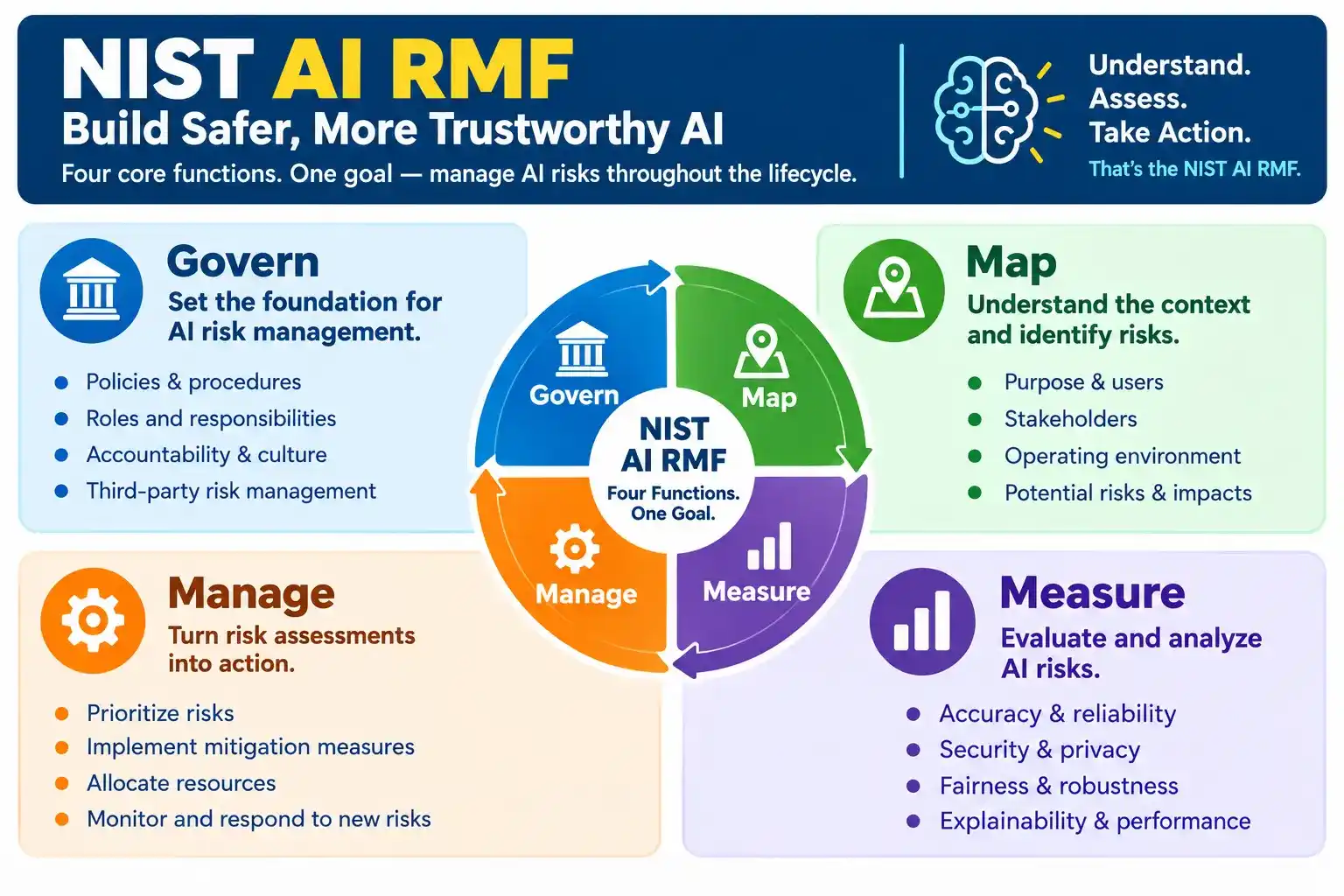
Govern, Map, Measure, and Manage.
These functions work together to help organizations establish an ongoing AI risk management process.
- Govern
The Govern function establishes the organizational foundation for AI risk management.
Organizations can use it to define policies, responsibilities, accountability structures, and processes for managing AI risks.
Key activities include:
- Establishing AI governance policies
- Defining roles and responsibilities
- Creating accountability mechanisms
- Building an organizational culture focused on responsible AI
- Aligning AI risk management with organizational values
- Establishing processes for managing third-party AI risks
Govern applies across the AI risk management process rather than to only one stage of the AI lifecycle.
- Map
The Map function helps organizations understand the context in which an AI system operates and identify its potential risks and impacts.
Before organizations can manage an AI risk effectively, they need to understand the system, its intended purpose, users, stakeholders, data, and operating environment.
Organizations can:
- Define the intended purpose of the AI system
- Identify relevant stakeholders
- Understand the system’s operating context
- Identify potential risks and impacts
- Document assumptions and limitations
- Consider legal, social, technical, and organizational factors
Mapping gives teams the context they need to make informed risk-management decisions.
- Measure
The Measure function focuses on analyzing and evaluating identified AI risks.
Organizations can use testing, evaluation, verification, and validation activities to assess whether an AI system meets relevant requirements and performs as intended.
Measurement activities can address areas such as:
- Accuracy and reliability
- Security
- Privacy
- Fairness
- Robustness
- Explainability
- System performance
- Potential harmful impacts
Organizations should establish appropriate metrics and evaluation methods based on the AI system’s context and intended use.
- Manage
The Manage function focuses on prioritizing and addressing identified AI risks.
Organizations can use the information collected through the Govern, Map, and Measure functions to determine which risks require action.
Typical activities include:
- Prioritizing identified risks
- Implementing mitigation measures
- Allocating resources
- Monitoring residual risks
- Responding to newly identified risks
- Documenting risk-treatment decisions
The Manage function helps organizations turn risk assessments into practical actions.
What are the Benefits of Using NIST AI RMF?
- Improves AI Risk Management
The NIST AI RMF provides a structured roadmap for organizations to uncover, evaluate, and mitigate security and operational risks across every stage of the AI lifecycle.
- Strengthens AI Governance
It helps organizations establish clear roles, responsibilities, policies, and accountability for AI systems.
- Enhances AI Trustworthiness
The framework encourages organizations to consider reliability, security, privacy, transparency, explainability, and fairness when managing AI systems.
- Supports Better Decision-Making
By identifying AI threats early and evaluating their potential consequences, enterprises can build, launch, and monitor AI applications with confidence.
- Provides Flexible Guidance
The AI RMF is voluntary and flexible, allowing organizations to adapt its practices to their industry, AI use cases, risk levels, and organizational needs.
Conclusion
Artificial Intelligence is reshaping enterprise technology, but deploying autonomous, learning-driven systems without dedicated governance creates massive operational and security risks. The NIST AI Risk Management Framework solves this challenge by replacing static security checklists with a dynamic, socio-technical blueprint. By embedding the four core functions Govern, Map, Measure, and Manage into every stage of the AI lifecycle, organizations can innovate confidently while keeping their systems secure, ethical, and fully compliant.
Master the practical skills required to model AI architectures, build NIST-aligned guardrails, and secure LLM applications by enrolling in the Practical AI Security Engineering Program at InfosecTrain.

TRAINING CALENDAR of Upcoming Batches For Practical AI Security Engineering Program
| Start Date | End Date | Start - End Time | Batch Type | Training Mode | Batch Status | |
|---|---|---|---|---|---|---|
| 12-Oct-2026 | 16-Nov-2026 | 08:00 - 10:00 IST | Weekday | Online | [ Open ] | |
| 31-Oct-2026 | 13-Dec-2026 | 19:00 - 23:00 IST | Weekend | Online | [ Close ] | |
| 30-Nov-2026 | 04-Jan-2027 | 20:00 - 22:00 IST | Weekday | Online | [ Open ] | |
| 23-Jan-2027 | 28-Feb-2027 | 09:00 - 13:00 IST | Weekend | Online | [ Open ] | |
| 20-Mar-2027 | 25-Apr-2027 | 09:00 - 13:00 IST | Weekend | Online | [ Open ] |
Frequently Asked Questions
What is the NIST AI Risk Management Framework?
The NIST AI Risk Management Framework offers flexible guidance to help enterprises uncover, analyze, and manage AI-related threats, fostering responsible and trustworthy AI deployment across the organization.
What are the four core functions of NIST AI RMF?
The four core functions are Govern, Map, Measure, and Manage. Together, they provide a structured approach to AI risk management.
Is the NIST AI RMF mandatory?
Compliance with the NIST AI RMF is entirely voluntary and adaptable, enabling organizations to scale its guidelines to fit their specific AI applications, industry standards, and risk tolerance.
What are the key characteristics of trustworthy AI?
The NIST AI Risk Management Framework evaluates model trustworthiness across seven critical parameters, ensuring systems remain safe, secure, transparent, privacy-preserving, fair, reliable, and accountable throughout their lifecycle.
Why is AI risk management important?
AI risk management helps organizations identify and address risks related to security, privacy, reliability, bias, safety, and governance throughout the AI lifecycle.
What does the Govern function do?
Govern establishes policies, roles, responsibilities, accountability, and organizational processes for managing AI risks.
What does the Map function do?
Map helps organizations understand an AI system's purpose, context, stakeholders, limitations, and potential risks and impacts.
What does the Measure function do?
Measure involves testing and evaluating AI systems for factors such as reliability, security, privacy, fairness, explainability, and performance.
What does the Manage function do?
Manage helps organizations prioritize identified AI risks, implement mitigation measures, allocate resources, and monitor remaining risks.
Who can use the NIST AI RMF?
Organizations across industries can use the NIST AI RMF. It supports AI developers, security teams, risk professionals, compliance teams, business leaders, and AI governance teams managing AI systems.