Practical Ethical hacking
Registrations for this batch are now closed.
Next batch coming soon!
We are  now! Registrations open until 11 Am.











Ethical hacking is one of the most important starting points for anyone who wants to understand how attackers think, how systems are tested, and how security weaknesses are identified before they are exploited. This bootcamp gives learners a structured introduction to ethical hacking concepts, penetration testing basics, reconnaissance, scanning, vulnerability assessment, web application attacks, password attacks, and social engineering risks.
Designed for beginners and early-stage cybersecurity learners, the program breaks down offensive security concepts in a clear and practical way. Participants will understand the ethical hacking methodology, common attack surfaces, basic tools, security testing approaches, and the role of responsible reporting in real-world cybersecurity assessments.

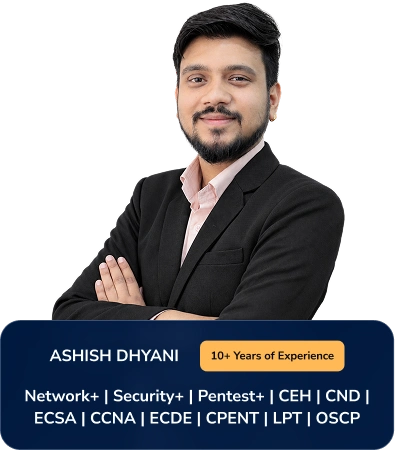
Ashish Dhyani
10+ Years of ExperienceAshish Dhyani is an accomplished cybersecurity and network security professional, known for blending technical precision with practical application. He has delivered 30+ training programs annually, mentoring over 250 professionals worldwide in practical network defense, penetration testing, and exploit development.
- Internal & external vulnerability assessment and penetration testing (manual + tools).
- Cyber Threat Intelligence and Digital Forensics operations.
- Secure application and infrastructure design aligned with global standards.
- OSINT-based threat analysis and mitigation.
- Advanced red teaming, exploit development, and VAPT reporting.
Special Offer! Limited Time Only
Module 1: Ethical Hacking Fundamentals
- Cybersecurity and Information Security
- CIA Triad
- Threats, Vulnerabilities and Risk
- Ethical Hacking and Hacker Types
- Red Team, Blue Team and Purple Team
- Penetration Testing Basics
- Black-Box, White-Box and Gray-Box Testing
Module 2: AI-Assisted Ethical Hacking Methodology
- Ethical Hacking Methodology
- Cyber Kill Chain
- MITRE ATT&CK Introduction
- Role of AI in Ethical Hacking
- Responsible Use of AI in Security Testing
- Map reconnaissance, scanning and exploitation phases
- Map a sample attack to Cyber Kill Chain and MITRE ATT&CK
- Use AI to analyze findings
- SGPT, MITRE ATT&CK Navigator
Module 3: Footprinting and Reconnaissance
- Passive and Active Reconnaissance
- OSINT Fundamentals
- Domain and DNS Information Gathering
- Perform WHOIS and DNS lookups
- Conduct search engine reconnaissance
- Identify website technologies and subdomains
- WHOIS, nslookup / dig, Wappalyzer, theHarvester
Module 4: Network Scanning
- IP Addressing Basics
- TCP, UDP, Ports and Services
- Host Discovery and Network Enumeration
- Discover live hosts
- Perform port scanning
- Identify services, versions and exposed ports
- Nmap, Netcat, Wireshark
Module 5: Vulnerability Assessment
- Vulnerabilities and Exploit
- Security Misconfigurations and Missing Patches
- CVE and CVSS
- Vulnerability Prioritization
- Perform a basic vulnerability scan
- Analyze findings and related CVEs
- Interpret CVSS scores and prioritize vulnerabilities
- Nikto, Nmap NSE, NIST NVD
Module 6: Web Application Hacking
- Web Application Architecture
- HTTP Requests and Responses
- Parameters, Cookies and Sessions
- Authentication Basics
- OWASP Top 10 Introduction
- Inspect and modify HTTP requests
- Analyze cookies and sessions
- Demonstrate basic SQL Injection and XSS
- Identify authentication weaknesses
- Burp Suite, SQLMap
Module 7: Password and System Hacking
- Password Security and Hashing
- Credential-Based Attacks
- Multi-Factor Authentication
- Privilege Escalation Basics
- Identify and analyze password hashes
- Demonstrate dictionary and brute-force concepts
- Review weak password policies and privilege escalation indicators
- Hashcat, John the Ripper, Hydra
Module 8: Social Engineering and Phishing
- Social Engineering Fundamentals
- Phishing and Spear Phishing
- Pretexting, Baiting and Impersonation
- Business Email Compromise
- Social Engineering Prevention
- Analyze sample phishing emails
- Inspect suspicious URLs and email headers
- Identify common social engineering indicators
- Zphisher, VirusTotal, URLScan.io
*Note: Participants will have access to session recordings for a period of 60 days.
Interested in Joining the
Our advisor will contact you with event details, and exclusive offers!