ISO 42001 vs. NIST AI RMF vs. EU AI Act
Quick Insights:
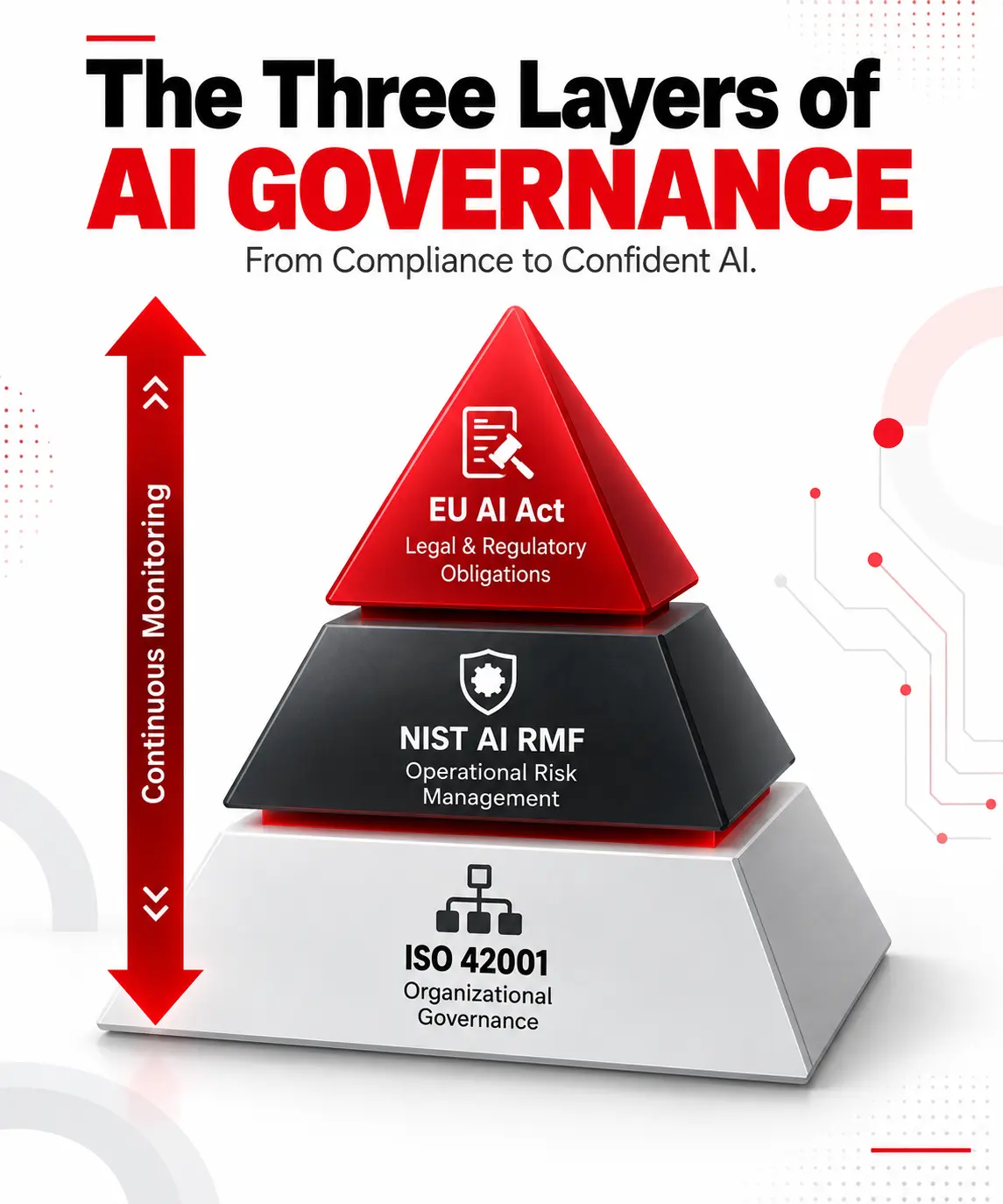
ISO/IEC 42001 helps an organization build and continually improve an Artificial Intelligence Management System (AIMS). NIST AI RMF provides a flexible method for identifying, measuring, prioritizing, and managing AI risks. The EU AI Act establishes legally enforceable requirements for AI systems and models within its scope. In practice, an organization may use all three rather than choosing only one. ISO/IEC 42001 can provide the management structure, NIST AI RMF can strengthen practical risk-management activities, and the EU AI Act can determine specific legal obligations for AI offered or used in the European Union.
Artificial intelligence has moved well beyond experimentation. Organizations now use AI to screen candidates, detect fraud, support healthcare decisions, automate customer service, generate content, write code, and make operational decisions. But when an AI system gets something wrong, who is responsible, how is the risk managed, and which rules apply?
That is where AI governance becomes critical. As organizations move AI into everyday operations, three approaches frequently come into focus: ISO/IEC 42001, NIST AI Risk Management Framework (RMF), and the EU AI Act. Although they share common goals around responsible and trustworthy AI, they serve different purposes.
One is a management system standard, another is a voluntary risk framework, and the third is a binding regulation. So, ISO 42001 vs. NIST AI RMF vs. EU AI Act: what exactly is the difference, and how can organizations use them together? Let’s discuss them.
What is ISO/IEC 42001?
ISO/IEC 42001:2023 is the world’s first AI management system standard. It provides requirements for establishing, implementing, maintaining, and continually improving an Artificial Intelligence Management System (AIMS).
The standard helps organizations create a structured approach to AI governance by defining responsibilities, policies, risk and impact assessments, controls, monitoring, and continual improvement. It applies to organizations of all sizes that develop, provide, or use AI-based products and services.
ISO 42001 follows the Plan-Do-Check-Act (PDCA) model, making AI governance an ongoing process rather than a one-time compliance activity. Organizations can also voluntarily pursue independent ISO/IEC 42001 certification to demonstrate that their AIMS meets the standard’s requirements.
What is the NIST AI Risk Management Framework?
Unlike the EU AI Act, the NIST AI RMF is not legislation. NIST describes the framework as voluntary, rights-preserving, non-sector-specific, and use-case agnostic. It helps organizations manage risks associated with designing, developing, deploying, and using AI systems.
The framework is built around 4 core functions:
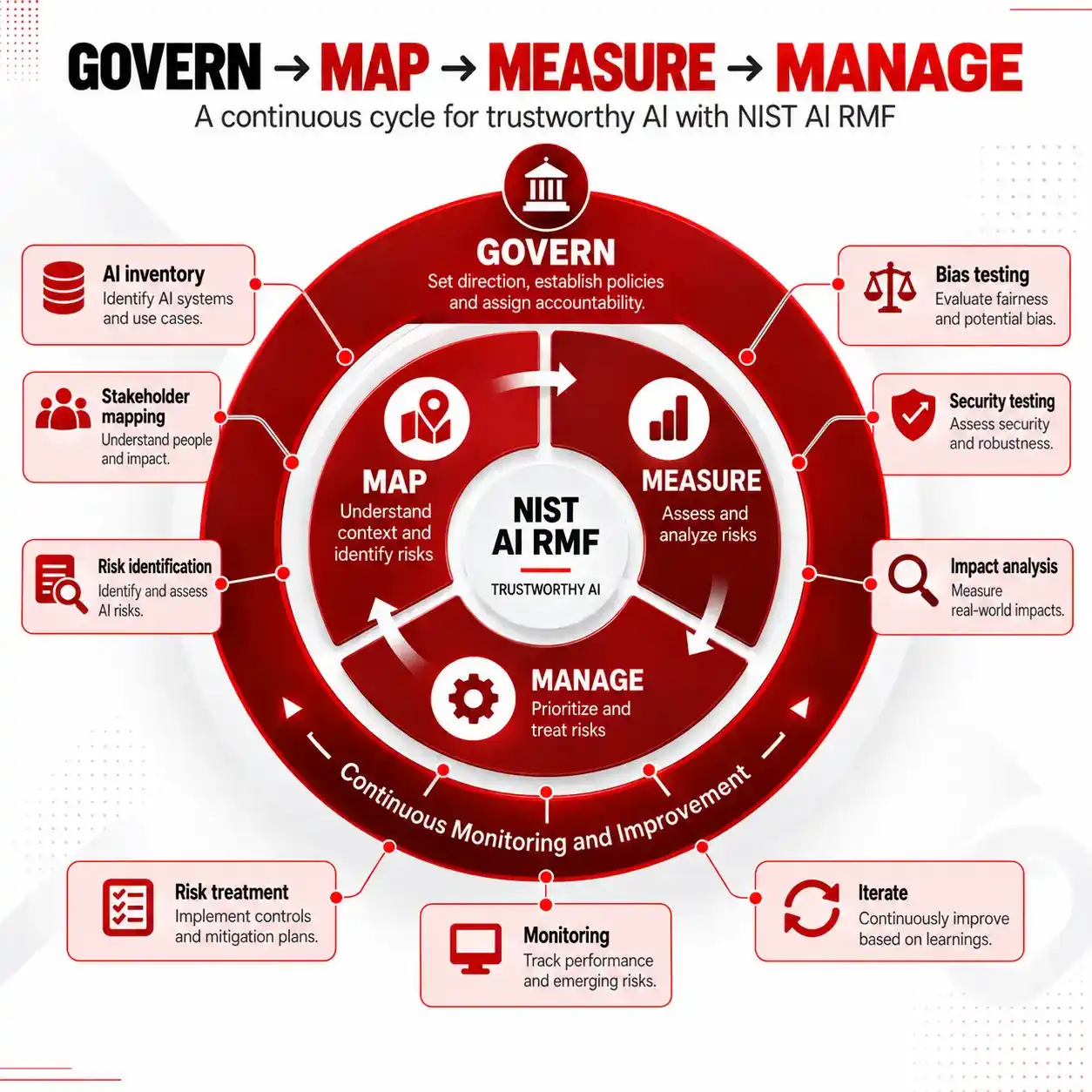
- GOVERN establishes policies, accountability, roles, processes, and organizational risk-management structures.
- MAP establishes context and identifies relevant risks, affected parties, intended uses, impacts, and dependencies.
- MEASURE uses qualitative and quantitative methods to analyze, test, benchmark, and monitor AI risks.
- MANAGE prioritizes identified risks and establishes actions for responding to, monitoring, and improving risk treatment.
NIST AI RMF also describes important characteristics of trustworthy AI, including systems that are valid and reliable, safe, secure, and resilient, accountable and transparent, explainable and interpretable, privacy-enhanced, and fair, with harmful bias managed.
For Generative AI, NIST has also published the Generative Artificial Intelligence Profile, NIST AI 600-1, which complements AI RMF 1.0 with GenAI-specific risk-management guidance.
Explore: ISO 42001 vs. NIST AI RMF
What is the EU AI Act?
The EU AI Act is fundamentally different from ISO 42001 and NIST AI RMF because it is a law. Its purpose includes establishing harmonized rules for AI in the European Union while promoting human-centric and trustworthy AI and protecting health, safety, and fundamental rights. It includes rules covering prohibited AI practices, high-risk AI systems, transparency requirements, general-purpose AI models, governance, and enforcement.
The Act can also affect organizations outside the EU. Its scope includes certain providers and deployers established outside the EU when, for example, the output produced by an AI system is used in the Union.
That extraterritorial reach makes the legislation relevant to multinational businesses, SaaS providers, AI developers, model providers, and other organizations serving the European market.
Explore:
Key Differences Between: ISO 42001, NIST AI RMF, and EU AI Act
The biggest difference: Standard vs. Framework vs. Law
| Aspects | ISO/IEC 42001 | NIST AI RMF | EU AI Act |
| Type | International management system standard | AI risk management framework | EU regulation/law |
| Primary objective | Establish, maintain, and continually improve an AIMS | Help organizations identify and manage AI risks | Establish harmonized legal rules and requirements for AI within its scope |
| Mandatory? | Voluntary unless required contractually or through another obligation | Voluntary | Legally binding for entities and activities within scope |
| Main structure | Artificial Intelligence Management System and PDCA cycle | Govern, Map, Measure, Manage | Risk- and role-based regulatory requirements, including prohibited practices, high-risk AI, transparency and GPAI rules |
| Certification | Organizations can voluntarily seek independent certification | No NIST AI RMF certification built into the framework | Compliance/conformity obligations depend on the relevant provisions and AI system |
| Core focus | Organizational AI governance and management system | Practical AI risk identification, assessment, measurement, and treatment | Legal compliance and protection of health, safety, and fundamental rights |
| Risk approach | Organization-wide risk and opportunity management | Contextual and lifecycle-based AI risk management | Regulatory obligations vary according to AI category, role, and use case |
| Generative AI relevance | Applicable to organizations developing, providing, or using AI | Dedicated GenAI Profile available | Specific obligations exist for providers of GPAI models |
| Enforcement | Through organizational governance, audits, and certification arrangements rather than statutory fines under the standard itself | No regulatory enforcement mechanism built into AI RMF | Regulatory enforcement by relevant EU and national authorities |
| Financial penalties | None imposed by ISO 42001 itself | None imposed by NIST AI RMF itself | Significant statutory penalties can apply, including thresholds reaching €35 million or 7% of worldwide annual turnover for certain infringements |
Can Organizations Use ISO 42001, NIST AI RMF, and the EU AI Act Together?
Yes. In many organizations, that may be more practical than treating the three as competing approaches. Imagine a multinational company developing an AI-powered recruitment platform. Its governance team could use ISO 42001 to establish the overall AIMS, including leadership responsibilities, policies, risk processes, documentation, performance evaluation, audits, and continual improvement.
Its product and risk teams could use NIST AI RMF to map the recruitment context, measure issues, and manage risks according to their severity and organizational risk tolerance.
Its legal and compliance teams would separately assess obligations under the EU AI Act, including whether the system falls into an applicable high-risk category and what requirements follow from that classification.
Instead of maintaining three completely separate programs, organizations can map overlapping requirements into a shared control environment.
That is usually where AI governance becomes manageable.
Which One Should Your Organization Implement?
The answer depends on what problem your organization is trying to solve.
- If the goal is to establish an auditable AI management system across the organization, ISO/IEC 42001 is directly designed for that purpose.
- If the immediate need is to identify, assess, measure, prioritize, and manage AI risks, NIST AI RMF provides a flexible operational structure.
- If your organization develops, provides, imports, distributes, deploys, or otherwise works with AI covered by the EU AI Act, the relevant legal requirements must be addressed according to your role and use case.
Conclusion
There is no single playbook for managing AI responsibly. As AI becomes part of every business decision, organizations need to know where it is being used, what could go wrong, who is responsible, and how problems will be addressed.
ISO/IEC 42001, NIST AI RMF, and the EU AI Act can work together to answer these questions from different angles. The real value comes from connecting them rather than managing each in isolation. This creates an AI governance approach that is easier to manage, easier to audit, and better prepared to adapt as AI technologies, risks, and regulations continue to change.
You can also explore:
- Top AI Governance Standards and Frameworks
- How Will AI Governance Impact Enterprise Risk Management in 2026?
- Roles and Responsibilities in AI Governance
- Data Governance vs. AI Governance
- Top AI Governance Tools for 2026
Build AI Governance and Risk Skills with InfosecTrain
Understanding these AI frameworks and applying them effectively requires practical governance, risk, and compliance skills. Enroll in InfosecTrain’s ISO/IEC 42001:2023 Lead Implementer Training to gain practical skills in building and maintaining an Artificial Intelligence Management System (AIMS).
Strengthen your AI risk expertise with the Advanced in AI Risk (AAIR) Certification Training, or explore the AI Governance Specialist Training for broader knowledge of responsible AI, ISO/IEC 42001, the EU AI Act, and NIST AI RMF.
Build practical skills to govern AI, manage emerging risks, and strengthen your organization’s AI compliance readiness.

TRAINING CALENDAR of Upcoming Batches For ISO 42001 Lead Implementer Training
| Start Date | End Date | Start - End Time | Batch Type | Training Mode | Batch Status | |
|---|---|---|---|---|---|---|
| 10-Oct-2026 | 15-Nov-2026 | 09:00 - 13:00 IST | Weekend | Online | [ Open ] | |
| 09-Jan-2027 | 07-Feb-2027 | 19:00 - 23:00 IST | Weekend | Online | [ Open ] |

TRAINING CALENDAR of Upcoming Batches For Advanced in AI Risk (AAIR) Certification Training
Start Date
End Date
Start - End Time
Batch Type
Training Mode
Batch Status
05-Dec-2026
10-Jan-2027
09:00 - 12:00 IST
Weekend
Online
[ Open ]

TRAINING CALENDAR of Upcoming Batches For Certified AI Governance Specialist (CAIGS) Training
| Start Date | End Date | Start - End Time | Batch Type | Training Mode | Batch Status | |
|---|---|---|---|---|---|---|
| 09-Nov-2026 | 17-Dec-2026 | 19:30 - 22:00 IST | Weekday | Online | [ Open ] | |
| 01-Feb-2027 | 04-Mar-2027 | 19:30 - 22:00 IST | Weekday | Online | [ Open ] |
Frequently Asked Questions
How do ISO 42001, NIST AI RMF, and the EU AI Act differ from each other?
ISO 42001 focuses on building an organization-wide approach to AI governance, while NIST AI RMF helps organizations identify and manage AI risks. The EU AI Act, on the other hand, sets enforceable requirements for AI systems and organizations that fall within its scope.
Is ISO 42001 mandatory?
No. ISO/IEC 42001 is a voluntary standard, not a legal requirement. However, organizations may adopt it to strengthen AI governance, meet customer or contractual expectations, or pursue independent certification.
Is NIST AI RMF mandatory?
No. NIST describes AI RMF as voluntary, non-sector-specific, and use-case agnostic. Organizations can use it to structure AI risk-management practices without it functioning as a standalone legal requirement.
Is the EU AI Act mandatory?
Yes, where an organization, AI system, model, or activity falls within the Act's scope. Its provisions apply according to factors such as the organization's role, type of AI, use case, and applicable implementation date.
Can ISO 42001 help with EU AI Act compliance?
Yes. ISO 42001 can support EU AI Act compliance through structured governance and risk management, but it does not replace legal requirements or guarantee compliance.
Can ISO 42001 and NIST AI RMF be used together?
Yes. ISO 42001 provides the management-system foundation, while NIST AI RMF strengthens AI risk identification, assessment, and management.
Does NIST AI RMF cover Generative AI?
Yes. NIST released the Generative Artificial Intelligence Profile, NIST AI 600-1, as a companion resource to AI RMF 1.0 for managing risks associated with Generative AI.
Does the EU AI Act apply to companies outside Europe?
Yes, in certain cases. It can apply to non-EU organizations when their AI systems or outputs are used within the EU.
Can an organization become ISO 42001 certified?
Yes. Organizations can voluntarily seek independent certification of an AIMS against ISO/IEC 42001. ISO does not perform the certification itself; independent certification bodies conduct certification activities.
Which framework should an organization start with?
Start with the organization's actual obligations and objectives. Determine applicable laws first, including whether the EU AI Act applies. Then decide whether ISO 42001 fits the overall management system and whether the NIST AI RMF can strengthen risk assessment and operational controls.