ISO 27701 & DPDPA: The Ultimate Guide to India’s Privacy Compliance
Quick Insights:
DPDPA is India’s data protection law, while ISO 27701 is an international privacy management standard that helps organizations build structured, auditable privacy practices. ISO 27701 certification does not automatically guarantee DPDPA compliance, but it can strongly support the journey by helping organizations manage personal data, data processing records, data subject rights, vendor risks, privacy controls, breach readiness, and evidence of ongoing compliance. For Indian organizations, ISO 27701 offers a practical way to move from policy-level privacy to operational privacy governance.
India’s digital economy is growing at a speed few markets can match. Every app, payment platform, healthcare portal, HR system, learning platform, fintech product, and AI-powered tool now depends on one critical asset: Personal Data.
But with that growth comes a serious question: Can organizations prove that they are handling personal data responsibly?
This is where India’s privacy conversation is changing. The Digital Personal Data Protection Act, commonly known as DPDPA, has moved data privacy from “good practice” to a formal compliance expectation. Organizations can no longer rely only on privacy policies written by legal teams. They need working systems, clear accountability, trained teams, security controls, vendor governance, breach response, consent management, and auditable evidence.
At the same time, global standards such as ISO 27701 are becoming increasingly relevant. ISO 27701 provides organizations with a structured approach to building, managing, auditing, and improving a Privacy Information Management System (PIMS). While DPDPA tells organizations what India expects under the law, ISO 27701 helps them create the operational system needed to meet many of those expectations.
What is DPDPA?
The DPDPA is India’s core law for regulating the processing of digital personal data. It focuses on protecting individuals, called data principals, while allowing organizations to process data for lawful purposes.
Under DPDPA, organizations that decide the purpose and means of processing personal data are known as data fiduciaries. In global privacy terminology, this role is broadly similar to that of a data controller, although the DPDPA uses its own terminology. Organizations that process data on behalf of a data fiduciary are known as data processors.
DPDPA focuses on key privacy areas such as:
- Lawful and transparent data processing
- Consent and notice management
- Rights of individuals over their data
- Reasonable security safeguards
- Breach notification
- Vendor and processor accountability
- Duties of Significant Data Fiduciaries
- Role of the DPO in applicable cases
- Oversight by India’s privacy regulator, the Data Protection Board of India, is often discussed broadly as a data protection authority
For organizations operating in India, DPDPA is not just a legal issue. It is a governance, technology, cybersecurity, risk management, and business trust issue.
What is ISO 27701?
ISO 27701 is an international privacy management standard that helps organizations move from ad-hoc privacy practices to a structured, auditable system for managing personal data, privacy risks, and compliance responsibilities.
It extends privacy governance beyond policy documents, turning it into a structured operating model. It helps organizations define privacy roles, manage risks, document processing activities, protect personal data, handle individual rights, and demonstrate accountability.
ISO 27701 is especially useful for organizations that already follow ISO 27001 or want to strengthen both information security and data privacy. It supports privacy practices for both controller-like and processor-like roles, making it useful for companies that handle data as service providers, SaaS vendors, outsourcing partners, fintech platforms, healthcare processors, HR platforms, edtech providers, and cloud-enabled businesses.
ISO 27701 vs DPDPA: The Core Difference
ISO 27701 and the DPDPA are related, but they are not the same.
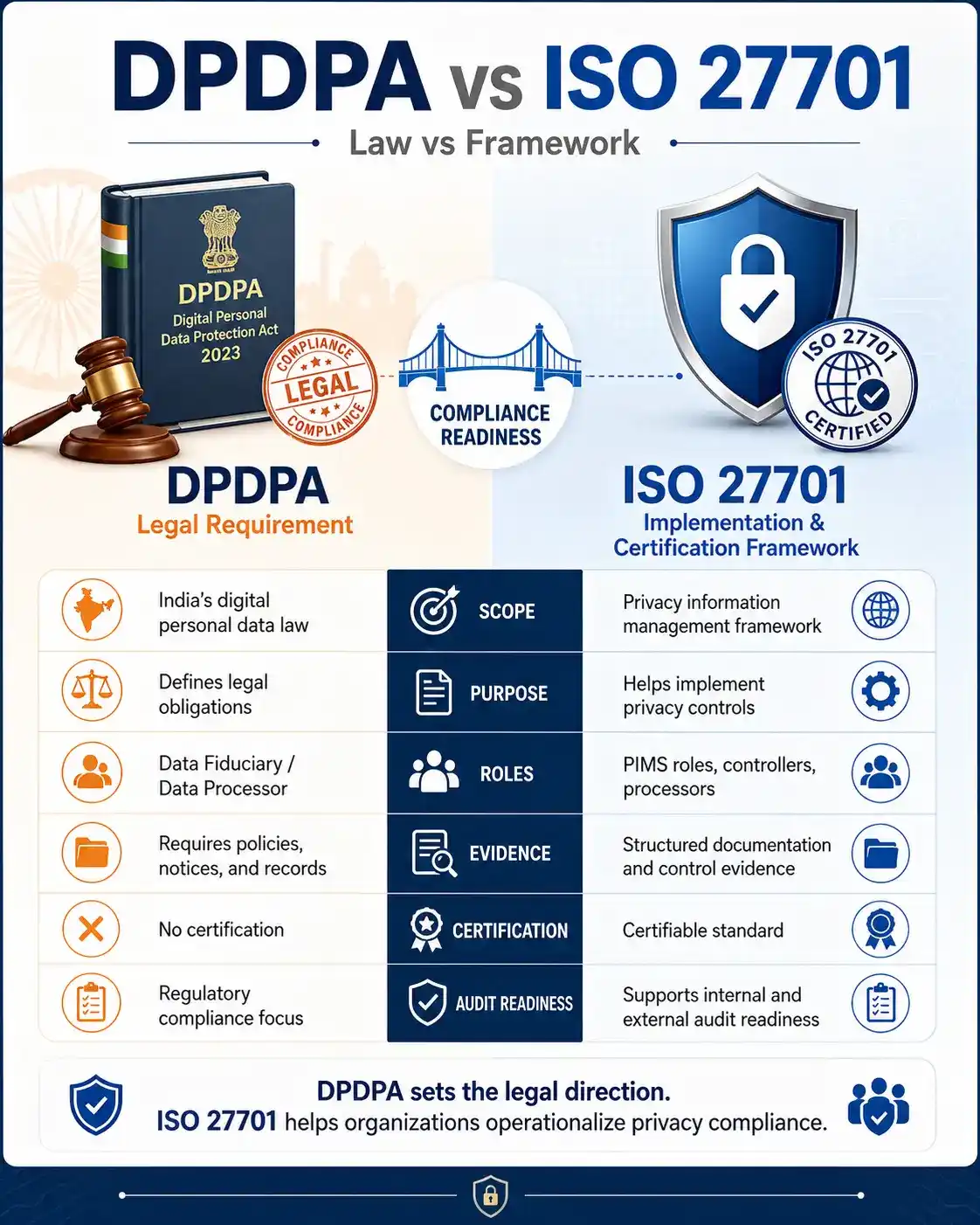
DPDPA is a law. ISO 27701 is a certifiable privacy management standard.
| Area | DPDPA | ISO 27701 |
| Nature | Indian data protection law | International privacy management standard |
| Main purpose | Regulate digital personal data processing in India | Build and improve a Privacy Information Management System |
| Applies to | Data Fiduciaries and Data Processors handling digital personal data under the Act | Organizations acting as PII controllers and/or processors |
| Legal force | Mandatory where applicable | Voluntary certification, but highly valuable |
| Focus | Rights, consent, notice, obligations, safeguards, breach reporting, and enforcement | Governance, policies, risk controls, documentation, audits, and continual improvement |
| Key roles | Data Fiduciary, Data Processor, Data Principal, and DPO for applicable organizations | PII Controller, PII Processor, Privacy Leadership, and Process Owners |
| Certification | DPDPA itself is not a certification | ISO 27701 is certifiable |
| Best use | Legal compliance with India’s Data Protection framework | Operational proof of privacy governance and readiness |
Why ISO 27701 Matters for DPDPA Compliance
DPDPA defines what Indian organizations must do to protect personal data, but ISO 27701 helps them build the structure to do it effectively. It supports DPDPA compliance by creating clear privacy roles, data processing records, risk management practices, vendor controls, data subject rights workflows, security safeguards, and audit-ready evidence. While ISO 27701 certification does not automatically guarantee DPDPA compliance, it provides organizations with a practical framework for managing privacy responsibilities, demonstrating accountability, and transitioning from policy-based compliance to a mature privacy governance system.
In Conclusion
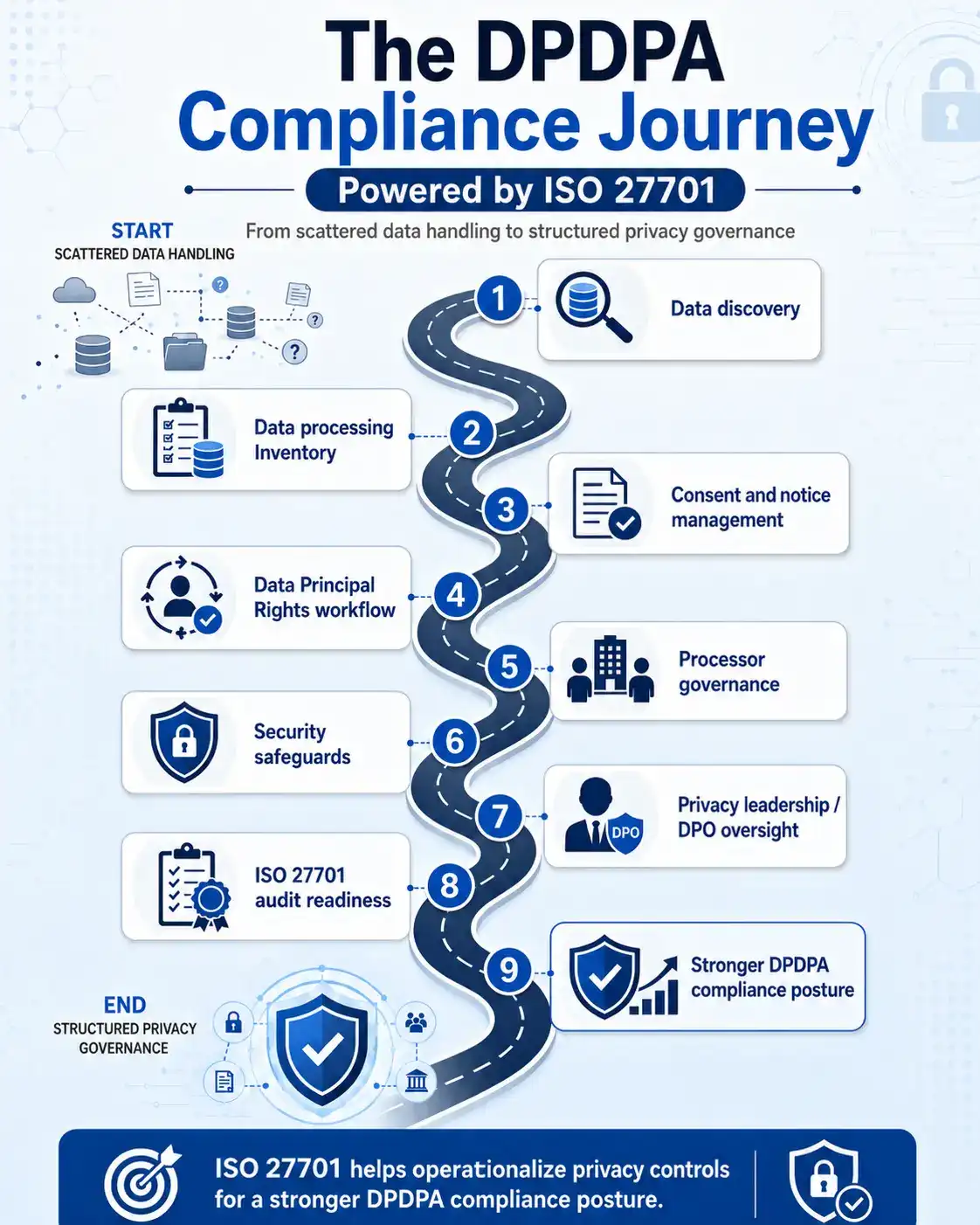
India’s data protection journey has entered a serious phase. DPDPA has created a legal foundation for responsible personal data processing. But compliance will not happen through documentation alone. Organizations need systems. They need trained people, privacy risk management, cybersecurity alignment, audit-ready evidence, and leadership commitment.
That is where ISO 27701 becomes a practical advantage.
It helps organizations move from reactive compliance to structured privacy governance. It supports DPDPA readiness, strengthens customer trust, enhances vendor accountability, and prepares teams for a future in which privacy, cybersecurity, and business growth are deeply interconnected.
Take the Next Step with InfosecTrain
Privacy compliance requires more than understanding the law or earning a certification. It needs trained teams, clear processes, strong governance, and audit-ready evidence. InfosecTrain helps privacy, compliance, cybersecurity, legal, risk, and audit professionals build these capabilities through expert-led programs such as ISO 27701 Lead Auditor, ISO 27701 Lead Implementer, DPO Hands-on Training, CIPP/E, CIPM, and other privacy-focused courses.
Whether your goal is to strengthen DPDPA readiness, implement a Privacy Information Management System, or build global privacy expertise, InfosecTrain can help you take the next step with confidence.


TRAINING CALENDAR of Upcoming Batches For DPO Training
Start Date
End Date
Start - End Time
Batch Type
Training Mode
Batch Status
03-Dec-2026
18-Dec-2026
20:00 - 22:00 IST
Weekday
Online
[ Open ]
08-Feb-2027
23-Feb-2027
20:00 - 22:00 IST
Weekday
Online
[ Open ]
Frequently Asked Questions
What is the difference between ISO 27701 and DPDPA?
DPDPA is a legal requirement in India, while ISO 27701 is a certification standard that helps organizations manage privacy systematically.
Does ISO 27701 certification ensure DPDPA compliance?
No. But it supports DPDPA compliance by helping organizations build strong privacy processes, controls, and documentation.
Why should Indian organizations consider ISO 27701?
It helps organizations manage data privacy, cybersecurity, risk management, vendor controls, and compliance in a structured way.
Who should pursue ISO 27701 certification?
Any organization that collects, processes, stores, or shares personal data, especially IT, SaaS, fintech, healthcare, edtech, and outsourcing companies.
How does ISO 27701 support data subject rights?
It helps create clear processes for managing access, corrections, deletions, grievances, and other privacy-related requests.
Is ISO 27701 useful for GDPR compliance too?
Yes. ISO 27701 aligns with global privacy concepts and can support both GDPR compliance and DPDPA readiness.