Cybersecurity Attacks: Types, Techniques, and How to Prevent Them
Quick Insights:
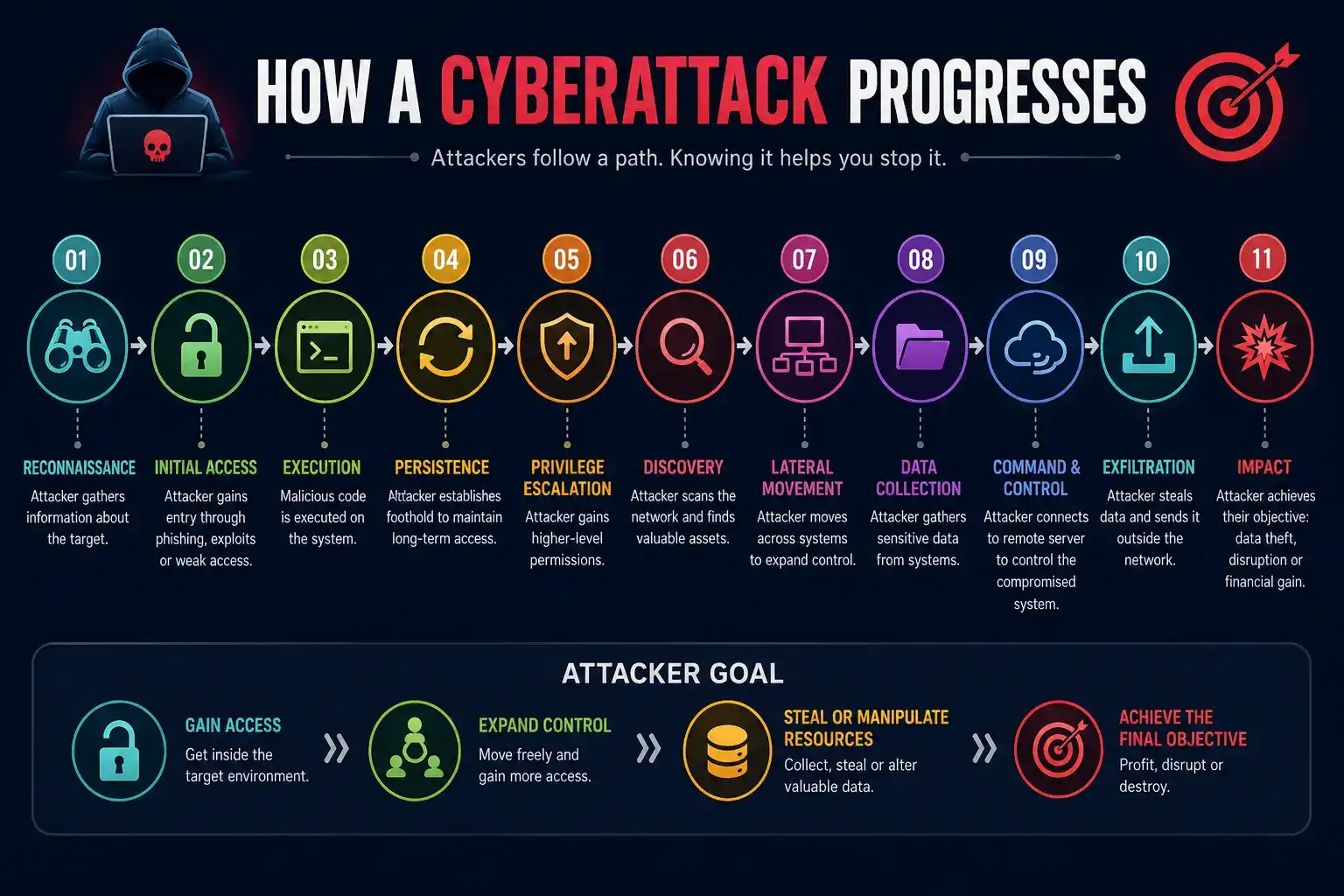
Modern cyberattacks build complex attack chains combining social engineering, credential theft, Living-off-the-Land scripts, and web exploits to breach networks, move laterally, and steal or encrypt data. Because human manipulation (phishing/BEC) drives over 90% of breaches, attacks routinely threaten all three pillars of the CIA Triad (Confidentiality, Integrity, Availability). Defending against modern threats requires shifting from perimeter defenses to a Zero Trust architecture. Organizations must combine phishing-resistant MFA (FIDO2), EDR/XDR telemetry, network micro-segmentation, immutable backups (3-2-1-1-0 rule), and strict out-of-band verification to detect and isolate attacks at every layer.
A financial analyst opened an urgent email appearing to come directly from the company’s Chief Executive:
We are closing a confidential acquisition before the market opens. Please process the attached invoice and initiate a wire transfer of $2.4 million immediately. Do not discuss this via phone as the deal is under a strict NDA.
Under pressure, the analyst clicked the link. No alarms sounded, and no security warnings popped up. Within ninety seconds, silent scripts executed in the background, stealing browser session tokens, hijacking administrative credentials, and deploying infostealer malware. By noon, the incident escalated into a full-scale ransomware attack, locking transaction databases and exfiltrating over 500 gigabytes of sensitive records.
This scenario illustrates a growing reality: over 90% of corporate data breaches begin with Social engineering, global cybercrime damages exceed $10.5 trillion annually, and the average enterprise breach costs $4.88 million.
What are Cybersecurity Attacks?
A cybersecurity attack is an intentional, unauthorized action by an individual or group to access, disrupt, alter, steal, or destroy a computer network, system, device, or data.
Core Objectives: The CIA Triad
Every cyber attack targets one or more pillars of the CIA Triad, the foundational model for information security:
- Confidentiality: Unauthorized access or exposure of sensitive information (e.g., stealing customer databases, trade secrets, or session tokens).
- Integrity: Unauthorized modification, corruption, or destruction of data (e.g., altering financial records, tampering with system code, or poisoning AI training datasets).
- Availability: Disruption of services to render systems unusable (e.g., locking enterprise databases with ransomware or crashing web servers using traffic floods).
Why Do Cyber Attacks Occur?
Threat actors execute cyber attacks for several primary motivations:
- Financial Gain: Extorting organizations via Ransomware, stealing payment credentials, or executing fraudulent wire transfers via Business Email Compromise (BEC).
- Cyber Espionage: Theft of intellectual property, military intelligence, or state secrets by nation-state adversaries.
- Operational Disruption: Causing downtime, reputational damage, or physical supply disruption against business competitors or critical infrastructure.
- Hacktivism: Promoting political or social agendas by defacing websites or leaking sensitive internal communications.
Common Types of Cybersecurity Attacks
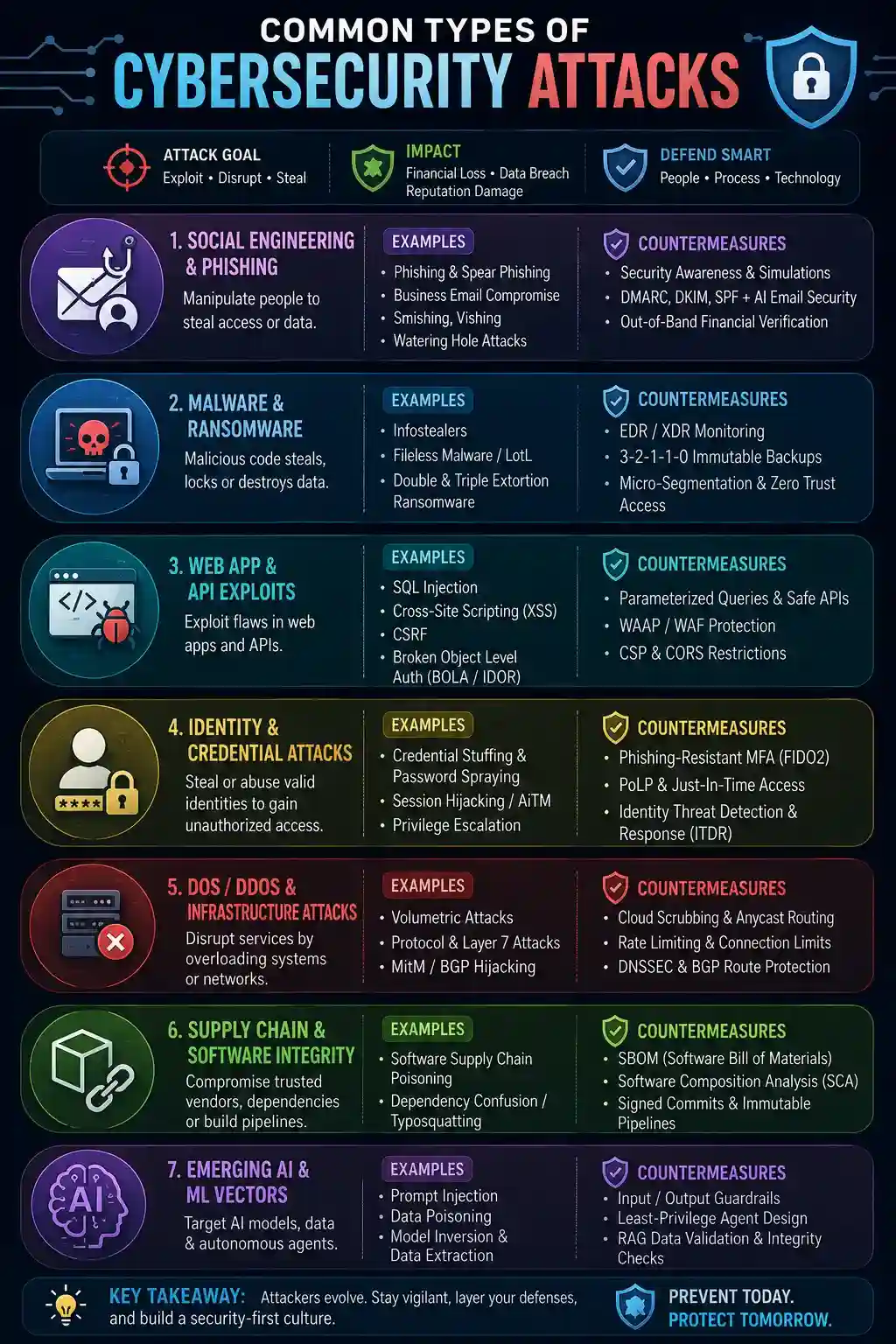
Social Engineering & Phishing
Attackers exploit human psychology (urgency, fear, curiosity, or authority) to bypass technical security controls and trick users into handing over access or data.
- Phishing & Spear Phishing: Deceptive emails mimicking trusted brands or internal executives. Spear phishing targets specific individuals using custom OSINT (Open-Source Intelligence).
- Business Email Compromise (BEC): Text-based impersonation of C-suite executives, vendors, or legal entities to redirect high-value wire transfers or payroll.
- Smishing & Vishing: SMS-based or voice/phone call manipulation used to bypass MFA checks or gather initial reconnaissance.
- Watering Hole Attacks: Compromising a niche website frequently visited by a specific target organization to serve targeted drive-by downloads.
Advanced Countermeasures
- Security Awareness & Simulation: Continuous, adaptive phishing campaigns tracking click-through rates, credential submission rates, and reporting speeds.
- Email Security Stack: Deploying DMARC, DKIM, SPF, alongside AI-driven Secure Email Gateways (SEGs) that inspect message body sentiment and domain age.
- Out-of-Band Financial Verification: Strict corporate policies mandating secondary voice or video confirmation before modifying vendor payment details.
Malware & Ransomware
Malware comprises malicious code designed to execute unauthorized actions on an endpoint, server, or cloud workload. Modern ransomware ecosystems operate on a Ransomware-as-a-Service (RaaS) model utilizing multi-extortion techniques.
- Infostealers: Lightweight background malware designed to harvest browser cookies, saved passwords, crypto wallets, and active session tokens (e.g., RedLine, Lumma).
- Fileless Malware & Living-off-the-Land (LotL): Executing payloads directly in RAM using administrative tools (PowerShell, WMI, PsExec) to evade traditional disk-scanning antivirus.
- Double & Triple Extortion Ransomware: Exfiltrating sensitive confidential files before bulk encryption, threatening public leaks or DDoS attacks if the ransom goes unpaid.
Advanced Countermeasures
- Endpoint Detection & Response (EDR / XDR): Continuous behavioral telemetry monitoring, automated process isolation, and memory inspection.
- Immutable 3-2-1-1-0 Backup Rule: 3 copies of data, on 2 different media, 1 off-site, 1 air-gapped/immutable (write-once-read-many), with 0 errors during test restores.
- Micro-Segmentation & Zero Trust Remote Access: Restricting lateral movement using granular network access controls (ZTNA) rather than legacy broad-access VPNs.
Web Application & API Exploits
Public-facing web applications and APIs are constantly scanned by automated botnets looking for logic flaws, injection bugs, and unpatched frameworks.
- SQL Injection (SQLi): Inserting malicious SQL statements into input fields to bypass authentication or extract/drop database contents.
- Cross-Site Scripting (XSS): Injecting malicious scripts into web apps that execute inside victim browser sessions (Stored, Reflected, or DOM-based XSS).
- Cross-Site Request Forgery (CSRF): Forcing an authenticated browser user to submit unauthorized commands to a vulnerable application.
- Broken Object Level Authorization (BOLA / IDOR): API vulnerabilities where changing an object ID parameter grants unauthorized access to another user’s private data.
Advanced Countermeasures
- Parameterized Queries & Safe APIs: Utilizing prepared statements and ORMs to separate executable code from user data input.
- Web Application & API Protection (WAAP / WAF): Deep packet inspection at Layer 7 to inspect payload signatures, block known malicious IPs, and enforce strict rate limits.
- Content Security Policy (CSP) & CORS Restrictions: Browser-side headers specifying strict execution rules for dynamic scripts and cross-origin resource requests.
Identity & Credential-Based Attacks
Identity has become the primary security boundary in cloud-native environments. Attackers seek valid credentials to appear legitimate inside enterprise systems.
- Credential Stuffing & Password Spraying: Automated scripts testing leaked credentials against thousands of endpoints or attempting common passwords against many accounts to avoid lockout thresholds.
- Session Hijacking & Adversary-in-the-Middle (AiTM): Setting up proxy phishing sites (e.g., Evilginx) that capture live session tokens and MFA codes in real time.
- Privilege Escalation: Exploiting local system misconfigurations or kernel vulnerabilities to gain administrative/root access from an unprivileged user context.
Advanced Countermeasures
- Phishing-Resistant MFA (FIDO2 / WebAuthn): Eliminating SMS/push-notification OTPs in favor of hardware tokens (e.g., YubiKeys) or passkeys bound to specific domain names.
- Principle of Least Privilege (PoLP) & Just-In-Time (JIT) Access: Restricting administrative access through Privileged Access Management (PAM) with temporary, scoped approvals.
- Identity Threat Detection & Response (ITDR): Monitoring directory services (Active Directory / Entra ID) for anomalous behavior, such as ticket-granting attacks (Kerberoasting).
Denial of Service (DoS / DDoS) & Infrastructure Attacks
Attacks intended to degrade or disrupt service availability for legitimate users by swamping network pipes, firewalls, or application servers.
- Volumetric Attacks: Flooding bandwidth capacity using massive botnets (e.g., NTP/DNS amplification attacks).
- Protocol & Layer 7 Attacks: Targeting specific service weaknesses, such as SYN floods against firewalls or resource-heavy HTTP POST/GET requests against application backends.
- Man-in-the-Middle (MitM) / BGP Hijacking: Intercepting or rerouting network traffic by corrupting DNS caches or manipulating Internet routing tables.
Advanced Countermeasures
- Cloud Scrubbing & Anycast Routing: Distributing incoming traffic loads across massive, global scrubbing facilities to filter out malicious packets before hitting infrastructure.
- Rate Limiting & Web Application Connection Limits: Enforcing dynamic threshold limits on API calls and HTTP requests per client IP.
- DNSSEC & BGP Route Leak Protection: Implementing cryptographic signing for DNS records and enforcing Resource Public Key Infrastructure (RPKI) for internet routing.
Supply Chain & Software Integrity Attacks
Rather than attacking a target directly, threat actors compromise trusted third-party dependencies, software vendors, or build pipelines.
- Software Supply Chain Poisoning: Injecting backdoor code into open-source repositories (e.g., npm, PyPI) or vendor software updates (e.g., SolarWinds, XZ Utils).
- Dependency Confusion / Typosquatting: Publishing malicious packages under names nearly identical to widely used open-source libraries.
Advanced Countermeasures
- Software Bill of Materials (SBOM): Maintaining an inventory of all third-party software components, libraries, and transitive dependencies.
- Software Composition Analysis (SCA): Automated pipeline scanning for known vulnerabilities (CVEs) in open-source components before deployment.
- Signed Commits & Immutable Build Pipelines: Enforcing strict cryptographic signatures on code commits and artifact repositories.
Emerging AI & Machine Learning Vectors
As artificial intelligence becomes deeply embedded into enterprise systems, specialized attack vectors target model parameters, training sets, and autonomous agents.
- Prompt Injection (Direct & Indirect): Crafting input text or embedding hidden instructions in external data sources (e.g., PDFs, web pages) to bypass system prompts and force LLMs to run unauthorized tools or reveal secret data.
- Data Poisoning: Corrupting fine-tuning datasets or RAG vector databases to introduce targeted backdoors, biases, or incorrect logic into AI outputs.
- Model Inversion & Data Extraction: Querying a model systematically to reconstruct proprietary training data or extract confidential personal information.
Advanced Countermeasures
- Input/Output Guardrails: Deploying dedicated guardrail models to validate, sanitize, and evaluate both incoming user prompts and outgoing AI responses in real time.
- Least-Privilege Agent Design: Isolating AI agent permissions, enforcing human-in-the-loop approvals for sensitive actions (file modifications, database updates, network calls).
- RAG Data Validation: Sanitizing and verifying the integrity of vector database documents before ingestion into the retrieval pipeline.
Cybersecurity Techniques Attackers Commonly Use
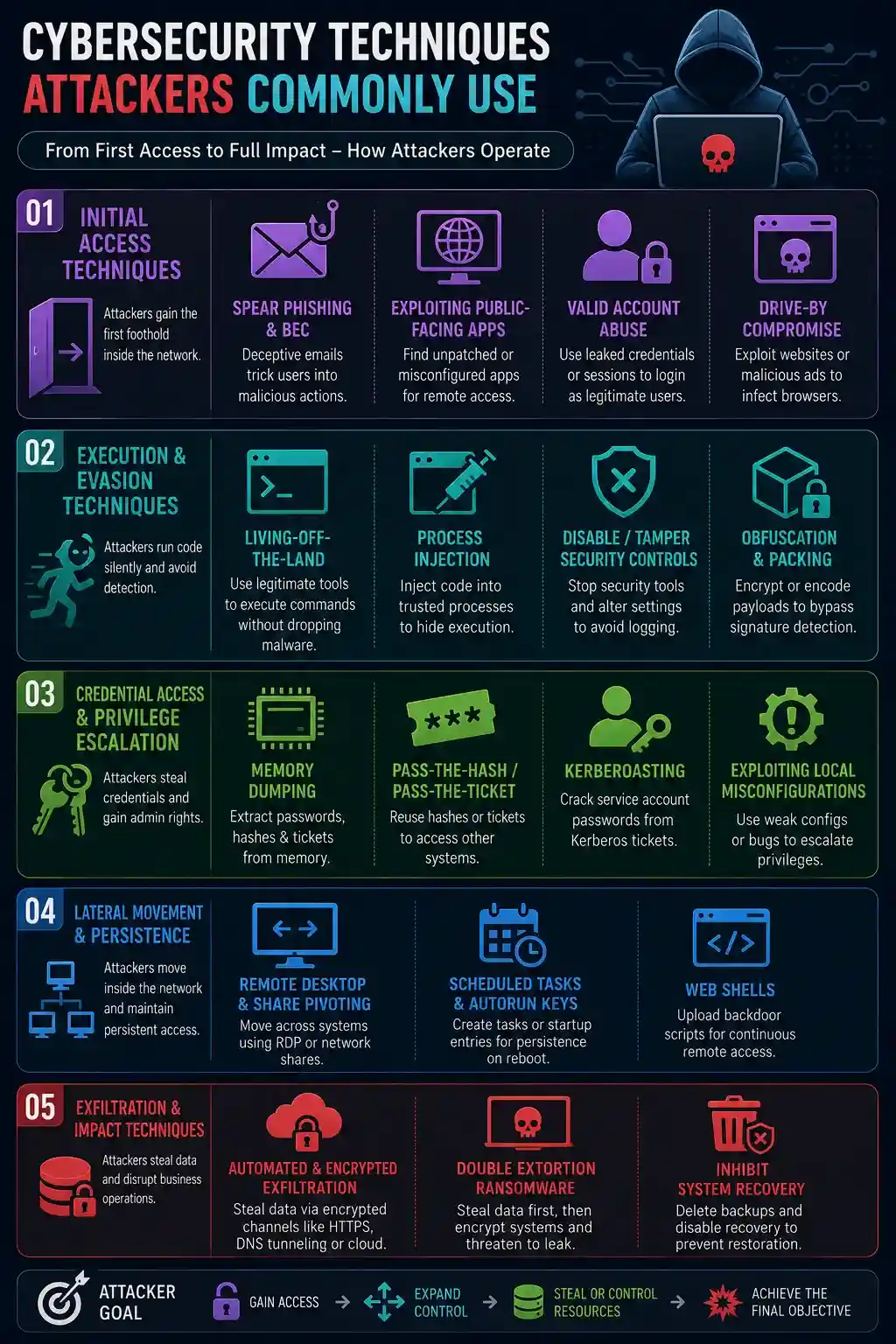
Initial Access Techniques
Initial access encompasses vectors used by threat actors to gain their first foothold inside an enterprise network.
- Spear Phishing & BEC: Customizing social engineering emails with stolen corporate context or lookalike domains to deliver malicious attachments or trick personnel into performing unauthorized actions.
- Exploiting Public-Facing Applications: Scanning the internet for unpatched software vulnerabilities, exposed administrative portals, or misconfigured cloud buckets to achieve remote code execution.
- Valid Account Abuse: Purchasing leaked credentials, session cookies, or VPN logins from Dark Web access brokers to log in as a legitimate employee.
- Drive-By Compromise: Compromising popular websites (Watering Hole attacks) or using malicious ad networks (Malvertising) to deliver browser-based exploits automatically when a user visits a page.
Execution & Evasion Techniques
Once initial access is established, attackers deploy evasion tactics to run code without triggering Endpoint Detection & Response (EDR) or Antivirus (AV) tools.
- Living-off-the-Land: Using legitimate, built-in operating system administrative tools such as command-line shells or management instrumentation to download payloads and execute commands natively without dropping suspicious binaries.
- Process Hollowing & Injection: Injecting malicious code into benign, running system processes to hide execution beneath trusted operating system instances.
- Disable/Tamper Security Controls: Modifying registry keys, terminating security sensor agents, or altering firewall rules to prevent detection logs from being sent to security analysts.
- Obfuscation & Packing: Encrypting, compressing, or encoding malicious scripts to bypass static signature detection.
Credential Access & Privilege Escalation
Attackers move from an unprivileged access point to full administrative control over domain infrastructure.
- Memory Dumping: Accessing local security authority memory space on infected endpoints to harvest plain-text passwords, authentication hashes, and Kerberos tickets.
- Pass-the-Hash / Pass-the-Ticket: Reusing harvested authentication hashes or tickets to authenticate to other machines on the network without needing the original plain-text password.
- Kerberoasting: Requesting service tickets for accounts with Service Principal Names and cracking their encrypted passwords offline to compromise high-privilege service accounts.
- Exploiting Local Misconfigurations: Leveraging unquoted service paths, weak file permissions, or unpatched kernel bugs to elevate permissions from a standard user to full administrative access.
Lateral Movement & Persistence
Threat actors establish permanent footholds and navigate through internal subnets toward high-value target data.
- Remote Desktop and Share Pivoting: Moving between internal host machines using remote desktop sessions or network file shares with compromised administrative credentials.
- Scheduled Tasks & Autorun Keys: Creating persistent system tasks, cron jobs, or startup registry keys that re-execute malicious implants automatically every time a system reboots.
- Web Shells: Uploading persistent backdoor scripts to compromised web servers, allowing continuous command execution over standard web ports.
Exfiltration & Impact Techniques
The final phase of an attack involves stealing intellectual property and disrupting business operations.
- Automated & Encrypted Exfiltration: Compressing stolen databases into password-protected archives, followed by exfiltration via encrypted channels (HTTPS, DNS tunneling, or cloud storage interfaces).
- Double Extortion Ransomware: Exfiltrating sensitive company data before launching multi-threaded volume encryption routines across servers and virtual machine hypervisors.
- Inhibit System Recovery: Deleting online system shadow copies, disabling automatic recovery features, and encrypting hypervisor backup volumes to prevent easy system restoration.
How Organizations Can Defend Against Cybersecurity Attacks
Identity & Access Controls (The New Security Perimeter)
Because identity has replaced traditional network boundaries, protecting user accounts and access pathways is the single most critical defensive layer.
- Phishing-Resistant Multi-Factor Authentication (MFA): Enforce hardware-backed MFA (such as FIDO2 security keys or passkeys) across all corporate applications and VPNs to eliminate reliance on easily intercepted SMS OTPs or push notifications.
- Principle of Least Privilege (PoLP): Limit user and service account permissions strictly to what is required for daily job responsibilities. Implement Privileged Access Management (PAM) for temporary, just-in-time administrative access.
- Identity Threat Detection & Response (ITDR): Continuously monitor directory services (e.g., Active Directory, Entra ID) for anomalous behavior, such as password spraying, ticket-granting attacks, or unauthorized privilege elevation.
Endpoint & Workload Protection
Endpoints (laptops, mobile devices, servers, and cloud instances) are primary targets for initial access and malware execution.
- Endpoint Detection and Response (EDR / XDR): Deploy modern EDR tools that continuously monitor system telemetry and memory space to identify, block, and isolate fileless malware, Living-off-the-Land scripts, and process injection in real time.
- Patch & Vulnerability Management: Maintain a risk-prioritized, automated patching schedule to remediate known zero-day software vulnerabilities and public CVEs before attackers can exploit them.
- Host-Based Hardening: Disable unnecessary administrative protocols, enforce script execution policies (e.g., PowerShell Constrained Language Mode), and block unauthorized USB/removable media access.
Network & Infrastructure Defense
Segmenting and monitoring network traffic prevents adversaries from freely navigating internal subnets after a perimeter breach.
- Network Micro-Segmentation: Divide internal corporate and cloud networks into small, isolated security zones. Restrict lateral movement using granular access rules so a breach in one department cannot reach critical databases.
- Zero Trust Network Access (ZTNA): Replace legacy, broad-access VPNs with ZTNA solutions that grant access strictly on an application-by-application basis after verifying user identity and device posture.
- Web & Email Gateways: Implement AI-driven Secure Email Gateways (SEGs) with DMARC, DKIM, and SPF enforcement to prevent domain spoofing and block malicious phishing links before reaching user inboxes.
Application & Data Security
Securing web applications and sensitive data ensures critical assets remain intact even during a broader corporate intrusion.
- Parameterized Queries & Web Application Firewalls (WAF): Enforce parameterized database queries to prevent SQL Injection, and deploy Layer-7 WAFs to filter malicious HTTP/S payloads, Cross-Site Scripting (XSS), and automated bot attacks.
- Data Encryption at Rest & in Transit: Protect sensitive customer records and internal intellectual property using strong encryption standards (such as AES-256 and TLS 1.3).
- Immutable, Air-Gapped Backups: Follow the 3-2-1-1-0 backup rule (3 copies of data, 2 different media types, 1 off-site, 1 air-gapped/immutable, with 0 restore errors). Immutable backups prevent ransomware actors from modifying or deleting recovery files.
Security Operations & Human Centric Controls
Technology alone cannot secure an enterprise; operational processes and continuous human training complete the defensive posture.
- Security Awareness & Phishing Simulations: Conduct regular, practical training to help employees identify social engineering, forced urgency, and out-of-band verification requirements for high-value financial requests.
- Out-of-Band Financial & Operational Verification: Establish strict non-technical procedures requiring dual authorization and secondary voice/video verification for wire transfers or changes to vendor payment details.
- Incident Response Planning & Tabletop Exercises: Maintain up-to-date Incident Response (IR) runbooks for ransomware, data exfiltration, and account compromise. Regularly test these plans through simulated executive and technical tabletop exercises.
Conclusion
As the digital attack surface expands across cloud environments, remote workforces, and interconnected networks, understanding the mechanics of cybersecurity attacks and techniques is no longer optional—it is a core business necessity. Modern threat actors systematically chain together human manipulation, identity exploitation, and evasive technical scripts to breach enterprise defenses. Organizations can no longer rely on perimeter firewalls alone; they must adopt a proactive, multi-layered Zero Trust architecture, enforce strict identity verification, and build resilient incident response capabilities to safeguard their most critical digital assets.
To stay ahead of modern, AI-driven threat vectors and master advanced defense-in-depth strategies, consider strengthening your expertise through the Cybersecurity AI Foundation course with InfosecTrain.

TRAINING CALENDAR of Upcoming Batches For Cybersecurity AI Foundation Program
| Start Date | End Date | Start - End Time | Batch Type | Training Mode | Batch Status | |
|---|---|---|---|---|---|---|
| 03-Oct-2026 | 15-Nov-2026 | 09:00 - 13:00 IST | Weekend | Online | [ Close ] | |
| 14-Nov-2026 | 20-Dec-2026 | 19:00 - 23:00 IST | Weekend | Online | [ Open ] | |
| 05-Dec-2026 | 10-Jan-2027 | 09:00 - 13:00 IST | Weekend | Online | [ Open ] | |
| 09-Jan-2027 | 14-Feb-2027 | 19:00 - 23:00 IST | Weekend | Online | [ Open ] | |
| 27-Feb-2027 | 04-Apr-2027 | 19:00 - 23:00 IST | Weekend | Online | [ Open ] |
Frequently Asked Questions
What are the primary objectives of a cybersecurity attack?
Cyberattacks target the CIA Triad: compromising Confidentiality (stealing data), degrading Integrity (altering or tampering with records), or destroying Availability (locking systems with ransomware or crashing networks).
What is the most common entry point for enterprise data breaches?
Over 90% of corporate breaches start with social engineering, specifically phishing or Business Email Compromise (BEC) emails designed to steal credentials or execute malicious downloads.
What is Living-off-the-Land (LotL) execution?
Living-off-the-Land refers to attackers using legitimate, built-in operating system tools (such as command-line shells or management instrumentation) to run scripts natively without dropping suspicious files that antivirus tools would flag.
How does modern ransomware differ from traditional ransomware?
Modern ransomware uses double and triple extortion tactics exfiltrating sensitive data before encrypting local drives, then threatening to leak confidential records publicly or launch DDoS attacks if the ransom is not paid.
What makes FIDO2 / WebAuthn multi-factor authentication phishing-resistant?
Unlike SMS codes or push notifications, FIDO2 uses hardware-backed cryptographic keys bound directly to specific web domains, rendering real-time proxy phishing (Adversary-in-the-Middle) ineffective.
What is the 3-2-1-1-0 backup rule for ransomware resilience?
It mandates keeping 3 copies of data on 2 different media types, 1 off-site, 1 air-gapped/immutable (write-once-read-many), with 0 errors during automated test restores.
How does a Web Shell allow persistent access to a compromised server?
A web shell is a backdoor script uploaded to a vulnerable web server that allows attackers to maintain continuous administrative access and execute remote commands over standard HTTP/HTTPS web traffic.
What is Prompt Injection in the context of emerging AI threats?
Prompt injection involves crafting malicious inputs or embedding instructions in external data sources (such as PDFs or web pages) to bypass an AI model's guardrails and force it to execute unauthorized actions or leak private data.
Why is network micro-segmentation critical for stopping lateral movement?
Micro-segmentation divides networks into isolated, highly restricted zones. If an endpoint in one department is breached, strict access rules prevent the attacker from pivoting laterally into critical databases or domain controllers.
What role does Out-of-Band verification play in preventing financial fraud?
Out-of-Band verification establishes strict operational policies that require dual authorization and secondary voice or video confirmation via an independent channel before executing high-value wire transfers or changing vendor payment details.