How ISO 42001 Audit Reports Are Written?
Quick Insights:
An ISO/IEC 42001 audit report is not just a compliance memo. It is a structured, evidence-based narrative that shows whether an organization’s AI Management System, or AIMS, is designed well, operates as intended, and improves over time. The best reports connect scope, audit criteria, sampled evidence, clause-level conclusions, Annex A control coverage, nonconformities, and corrective actions in one place, so management, auditors, and technical teams can all see the same truth.
ISO/IEC 42001 is the world’s first international management system standard for Artificial Intelligence Management Systems, also known as AIMS. It helps organizations manage AI responsibly by establishing governance, risk management, accountability, transparency, and continual improvement across the AI lifecycle.
But once an audit is completed, the real value comes from the audit report.
An ISO 42001 audit report is not just a formal document for certification purposes. It is a structured record that explains what was audited, what evidence was reviewed, where the organization is compliant, where gaps exist, and what actions are required to improve the AI management system.
A well-written audit report helps leadership, Compliance Teams, AI Owners, Risk Managers, and technical teams understand whether AI governance is working in practice.
What is an ISO 42001 Audit Report?
An ISO 42001 audit report is a formal document prepared after an audit of an organization’s Artificial Intelligence Management System. It summarizes the audit scope, audit criteria, evidence reviewed, audit findings, nonconformities, observations, and recommendations. The report also explains whether the organization’s AI governance practices align with the requirements of ISO/IEC 42001. In simple terms, the report answers five important questions:
- What was audited?
- What requirements were checked?
- What evidence was reviewed?
- What was found?
- What corrective actions are needed?
A strong report is clear, evidence-based, and easy to act on. It should not read like a collection of random observations. It should show how the organization manages AI risks, controls, responsibilities, and lifecycle activities.
Why do Audit Reports Matter?
AI is moving from pilot mode to business infrastructure, and that changes the stakes. Stanford’s 2025 AI Index reported that 78% of organizations used AI in 2024, up from 55% the previous year. Its 2026 report also found that documented AI incidents rose to 362 in 2025 from 233 in 2024, while ISO/IEC 42001 was cited by 36% of respondents as an influence on responsible AI practice. AI adoption is accelerating, incidents are climbing, and governance expectations are getting sharper.
That is exactly why ISO/IEC 42001 matters. ISO describes it as the first global standard for AI management systems, built to help organizations establish, implement, maintain, and continually improve AI governance while addressing risks such as bias, safety, security, misuse, transparency, and accountability. NIST’s AI RMF reinforces the same risk-based idea from another angle by framing AI risk management around governance and controls for impacts on individuals, organizations, and society. In simple terms, the audit report becomes the scoreboard. It is the document that proves your AI governance is real, not just well-worded.
How is an ISO 42001 Audit Report Written?
Key Elements of an ISO 42001 Audit Report
A good ISO 42001 audit report usually includes the following sections.
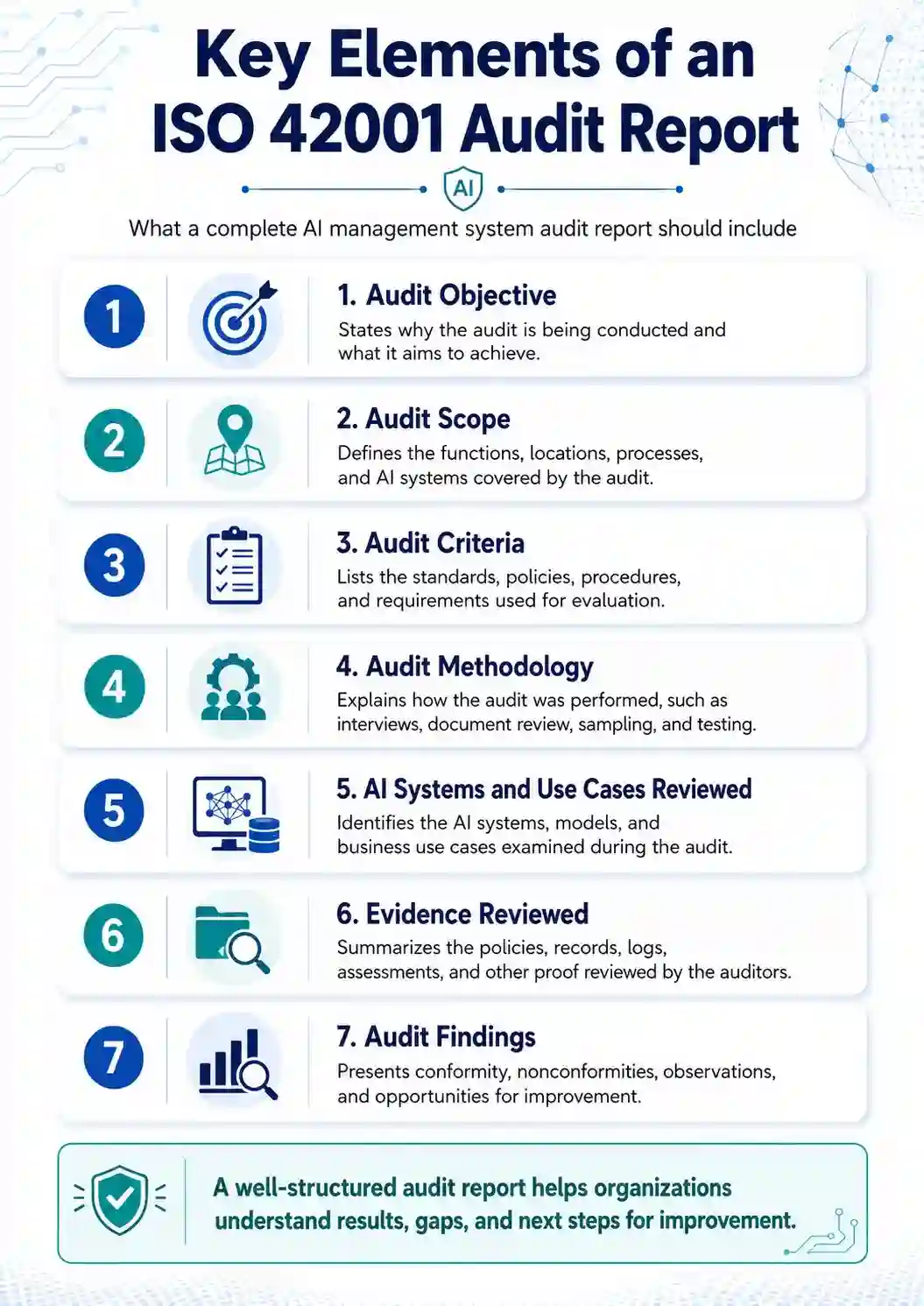
1. Audit Objective
The report should begin by explaining why the audit was conducted. For example, the objective may be to evaluate whether the organization’s Artificial Intelligence Management System meets ISO/IEC 42001 requirements, whether AI controls are implemented effectively, or whether the organization is ready for certification. This section keeps the report focused. It tells readers what the audit was meant to achieve.
2. Audit Scope
The audit scope defines what was included in the audit. This may include:
- AI systems or use cases reviewed
- Departments or business units covered
- Locations included in the audit
- AI lifecycle stages assessed
- Data types or data classes involved
- Governance processes reviewed
- Third-party or vendor-related AI activities
- Exclusions from the audit scope
Scope clarity is very important because AI systems can be spread across multiple teams, tools, platforms, and vendors. Without a clear scope, the report becomes confusing and difficult to validate. For example, an audit may cover an AI-powered chatbot used for customer support, but not include internal HR automation tools. Such exclusions should be clearly documented.
3. Audit Criteria
Audit criteria explain what the organization was audited against. For ISO 42001, the main criteria usually include:
- ISO/IEC 42001 Clauses 4 to 10
- Applicable Annex A controls
- Internal AI policies and procedures
- Legal, regulatory, or contractual requirements
- Risk management and impact assessment methods
- Statement of Applicability
- Organizational AI governance requirements
This section helps readers understand the standard or rules used to judge the organization’s AI management system.
4. Audit Methodology
The methodology section explains how the audit was performed. It may include:
- Document review
- Interviews with process owners
- Sampling of AI systems or records
- Review of logs and monitoring data
- Testing of selected controls
- Walkthroughs of AI lifecycle processes
- Review of corrective action records
This section adds credibility to the report. It shows that the audit was not based only on discussion, but also on objective evidence.
5. AI Systems and Use Cases Reviewed
Because ISO 42001 focuses on AI management, the report should clearly identify the AI systems, models, tools, or use cases reviewed during the audit. This may include AI used for:
- Customer support
- Fraud detection
- Recruitment screening
- Risk scoring
- Content generation
- Security monitoring
- Data classification
- Decision support
- Predictive analytics
For each AI system reviewed, the report should ideally mention its purpose, owner, risk level, lifecycle stage, and whether it is internally developed, externally procured, or vendor-managed. This makes the report more useful because readers can see exactly which AI activities were tested.
6. Evidence Reviewed
Evidence is the heart of an ISO 42001 audit report. Auditors do not only check whether a policy exists. They check whether the policy is implemented, maintained, and supported by records. Common evidence may include:
- AI policy
- AI inventory
- AI risk register
- AI impact assessments
- Statement of Applicability
- Risk treatment plans
- Model development and testing records
- Training data documentation
- Bias and performance testing records
- Human oversight records
- Monitoring logs
- Incident and issue records
- Access control records
- Change management records
- Training and awareness records
- Internal audit reports
- Management review minutes
- Corrective action records
A strong report does not simply list evidence. It connects evidence to audit conclusions. For example, if the organization claims that AI risks are reviewed before deployment, the report should mention whether the auditor found completed risk assessments, approval records, testing results, and deployment controls.
7. Audit Findings
The findings section is where the audit results are documented. A finding should be specific, factual, and linked to evidence. It should not be vague or opinion-based. A useful finding usually explains:
- What requirement was checked
- What was observed
- What evidence was reviewed
- What gap was identified
- Why the issue matters
- What action is required
For example: “ISO 42001 requires organizations to assess AI-related risks before deployment. During the audit, one sampled AI chatbot update was deployed without an updated impact assessment. Evidence reviewed included change logs, approval records, and the existing impact assessment register. This indicates that changes to AI systems are not consistently reviewed for potential impact before release.” This kind of finding is clear, traceable, and actionable.
Types of Findings in an ISO 42001 Audit Report
ISO 42001 audit reports commonly classify findings into different categories:
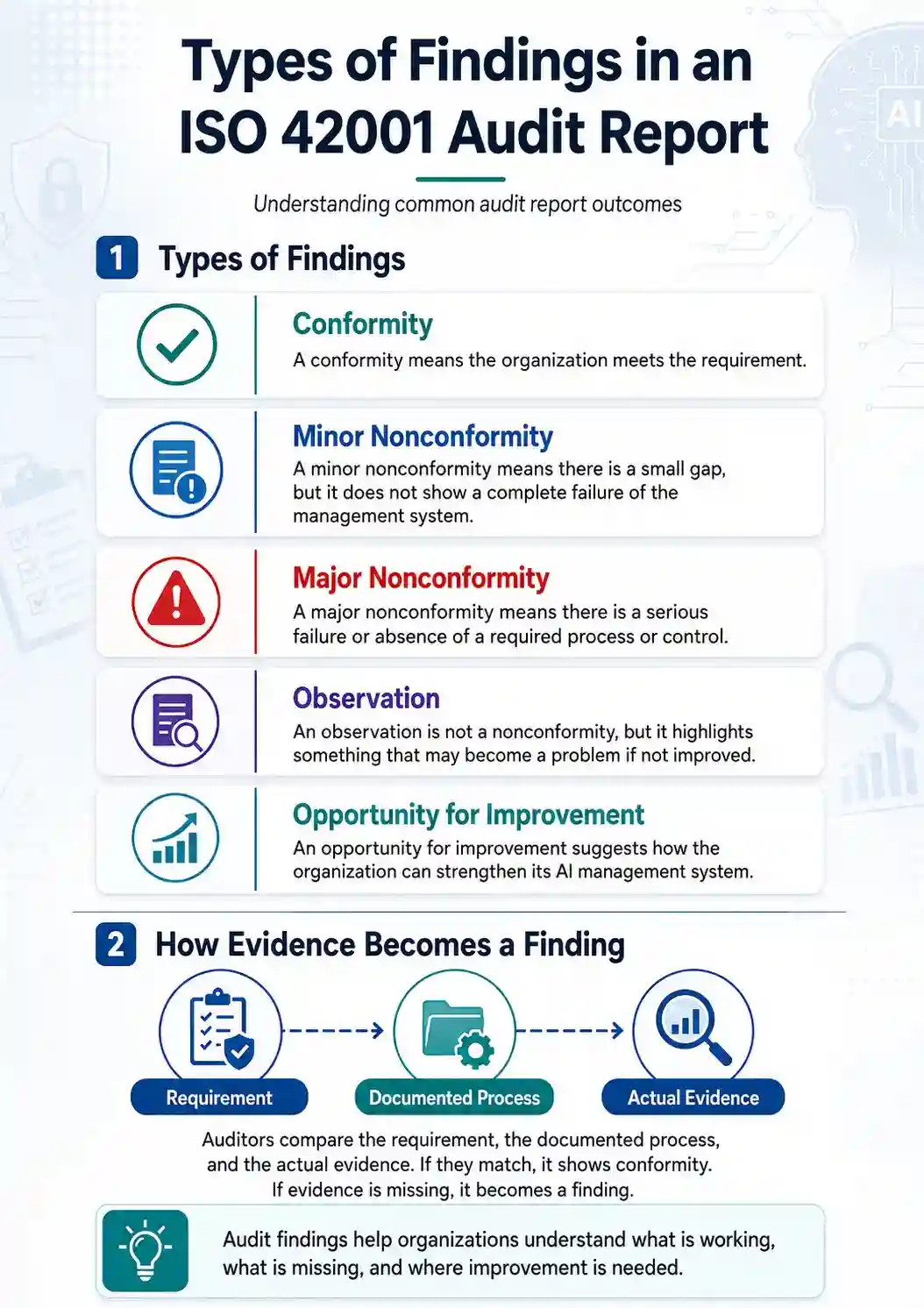
1. Conformity
A conformity means the organization meets the requirement.
For example, the organization may have a documented AI policy, approved by leadership, communicated to relevant employees, and reviewed periodically.
2. Minor Nonconformity
A minor nonconformity means there is a small gap, but it does not show a complete failure of the management system. For example, an AI risk assessment process exists, but one sampled record was incomplete.
3. Major Nonconformity
A major nonconformity means there is a serious failure or absence of a required process or control. For example, the organization uses high-risk AI systems but has no formal AI risk assessment process, no impact assessment method, and no evidence of management review.
4. Observation
An observation is not a nonconformity, but it highlights something that may become a problem if not improved. For example, evidence may be stored across multiple systems, making audit traceability difficult.
5. Opportunity for Improvement
An opportunity for improvement suggests how the organization can strengthen its AI management system. For example, the organization may improve by centralizing AI evidence, adding more measurable AI performance metrics, or improving documentation for human oversight.
6. How Evidence Becomes a Finding
One of the most important parts of audit reporting is turning evidence into meaningful findings. Auditors usually compare three things:
- The requirement
- The organization’s documented process
- The actual evidence of implementation
If all three align, the result is usually conformity. If the organization has a policy but no implementation evidence, it may become a nonconformity. If the process works but could be stronger, it may become an observation or opportunity for improvement.
For example:
Requirement: AI impact assessments should be performed for relevant AI systems.
Process: The organization’s AI procedure says impact assessments are required before deployment.
Evidence: One AI system was deployed without an updated impact assessment.
Finding: The organization cannot fully demonstrate that AI impact assessments are consistently performed before deployment.
This is how auditors move from documents to findings.
Stage 1 vs. Stage 2 ISO 42001 Audit Reporting
ISO 42001 audit reports may look different depending on the audit stage.
1. Stage 1 Audit Report
A Stage 1 audit usually focuses on readiness. The auditor checks whether the organization has designed the required management system elements. This may include:
- Defined AIMS scope
- AI policy
- AI governance structure
- Risk assessment methodology
- Impact assessment process
- Statement of Applicability
- Documented procedures
- Internal audit planning
- Management review readiness
The Stage 1 report often highlights whether the organization is ready for Stage 2
2. Stage 2 Audit Report
A Stage 2 audit focuses on implementation and effectiveness. The auditor checks whether the organization is actually following its AI governance processes. This may include:
- Implemented AI controls
- Completed risk assessments
- Operational monitoring
- Incident handling
- Training records
- Internal audit results
- Management review outputs
- Corrective action records
- AI lifecycle evidence
The Stage 2 report is usually more detailed because it evaluates whether the system works in practice.
Surveillance Audit Report
After certification, surveillance audits are conducted periodically to check whether the organization continues to maintain and improve its AIMS.
- A surveillance audit report may focus on:
- Changes in AI systems or use cases
- New risks or regulatory requirements
- Previous corrective actions
- Incidents and complaints
- Monitoring results
- Continual improvement activities
- Updated policies and records
This helps ensure that AI governance remains active and does not become a one-time certification exercise.
Good ISO 42001 Audit Report Writing Formula
A practical formula for writing each finding is:
Requirement → Observation → Evidence → Risk/Impact → Corrective Action
Example:
Requirement: The organization must assess AI-related risks before deployment.
Observation: One sampled AI model update was released without an updated impact assessment.
Evidence: Change records, deployment approval logs, and the impact assessment register were reviewed.
Risk/Impact: New stakeholder, privacy, fairness, or safety impacts may not have been properly evaluated.
Corrective Action: Update the change management process to trigger an impact assessment review for material AI system changes.
This formula keeps the report professional, consistent, and useful.
Conclusion
An ISO 42001 audit report helps organizations prove that AI governance is not just documented, but actively implemented, monitored, and improved. For professionals who want to understand how to build, audit, and improve an AI Management System, InfosecTrain’s ISO 42001 Lead Auditor Training provides practical knowledge of AIMS requirements, risk assessment, Annex A controls, audit readiness, and continual improvement. Enroll with InfosecTrain today and gain the skills to lead responsible AI governance with confidence.

TRAINING CALENDAR of Upcoming Batches For ISO 42001 Lead Auditor Training
| Start Date | End Date | Start - End Time | Batch Type | Training Mode | Batch Status | |
|---|---|---|---|---|---|---|
| 17-Oct-2026 | 29-Nov-2026 | 19:00 - 23:00 IST | Weekend | Online | [ Open ] | |
| 05-Dec-2026 | 10-Jan-2027 | 09:00 - 13:00 IST | Weekend | Online | [ Open ] | |
| 13-Feb-2027 | 14-Mar-2027 | 19:00 - 23:00 IST | Weekend | Online | [ Open ] |
Frequently Asked Questions
What is an ISO 42001 audit report?
It is the formal record of whether an organization’s AI Management System conforms to ISO/IEC 42001 and works effectively in practice. It documents the scope, criteria, evidence reviewed, findings, and required corrective actions.
What should be included in an ISO 42001 audit report?
The report should include the audit scope, objectives, criteria, methodology, sampled evidence, clause and control coverage, findings, and follow-up actions. Strong reports also include the Statement of Applicability, management summary, prior findings, and remediation tracking.
How are ISO 42001 findings classified?
Findings are commonly classified as conformities, minor nonconformities, major nonconformities, and observations or opportunities for improvement. The classification depends on the seriousness of the gap and whether it undermines the effectiveness of the AIMS.
What evidence do auditors review for ISO 42001?
Auditors typically review AI policies, risk registers, impact assessments, AI inventories, lifecycle documentation, monitoring logs, incident records, internal audit results, management review minutes, and corrective action records. They also cross-check whether these records are consistent with each other.
What is the difference between a Stage 1 and a Stage 2 ISO 42001 audit?
Stage 1 reviews readiness, documented information, scope, methodology, and governance design. Stage 2 tests whether policies, controls, and monitoring actually operate effectively across the in-scope AI environment.