Components of Privacy Risk Assessment
Quick Insights:
Privacy Risk Assessment under ISO/IEC 27701 helps organizations move from reactive compliance to proactive privacy management. It involves identifying where personal data resides, understanding how it flows, evaluating risks to individuals, and implementing controls to mitigate those risks. Key components include data mapping, risk identification, impact analysis, Privacy Impact Assessments (PIAs), and continuous monitoring. By embedding these practices into operations, organizations can strengthen governance, reduce compliance risks, and protect both business interests and individual privacy rights.
Imagine your organization has invested heavily in cybersecurity, implemented ISO 27001, and deployed advanced tools; yet a single customer privacy complaint triggers a regulatory investigation.
The issue? Not a breach. Not a hack.
But a failure to understand how personal data was being collected, used, and retained.
This is the reality many organizations face today. Privacy risks don’t just come from external threats; they often come from internal blind spots, limited data visibility, and the absence of structured assessments.
This is where Privacy Risk Assessment under ISO 27701 becomes a game-changer. It enables organizations to shift from reactive firefighting to proactive privacy governance by identifying risks before they lead to compliance failures.
What is Privacy Risk Assessment?
Privacy Risk Assessment (PRA) is the process of identifying, analyzing, and mitigating risks associated with the processing of Personally Identifiable Information (PII). It ensures that organizations proactively address threats to individuals’ privacy rights and freedoms.
It extends traditional information security risk assessment by focusing specifically on:
- Risks to individuals’ privacy rights
- Misuse or unauthorized access to personal data
- Non-compliance with privacy regulations
This approach ensures that organizations manage both security risks and privacy-specific risks in an integrated manner.
Key Components of Privacy Risk Assessment
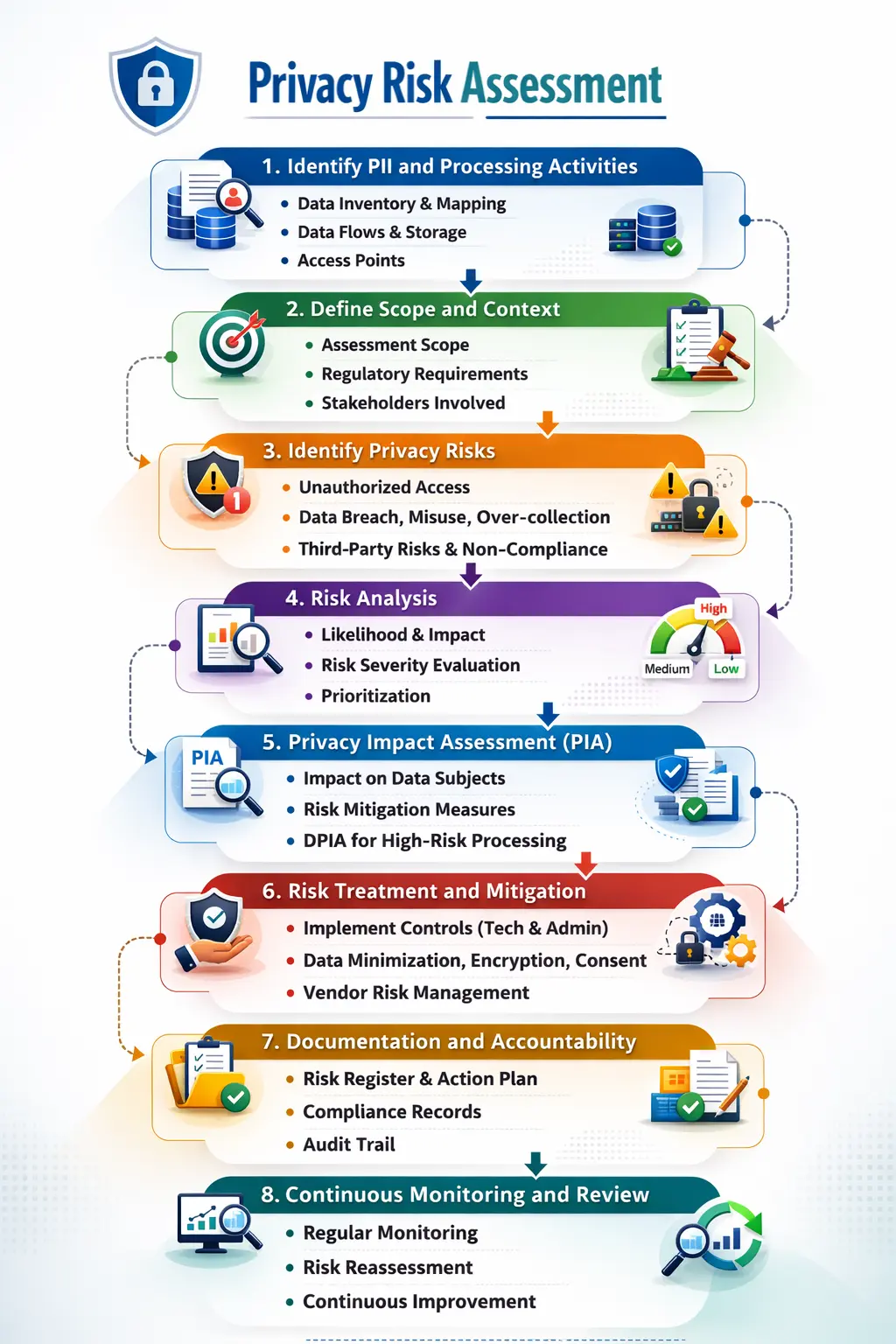
1. Identification of PII and Data Processing Activities
The first step in any privacy risk assessment is understanding:
- What personal data is being processed
- Where the data is stored
- How the data flows across systems
- Who has access to the data
This involves:
- Mapping all PII across systems
- Identifying data sources (customers, employees, third parties)
- Documenting data flows across the organization
- Understanding processing purposes
This is often referred to as data inventory and data mapping, which forms the foundation of your PIMS. Without knowing where your data resides, assessing risk is impossible.
2. Define Scope and Context
Before assessing risks, organizations must define:
- Scope of the assessment (systems, processes, departments)
- Applicable regulations (GDPR, DPDP, etc.)
- Stakeholders involved in data processing (DPO, IT, Legal, Compliance)
- Internal policies and business objectives
This ensures that the assessment is aligned with organizational objectives and regulatory requirements.
3. Identification of Privacy Risks
Once the scope is defined, the next step is identifying potential privacy risks.
Common privacy risks include:
- Unauthorized access to personal data
- Data breaches or leakage
- Excessive data collection (data minimization failure)
- Improper data sharing with third parties
- Lack of user consent or transparency
- Data retention beyond required periods
This step focuses on risks impacting individual rights and freedoms, not just systems.
4. Risk Analysis (Likelihood and Impact) & Evaluation
After identifying risks, organizations must analyze:
- Likelihood of occurrence
- Impact on individuals (financial, reputational, and legal harm)
- Severity of the risk
Risk evaluation helps prioritize which risks need immediate attention.
ISO 27701 emphasizes evaluating risks from the data subject’s perspective, which is a key differentiator from traditional risk assessments.
5. Privacy Impact Assessment (PIA)
A critical component of ISO 27701 risk assessment is conducting Privacy Impact Assessments (PIAs). These assessments help:
- Evaluate risks before implementing new processes
- Assess impact on data subjects
- Ensure privacy-by-design
- Ensure compliance before implementation
PIAs are mandatory for high-risk data processing scenarios under many regulations.
6. Risk Treatment and Mitigation
Once risks are evaluated, organizations must define and implement risk treatment strategies such as:
- Implementing privacy controls
- Enhancing security measures
- Updating policies and procedures
- Minimizing data collection (data minimization)
Examples of mitigation measures:
- Encryption and pseudonymization
- Access control mechanisms
- Data minimization practices
- Consent management systems
- Vendor risk management
7. Documentation and Accountability
One of the core principles of ISO 27701 is accountability. Organizations must:
- Document risk assessments
- Maintain Records of Processing Activities (RoPA)
- Keep evidence of decisions and controls implemented
The documentation is critical for:
- Regulatory audits
- Certification processes
- Demonstrating compliance
These ensure:
- Transparency
- Audit readiness
- Demonstration of compliance
If it is not documented, it did not happen; a key principle in ISO standards.
8. Continuous Monitoring and Review
Privacy risk assessment is an ongoing process that evolves with:
- New technologies (AI, cloud, IoT)
- Changing regulations
- Business process changes
Therefore, organizations must:
- Continuously monitor risks
- Update assessments based on changes
- Review controls regularly
Continuous improvement ensures that your privacy program remains resilient and adaptive.
You can also check out A practical roadmap to implement ISO 27701 effectively: ISO 27701 Implementation Guide: Step-by-Step.
Why is Privacy Risk Assessment Critical?
With the average cost of data breaches exceeding millions and regulatory penalties reaching up to 4% of global revenue, organizations cannot afford reactive approaches.
A well-implemented privacy risk assessment helps organizations:
- Prevent data breaches and privacy incidents
- Ensure compliance with global regulations
- Protect individuals’ rights and freedoms
- Build trust with customers and stakeholders
- Avoid financial penalties and reputational damage
More importantly, it shifts privacy from a compliance burden to a competitive advantage.
Common Challenges in Privacy Risk Assessment
Organizations often face challenges such as:
- Lack of visibility into data flows
- Complex regulatory requirements
- Third-party risk management
- Insufficient privacy expertise
In Conclusion
Privacy risk is no longer something organizations can afford to address after the fact; it needs to be understood and managed from the start. A structured Privacy Risk Assessment clarifies how personal data is handled, highlights potential gaps, and helps prioritize actions that actually reduce risk. Instead of reacting to incidents, organizations can take a more informed, proactive approach to protecting data and meeting regulatory expectations. For professionals, building this capability is key to creating privacy programs that are practical, resilient, and aligned with real-world challenges.
Build Your ISO 27701 Expertise with InfosecTrain
Looking to gain hands-on expertise in implementing ISO 27701?
To effectively implement Privacy Risk Assessment and PIMS, professionals need both conceptual clarity and practical experience.
InfosecTrain offers:
- ISO 27701:2025 Lead Implementer Certification Training
- ISO 27701:2025 Lead Auditor Certification Training
These programs are designed to help you:
- Master privacy risk assessment techniques
- Implement a robust PIMS framework
- Align with global privacy regulations
Enroll now and become a certified privacy leader in 2026!


Frequently Asked Questions
What is Privacy Risk Assessment?
It is the process of identifying, analyzing, and mitigating risks related to personal data processing.
How is it different from security risk assessment?
It focuses on risks to individuals’ privacy rights, not just system or data security.
What are the key components of a Privacy Risk Assessment?
Data mapping, risk identification, impact analysis, PIAs, risk treatment, and continuous monitoring.
What is a Privacy Impact Assessment (PIA)?
A process to evaluate privacy risks before implementing new systems or data processing activities.
Why is Privacy Risk Assessment important?
It helps prevent privacy incidents, ensures compliance, and protects both individuals and organizations.