What Is a Firewall? How It Works, Types, Advantages & Disadvantages
Quick Insights:
Firewalls serve as a critical first line of network defense by monitoring and filtering incoming and outgoing traffic against established security policies. While modern Next-Generation Firewalls (NGFWs) provide advanced features like deep packet inspection, encrypted traffic analysis, and application awareness, they cannot prevent all cyber threats on their own. To defend against phishing, insider threats, and unpatched vulnerabilities, firewalls must be integrated into a broader defense strategy alongside Zero Trust architecture, Multi-Factor Authentication (MFA), and endpoint protection solutions (EDR/XDR).
Growing reliance on digital platforms for everyday communication has elevated cybersecurity to a top strategic priority for modern organizations, business operations, financial transactions, and cloud services. This growing dependence on connected networks has also expanded the attack surface, leading to a rise in cyber threats such as ransomware, phishing, malware, unauthorized access, and data breaches. Deploying firewalls is essential for modern network security and data protection. Acting as a core defensive barrier, they analyze and regulate all network traffic based on specific security policies, keeping malicious activity at bay while allowing trusted traffic through.
What is a Firewall?
As a core network defense, a firewall evaluates and manages all incoming and outgoing traffic to enforce predetermined security policies, incoming and outgoing network traffic based on predefined security policies. Firewalls act as the first line of defense by blocking unauthorized access while allowing legitimate communications. Modern NGFWs enhance network defense through advanced capabilities such as deep packet inspection, application control, intrusion prevention, encrypted traffic inspection, and threat intelligence feeds. Although firewalls help reduce malware-related risks, they work best alongside endpoint security solutions such as antivirus, EDR, and XDR.
How Does a Firewall Work?
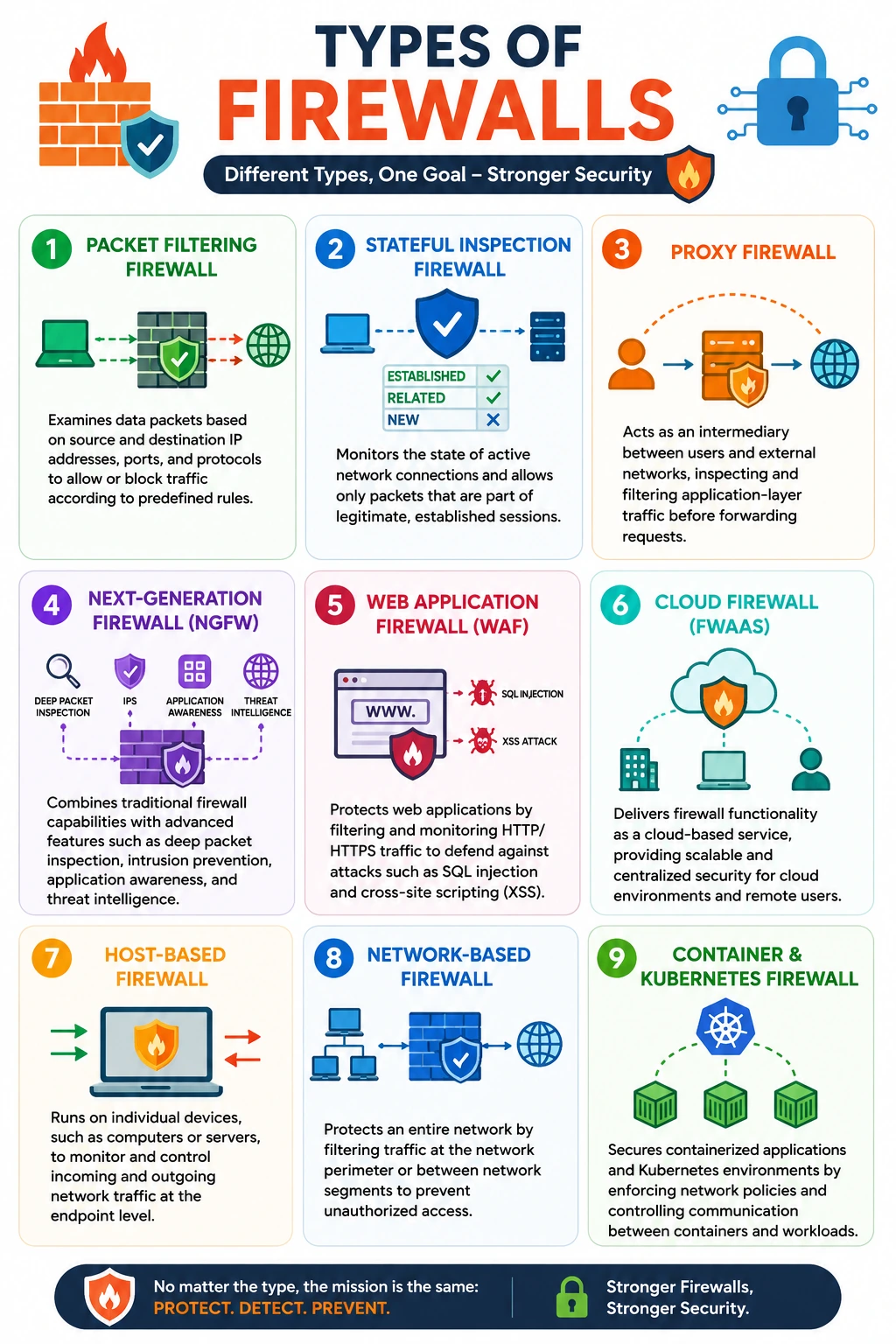
Modern firewalls inspect every network connection before allowing it to pass through the network. Instead of relying only on IP addresses and ports, they analyze users, applications, devices, URLs, encrypted traffic, behavioral patterns, and threat intelligence feeds. Many organizations also integrate firewalls with Zero Trust architectures to continuously verify every connection and reduce the risk of unauthorized access.
Types of Firewalls
Advantages of Firewall
In this era of the internet, firewalls are considered one of the most significant because of their different salient features. So here are some of the advantages of firewalls.
1. Monitor Network Traffic
A firewall’s primary duty is to monitor the network traffic. When information moves through a network, it occurs in small pieces called “packets.” The firewall examines each of these packets for any potential threats. If the firewall detects them, it will close them down instantly.
2. Protection Against Viruses
Firewalls primarily protect networks by controlling communication between trusted and untrusted systems. While modern NGFWs can identify and block many malicious downloads and command-and-control communications, dedicated antivirus and endpoint detection solutions remain essential for detecting and removing malware from infected devices.
3. Protection Against Malware
Trojans and other malicious software have become too sophisticated to be conveniently avoided. For this reason, setting up a firewall and taking other precautions against malware is essential.
4. Access Control
A firewall’s access policy can be implemented for particular hosts and services. The attackers exploit several hosts; therefore, preventing such hosts from accessing the system is preferable. This access policy can be enforced if users believe they need protection against these types of unwanted access.
5. Better Privacy
Modern firewalls improve privacy by blocking unauthorized connections, filtering malicious websites, inspecting encrypted traffic, and preventing unauthorized data transfers. Many enterprise firewalls also integrate with Data Loss Prevention (DLP) solutions to help protect sensitive information from accidental or intentional disclosure.
Disadvantages of Firewalls
Here are some of the disadvantages of firewalls
1. Cost
Most modern operating systems, including Windows 11, Linux distributions, and macOS, include built-in firewall capabilities. Enterprise organizations often invest in Next-Generation Firewalls, cloud-native firewalls, or Firewall as a Service (FWaaS), which provide advanced security features but require licensing, ongoing maintenance, and skilled administrators.
2. User Restrictions
Firewalls prevent unauthorized network access to your system without question. This can be advantageous for the average user but can be problematic for large organizations. The firewall’s policies must be stringent to prevent employees from performing specific tasks. However, this strictness can sometimes lead to a significant decline in the company’s overall productivity, potentially prompting employees to resort to backdoor exploits.
3. Performance
Modern firewall software is highly optimized and typically has minimal impact on system performance. However, enabling advanced security features such as SSL/TLS inspection, deep packet inspection, malware sandboxing, and intrusion prevention may increase resource utilization depending on network traffic volume.
4. Complex Operations
Even though firewall maintenance is simplified for small companies, this is only true for some organizations. Big businesses require a separate staff to operate their firewalls, and these individuals ensure that the firewall’s security is sufficient to protect the network from attackers.
5. Limited Protection Against Advanced Threats
Even advanced firewalls cannot prevent every cyber threat. They cannot stop phishing attacks that rely on human error, insider threats, credential theft, or vulnerabilities in unpatched systems. Organizations should combine firewalls with Zero Trust security, Multi-Factor Authentication (MFA), endpoint protection, Security Information and Event Management (SIEM), and continuous security monitoring.
Conclusion
Firewalls are a fundamental part of modern cybersecurity, helping organizations monitor network traffic, block unauthorized access, and reduce the risk of cyber threats. While they provide strong protection, they are most effective when combined with other security controls such as endpoint protection, MFA, and continuous monitoring. To build practical expertise in firewall technologies and network security, explore InfosecTrain’s Network Security Training Course. As a leading cybersecurity training provider, InfosecTrain offers expert-led certification programs and hands-on learning to help professionals develop in-demand cybersecurity skills.

Frequently Asked Questions
What is the primary function of a firewall in cybersecurity?
A firewall acts as a security barrier that monitors and controls network traffic, blocking unauthorized access and potential threats while allowing safe, legitimate communication to pass through.
Can a firewall protect against all types of cyberattacks?
No. While firewalls effectively block unauthorized network connections and malicious traffic, they cannot prevent threats that bypass network controls, such as social engineering, phishing attacks, credential theft, or malicious insider activity.
What is the difference between a traditional firewall and a Next-Generation Firewall (NGFW)?
Traditional firewalls inspect traffic based primarily on basic parameters like IP addresses and ports. NGFWs offer advanced capabilities, including deep packet inspection, application-level awareness, intrusion prevention systems (IPS), and threat intelligence integration.
Does a firewall replace the need for antivirus or Endpoint Detection and Response (EDR)?
No. Firewalls protect the network perimeter and traffic flow, while antivirus and EDR/XDR solutions safeguard individual endpoint devices (computers, servers) by detecting and removing malware that may already reside on or infect a system.
How do firewalls impact network and system performance?
Basic firewall operations have a negligible impact on system speed. However, enabling resource-intensive security features such as deep packet inspection, SSL/TLS decryption, and live malware sandboxing can increase resource usage during high traffic volumes.