Program Highlights
This isn’t a surface-level training, it’s an in-depth malware analysis journey built for professionals who want to go beyond detection and into dissection. Each module combines instructor-led sessions with guided lab practice to ensure you don’t just watch but actively analyze real malware samples.
You’ll explore static and dynamic analysis, dive deep into API and assembly patterns, and gain fluency in debugging and reverse engineering using industry-grade tools. With dedicated instructor mentorship, community support, and post-training career direction, you’ll walk out with the confidence to handle live threats and contribute to cybersecurity operations with precision.
 32-Hour LIVE Instructor-led Training
  Real-world Malware Samples
  Hands-on Session
  Covers multiple languages: native PE, .NET, Golang, shellcode
  Integrates Memory Forensics
  Certified Microsoft Experts
  Career Guidance & Mentorship
  Dedicated Telegram Support Group
  Access to Recorded Sessions
Training Schedule
- upcoming classes
- corporate training
- 1 on 1 training
Looking for a customized training?
REQUEST A BATCHWhy Choose Our Corporate Training Solution
- Upskill your team on the latest tech
- Highly customized solutions
- Free Training Needs Analysis
- Skill-specific training delivery
- Secure your organizations inside-out
Why Choose 1-on-1 Training
- Get personalized attention
- Customized content
- Learn at your dedicated hour
- Instant clarification of doubt
- Guaranteed to run


About Course
InfosecTrain’s Malware Analysis & Reverse Engineering Training is a hands-on program designed to transform cybersecurity professionals into expert malware analysts. Throughout the 32-hour live sessions, participants will learn how to deconstruct malicious code, identify Indicators of Compromise (IOCs), and reverse-engineer malware behavior to understand how threats operate in real-world networks.
From building an isolated malware lab to mastering disassemblers and memory forensics tools, the course blends theory, practical labs, and mentorship to prepare you for high-demand roles in SOC operations, incident response, and threat research.
Whether you’re a beginner or an experienced analyst aiming to enhance your skills, this training provides the clarity, structure, and practical experience to make you confident in analyzing and reporting malware incidents effectively.
Course Curriculum
- Module 1: Foundations & Static Analysis
- Introduce malware types, lifecycle, threat actor tactics, techniques, and procedures (TTPs)
- Explain static vs dynamic analysis and their applications
- Guide on building a secure, isolated malware analysis lab
- Review Windows internals relevant to malware behavior (processes, services, PE format, registry
locations) - Detail initial triage steps: identifying file hashes, metadata, strings, and suspicious imports
- Practical Exercises:
- Analyze a malware sample to extract static features
- Apply signature-based detections to the sample
- Create and test YARA rules against the filesystem and running processes
- Discuss dynamic analysis preparation and safe execution practices
- Module 2: Dynamic Analysis & Endpoint/Network Forensics
- Explain dynamic analysis workflow and tools (Process Monitor, Process Explorer)
- Practical Exercises:
- Execute malware in a controlled environment and monitor behavior
- Capture endpoint-level activity using EDR and logs
- Perform network traffic capture and analysis to identify malicious connections
- Demonstrate behavioral monitoring and sandbox analysis interpretation
- Analyze malicious documents (Excel, Word, PDF, RTF, CHM) and identify embedded threats
- Module 3: Reverse Engineering & API Analysis
- Present approach and methodology for reverse engineering binaries
- Introduce assembly basics (x86/x64) and instruction patterns
- Overview of reverse engineering tools (IDA, Ghidra, x64dbg, dnSpy) and their use cases
- Discuss Windows API functions commonly exploited by malware and sequences for malicious behavior
- Practical Exercises:
- Monitor and log API calls to identify malware functionality
- Analyze process iteration and malicious DLL loading
- Examine process injection techniques and understand impact
- Perform detailed code analysis on small binaries
- Module 4: Advanced Analysis, Memory Forensics & Reporting
- Explain shellcode analysis techniques and debugging methods
- Practical Exercises:
- Identify, dump, and debug shellcode in a safe environment
- Analyze .NET/C# malware using decompilers to trace logic
- Unpack and analyze Golang malware samples
- Acquire memory images and detect in-memory artifacts (shellcode, process hollowing)
- Analyze stealer malware and ransomware techniques
- Identify malware persistence mechanisms
- Compile a professional malware analysis report with IOCs, findings, and remediation
recommendations
Target Audience
This training is ideal for:
- SOC Analysts
- Incident Response Teams
- Threat Intelligence Analysts
- Malware Researchers and Reverse Engineers
- Security Engineers and Forensic Investigators
- Penetration Testers interested in binary analysis
Pre-requisites
- Working knowledge of Windows internals and command line
- Familiarity with networking fundamentals (TCP/IP, ports, common protocols)
- Basic scripting experience (Python, PowerShell)
- Prior exposure to endpoint tools and logs (e.g., EDR, Sysinternals) is advantageous
Course Objectives
Upon successful completion of the training, participants will be able to:
- Identify and triage suspicious binaries and documents.
- Extract IOCs (file hashes, strings, domains, IPs, mutexes, registry keys) and create actionable YARA rules.
- Perform dynamic sandbox analysis and interpret network/behavioral indicators.
- Reverse engineer functions using disassemblers and debuggers to uncover malicious logic.
- Detect advanced persistence and in-memory techniques such as process injection and shellcode execution.
- Prepare a clear, reproducible malware analysis report for stakeholders.


Vision

Goal

Skill-Building

Mentoring

Direction

Support

Success


It was a very good experience with the team. The class was clear and understandable, and it benefited me in learning all the concepts and gaining valuable knowledge.

I loved the overall training! Trainer is very knowledgeable, had clear understanding of all the topics covered. Loved the way he pays attention to details.

I had a great experience with the team. The training advisor was very supportive, and the trainer explained the concepts clearly and effectively. The program was well-structured and has definitely enhanced my skills in AI. Thank you for a wonderful learning experience.

The class was really good. The instructor gave us confidence and delivered the content in an impactful and easy-to-understand manner.

The program helped me understand several areas I was unfamiliar with. The instructor was exceptionally skilled and confident in delivering content.
The program was well-structured and easy to follow. The instructor’s use of real-life AI examples made it easier to connect with and understand the concepts.

Frequently Asked Questions
What is Malware Analysis and Reverse Engineering?
It’s the process of examining malicious software to understand its behavior, origin, and impact helping analysts detect, prevent, and remediate future attacks.
Who should take this course?
Ideal for SOC analysts, incident responders, malware researchers, threat hunters, and cybersecurity engineers aiming to specialize in malware behavior analysis.
What are the prerequisites?
Basic knowledge of Windows internals, networking, and scripting (Python or PowerShell) is recommended. Prior exposure to EDR or Sysinternals tools is helpful.
What skills will I gain?
You’ll learn static and dynamic analysis, YARA rule creation, reverse engineering, API tracing, shellcode debugging, and forensic memory acquisition.
Which tools are covered?
IDA, Ghidra, x64dbg, Wireshark, Volatility, YARA, dnSpy, PE-Studio, and more.
Will I receive a certificate?
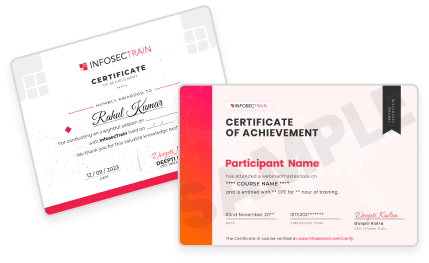
Yes, participants receive an official InfosecTrain certificate upon successful completion.
How does it help in my career?
It strengthens your profile for roles in malware research, SOC analysis, incident response, and digital forensics.
Is it available online?
Yes, it’s a live, instructor-led online program with global access and recorded sessions for later review.
What’s the course duration?
The total duration is 32 hours, spread across instructor-led live sessions and hands-on labs.
Can this training prepare me for malware analyst job roles?
Absolutely. The course focuses on real-world tools, lab analysis, and reporting skills required for malware analysis job interviews.
How is reverse engineering used to prevent cyber threats?
By understanding malware internals, analysts can detect persistence methods, develop signatures, and create proactive defense strategies.
Does InfosecTrain offer corporate or team training?
Yes, customized corporate training with dedicated mentorship, progress tracking, and team-based lab environments is available.