 AI Powered Course
AWS Certified AI Practitioner Training
Master the Essentials of AI and Machine Learning with AWS

Program Highlights
The AWS Certified AI Practitioner Training from InfosecTrain equips learners with foundational AI, ML, and generative AI knowledge, along with hands-on experience using AWS services. It prepares participants to pass the AIF-C01 exam and build practical, secure, and responsible AI solutions in real-world environments.
 16-Hour of Instructor-led Training
  Learn from Industry Experts
  Hands-On Labs & Practical Exercises
  Highly Interactive and Dynamic Sessions
  Interactive Case Studies
  Flexible Learning Schedule
  Career Guidance and Mentorship
  Extended Post Training Support
  Access to Recorded Sessions
Training Schedule
- upcoming classes
- corporate training
- 1 on 1 training
Looking for a customized training?
REQUEST A BATCHWhy Choose Our Corporate Training Solution
- Upskill your team on the latest tech
- Highly customized solutions
- Free Training Needs Analysis
- Skill-specific training delivery
- Secure your organizations inside-out
Why Choose 1-on-1 Training
- Get personalized attention
- Customized content
- Learn at your dedicated hour
- Instant clarification of doubt
- Guaranteed to run


About Course
The AWS Certified AI Practitioner Training Course from InfosecTrain offers a comprehensive entry point into the world of Artificial Intelligence (AI) and Machine Learning (ML) using AWS technologies. It covers essential concepts in AI, generative AI, and foundation models, while emphasizing responsible development, security, and compliance.
Participants will gain hands-on skills in prompt engineering, model evaluation, and deploying AI applications on AWS infrastructure. No prior experience with AI/ML is required, making this course ideal for both professionals and enthusiasts. With hands-on insights and exam-focused content, this course prepares learners to confidently attempt the AWS Certified AI Practitioner (AIF-C01) exam and apply their knowledge to solve business problems using AI-driven solutions.
Course Curriculum
- Domain 1: Fundamentals of AI and ML (20%)
- 1.1: Explain basic AI concepts and terminologies
- Define basic AI terms (e.g., AI, ML, deep learning, neural networks, computer vision, Natural Language Processing (NLP), model, algorithm, training and inferencing, bias, fairness, fit, Large Language Model (LLM)).
- Describe the similarities and differences between AI, ML, and deep learning.
- Describe various types of inferencing (e.g., batch, real-time).
- Describe the different types of data in AI models (e.g., labeled and unlabeled, tabular, time-series, image, text, structured, and unstructured).
- Describe supervised learning, unsupervised learning, and reinforcement learning.
- 1.2: Identify practical use cases for AI
- Recognize applications where AI/ML can provide value (e.g., assist human decision making, solution scalability, automation).
- Determine when AI/ML solutions are not appropriate (e.g., cost-benefit analysis, situations when a specific outcome is needed instead of a prediction).
- Select the appropriate ML techniques for specific use cases (e.g., regression, classification, clustering).
- Identify examples of real-world AI applications (e.g., computer vision, NLP, speech recognition, recommendation systems, fraud detection, forecasting).
- Explain the capabilities of AWS managed AI/ML services (e.g., SageMaker, Amazon Transcribe, Amazon Translate, Amazon Comprehend, Amazon Lex, Amazon Polly).
- 1.3: Describe the ML development lifecycle
- Describe components of an ML pipeline (e.g., data collection, Exploratory Data Analysis (EDA), data pre-processing, feature engineering, model training, hyperparameter tuning, evaluation, deployment, monitoring).
- Understand sources of ML models (e.g., open source pre-trained models, training custom models).
- Describe methods to use a model in production (e.g., managed API service, self-hosted API).
- Identify relevant AWS services and features for each stage of an ML pipeline (e.g., SageMaker, Amazon SageMaker Data Wrangler, Amazon SageMaker Feature Store, Amazon SageMaker Model Monitor).
- Understand fundamental concepts of ML Operations (MLOps) (e.g., experimentation, repeatable processes, scalable systems, managing technical debt, achieving production readiness, model monitoring, model re-training).
- Understand model performance metrics (e.g., accuracy, Area Under the ROC Curve (AUC), F1 score) and business metrics (e.g., cost per user, development costs, customer feedback, Return on Investment (ROI)) to evaluate ML models.
- 1.1: Explain basic AI concepts and terminologies
- Domain 2: Fundamentals of Generative AI (24%)
- 2.1: Explain the basic concepts of generative AI
- Understand foundational generative AI concepts (e.g., tokens, chunking, embeddings, vectors, prompt engineering, transformer-based LLMs, foundation models, multi-modal models, diffusion models).
- Identify potential use cases for generative AI models (e.g., image, video, and audio generation; summarization; chatbots; translation; code generation; customer service agents; search; recommendation engines).
- Describe the foundation model lifecycle (e.g., data selection, model selection, pre-training, fine-tuning, evaluation, deployment, feedback).
- 2.2: Understand the capabilities and limitations of generative AI for solving business problems
- Describe the advantages of generative AI (e.g., adaptability, responsiveness, and simplicity).
- Identify disadvantages of generative AI solutions (e.g., hallucinations, interpretability, inaccuracy, and nondeterminism).
- Understand various factors to select appropriate generative AI models (e.g., model types, performance requirements, capabilities, constraints, and compliance).
- Determine business value and metrics for generative AI applications (e.g., cross-domain performance, efficiency, conversion rate, average revenue per user, accuracy, and customer lifetime value).
- 2.3: Describe AWS infrastructure and technologies for building generative AI applications
- Identify AWS services and features to develop generative AI applications (e.g., Amazon SageMaker JumpStart, Amazon Bedrock, PartyRock, an Amazon Bedrock Playground, and Amazon Q).
- Describe the advantages of using AWS generative AI services to build applications (e.g., accessibility, lower barrier to entry, efficiency, cost-effectiveness, speed to market, and ability to meet business objectives).
- Understand the benefits of AWS infrastructure for generative AI applications (e.g., security, compliance, responsibility, and safety).
- Understand cost tradeoffs of AWS generative AI services (e.g., responsiveness, availability, redundancy, performance, regional coverage, token-based pricing, provision throughput, and custom models).
- 2.1: Explain the basic concepts of generative AI
- Domain 3: Applications of Foundation Models (28%)
- 3.1: Describe design considerations for applications that use foundation models
- Identify selection criteria to choose pre-trained models (e.g., cost, modality, latency, multi-lingual, model size, model complexity, customization, input/output length).
- Understand the effect of inference parameters on model responses (e.g., temperature, input/output length).
- Define Retrieval Augmented Generation (RAG) and describe its business applications (e.g., Amazon Bedrock, knowledge base).
- Identify AWS services that help store embeddings within vector databases (e.g., Amazon OpenSearch Service, Amazon Aurora, Amazon Neptune, Amazon DocumentDB (with MongoDB compatibility), Amazon RDS for PostgreSQL).
- Explain the cost tradeoffs of various approaches to foundation model customization (e.g., pre-training, fine-tuning, in-context learning, and RAG).
- Understand the role of agents in multi-step tasks (e.g., Agents for Amazon Bedrock).
- 3.2: Choose effective prompt engineering techniques
- Describe the concepts and constructs of prompt engineering (e.g., context, instruction, negative prompts, model latent space).
- Understand techniques for prompt engineering (e.g. chain-of-thought, zero-shot, single-shot, few-shot, and prompt templates).
- Understand the benefits and best practices for prompt engineering (e.g., response quality improvement, experimentation, guardrails, discovery, specificity and concision, using multiple comments).
- Define potential risks and limitations of prompt engineering (e.g., exposure, poisoning, hijacking, and jailbreaking).
- 3.3: Describe the training and fine-tuning process for foundation models
- Describe the key elements of training a foundation model (e.g., pre-training, fine-tuning, continuous pre-training).
- Define methods for fine-tuning a foundation model (e.g., instruction tuning, adapting models for specific domains, transfer learning, continuous pre-training).
- Describe how to prepare data to fine-tune a foundation model (e.g., data curation, governance, size, labeling, representativeness, Reinforcement Learning from Human Feedback (RLHF)).
- 3.4: Describe methods to evaluate foundation model performance
- Understand approaches to evaluate foundation model performance (e.g., human evaluation, benchmark datasets).
- Identify relevant metrics to assess foundation model performance (e.g., Recall-Oriented Understudy for Gisting Evaluation (ROUGE), Bilingual Evaluation Understudy (BLEU), BERTScore).
- Determine whether a foundation model effectively meets business objectives (e.g., productivity, user engagement, task engineering).
- 3.1: Describe design considerations for applications that use foundation models
- Domain 4: Guidelines for Responsible AI (14%)
- 4.1: Explain the development of AI systems that are responsible
- Identify features of responsible AI (e.g., bias, fairness, inclusivity, robustness, safety, and veracity).
- Understand how to use tools to identify features of responsible AI (e.g., Guardrails for Amazon Bedrock).
- Understand responsible practices to select a model (e.g., environmental considerations and sustainability).
- Identify legal risks of working with generative AI (e.g., intellectual property infringement claims, biased model outputs, loss of customer trust, end-user risk, and hallucinations).
- Identify characteristics of datasets (e.g., inclusivity, diversity, curated data sources, and balanced datasets).
- Understand effects of bias and variance (e.g., effects on demographic groups, inaccuracy, overfitting, and underfitting).
- Describe tools to detect and monitor bias, trustworthiness, and truthfulness (e.g., analyzing label quality, human audits, subgroup analysis, Amazon SageMaker Clarify, SageMaker Model Monitor, and Amazon Augmented AI (Amazon A2I)).
- 4.2: Recognize the importance of transparent and explainable models
- Understand the differences between models that are transparent and explainable and models that are not transparent and explainable.
- Understand the tools to identify transparent and explainable models (e.g., Amazon SageMaker Model Cards, open source models, data, and licensing).
- Identify tradeoffs between model safety and transparency (e.g., measure interpretability and performance).
- Understand principles of human-centered design for explainable AI.
- 4.1: Explain the development of AI systems that are responsible
- Domain 5: Security, Compliance, and Governance for AI Solutions (14%)
- 5.1: Explain methods to secure AI systems
- Identify AWS services and features to secure AI systems (e.g., IAM roles, policies, and permissions; encryption; Amazon Macie; AWS PrivateLink; and AWS shared responsibility model).
- Understand the concept of source citation and documenting data origins (e.g., data lineage, data cataloging, and SageMaker Model Cards).
- Describe best practices for secure data engineering (e.g., assessing data quality, implementing privacy-enhancing technologies, data access control, and data integrity).
- Understand security and privacy considerations for AI systems (e.g., application security, threat detection, vulnerability management, infrastructure protection, prompt injection, and encryption at rest and in transit).
- 5.2: Recognize governance and compliance regulations for AI systems
- Identify regulatory compliance standards for AI systems (e.g.,International Organization for Standardization (ISO), System and Organization Controls (SOC), and algorithm accountability laws).
- Identify AWS services and features to assist with governance and regulation compliance (e.g., AWS Config, Amazon Inspector, AWS Audit Manager, AWS Artifact, AWS CloudTrail, and AWS Trusted Advisor).
- Describe data governance strategies (e.g., data lifecycles, logging, residency, monitoring, observation, and retention).
- Describe processes to follow governance protocols (e.g., policies, review cadence, review strategies, governance frameworks such as the Generative AI Security Scoping Matrix, transparency standards, and team training requirements).
- 5.1: Explain methods to secure AI systems
Target Audience
- Software Developers
- Cloud Engineers
- Cloud Practitioners
- Data Analysts
- Business Analysts
- Data Scientists
- Marketing Professionals
- Project and Product Managers
- IT Leaders & Decision Makers
- Students & AI Enthusiasts
Pre-requisites
- There are no strict prerequisites. However, a basic understanding of cloud computing and AWS fundamentals is helpful. Familiarity with statistics and data concepts is beneficial but not required. The course is designed for beginners with no prior AI/ML experience.
Exam Details
| Exam Name | AWS Certified AI Practitioner (AIF-C01) |
| Exam Duration | 90 Minutes |
| Number of Questions | 65 |
| Exam Format | Multiple-choice, multiple-response, ordering, matching, and case studies |
| Passing Score | 700 out of 1000 |
| Language | English, Korean, Japanese, Portuguese(Brazil), Chinese |
| Testing Options | Pearson VUE testing center or Online proctored exam |
Course Objectives
- Understand and articulate fundamental AI and Machine Learning (ML) concepts, terms, and methodologies.
- Understand the stages of the ML development lifecycle from data preparation to model deployment.
- Understand the key concepts of generative AI, including how it differs from traditional AI approaches.
- Assess the capabilities, limitations, and appropriate business applications of generative AI.
- Learn how to use AWS infrastructure and tools to build and deploy generative AI solutions.
- Apply best practices in designing applications powered by foundation models, including prompt engineering and model evaluation.
- Recognize the principles and practices for developing responsible, transparent, and explainable AI systems.
- Understand the security, governance, and compliance frameworks necessary for deploying AI solutions responsibly and safely.


Vision

Goal

Skill-Building

Mentoring

Direction

Support

Success

Demand Surge According to NetApp’s 2025 “AI Space Race” report, 81% of global organizations are now piloting or scaling AI initiatives.
AI Adoption AI is now used in at least one business function by 78% of companies.
Leaders Report an AI Literacy Gap According to DataCamp’s 2025 report, most executives cite a significant skills shortfall in AI understanding.
Workforce Properly Trained Just one-third of employees feel ready to use AI tools effectively, revealing missed opportunities and urgent training needs.

Education

Healthcare

Retail

Government

Manufacturing

Finance



It was a very good experience with the team. The class was clear and understandable, and it benefited me in learning all the concepts and gaining valuable knowledge.

I loved the overall training! Trainer is very knowledgeable, had clear understanding of all the topics covered. Loved the way he pays attention to details.

I had a great experience with the team. The training advisor was very supportive, and the trainer explained the concepts clearly and effectively. The program was well-structured and has definitely enhanced my skills in AI. Thank you for a wonderful learning experience.

The class was really good. The instructor gave us confidence and delivered the content in an impactful and easy-to-understand manner.

The program helped me understand several areas I was unfamiliar with. The instructor was exceptionally skilled and confident in delivering content.
The program was well-structured and easy to follow. The instructor’s use of real-life AI examples made it easier to connect with and understand the concepts.

Frequently Asked Questions
What is the AWS Certified AI Practitioner Training?
The AWS Certified AI Practitioner validates foundational knowledge of artificial intelligence (AI), machine learning (ML), and generative AI, along with how these technologies are applied using AWS services.
Who should enroll in the AWS Certified AI Practitioner Training Course?
This course is well-suited for professionals and enthusiasts seeking to establish a foundational knowledge of AI and machine learning using AWS. Recommended participants include:
- Software Developers
- Cloud Engineers and Practitioners
- Data Analysts and Data Scientists
- Business Analysts and Marketing Professionals
- Project/Product Managers
- IT Leaders and Decision Makers
- Students and AI Enthusiasts
Are there any prerequisites for the AWS Certified AI Practitioner Online Training?
There are no strict prerequisites. However, a basic understanding of cloud computing and AWS fundamentals is helpful. Familiarity with statistics and data concepts is beneficial but not required. The course is designed for beginners with no prior experience in AI/ML.
What subjects are included in the AWS Certified AI Practitioner Training Course?
The training covers five main domains:
- Fundamentals of AI and ML: Key concepts, use cases, and ML lifecycle
- Fundamentals of Generative AI: Core principles, strengths/limitations, and AWS tools
- Applications of Foundation Models: Design, prompt engineering, training, evaluation
- Responsible AI: Ethics, transparency, and responsible development
- Security, Compliance, Governance: Securing AI systems and ensuring regulatory compliance
Does the AWS Certified AI Practitioner Training prepare me for the exam?
Yes. This training is designed to fully prepare you for the AWS Certified AI Practitioner (AIF-C01) exam. It covers all five domains outlined in the exam guide.
Is hands-on lab work included in the AWS Certified AI Practitioner Course?
Yes. The course features hands-on labs where you can apply theoretical concepts in real-world scenarios using AWS technologies. You will work with AI tools, generative models, and prompt engineering techniques to solidify your understanding through practical experience.
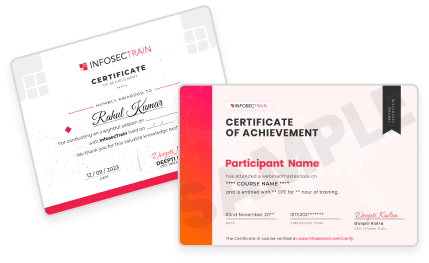
Will I receive a certificate upon completing the AWS Certified AI Practitioner Training?
Yes. Upon successful completion of the training course, InfosecTrain provides a course completion certificate.
Is the AWS Certified AI Practitioner Training instructor-led or self-paced?
InfosecTrain offers both instructor-led and self-paced options. You can choose live interactive sessions with expert trainers or learn at your own pace with recorded content and guided labs, depending on your learning preference and schedule.
What job roles can I pursue after completing the AWS Certified AI Practitioner Training?
This certificate opens doors to multiple AI and cloud-related roles, such as:
- AI/ML Developer
- Cloud Engineer
- Data Analyst
- AI Product Manager
- Business Analyst
- Marketing Analyst
- IT Decision-Maker
Why choose InfosecTrain for AWS Certified AI Practitioner Training?
InfosecTrain offers expert instructors, hands-on labs, real-world case studies, and flexible learning options.