Top Cloud Platforms in 2026: Complete Guide to Leading Cloud Providers
Quick Insights:
AWS remains the leading cloud platform for organizations seeking a broad service portfolio, global infrastructure, and support for diverse workloads. Microsoft Azure is particularly suitable for Microsoft-based enterprises and hybrid-cloud environments, while Google Cloud stands out for AI, data analytics, Kubernetes, and cloud-native development. Platforms such as OCI, IBM Cloud, Alibaba Cloud, DigitalOcean, VMware Cloud Foundation, and Salesforce address specialized needs, including enterprise databases, regulated workloads, regional operations, startup infrastructure, private cloud, and CRM automation. Ultimately, the right platform depends on workload requirements, security, compliance, existing technologies, available skills, scalability, and total cost.
With the rapid evolution of the digital landscape, cloud computing has become a game-changer, revolutionizing how businesses operate and interact with technology. Cloud platforms have become the backbone of modern IT infrastructure, providing businesses with unparalleled scalability, flexibility, and cost-efficiency. Enterprise spending on cloud infrastructure services worldwide reached approximately $129 billion in the first quarter of 2026, increasing by 35% compared with the same period in 2025. AWS continued to lead with a 28% market share, followed by Microsoft Azure at 21% and Google Cloud at 14%. Together, the three providers accounted for more than 60% of the worldwide cloud infrastructure market.

In this dynamic and competitive environment, a few cloud platforms have consistently stood out, capturing the attention of businesses worldwide. These platforms offer diverse services, from computing and storage to networking, databases, and analytics. Their impressive capability to meet the needs of diverse businesses, from small startups to multinational enterprises, has propelled them to the forefront of the cloud computing industry.
This guide compares the top cloud platforms that deserve close attention. Let us delve into the top cloud platforms.
Best Cloud Computing Platforms
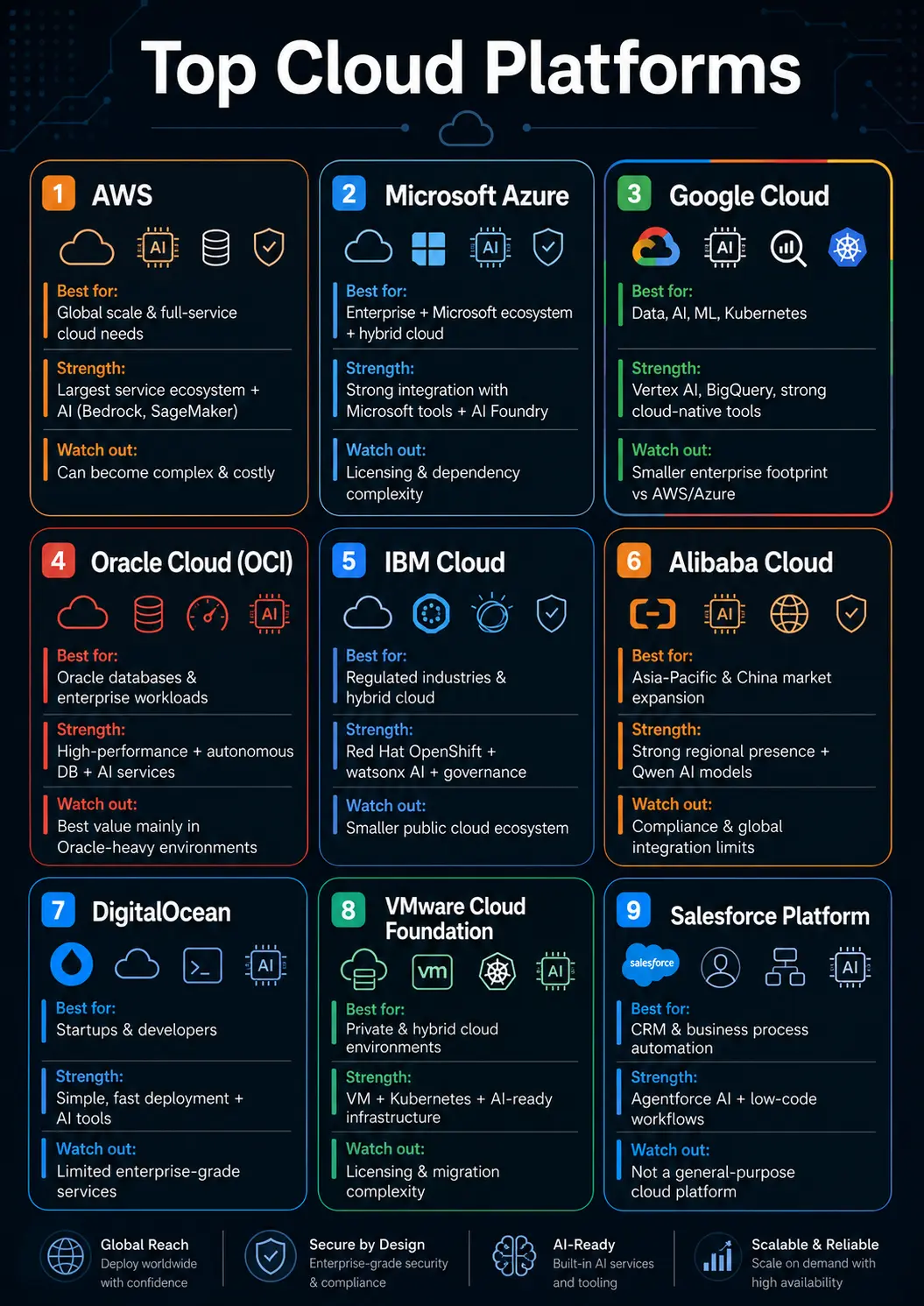
1. Amazon Web Services (AWS)
Amazon Web Services remains the largest cloud infrastructure provider. Its broad portfolio covers computing, storage, databases, networking, analytics, cybersecurity, serverless computing, Internet of Things, machine learning, and generative AI. AWS is particularly valuable for organizations that need a large global infrastructure footprint or want access to numerous managed services within one ecosystem.
For AI development, AWS offers services such as Amazon Bedrock for building generative AI applications, Amazon SageMaker AI for model development and deployment, and Amazon Nova foundation models.
Key Features:
- Broad portfolio of infrastructure and managed cloud services
- Extensive global regions and availability zones
- Amazon S3 for scalable object storage
- AWS Lambda for serverless application development
- Amazon EKS for managed Kubernetes
- Amazon Bedrock and SageMaker AI for AI workloads
- Mature security, identity, monitoring, and compliance services
2. Microsoft Azure
Microsoft Azure has been steadily gaining ground, providing a cloud platform with a strong focus on hybrid solutions. Azure’s seamless integration with Microsoft’s on-premises products, such as Windows Server and Office 365, makes it a popular choice for enterprises with Microsoft environments. With a huge global network of data centers, it ensures low-latency connectivity worldwide. Its close integration with Microsoft’s ecosystem enables seamless transitions and robust support for diverse applications, making Azure a preferred choice for enterprises seeking reliable, scalable, and innovative cloud solutions.
Key Features:
- Strong integration with the Microsoft ecosystem
- Advanced hybrid and multicloud capabilities
- Microsoft Foundry for AI applications and agents
- Azure Arc for distributed infrastructure management
- Microsoft Sentinel and Defender for Cloud
- Managed databases, Kubernetes, DevOps, and analytics
- Enterprise identity integration through Microsoft Entra
3. Google Cloud Platform (GCP)
Google Cloud Platform (GCP) has emerged as a formidable player in cloud computing, renowned for its innovative technologies and focus on open-source solutions. It is Google’s suite of cloud computing services, encompassing various tools for computing, storage, databases, machine learning, and more. With its widespread reach and innovative edge computing initiatives, it has become a preferred option for businesses, from startups to large enterprises. Moreover, its scalability, reliability, and cost-efficiency further enhance its attractiveness as a versatile solution.
Key Features:
- Vertex AI and Gemini for generative AI development
- BigQuery for large-scale data analytics
- Google Kubernetes Engine for container orchestration
- Strong open-source and cloud-native ecosystem
- Data engineering and machine learning services
- Global networking and application development tools
- Security and governance capabilities for enterprise AI
4. IBM Cloud
IBM Cloud focuses on enterprise hybrid cloud, regulated workloads, data governance, artificial intelligence, and application modernization. Its connection with Red Hat technologies makes it suitable for organizations that want to run applications consistently across public cloud, private cloud, and on-premises environments. IBM’s watsonx portfolio provides tools for AI development, data management, governance, and model operations.
Key Features:
- Hybrid-cloud architecture and application portability
- Red Hat OpenShift integration
- Watsonx AI and data services
- Enterprise AI governance capabilities
- Solutions for regulated industries
- Mainframe and legacy system integration
- Automation and infrastructure management tools
5. Oracle Cloud Infrastructure (OCI)
Oracle Cloud Infrastructure (OCI) is a comprehensive cloud platform focusing on enterprise-grade solutions, database administration, and high-performance computing. OCI provides robust services, such as bare metal instances, virtual machines, and container solutions, which offer scalability. It seamlessly integrates with Oracle’s on-premises products, including Oracle Fusion Cloud Applications and Oracle Database. Its unique offerings encompass Artificial Intelligence/Machine Learning capabilities, edge computing, and integrated cloud-native tools, catering to diverse business needs.
Key Features:
- Strong integration with Oracle databases and applications
- Bare-metal and high-performance computing options
- Autonomous database capabilities
- OCI Generative AI and dedicated AI clusters
- Enterprise networking and storage
- Support for containerized and cloud-native applications
- Hybrid and multicloud connectivity options
6. VMware Cloud Foundation
VMware Cloud Foundation is positioned as a modern private-cloud platform for operating virtual machines, containers, Kubernetes, networking, storage, and security through a unified environment.
Broadcom introduced VMware Cloud Foundation 9.1 in 2026 with additional capabilities for production AI, Kubernetes-native private cloud, integrated security, and mixed computing infrastructure across AMD, Intel, and NVIDIA technologies.
Key Features:
- Private-cloud infrastructure
- Unified support for virtual machines and containers
- Built-in Kubernetes capabilities
- Integrated networking, storage, and security
- Support for production AI infrastructure
- Consistent operations across data centers and cloud environments
- Familiar environment for existing VMware customers
7. DigitalOcean
DigitalOcean is a developer-focused cloud platform known for simplifying infrastructure deployment. It is commonly used by startups, independent developers, software-as-a-service companies, and small to medium-sized businesses.
Its services include virtual machines, managed Kubernetes, databases, storage, serverless application deployment, and developer tools. DigitalOcean has also repositioned itself as an AI-native cloud, offering services for inference, AI agents, knowledge bases, vector search, and retrieval-augmented generation.
Key Features:
- Simple cloud management experience
- Developer-friendly documentation and tools
- Virtual machines and managed Kubernetes
- Managed databases and scalable storage
- Application deployment platform
- AI agents, inference, and RAG capabilities
- Accessible environment for smaller engineering teams
8. Salesforce
Salesforce Cloud Platform is a powerful suite of cloud-based services renowned for its Customer Relationship Management (CRM) solutions. Businesses exploring AI CRM software can also compare different CRM platforms based on their features, pricing, and business requirements. It encompasses various cloud offerings, including Sales Cloud, Service Cloud, Marketing Cloud, and more, enabling businesses to build, connect, and deploy custom applications and integrations. With AI-powered insights and seamless app integration capabilities including Salesforce VoIP integration, this platform facilitates automation, enhances productivity, and fosters innovation, making it a preferred choice for companies seeking efficient and tailored CRM solutions.
Key Features:
- Cloud-based CRM applications
- Agentforce AI agent platform
- Low-code workflow and application development
- Customer data integration
- Sales, service, marketing, and commerce solutions
- MuleSoft integration and automation
- Enterprise application security and governance
9. Alibaba Cloud
Alibaba Cloud is an important platform for businesses operating in China and the wider Asia-Pacific market. It offers computing, storage, databases, networking, security, analytics, containers, and artificial intelligence services.
In 2026, Alibaba Cloud expanded its international agentic AI ecosystem with new Qwen models, AI infrastructure upgrades, AI-native platforms, and agent-development products.
Key Features
- Strong cloud presence in China and Asia-Pacific markets
- Elastic computing and storage services
- Qwen foundation models
- AI agent and model-development platforms
- Data analytics and database services
- Services for e-commerce and large internet applications
- Regional cloud security and networking capabilities

How to Choose the Best Cloud Platform
- Evaluate Your Workload: Match the platform to your use case: AWS for broad services, Azure for Microsoft ecosystems, Google Cloud for data/AI, and OCI for Oracle workloads.
- Check Security & Compliance: Assess identity, encryption, logging, threat detection, certifications, and data residency under the shared responsibility model.
- Compare AI Capabilities: Review models, GPUs, customization, AI tools, vector search, guardrails, monitoring, regional availability, and AI costs.
- Calculate Total Cost: Include compute, storage, networking, data transfer, managed services, security, support, and migration—not just VM pricing.
- Assess Skills & Ecosystem: Choose platforms your team can support. Consider talent availability, documentation, training, partners, and community.
- Plan for Vendor Lock-In: Prefer portable architectures using containers, Kubernetes, open APIs, IaC, and modular designs to reduce dependency risks.
AWS vs. Azure vs. Google Cloud: Which Is Better in 2026?
There is no universal winner.
Choose AWS when you need the broadest cloud-service ecosystem, extensive infrastructure options, and strong support for diverse workloads.
Choose Azure when your organization relies heavily on Microsoft technologies or requires extensive hybrid-cloud integration.
Choose Google Cloud when data analytics, machine learning, Kubernetes, and AI application development are strategic priorities.
Large organizations may use two or more providers, but multicloud should solve a clear business, resilience, regulatory, or technical requirement. Using multiple platforms without standardized governance can increase costs, skills requirements, security gaps, and operational complexity.
Conclusion
Nowadays, the cloud market is driven by AI, sovereign cloud, Kubernetes, hybrid architectures, and cost optimization pressures. AWS leads overall infrastructure, Azure excels in Microsoft-centric and hybrid environments, and Google Cloud is strongest in data and AI workloads. OCI, IBM Cloud, Alibaba Cloud, DigitalOcean, VMware Cloud Foundation, and Salesforce serve more specialized needs.
The best cloud platform is not the most popular one, but the one that best fits workload requirements, security, compliance, skills, and cost efficiency while minimizing unnecessary complexity.
Master in Cloud Security with InfosecTrain
Choosing a cloud platform is only the first step. Organizations also need professionals who understand how to configure, secure, monitor, and govern cloud environments.
InfosecTrain offers instructor-led training in cloud computing, cloud security, cybersecurity, AI security, governance, and related certification areas. The training helps beginners and working professionals understand cloud architecture, identity, networking, security controls, compliance, risk management, and practical cloud-protection strategies.
Whether you are beginning your cloud journey or preparing for an advanced cloud-security role, structured training and hands-on practice can help you build the skills needed to work confidently across modern cloud environments.

TRAINING CALENDAR of Upcoming Batches For CCSP Training
| Start Date | End Date | Start - End Time | Batch Type | Training Mode | Batch Status | |
|---|---|---|---|---|---|---|
| 14-Nov-2026 | 10-Jan-2027 | 19:00 - 23:00 IST | Weekend | Online | [ Open ] | |
| 23-Jan-2027 | 07-Mar-2027 | 19:00 - 23:00 IST | Weekend | Online | [ Open ] | |
| 13-Mar-2027 | 02-May-2027 | 09:00 - 13:00 IST | Weekend | Online | [ Open ] |
Frequently Asked Questions
Which is the largest cloud platform in 2026?
AWS remained the largest cloud infrastructure provider in Q1 2026 with ~28% market share, followed by Microsoft Azure (~21%) and Google Cloud (~14%).
What is the best cloud platform for AI?
AWS, Azure, and Google Cloud all lead in AI. AWS offers Bedrock and SageMaker, Azure provides Microsoft Foundry and enterprise integration, and Google Cloud delivers Vertex AI and Gemini. The best choice depends on data, skills, cost, and use case.
Which cloud platform is best for startups?
AWS, Azure, Google Cloud, and DigitalOcean are all suitable. DigitalOcean is best for simplicity, while hyperscalers are better for scaling and advanced services.
Which cloud platform is best for hybrid cloud?
Microsoft Azure, IBM Cloud, and VMware Cloud Foundation are leading hybrid options. Selection depends on existing infrastructure, security needs, and application landscape.
Is multicloud better than using one provider?
Multicloud improves flexibility, resilience, and service access but increases complexity, cost, and operational overhead. It should be used only when there is a clear business need.