Why Choose AI Security Architecture Training with Infosectrain?
Quick Insights:
InfosecTrain's AI Security Architecture Training is a 16-hour, live instructor-led course that focuses on the security challenges of using AI in business applications. It covers LLM security, RAG attacks, AI agents, threat modeling, and risk management. The course also includes hands-on labs, so participants can see where AI systems may be vulnerable and how to secure them. It's mainly aimed at Security Architects, Security Engineers, Cloud Architects, and GRC Professionals who already work in cybersecurity and want to understand the risks that come with AI.
AI is now becoming a regular part of how businesses operate. Companies use it to handle customer queries, automate routine tasks, and make better use of their data. But when AI tools have access to sensitive information, databases, and other business systems, security becomes a serious concern. A poorly secured AI application could expose confidential data, follow malicious instructions, or allow attackers to misuse connected tools.
This makes AI security a little different from traditional cybersecurity. It’s not enough to secure individual applications or networks. Security teams also need to look at how AI models, data sources, APIs, and other components work together, where things could go wrong, and what controls can prevent attacks.
That’s what InfosecTrain’s AI Security Architecture Training aims to address. The course combines instructor-led learning with hands-on labs to help cybersecurity professionals understand AI-related threats, spot weaknesses in system design, and learn practical ways to secure AI applications.
What Is the AI Security Architecture Course at InfosecTrain?
InfosecTrain’s AI Security Architecture Training is a 16-hour, live instructor-led program for professionals who want to strengthen their understanding of securing AI-enabled environments.
The course looks at how AI systems work, what makes them different from traditional applications, and where security risks can arise. It covers everything from Large Language Models (LLMs) and AI agents to RAG systems, AI infrastructure, and third-party services. Learners also get hands-on experience identifying security gaps and understanding how to address them.
What You Will Learn
The AI Security Architecture Course covers several important areas:
- AI Fundamentals: Get familiar with how Large Language Models (LLMs), AI infrastructure, and MLOps work, and how they fit into an AI system.
- AI Governance and Risk Management: Learn how to assess AI-related risks, address compliance requirements, and maintain the documentation needed for audits.
- AI Threat Modeling: Understand how to examine an AI system, identify its critical assets, and find possible entry points attackers could use.
- AI Attack Surfaces: Look at security risks in LLM applications, RAG systems, AI agents, memory, context, MCP, and agent-to-agent communication.
- Defense-in-Depth: Learn why relying on a single security control isn’t enough and how different layers of protection can work together.
- AI Agent Security: Explore how AI agents interact with tools, handle data, and use memory. You’ll also learn where these interactions can create security gaps.
- Third-Party Security Risks: Understand how external APIs, services, and third-party components can affect the security of an AI application.
How Does the AI Security Architecture Course Benefit Professionals?
Here are some of the main benefits of AI Security Architecture Training.
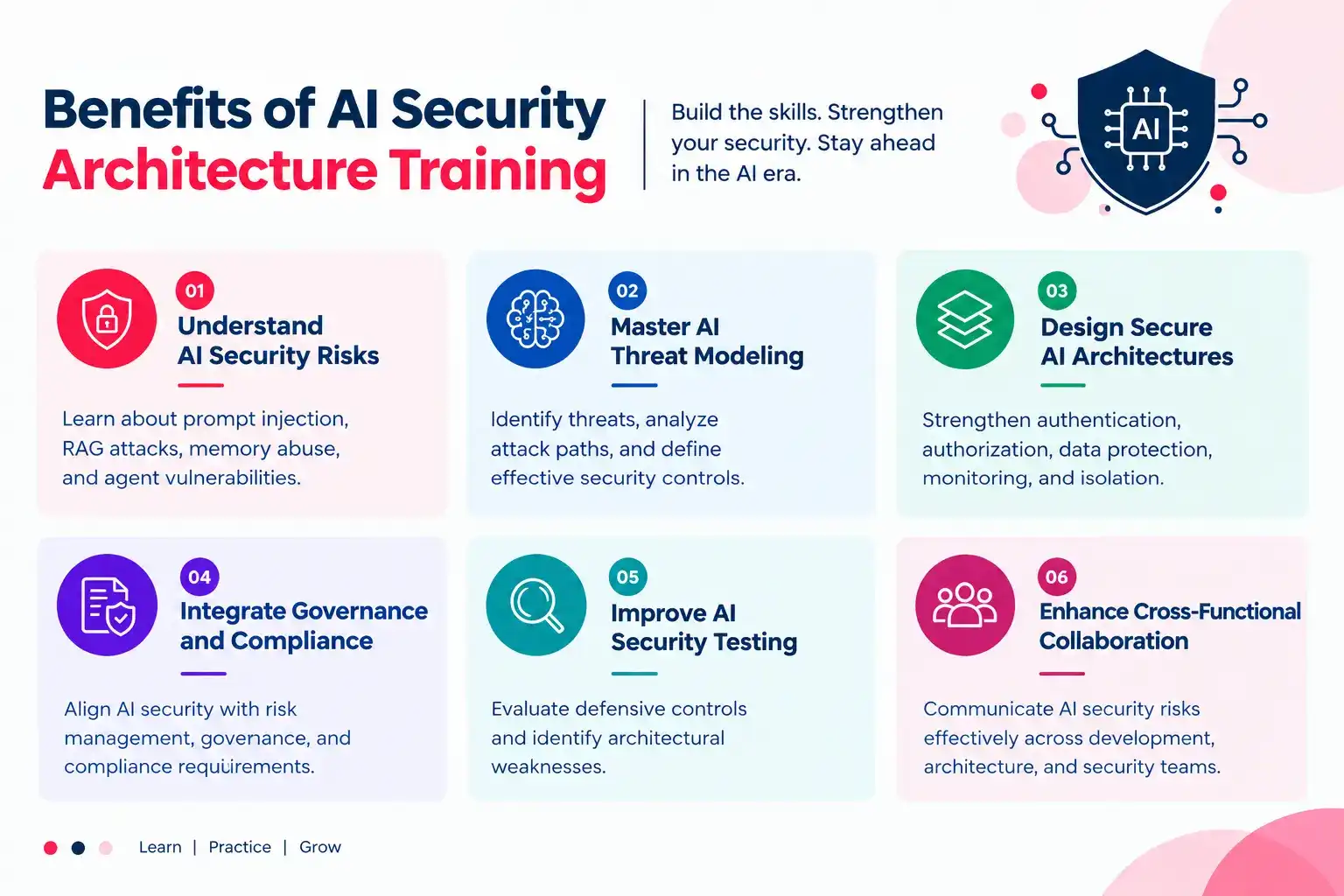
How Does the AI Security Architecture Course Benefit You in Your Career?
As companies adopt AI, they need cybersecurity professionals who can identify risks and secure AI systems by design. The AI Security Architecture Training builds on your existing skills and teaches you to identify AI-specific threats, apply recognized frameworks, and recommend practical security controls. These skills can help you lead AI security projects at work or move into specialized roles such as:
- AI Security Architect
- AI Security Engineer
- AI Red Team Engineer / Specialist
- AI Governance, Risk and Compliance Specialist
Why Choose the AI Security Architecture Course with InfosecTrain?
If you’re already working in cybersecurity and want to understand how to secure AI systems, InfosecTrain’s AI Security Architecture Training can help you build on your existing knowledge. The course covers current AI security challenges through live classes, practical labs, and discussions based on real-world scenarios.
Here are some reasons to consider this training.
1. 16-Hour Live Instructor-Led Training
InfosecTrain offers 16 hours of live instructor-led training, so you can learn directly from a trainer rather than going through pre-recorded lessons on your own. You can ask questions, discuss security scenarios, and get help understanding topics that might be difficult to grasp through self-study.
2. Learn from Experienced Cybersecurity Professionals
When it comes to AI security, knowing about a threat is only part of the job. You also need to understand how it could affect a system and what can be done to prevent it. InfosecTrain’s experienced trainers help explain these situations using practical examples, making it easier to connect what you learn with the security challenges you may face at work.
3. Practical and Hands-On Learning
Learning about AI security is one thing, but putting that knowledge to use is just as important. The training includes hands-on labs where you can work through practical scenarios, identify security gaps, and understand how different controls help protect AI systems. This gives you a better idea of how to handle similar security challenges in your day-to-day work.
4. Learn to Secure Modern AI Systems
AI applications today do much more than answer questions. They can retrieve information from company databases, interact with external tools, and perform tasks with limited human involvement. Each of these capabilities brings security concerns.
The course covers topics such as:
- LLM platforms and AI infrastructure
- RAG architectures
- AI agents
- MCP and A2A architectures
- Security risks involving third-party APIs and services
- Security testing and defense-in-depth
You will get a better understanding of how these systems work, where attackers might find weaknesses, and what can be done to secure them.
5. Access to Recorded Sessions
Some topics take more than one explanation to fully understand. With recorded sessions, you can go back to important lessons, review tricky concepts, and catch up on anything you missed. It’s especially helpful when you’re balancing training with a busy work schedule.
6. Post-Training Support
Learning doesn’t stop when the course ends. If you have questions later or need help understanding a topic, InfosecTrain’s post-training support gives you an opportunity to reach out for guidance and clear up your doubts.
7. Telegram Group Support
InfosecTrain also offers Telegram group support that gives learners a place to stay connected, ask queries, and discuss course-related topics with fellow participants. It is a convenient way to share knowledge, exchange valuable ideas, and stay connected with the learning community even after the training sessions end.
8. Build Skills That Support Your Career
As more businesses introduce AI into their systems, cybersecurity teams are being asked to assess risks they may not have dealt with before. Understanding AI threat modeling, LLM vulnerabilities, RAG security, and secure architecture design can help you handle these responsibilities.
The course gives you knowledge you can use in your current role or build on if you’re considering a move into AI security.
9. Understand AI Governance, Risk, and Compliance
Keeping AI systems secure isn’t just about identifying vulnerabilities. Businesses also need to understand the risks involved, decide who is responsible for managing them, and meet applicable security and compliance requirements.
The training covers AI governance, risk assessments, compliance considerations, and audit requirements, helping you understand how security decisions fit into an organization’s wider risk management approach.
10. Earn 16 CPE Credits
The course offers 16 Continuing Professional Education (CPE) credits, which may help you meet the ongoing learning requirements of certain cybersecurity certifications. Whether these credits count toward your certification depends on the rules of the issuing body.
11. Build on Your Existing Cybersecurity Experience
You don’t need to start learning cybersecurity from scratch to understand AI security. If you already work with security controls, access management, application security, or risk assessments, you’ll have a useful foundation for this course.
InfosecTrain’s training is aimed at professionals such as Security Architects, Security Engineers, Cloud Architects, and GRC Professionals who want to understand how their existing skills apply to AI systems.
InfosecTrain AI Security Architecture vs. Other Training Options
| Comparison Factor | InfosecTrain | Other Training Providers |
| Training Format | 16 hours of live, instructor-led training | Training formats and durations vary by provider |
| Practical Labs | Hands-on labs for applying AI security concepts | Practical lab availability and depth vary by course |
| Study Materials | Study materials to support learning and revision | Learning materials and their level of detail vary by provider |
| Learning Management System (LMS) | Provides a self-paced and instructor-led LMS platform, offering flexible learning options to suit different schedules and learning preferences | Learning platforms, delivery formats, and self-paced learning options vary by provider |
| Video Lectures | Recorded video content for review and revision | Recorded lecture availability varies by training format |
| Downloadable Resources | Downloadable resources for continued learning and reference | Downloadable resources vary by course |
| LLM Security | Coverage of LLM vulnerabilities, attack surfaces, and defensive techniques | LLM security coverage depends on the curriculum |
| RAG Security | Focus on RAG attack paths, memory, context abuse, and security risks | RAG security coverage varies across training programs |
| Agentic AI Security | Coverage of agent architectures, vulnerabilities, and secure design patterns | Agentic AI security topics depend on the course syllabus |
| Instructor Interaction | Live instructor-led sessions with opportunities to engage during training | Instructor interaction depends on the delivery format |
| Post-Training Support | Learning support to reinforce course concepts | Support options and duration vary by provider |
| Career Guidance | Guidance to connect AI security skills with professional goals | Career support offerings vary by provider |
| Learning Experience | A combination of live instruction, hands-on practice, and supporting resources | Learning experience depends on the training format and included resources |
| Career Relevance | Focus on skills relevant to AI security architecture and related cybersecurity roles | Role alignment depends on the curriculum and practical learning opportunities |
In Conclusion
Artificial intelligence is expanding the scope of enterprise cybersecurity. As companies use more AI tools, keeping them secure is becoming an important part of cybersecurity. From LLM applications and RAG systems to AI agents, each comes with its own security risks. Cybersecurity professionals need to know where these risks exist and how to address them.
If you want to improve your AI security skills, explore InfosecTrain‘s AI Security Architecture Training course curriculum, check upcoming batches, and see how the training fits your career goals.

TRAINING CALENDAR of Upcoming Batches For
| Start Date | End Date | Start - End Time | Batch Type | Training Mode | Batch Status | |
|---|---|---|---|---|---|---|
| 12-Dec-2026 | 20-Dec-2026 | 10:00 - 14:00 IST | Weekend | Online | [ Open ] |
Frequently Asked Questions
What is AI Security Architecture Training?
AI Security Architecture Training teaches professionals how to analyze, design, and protect AI-enabled systems. It covers AI-specific attack surfaces, threat modeling, secure design patterns, defensive controls, governance, and risk management.
How long is InfosecTrain's AI Security Architecture Course?
InfosecTrain's AI Security Architecture Training is a 16-hour live instructor-led program. Check the official course page for the current schedule and delivery details.
Who should enroll in the AI Security Architecture Course?
The course is intended for professionals such as Security Architects, Security Engineers, Cloud Architects, and GRC Professionals who want to develop AI security architecture skills.
Do I need prior AI or machine learning experience?
You don't need to be an AI expert, but a basic understanding of cybersecurity, security controls, and common vulnerabilities is recommended.
What will I learn in InfosecTrain's AI Security Architecture Training?
You'll learn about AI threat modeling, LLM security, RAG attacks, agentic AI risks, secure system design, governance, and security testing.
Will I get hands-on practice during the course?
Yes, the course includes practical labs where you can work through AI security scenarios and understand how to deal with potential threats.
How is AI security architecture different from AI security?
AI security is about keeping AI systems safe from threats. AI security architecture focuses on designing those systems in a way that reduces security risks from the start.
Does the course cover LLM and agentic AI security?
Yes, you'll learn about LLM vulnerabilities, AI agent risks, RAG security, memory and context attacks, and ways to secure AI agent workflows.
How can AI Security Architecture Training help my career?
The training can help you develop skills relevant to AI security engineering, security architecture, cloud security, application security, and AI risk assessment. Career outcomes depend on your existing experience, practical ability, and the requirements of individual employers.
Are recorded sessions and post-training support included?
Yes, InfosecTrain provides access to recorded training sessions for revision, along with post-training support to help learners clarify doubts, revisit key concepts, and reinforce their understanding of AI security architecture.