How InfosecTrain’s Advanced Threat Hunting and DFIR course is Different from Others?
Cyber threats are evolving at lightning speed, and cybersecurity professionals must constantly sharpen their skills to keep pace. When it comes to mastering Threat Hunting, Digital Forensics and Incident Response (DFIR), a training course that blends real-world application with cutting-edge techniques is essential. Simply put, not all courses prepare practitioners to handle the complex challenges faced in today’s digital battlefield.
InfoSecTrain’s Advanced Threat Hunting and Digital Forensics & Incident Response Training breaks away from the typical mold. It offers an immersive, hands-on experience tailored to empower security teams to detect, analyze, and respond to advanced cyber threats effectively. Let’s explore what makes this course truly stand out and why it should be the next step for cybersecurity professionals aiming to elevate their expertise.
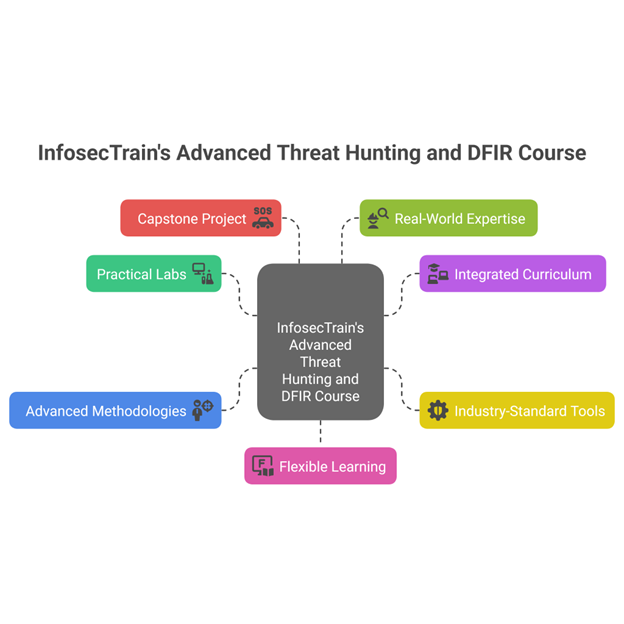
1. Practical, Hands-On Labs That Mirror Real-World Challenges
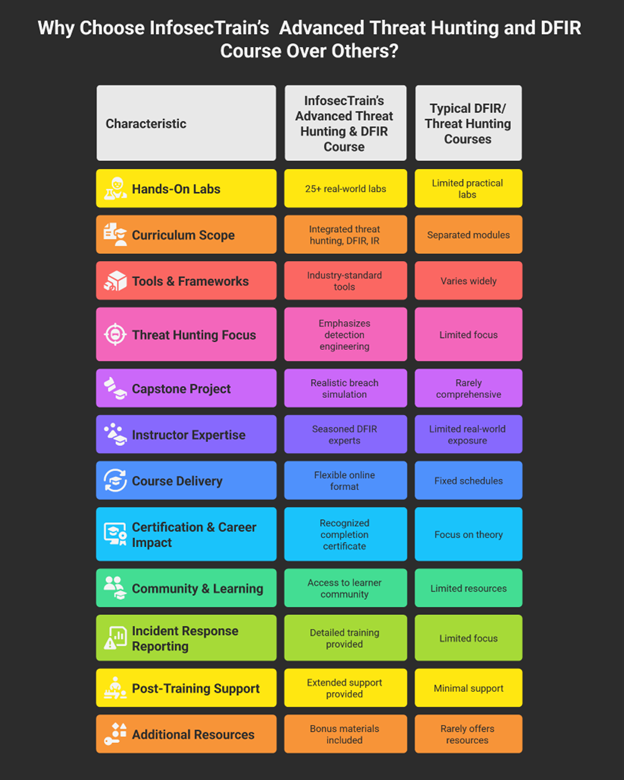
Many cybersecurity courses rely heavily on theory and lecture-style teaching, which often leaves participants unprepared for practical scenarios. This course flips that model by emphasizing more than 25 hands-on labs designed around real cyberattack simulations. Whether it is analyzing live malware samples, performing memory forensics with Volatility, or dissecting network traffic using Wireshark, participants engage directly with the tools and data they will encounter on the job. This practical approach is crucial. It transforms knowledge into skills, allowing participants to confidently investigate threats, conduct forensic analysis, and perform incident response with accuracy. Actionable learning like this is what truly separates practical training from mere information overload.
2. Integrated Curriculum Covering Threat Hunting, Forensics, and Incident Response
Too often, training programs treat threat hunting, digital forensics, and incident response as isolated topics. However, cyber incidents do not occur in isolation. They require a comprehensive understanding of attacker behavior, forensic data analysis, and timely response strategies.
This course offers a holistic learning path, weaving together the full DFIR lifecycle. It introduces frameworks like MITRE ATT&CK to understand adversary tactics and progresses through data collection, threat detection, and incident management. This well-rounded approach helps participants not only identify threats but also know exactly how to handle them, something every security professional requires in today’s fast-changing world.
3. Mastery of Industry-Standard Tools and Open Frameworks
The technology stack covered here reflects what leading organizations rely on worldwide. From Volatility for Memory Analysis and YARA for Malware Identification to MISP and STIX/TAXII standards for Threat Intelligence Sharing, the course focuses on open, proven tools that stand the test of time.
This means participants gain experience with platforms and frameworks widely adopted in enterprise environments, making their skills immediately relevant and job-ready. Rather than vendor-locked or outdated software, the course teaches universal techniques that are scalable across various industries.
4. Real-World Expertise Delivered by Seasoned Professionals
The best training comes from those who have “been there, done that.” InfoSecTrain’s instructors are seasoned DFIR practitioners with extensive frontline experience. This means lessons are packed with real case studies, practical tips, and industry insights that can not be found in textbooks.
This mentorship approach ensures complex concepts become accessible and meaningful, helping participants grasp not just the “how” but the “why” behind each technique. It is like having a veteran guide through the complexities of cyber investigations and threat hunting.
5. Advanced Threat Hunting Methodologies and Detection Engineering
Threat hunting is not about waiting for alerts. It is about proactively searching for stealthy adversaries hiding inside networks. This course demystifies the process by training participants in detection engineering, including custom rule creation, anomaly analysis, and mapping adversary behavior using MITRE ATT&CK.
This focus on proactive defense prepares security teams to catch threats earlier and reduce dwell time, a key factor in minimizing damage. Courses lacking this emphasis often leave participants reactive instead of strategic, missing a critical piece of the modern cybersecurity puzzle.
6. Capstone Project Simulating End-to-End Incident Response
Theory and labs are essential, but nothing beats working through a full incident from start to finish. This course’s capstone project puts participants in the driver’s seat of an advanced breach scenario. They investigate, hunt, analyze forensic evidence, and produce both technical and executive incident reports.
This immersive experience builds confidence and proficiency in incident handling workflows, bridging the gap between classroom knowledge and operational reality.
7. Flexible Learning Format with Ongoing Support
Designed with busy professionals in mind, the course offers a flexible online format to fit varying schedules. Alongside the training, participants receive dedicated support and access to resources and community forums, ensuring they never navigate their learning journey alone. This continuous engagement improves retention and motivation, which are crucial for mastering complex cybersecurity skills.
Advanced Threat Hunting and DFIR Training with InfosecTrain
The cybersecurity field demands more than theoretical knowledge; it requires practical skills, strategic thinking, and mastery of real-world tools and technologies. The Advanced Threat Hunting and DFIR course by InfoSecTrain embodies all these qualities. It prepares professionals not only to respond to incidents but also to proactively and effectively hunt down threats.

For anyone serious about advancing in DFIR and threat hunting, this course offers a unique blend of depth, practicality, and expert guidance that few others can match. Elevate your career and enhance your organization’s security posture with training tailored to today’s dynamic cyber environment.
TRAINING CALENDAR of Upcoming Batches For Advanced Threat Hunting Digital Forensics & Incident Response (DFIR) Training
| Start Date | End Date | Start - End Time | Batch Type | Training Mode | Batch Status | |
|---|---|---|---|---|---|---|
| 03-Oct-2026 | 01-Nov-2026 | 19:00 - 23:00 IST | Weekend | Online | [ Open ] |