ISO 27001 Stage 1 vs. Stage 2 Audit: What Businesses Need to Prepare
Quick Insights:
ISO 27001 certification happens in two stages, and each asks a different question. Stage 1 is a readiness check: the certification body reviews your ISMS scope, security policy, risk assessment, risk treatment plan, Statement of Applicability, and internal audit and management review records to confirm the system is properly designed. Stage 2 is the proof-of-practice audit: auditors interview employees, sample records, and examine logs, access reviews, and incident handling to confirm your controls work in daily operations. Completing either stage does not award a certificate. Any minor or major nonconformities must be corrected, and the certification body makes the final decision. To prepare, define a clear scope, keep documentation current, maintain evidence for every control, run internal audits, and close gaps before the external auditors arrive.
Your organization has spent months developing security policies, assessing risks, and implementing controls. The team thinks that everything is ready for ISO 27001 certification. Then the auditor generates a simple question: “Can you show me evidence that this security process is actually being followed?”
Suddenly, you notice that a policy document does not look quite enough. This is where many businesses find the difference between preparing for an ISO 27001 audit and being genuinely ready for one. Achieving ISO 27001 certification requires more than documenting security practices. Organizations must validate that their Information Security Management System (ISMS) is properly designed, implemented, monitored, and continuously improved. That’s why the ISO 27001 certification audit is divided into two important stages: Stage 1 and Stage 2.
Stage 1 focuses on your ISMS documentation and checks whether you’re ready for the next audit. Stage 2 looks at how your security processes work in practice and whether your company follows them. Knowing what to expect at each stage gives your team time to prepare, fix any gaps, and avoid delays in getting certified.
In this article, we’ll explain the differences between ISO 27001 Stage 1 and Stage 2 audits.
What Is an ISO 27001 Audit?
An ISO 27001 audit is a structured analysis of an organization’s ISMS against the requirements of ISO/IEC 27001. The purpose is to determine whether the organization has established an effective approach to protecting information through risk management, security controls, clearly defined responsibilities, and ongoing improvement.
ISO/IEC 27001 standard covers management system requirements in Clauses 4 through 10 and includes 93 reference controls in Annex A.
An audit examines areas such as:
- Information security policies and objectives
- Identification and treatment of security risks
- Access control and identity management
- Incident management and business continuity
- Employee security awareness
- Internal audits and management reviews
- Performance monitoring and corrective actions
For initial certification, an independent certification body conducts the assessment in two stages.
STAGE 1: Are you ready?
Evaluates ISMS documentation, scope, planning, and preparedness.
STAGE 2: Does it work?
Verifies implementation, operational evidence, and effectiveness.
Both stages are required for initial accredited ISO 27001 certification.
What Is an ISO 27001 Stage 1 Audit?
The ISO 27001 Stage 1 audit is the initial readiness assessment performed by the certification body. Its main objective is to understand whether the organization’s ISMS has been sufficiently established and whether the organization is prepared to proceed to Stage 2. At this stage, auditors primarily review documented information, discuss the ISMS with relevant personnel, evaluate site-specific conditions, and assess how well the organization understands ISO 27001 requirements.
What Do Auditors Check During Stage 1?
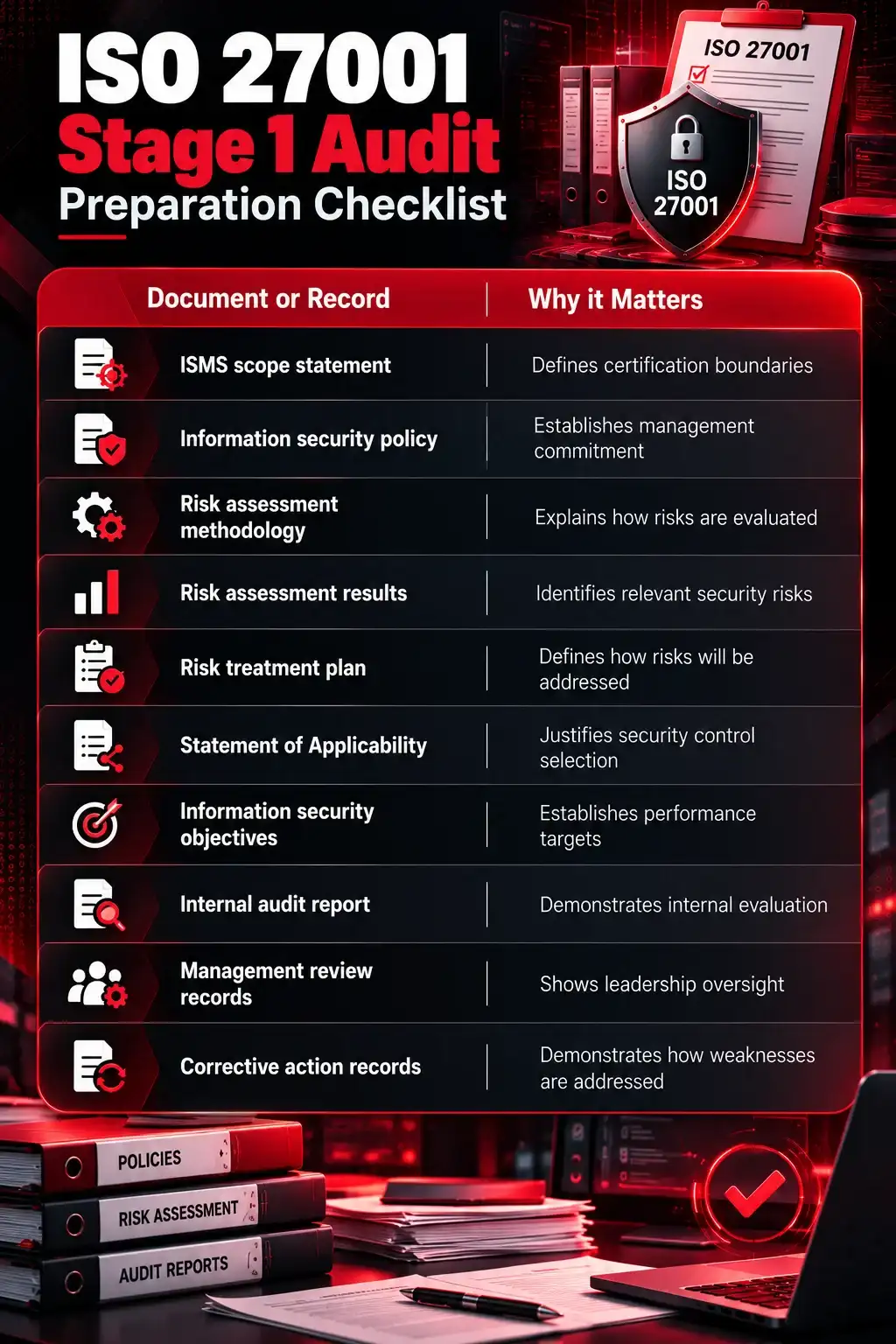
During the Stage 1 audit, auditors review your ISMS documents and check whether your company is ready for Stage 2. They mainly look at:
- ISMS Scope: Which departments, locations, systems, and services are included in the certification.
- Information Security Policy: Whether your company has an approved security policy that meets its business needs.
- Risk Assessment: How your company identifies, assesses, and prioritizes security risks.
- Risk Treatment Plan: What steps you have planned to manage risks and who is responsible for them.
- Statement of Applicability (SoA): Which Annex A security controls apply to your business and why certain controls are excluded.
- Security Objectives: What security goals your company has set and how it tracks progress.
- Internal Audit and Management Review: Whether internal audits and management reviews have been completed and properly recorded.
- Stage 2 Readiness: Whether your ISMS is sufficiently implemented and ready for a detailed audit.
Stage 1 isn’t simply a document-counting exercise. Auditors also consider whether the ISMS is mature enough to justify moving forward.
What Happens After Stage 1?
Following the assessment, the certification body provides documented conclusions about readiness and identifies areas of concern that may become nonconformities during Stage 2. The business then has an opportunity to address those concerns before the next audit.
Importantly, completing Stage 1 does not mean the organization has achieved ISO 27001 certification. It establishes whether the organization is sufficiently prepared for the next stage.
What Is an ISO 27001 Stage 2 Audit?
The ISO 27001 Stage 2 audit is the detailed evaluation of how effectively an organization’s ISMS has been implemented. If Stage 1 examines whether the required management system has been established, Stage 2 looks for proof that it operates as intended.
During Stage 2, auditors interview employees, observe operational practices, examine system configurations, and review records generated during routine business activities. The focus shifts from “What does your policy say?” to “Can you demonstrate that employees and systems follow this policy?”
What Do Auditors Check During Stage 2?
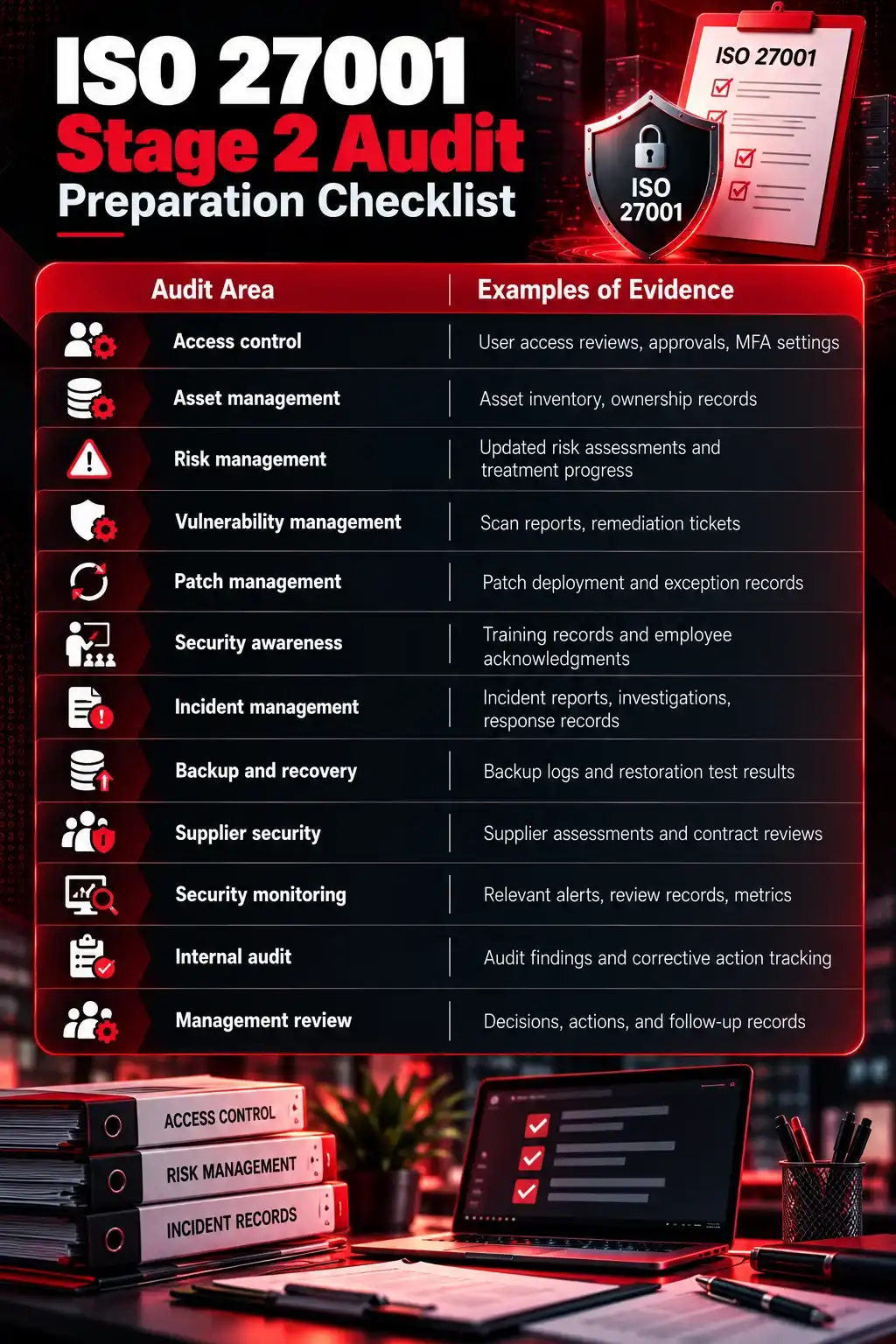
During the Stage 2 audit, auditors check whether your company follows its security policies and procedures. They review records, speak with employees, and look at how security controls work in day-to-day operations.
- Security Controls: Auditors check whether the required security controls are in place and working. For example, they may ask for proof that multifactor authentication is enabled for admin accounts.
- Access Management: They review how employees get access to systems, how permissions are updated, and whether accounts are disabled when someone leaves the company.
- Security Incidents: Auditors look at how your company reports and handles security incidents. They may check incident reports, response records, and actions taken to prevent similar issues.
- Employee Awareness: Auditors may ask how employees handle sensitive information, report phishing emails, and follow company security rules.
- Vulnerability and Patch Management: Auditors review how your company finds security weaknesses, installs updates, and fixes identified issues.
- Security Monitoring: They check whether your company tracks its security goals and regularly reviews how well its controls are working.
- Continual Improvement: Auditors look at how your company fixes security gaps and check whether those fixes have worked.
What Is the Outcome of the Stage 2 Audit?
After the Stage 2 audit, auditors share their findings and highlight any areas that need improvement. If they find nonconformities, your company may need to take corrective action and provide evidence that the issues have been addressed.
Once the audit findings and required corrective actions have been reviewed, the certification body makes the final decision on ISO 27001 certification.
Completing Stage 2 does not automatically mean your company is certified. The certification body reviews the audit report and checks whether any nonconformities have been properly addressed. If all certification requirements are met, your company receives its ISO 27001 certificate. Once certified, your company must undergo regular surveillance audits to maintain its certification.
ISO 27001 Stage 1 vs. Stage 2 Audit: Key Differences
Although both stages assess the same management system, their purpose, depth, and expected evidence differ significantly.
| Comparison | Stage 1 Audit | Stage 2 Audit |
| Primary Objective | Assess readiness | Evaluate implementation and effectiveness |
| Main Focus | ISMS design, scope, and documented information | Operational execution and evidence |
| Typical Approach | Document reviews and discussions | Interviews, sampling, observations, and record reviews |
| Auditor’s Question | Is the organization ready for a full audit? | Does the ISMS meet requirements and operate effectively? |
| Evidence Examined | Policies, risk registers, SoA, audit plans and records | Operational logs, tickets, approvals, test reports, and performance records |
| Employee Involvement | Mostly ISMS owners and relevant management | Management, process owners, technical teams, and employees |
| Audit Depth | Readiness-oriented | Detailed conformity and effectiveness assessment |
| Typical Output | Readiness conclusions and areas of concern | Audit findings and certification recommendation |
| Certification Outcome | No certificate issued | Supports the subsequent certification decision |
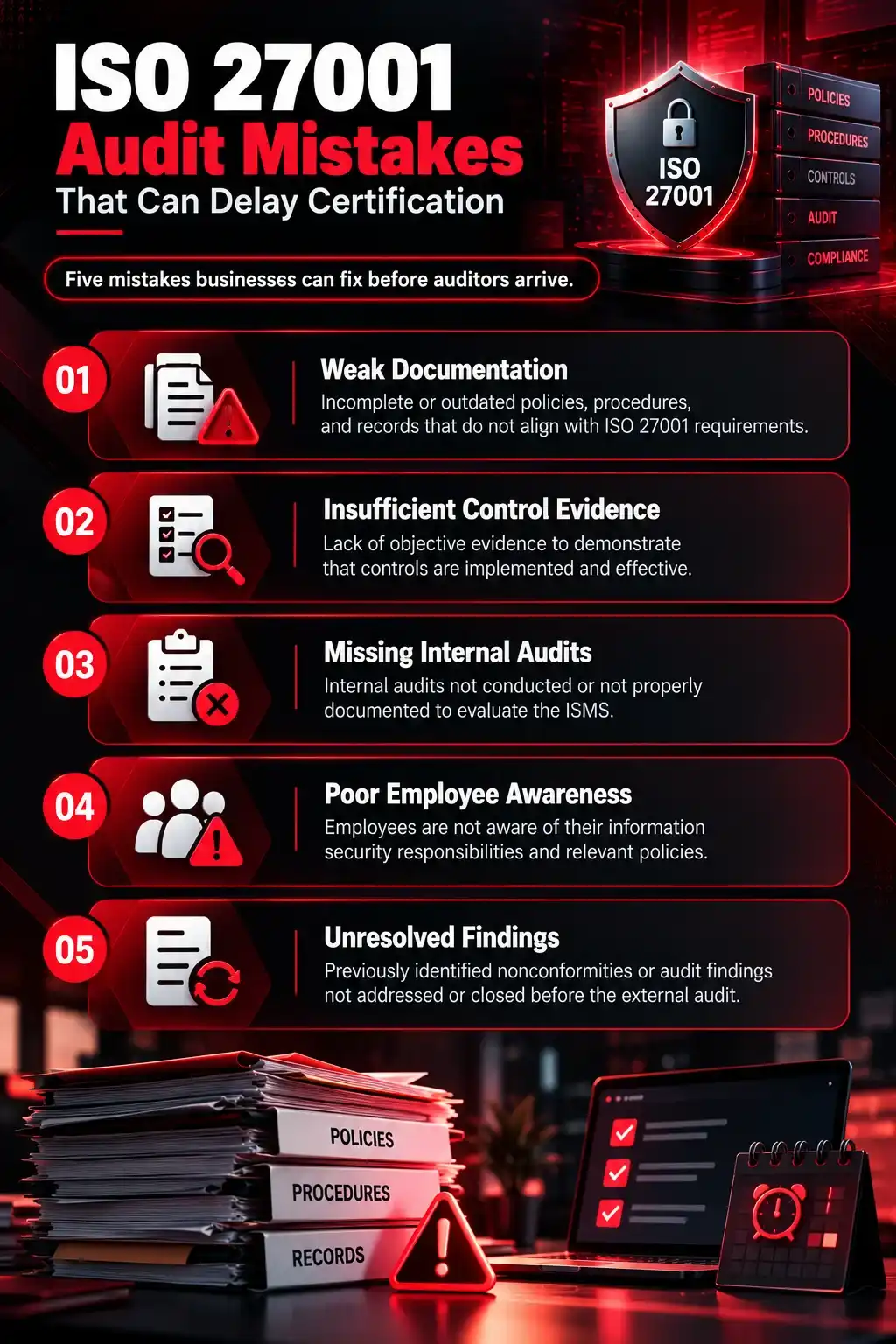
Common Mistakes Businesses Make During ISO 27001 Audits
Even organizations with strong technical security can encounter certification difficulties if their ISMS is poorly coordinated.
What Happens If Your Organization Fails an ISO 27001 Audit?
Not every audit finding means certification has failed. Auditors may identify nonconformities that require action before a certification decision can be completed. Findings generally fall into two categories.
Minor nonconformity
A minor nonconformity indicates a specific weakness that does not, by itself, demonstrate a significant failure of the management system’s ability to achieve intended results. For example, your team may have completed a security review but forgotten to record the required approval.
In most cases, your company needs to identify what caused the issue and submit a plan to fix it. The certification body will review the proposed actions.
Major nonconformity
A major nonconformity indicates a more serious problem that affects the management system’s ability to achieve intended results or creates significant doubt about its effectiveness. For example, an organization may have failed to establish or implement a required risk assessment process.
Major nonconformities normally require implemented corrective actions and verification of effectiveness before initial certification can be granted. Certification decisions are made by the certification body, not simply by the auditor who conducted the assessment.
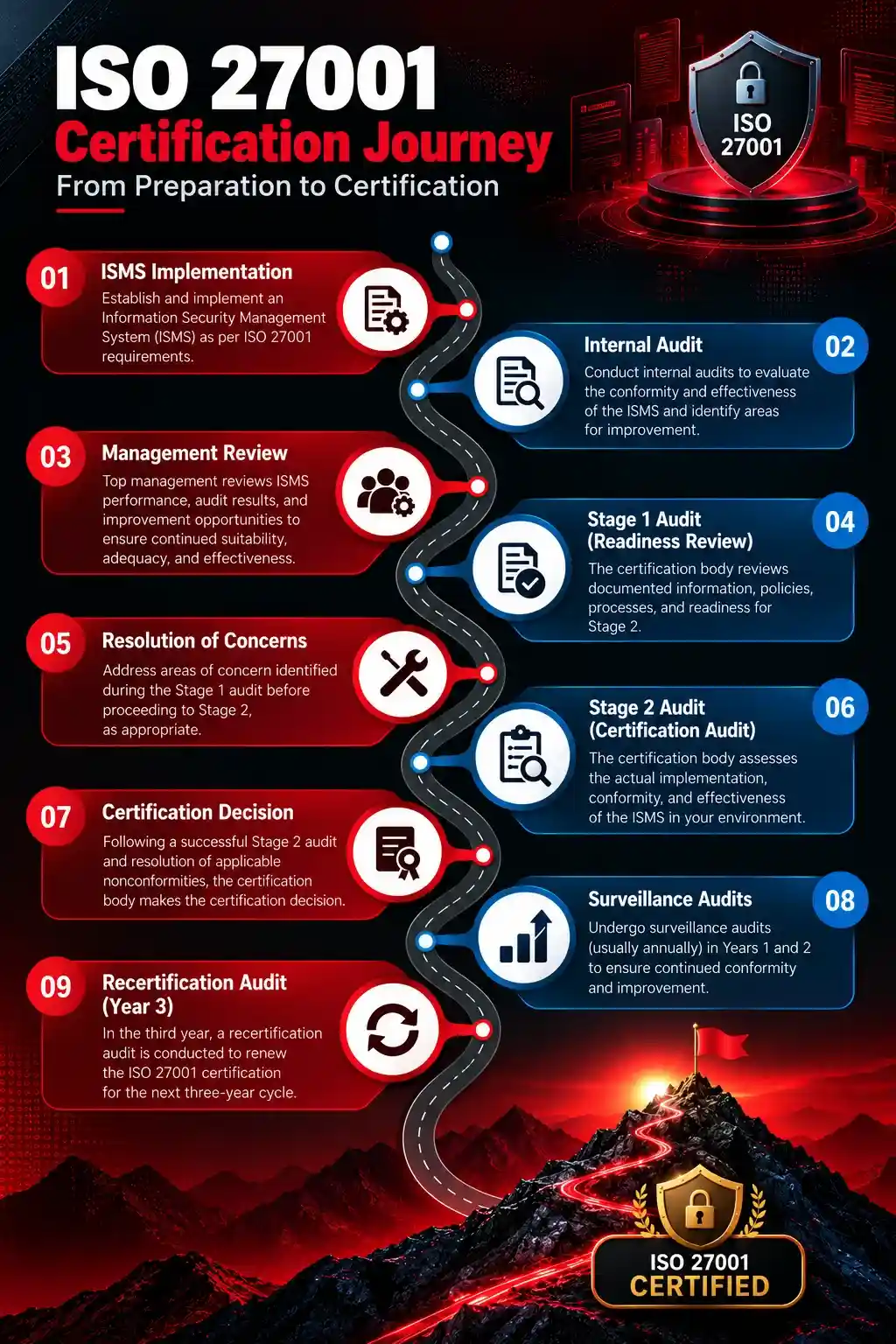
ISO 27001 Certification Process
Conclusion
ISO 27001 Stage 1 and Stage 2 audits differ mainly in what they assess. Stage 1 reviews your ISMS documents, risk assessments, and overall readiness. Stage 2 checks whether your company follows these processes and keeps proper records. To prepare for both audits, keep your documents up to date, review security controls regularly, and fix any gaps you find.
Getting ISO 27001 certified is important, but maintaining good security practices matters just as much. Regular reviews and improvements can help your business manage risks and keep sensitive information secure.
Build Your ISO 27001 Audit Expertise with InfosecTrain
Ready to move from ISO 27001 documentation to confident audit execution?
Understanding the standard is one thing. Knowing how to apply its requirements, evaluate security controls, collect reliable evidence, and prepare for certification audits requires practical knowledge. InfosecTrain offers instructor-led ISO 27001 training designed to help information security professionals develop their ISMS implementation and auditing skills.
- ISO 27001:2022 Lead Auditor Training: Develop skills in audit planning, conducting assessments, evaluating evidence, reporting nonconformities, and managing audit activities.
- ISO 27001:2022 Lead Implementer Training: Learn how to establish, implement, maintain, and improve an ISMS, including risk treatment, documentation, and certification audit preparation.
Strengthen your ISO 27001 knowledge and take the next step in your information security career.

TRAINING CALENDAR of Upcoming Batches For ISO 27001 Lead Auditor Training
| Start Date | End Date | Start - End Time | Batch Type | Training Mode | Batch Status | |
|---|---|---|---|---|---|---|
| 28-Nov-2026 | 27-Dec-2026 | 09:00 - 13:00 IST | Weekend | Online | [ Open ] | |
| 13-Dec-2026 | 30-Jan-2027 | 09:00 - 13:00 IST | Weekend | Online | [ Open ] | |
| 09-Jan-2027 | 14-Feb-2027 | 19:00 - 23:00 IST | Weekend | Online | [ Open ] | |
| 14-Feb-2027 | 27-Mar-2027 | 09:00 - 13:00 IST | Weekend | Online | [ Open ] | |
| 13-Mar-2027 | 11-Apr-2027 | 19:00 - 23:00 IST | Weekend | Online | [ Open ] |

TRAINING CALENDAR of Upcoming Batches For ISO 27001 Lead Implementer Training
| Start Date | End Date | Start - End Time | Batch Type | Training Mode | Batch Status | |
|---|---|---|---|---|---|---|
| 16-Jan-2027 | 21-Feb-2027 | 09:00 - 13:00 IST | Weekend | Online | [ Open ] | |
| 13-Mar-2027 | 11-Apr-2027 | 09:00 - 13:00 IST | Weekend | Online | [ Open ] |
Frequently Asked Questions
What is the difference between ISO 27001 Stage 1 and Stage 2 audits?
Stage 1 checks whether your Information Security Management System (ISMS) is ready for certification. Stage 2 checks how well your security policies and controls work in practice.
Is the ISO 27001 Stage 1 audit mandatory?
Yes. Stage 1 is a required step in the initial ISO 27001 certification process. It helps auditors assess your readiness for Stage 2.
What documents are needed for an ISO 27001 Stage 1 audit?
Key documents include the ISMS scope, security policy, risk assessment, risk treatment plan, Statement of Applicability (SoA), internal audit reports, and management review records.
How long does an ISO 27001 Stage 1 audit take?
It depends on your company's size, locations, and ISMS complexity. The certification body decides the audit duration based on your certification scope.
What happens during an ISO 27001 Stage 2 audit?
Auditors review security records, interview employees, and check whether your security controls are properly implemented and working as intended.
Can a company fail an ISO 27001 Stage 1 audit?
Stage 1 isn't a typical pass-or-fail audit. However, if auditors find major gaps, you may need to fix them before moving to Stage 2.
Can ISO 27001 Stage 1 and Stage 2 audits happen on the same day?
Both stages must happen in order. While there's no fixed minimum gap, companies should have enough time to address any issues found during Stage 1.
Who conducts ISO 27001 Stage 1 and Stage 2 audits?
Independent certification bodies conduct both audits. For accredited certification, choose a certification body accredited for ISO 27001.
What is the Statement of Applicability in ISO 27001?
The Statement of Applicability (SoA) lists the security controls your organization needs, explains why you included or excluded them, and shows their implementation status.
What are common ISO 27001 Stage 2 audit nonconformities?
Common issues include missing access-review records, incomplete risk treatment, weak security monitoring, outdated procedures, and insufficient evidence that controls are working.
Does passing Stage 2 guarantee ISO 27001 certification?
No. The certification body reviews the audit findings and any required corrective actions before making the final certification decision.
How can companies prepare for ISO 27001 certification?
Start with a clear ISMS scope, implement suitable security controls, keep records updated, conduct internal audits, review the ISMS with management, and fix gaps before the external audit.