How to Prepare for the CISA Exam: Complete Study Guide
Quick Insights:
Preparing for the CISA exam requires more than memorizing concepts and practice questions. A strong preparation strategy combines a clear study plan, understanding of all five CISA domains, an auditor-focused mindset, scenario-based practice, mock exams, and regular revision. Using trusted ISACA resources, structured CISA training, study groups, and focused video resources can further strengthen preparation and help candidates approach exam questions with greater confidence.
You can know cybersecurity, understand IT controls, and even have years of industry experience, yet still find CISA questions surprisingly tricky. Why? Because the exam doesn’t just ask what you know. It tests whether you can think through a situation the way an information systems auditor would.
That’s where CISA preparation becomes different from simply reading a study guide and memorizing definitions. You need to understand risk, controls, governance, audit evidence, and business priorities well enough to apply them when two or three answers all seem reasonable.
The Certified Information Systems Auditor (CISA) certification from ISACA is widely recognized among professionals working in IT audit, governance, risk, compliance, and information security. Preparing for the exam requires a clear strategy, especially when you’re balancing study time with a full-time job. So, where should you begin, how much time should you spend on each domain, and what can you do to avoid common preparation mistakes?
This guide walks you through how to prepare for the CISA exam step by step, from understanding the exam structure and creating a study plan to practicing scenario-based questions, taking mock exams, and making the most of your final week.
What is the CISA Certification?
CISA, or Certified Information Systems Auditor, is a professional certification offered by ISACA for professionals working in areas such as IT auditing, information security, governance, risk, compliance, IT controls, and assurance. The certification is particularly relevant to professionals who evaluate whether information systems and technology controls support business objectives while managing risk appropriately.
The CISA exam currently consists of 150 questions covering five job-practice domains. These domains reflect real-world responsibilities related to auditing, governance, information systems, business resilience, and information security.
The certification is relevant to roles such as:
- IT Auditor
- Internal Auditor
- Information Security Analyst
- IT Risk Analyst
- Governance, Risk, and Compliance (GRC) Professional
- Cybersecurity Consultant
- Compliance Analyst
- IT Manager
- Security Auditor
CISA Exam Domains You Need to Prepare
Before opening a study guide or attempting hundreds of questions, understand the exam blueprint. The current CISA exam covers these five areas:
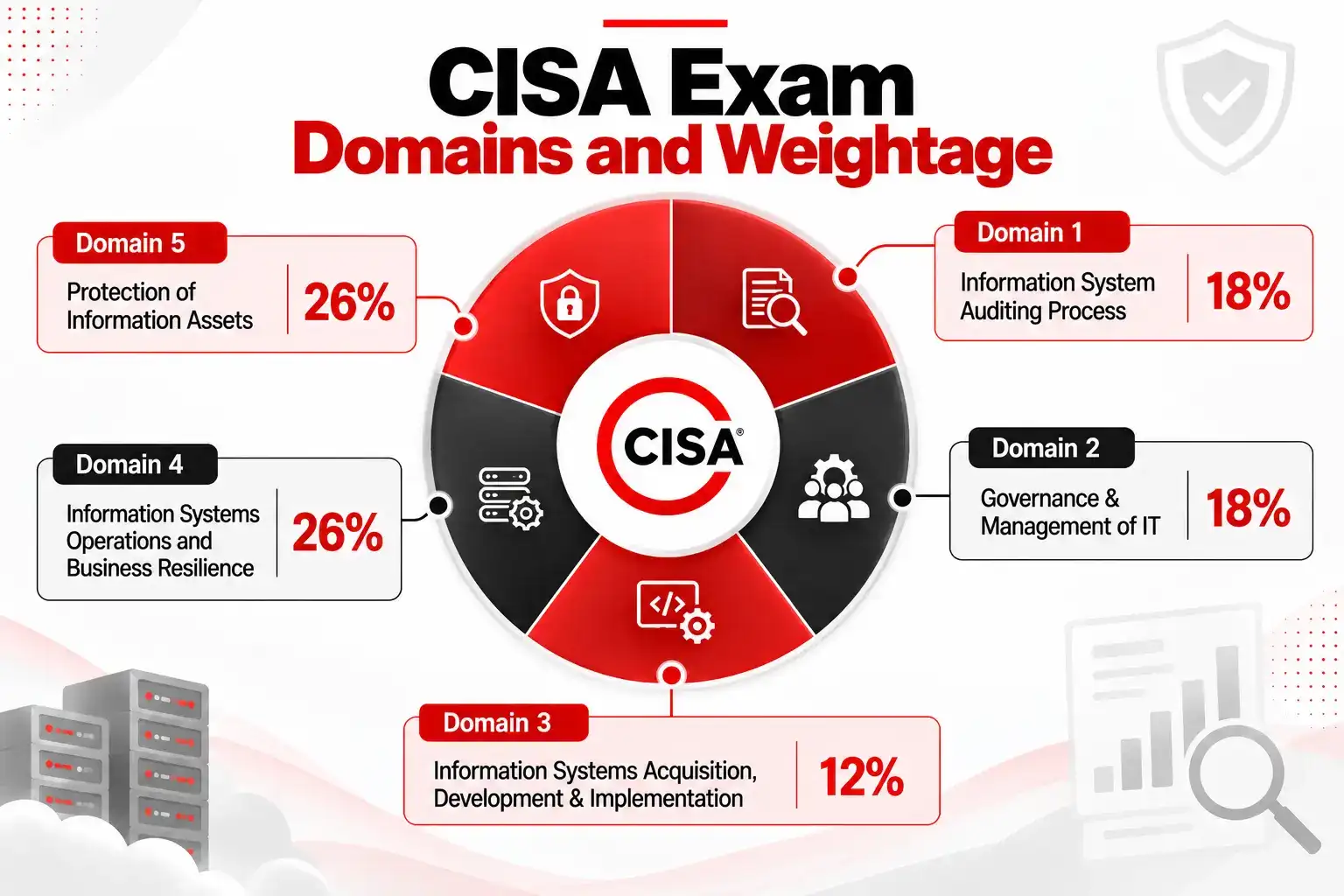
The weighting immediately tells you something important about preparation.
Domains 4 and 5 together account for more than half of the exam. That doesn’t mean you should ignore the other three. It means your study schedule should reflect the relative importance of each domain instead of giving every topic exactly the same amount of time.
How to Prepare for the CISA Exam?
Preparing for CISA is easier when you treat it as a process rather than trying to cover everything at once. The following steps can help you move from understanding the syllabus to becoming comfortable with exam-style questions.
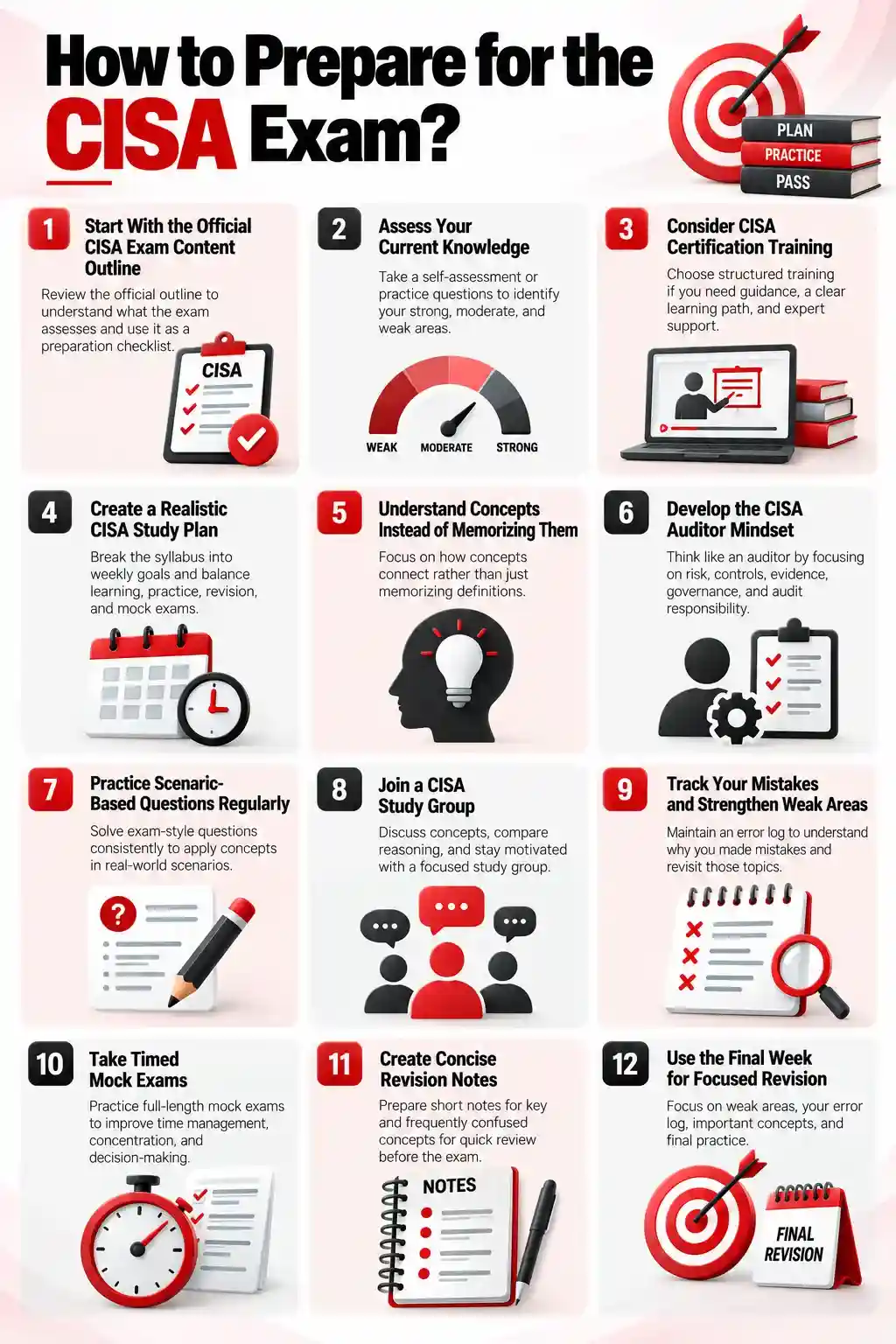
1. Start With the Official CISA Exam Content Outline
Before opening multiple books or watching hours of videos, review the official CISA Exam Content Outline. It gives you a clear picture of what the exam is designed to assess.
Use it as a preparation checklist and classify topics as:
- Strong: You understand and can apply the concept.
- Moderate: You know the concept but struggle with scenario questions.
- Weak: You need to learn or revisit the topic.
This gives your preparation direction from day one.
2. Assess Your Current Knowledge
Not every candidate starts from the same point. If you already work in cybersecurity, some information-security concepts may be familiar. If you work in auditing or GRC, governance and audit processes may come more naturally.
Take an initial set of practice questions or perform a domain-by-domain self-assessment. Identify where you are losing marks and allocate more study time to those areas. Your goal is not to spend equal time everywhere. It’s to spend your time where improvement is required.
3. Consider CISA Certification Training
Self-study works for some candidates, but structured certification training can be useful if you’re new to information systems auditing, have limited preparation time, or find it difficult to interpret scenario-based questions.
A good CISA training program should help you:
- Follow a structured learning path across all five domains
- Understand difficult audit, governance, risk, and security concepts
- Learn from an experienced instructor
- Discuss practical examples and audit scenarios
- Clarify doubts as you progress
- Practice exam-oriented questions
- Identify weak areas before the exam
For example, InfosecTrain’s CISA Certification Training provides live instructor-led preparation, access to recorded sessions, exam-preparation resources, and post-training support.
Certification training shouldn’t replace self-study. Use it to create structure, understand difficult concepts, and improve your reasoning while continuing your own practice and revision.
4. Create a Realistic CISA Study Plan
Consistency matters more than an ambitious schedule you can not maintain. Break the syllabus into weekly goals and reserve separate time for learning, practice questions, revision, and mock exams. For many working professionals, an 8-to-12-week study plan can be a useful starting framework. However, the right timeline depends on your experience and available study time.
Avoid leaving practice questions until you have finished the entire syllabus. Practice alongside your learning so you can identify gaps early.
5. Understand Concepts Instead of Memorizing Them
CISA preparation shouldn’t become an exercise in memorizing definitions. Try to understand how concepts connect. For example:
Risk → Control → Testing → Evidence → Finding → Recommendation
Similarly, don’t just memorize preventive, detective, and corrective controls. Learn to recognize how they appear in practical situations. When you understand the reasoning behind a concept, you’re better prepared when the exam presents it in an unfamiliar scenario.
6. Develop the CISA Auditor Mindset
This is especially important for candidates coming from technical roles. A Security Engineer may see a vulnerability and immediately think: “How should we fix it?”
An auditor may first need to determine:
- What is the associated risk?
- What evidence supports the finding?
- Is the control operating effectively?
- Who owns the risk?
- What should happen at this stage of the audit?
The technically strongest solution isn’t always the best CISA answer. Train yourself to look at questions through the lens of risk, controls, evidence, governance, and audit responsibility.
7. Practice Scenario-Based Questions Regularly
Don’t wait until the final weeks to start solving questions. Practice alongside each topic or domain you study so you can apply concepts in realistic exam scenarios.
Pay attention to what the question is asking, especially terms such as FIRST, BEST, MOST IMPORTANT, and PRIMARY. Before selecting an answer, consider the auditor’s role, the business risk involved, and the correct sequence of actions.
The goal is not to complete as many questions as possible, but to become comfortable applying CISA concepts when several answers appear reasonable.
8. Join a CISA Study Group
Studying alone for several weeks can make it difficult to recognize gaps in your understanding. A focused CISA study group can expose you to different ways of interpreting audit scenarios.
Use study groups to:
- Discuss difficult CISA concepts
- Compare reasoning behind scenario-based answers
- Ask questions when you’re stuck
- Share useful official resources
- Review difficult domains together
- Stay accountable to your study schedule
- Discuss why one answer is stronger than another
The key is to choose a group focused on learning and discussion, rather than one that simply circulates exam dumps or memorized questions.
9. Track Your Mistakes and Strengthen Weak Areas
Keep a simple error log throughout your preparation. For every recurring mistake, record:
- The topic or domain
- Why your answer was incorrect
- The principle you misunderstood
- What you need to revise
Over time, patterns may emerge. You might consistently struggle with audit evidence, governance responsibilities, BIA/RTO/RPO, change management, access controls, or question sequencing.
10. Take Timed Mock Exams
Knowing the content is only one part of CISA preparation. You also need to maintain concentration and make decisions under time pressure.
Timed mock exams help you practice:
- Time management
- Question pacing
- Concentration
- Decision-making
- Mental endurance
- Moving efficiently between domains
They can also reveal whether you’re spending too much time on difficult questions. Practice making a decision, moving forward, and maintaining a steady pace throughout the exam.
11. Create Concise Revision Notes
As the exam approaches, you shouldn’t need to reread every chapter. Create short notes for concepts that are easy to confuse or forget. These could include:
- Audit evidence
- Control types
- Risk terminology
- Governance roles
- SDLC
- Change management
- BIA
- RTO and RPO
- Business continuity and disaster recovery
- Access management
- Encryption and PKI
- Incident response
Keep these notes short enough to review quickly. The goal is to trigger recall, not recreate your textbook.
12. Use the Final Week for Focused Revision
During the final week, shift away from heavy new learning and focus on consolidation. Concentrate on:
- Weak domains and recurring problem areas
- Your error log and revision notes
- Commonly confused concepts
- Mixed practice questions
- Exam keywords and question elimination
- Final timed practice
Avoid trying to cover the entire syllabus again. At this stage, your priority should be reinforcing what you already know, addressing recurring gaps, and becoming comfortable with your exam approach.
Recommended CISA Study Guides and Resources
A good CISA study guide should help you understand the concepts, but it should also stay aligned with the current exam domains. Instead of downloading random CISA PDFs, start with official ISACA resources and then use trusted supplementary material where needed.
| Study Resource | Best Used For |
| CISA Official Review Manual, 28th Edition | Comprehensive study and domain-wise concept review |
| CISA Exam Content Outline | Understanding the five domains and what to study |
| CISA Questions, Answers & Explanations (QAE) Database | Question practice and understanding CISA-style reasoning |
| Free CISA Practice Quiz | Initial self-assessment and exam-style practice |
| CISA Exam Candidate Guide | Exam registration, scheduling, rules, scoring, and exam-day information |
| ISACA Glossary | Understanding audit, governance, risk, security, and IT terminology |
Recommended Videos for CISA Preparation
Videos can be useful when you need a simpler explanation of difficult audit concepts or want to see how an experienced instructor approaches CISA-style questions. However, avoid jumping between random videos. Choose focused content that complements your primary study resources.
1. How to Pass CISA: Domain 1–Domain 5 Series by Prabh Nair
For candidates looking for domain-wise video preparation, Prabh Nair’s “How to Pass CISA From Domain 1–Domain 5” series can be a useful supplementary resource.
The series is structured around the CISA domains, making it easier to watch the relevant videos alongside your study plan.
2. Top CISA Practice Questions | CISA Exam Prep 2026
Once you’ve covered the concepts, practice-question videos can help you see how CISA knowledge is applied to exam-style scenarios. “Top CISA Practice Questions” is a useful supplementary video for candidates who want to practice CISA-style questions and understand the reasoning behind the answers.
3. Prabh Nair: How to Clear CISA in First Attempt
Another useful resource is “How to Clear CISA in First Attempt.”
The video discusses the CISA domains, key exam considerations, and preparation strategy. It can be useful for understanding how an experienced certification instructor approaches the examination.
How to Practice CISA Questions Effectively?
Use this five-step process whenever you practice:
READ → REASON → ELIMINATE → REVIEW → RECORD
Read: Identify what the scenario and keywords are asking.
Reason: Choose an answer based on the underlying CISA concept.
Eliminate: Remove options that don’t fit the role, risk, or sequence.
Review: Understand why the correct answer is stronger.
Record: Add recurring mistakes or weak concepts to your error log.
The goal isn’t simply to increase the number of questions you’ve completed. It’s to make sure each practice session improves your ability to recognize risk, responsibilities, controls, evidence, business priorities, and the correct sequence of actions.
Daily CISA Study Routine
You don’t necessarily need four-hour study sessions every evening. For someone working full-time, shorter but consistent sessions may be easier to sustain.
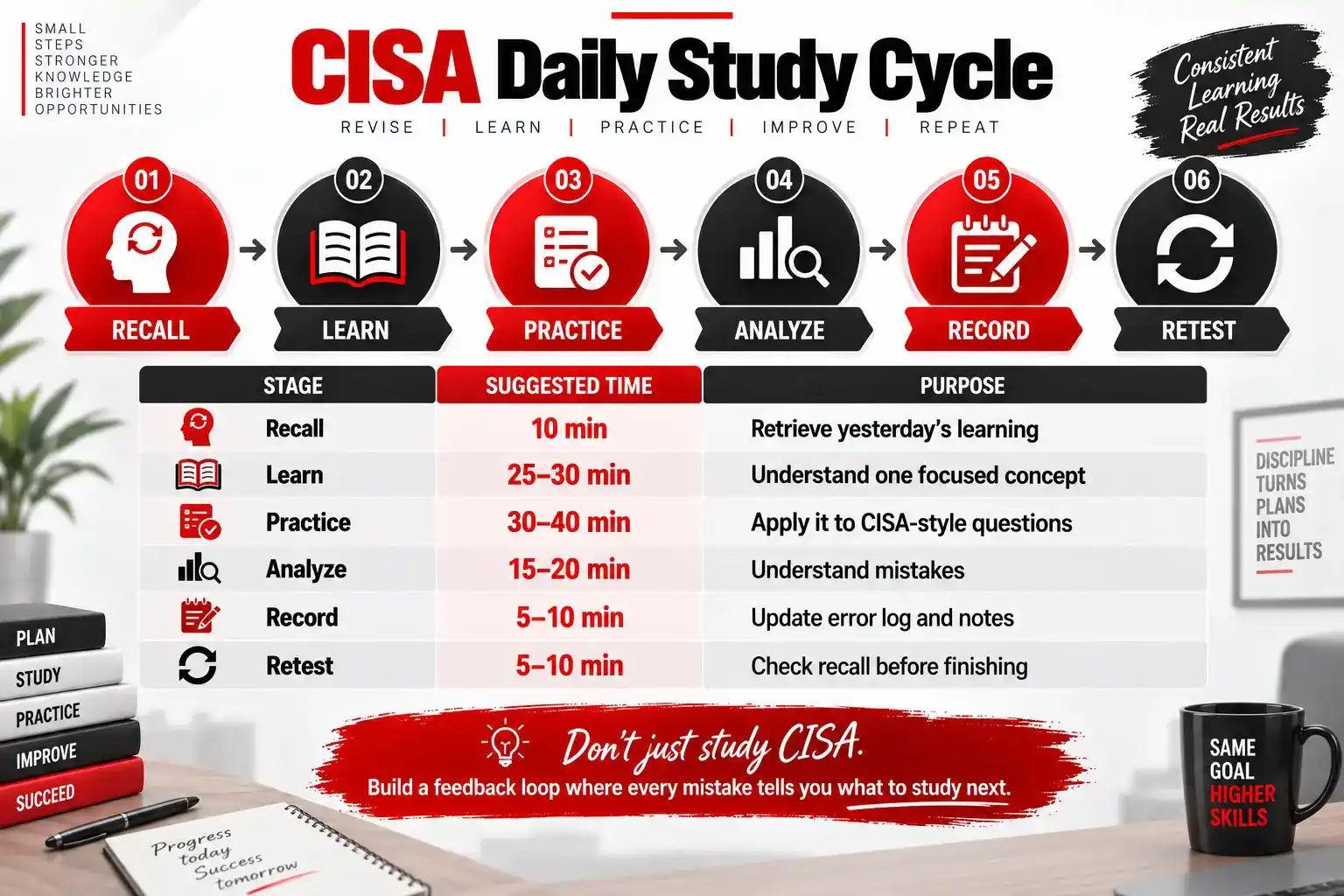
That’s much more purposeful than reading chapter after chapter without checking whether you can apply what you’ve learned.
Conclusion
CISA preparation isn’t about remembering every sentence in a review manual. It’s about learning how information systems auditors think. Understand risk. Understand controls. Know how evidence supports conclusions. Learn who is responsible for what. Connect technology decisions with business objectives. Most importantly, practice applying those ideas to situations where several answers look reasonable, but only one best fits the question.
Start with the official exam blueprint, build your understanding domain by domain, practice consistently, and study your mistakes as carefully as your correct answers. That approach doesn’t just prepare you for an exam. It develops the judgment that CISA is intended to validate.
Prepare for the CISA Exam With InfosecTrain
Preparing for CISA becomes much more manageable when you have a structured roadmap and someone who can explain the reasoning behind audit scenarios.
InfosecTrain’s CISA Certification Training can help professionals build exam-focused knowledge across information systems auditing, IT governance, systems development and implementation, IT operations and resilience, and protection of information assets. With expert-led training, structured domain coverage, practical explanations, and exam-focused preparation, learners can move beyond memorizing concepts and start approaching questions from an auditor’s perspective.

TRAINING CALENDAR of Upcoming Batches For CISA Training
| Start Date | End Date | Start - End Time | Batch Type | Training Mode | Batch Status | |
|---|---|---|---|---|---|---|
| 31-Oct-2026 | 06-Dec-2026 | 19:00 - 23:00 IST | Weekend | Online | [ Open ] | |
| 28-Nov-2026 | 17-Jan-2027 | 09:00 - 12:00 IST | Weekend | Online | [ Open ] | |
| 07-Dec-2026 | 06-Jan-2027 | 21:00 - 23:00 IST | Weekday | Online | [ Open ] | |
| 30-Jan-2027 | 14-Mar-2027 | 09:00 - 12:00 IST | Weekend | Online | [ Open ] | |
| 27-Feb-2027 | 28-Mar-2027 | 19:00 - 23:00 IST | Weekend | Online | [ Open ] | |
| 27-Mar-2027 | 09-May-2027 | 09:00 - 12:00 IST | Weekend | Online | [ Open ] |
Frequently Asked Questions
What is the best way to prepare for the CISA exam?
Start with the official CISA exam content outline, learn each domain conceptually, practice scenario-based questions, analyze every mistake, and complete timed mock tests. A structured study plan is generally more effective than jumping between unrelated resources.
How difficult is the CISA exam?
The difficulty depends on your experience. CISA can be challenging because many questions test audit judgment and application rather than simple recall.
How many questions are on the CISA exam?
The CISA exam consists of 150 questions covering five job-practice domains, according to ISACA's current exam content outline.
Do I need work experience before taking the CISA exam?
No. You can take the CISA exam before meeting the work experience requirement. However, passing the exam does not automatically make you CISA certified. To earn the full CISA certification, you must meet ISACA's applicable experience and certification requirements. Eligible students who pass the CISA exam but do not yet have the required professional experience may also qualify for ISACA's CISA Associate designation, which allows them to demonstrate their CISA knowledge while working toward the experience required for full certification.
Can a beginner take the CISA exam?
Yes. Beginners can take the exam, but they may need additional preparation in auditing, governance, risk, and IT controls.
How long does it take to prepare for CISA?
Preparation time varies according to experience and existing knowledge. For many working professionals, an 8-to-12-week structured plan is a reasonable starting point, but candidates should adjust the timeline based on diagnostic and practice-test results.
Is CISA only for IT auditors?
No. Although information systems auditing is central to CISA, the knowledge is also relevant to professionals working in IT risk, cybersecurity, governance, compliance, assurance, consulting, and technology management.
Are practice questions enough to pass the CISA exam?
No. Use practice questions alongside conceptual study to improve your understanding and exam-style reasoning.
How should I answer difficult CISA questions?
First, identify what the question is actually asking, especially words such as FIRST, BEST, PRIMARY, and MOST IMPORTANT. Then eliminate options that are outside the auditor's role, occur at the wrong stage of a process, or fail to address the main business risk.
What should I study during the final week before CISA?
Focus on consolidation rather than trying to learn everything again. Review weak topics, your error log, key terminology and processes, complete mixed practice questions, and revise short notes. Avoid turning the final days into an exhausting cram session.