How to Protect AI Training Data from Cyber Threats?
Quick Insights:
AI training data is a high-value target because it shapes how AI systems learn, respond, and make decisions. If attackers steal, poison, manipulate, or expose this data, the entire AI model can become unreliable, unsafe, or non-compliant. Organizations can protect AI training data by classifying datasets, applying strong governance, restricting access, validating data sources, preventing data poisoning, encrypting data, masking sensitive information, securing MLOps pipelines, maintaining data lineage, monitoring AI environments, reviewing third-party vendors, and adopting AI risk management practices.
AI systems are only as reliable as the data they learn from. Whether an organization is building a chatbot, fraud detection model, healthcare AI tool, recommendation engine, or cybersecurity automation system, training data becomes the foundation of every prediction, response, and decision.

But that foundation is now under attack. Cybercriminals no longer target only networks, applications, and endpoints. They are also targeting the data used to train AI models. If attackers can manipulate, steal, poison, or expose training data, they can quietly weaken the entire AI system before it even reaches production.
This is what makes AI training data security a business-critical priority. Protecting AI training data is not just a data science concern. It requires cybersecurity, privacy, governance, access control, monitoring, secure MLOps, and strong AI risk management.
Why AI Training Data Has Become a Cybersecurity Target
AI training data is valuable because it contains patterns, business logic, customer behavior, sensitive records, operational intelligence, and sometimes personal or regulated information. If this data is compromised, the impact can go far beyond a normal data breach.
A poisoned dataset can make an AI model behave incorrectly. A leaked dataset can expose confidential information. A manipulated dataset can introduce bias or hidden backdoors. A poorly governed dataset can create compliance and privacy risks.
For example, if an attacker inserts malicious examples into a training dataset, the model may learn the wrong behavior. If a financial fraud detection model is trained on manipulated data, it may fail to detect certain fraud patterns. If a chatbot is fine-tuned on unverified internal documents, it may later reveal sensitive information or produce unsafe responses. That is why AI training data must be treated like a high-value asset.
Common Cyber Threats to AI Training Data
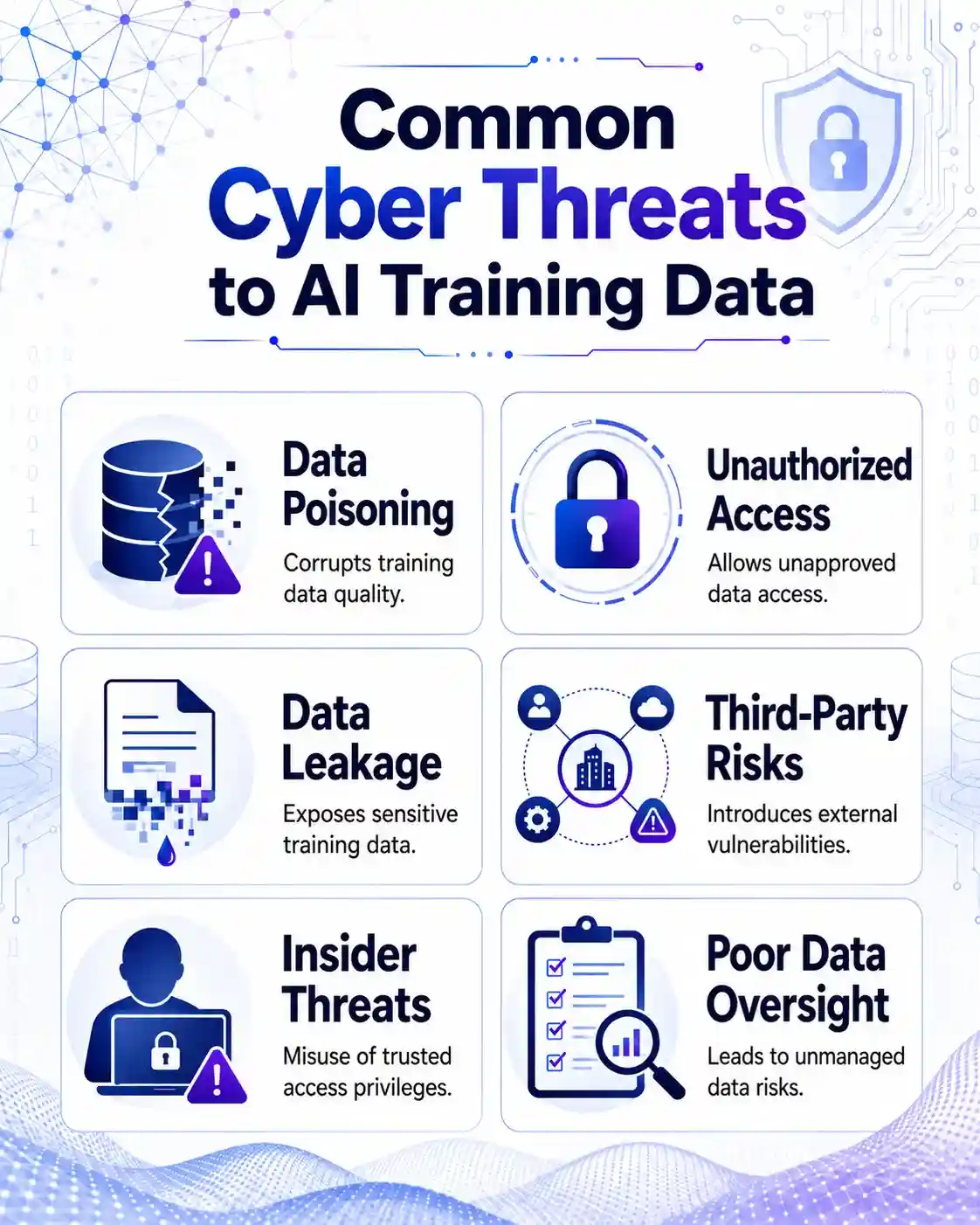
1. Data Poisoning Attacks
Data poisoning happens when attackers intentionally inject false, misleading, or malicious data into the training datasets to manipulate how the AI model learns, leading to incorrect or unsafe outputs after deployment.
2. Unauthorized Access to Training Datasets
Training datasets often contain sensitive business, customer, employee, or operational data. Weak access controls, exposed APIs, compromised credentials, or over-permissioned cloud storage can allow unauthorized users to copy, modify, or misuse training data.
3. Data Leakage and Privacy Exposure
AI training data may include personally identifiable information, financial records, healthcare data, intellectual property, or confidential business documents. Without anonymization, masking, and governance, it can cause privacy violations and reputational damage.
4. Third-Party Data Risks
Organizations often rely on external datasets, pre-trained models, labeling services, and open-source resources. If these sources are compromised, inaccurate, or poorly vetted, they can introduce harmful data and reduce model reliability.
5. Insider Threats
Individuals with authorized access, such as employees, contractors, data laborers, or third-party vendors, may intentionally or unintentionally expose, modify, or misuse training data, creating security and compliance risks.
6. Poor Data Tracking and Oversight
When organizations lack visibility into data origins, modifications, and usage, it becomes difficult to identify unauthorized changes, maintain compliance, and ensure the integrity of AI training data
How to Protect AI Training Data from Cyber Threats
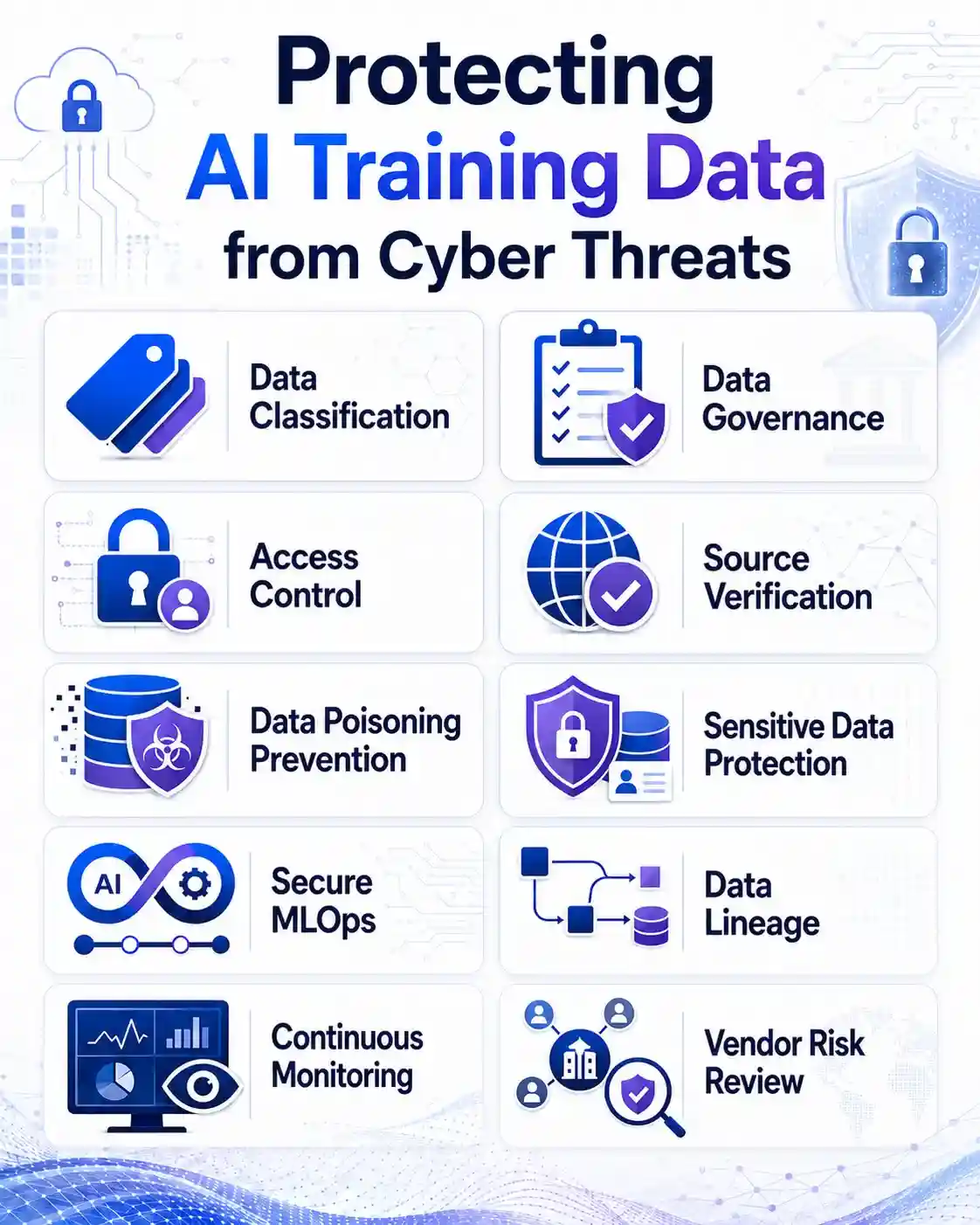
1. Classify AI Training Data Before Using It
The first step is to understand the type and sensitivity of the data. Organizations should classify data based on sensitivity, business value, regulatory impact, and usage. For example:
- Public data
- Internal business data
- Confidential data
- Personal data
- Regulated data
- Intellectual property
- Security-sensitive logs or threat intelligence
Once data is classified, security teams can apply the right level of protection.
2. Build a Secure Data Governance Process
AI training data should have clear ownership, approval workflows, usage rules, retention policies, and accountability. Strong governance ensures training data remains traceable, compliant, and controlled across cloud storage, development environments, and third-party platforms.
3. Use Strong Access Control and Least Privilege
Limit access to only authorized users and systems. Use RBAC, MFA, Just-in-Time Access, PAM, access reviews, environment separation, and activity logging to ensure no one has more access than required.
4. Validate and Verify Data Sources
Before using any dataset for AI training, organizations must verify its source, quality, licensing, consent status, label accuracy, bias indicators, and signs of tampering. If the data source cannot be trusted, the AI model cannot be trusted.. This is especially important when using public, third-party, crowdsourced, or scraped data.
5. Detect and Prevent Data Poisoning
Data poisoning can silently damage AI systems. To reduce this risk, organizations should use dataset validation, anomaly detection, outlier checks, human review, clean validation datasets, and model behavior testing.
6. Encrypt Data at Rest and in Transit
AI training data should be encrypted wherever it is stored and whenever it is transferred. This includes cloud storage, databases, data lakes, backups, APIs, collaboration tools, and MLOps pipelines. Encryption should be supported by strong key management, access control, and monitoring.
7. Mask, Anonymize, or Tokenize Sensitive Data
If training data contains personal, financial, healthcare, or other confidential information, organizations should reduce exposure to it before using it. Common techniques include
- Data masking
- Tokenization
- Pseudonymization
- Anonymization
- Synthetic data generation
- Differential privacy
- Redaction of sensitive fields
8. Secure the MLOps Pipeline
Protect every stage of the AI lifecycle, from data collection to deployment. A secure MLOps pipeline should include:
- Secure code repositories
- Approved data sources
- Version-controlled datasets
- Signed artifacts
- Secure CI/CD workflows
- Secrets management
- Container security
- Vulnerability scanning
- Environment separation
- Audit logs
- Model and dataset versioning
9. Maintain Data Lineage and Version Control
Every dataset should have a clear history. Trace where the data came from, who changed it, what preprocessing was applied, and which model version used it. Data lineage helps with:
- Security investigations
- Compliance audits
- Model debugging
- Poisoning detection
- Root cause analysis
- Accountability
- Model rollback
If a model starts behaving incorrectly, lineage helps teams identify whether the issue came from data changes, code changes, model updates, or external inputs.
10. Monitor AI Training Environments Continuously
AI training environments should be monitored like any other critical system. Monitor user activity, dataset changes, cloud access, APIs, data transfers, model training jobs, failed logins, and privileged actions. Integrate security logs with SIEM, SOC, and incident response workflows.
11. Review Third-Party Vendors and Data Partners
Many AI projects depend on external vendors for data collection, annotation, storage, model development, or AI infrastructure. These vendors must be assessed for security and privacy maturity. Organizations should review their security policies, access controls, compliance posture, breach response, subcontractors, and data deletion practices.
12. Apply AI Risk Management Frameworks
AI training data protection should be part of a broader AI risk management program. Organizations can align with secure AI development, privacy-by-design, data governance, model monitoring, incident response, and AI audit practices to build trustworthy AI systems.
In Conclusion
Protecting AI training data from cyber threats is now essential for building trustworthy AI. If the data is stolen, poisoned, exposed, or manipulated, the model’s behavior, reliability, and compliance posture can all be affected. The strongest approach is to secure the full data lifecycle. Organizations must classify data, verify sources, control access, prevent poisoning, encrypt sensitive information, secure MLOps pipelines, maintain lineage, monitor activity, and apply AI governance frameworks.
Build Your AI Security Skills with InfosecTrain
As AI becomes part of security operations, risk management, data protection, and business decision-making, professionals need the right skills to secure AI systems and protect sensitive AI data from emerging threats.
The CompTIA SecAI+ training from InfosecTrain helps learners understand AI security fundamentals, AI-related cyber risks, secure AI workflows, data protection, governance, privacy, and responsible AI security practices.

TRAINING CALENDAR of Upcoming Batches For CompTIA SecAl+ Certification Training
| Start Date | End Date | Start - End Time | Batch Type | Training Mode | Batch Status | |
|---|---|---|---|---|---|---|
| 28-Nov-2026 | 03-Jan-2027 | 09:00 - 13:00 IST | Weekend | Online | [ Close ] |
Frequently Asked Questions
What is AI training data security?
AI training data security protects the datasets used to train, fine-tune, and validate AI models from theft, misuse, leakage, and manipulation.
Why do attackers target AI training data?
Attackers target training data because it shapes how AI models behave. If the data is compromised, the model can produce unsafe, biased, or incorrect results.
What is data poisoning in AI?
Data poisoning is when attackers add malicious or misleading data to a training set to influence or corrupt the model’s output.
How can organizations prevent training data leakage?
Organizations can prevent leakage by limiting access, encrypting data, masking sensitive details, monitoring usage, and avoiding unapproved AI tools.
What role does MLOps play in AI data security?
Secure MLOps protects the AI pipeline by controlling data access, tracking changes, securing workflows, and monitoring model training environments.
Who should be involved in protecting AI training data?
Cybersecurity teams, AI engineers, data scientists, privacy teams, risk teams, and business owners should work together to secure AI training data.