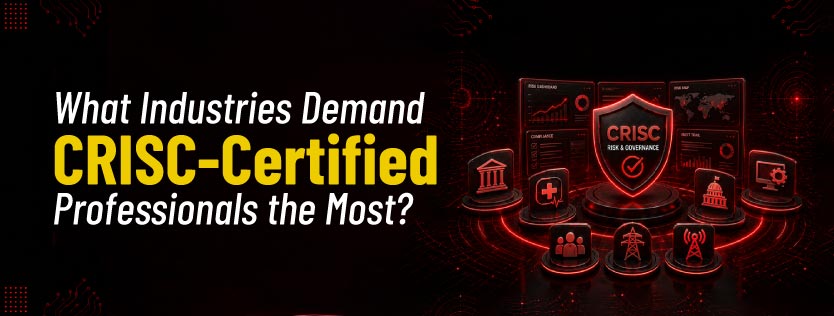
What Industries Demand CRISC-Certified Professionals the Most?
Quick Insights:
CRISC professionals act as proactive risk navigators, identifying threats before they impact the business and aligning IT risk with organizational goals. They are in high demand across industries like banking, healthcare, government, technology, retail, energy, and telecommunications. Their role goes beyond security—they help ensure compliance and resilience, translate technical risks into business decisions, and enable organizations to grow securely. This positions them as strategic leaders rather than just technical experts.
Imagine a city where everything, from traffic lights to water systems and electricity, is connected to a central digital brain.
- The Traditional Guard: They sit in a control room, waiting for a red light to flash or an alarm to go off. They are ready to react, but by then, the traffic is already jammed.
- The CRISC Leader (The Navigator): They walk the city streets before the system even turns on. They look for the what-ifs that no one else has considered.
How the Story Plays Out
- The Risk: While auditing the Smart Grid, the CRISC navigator notices that the city’s maintenance tablets use an outdated, easily mimicked automatic login.
- The Fix: Instead of waiting for a hacker to hijack a tablet and shut down the power, they implement Multi-Factor Authentication (MFA) and set up behavioral alerts that flag any strange activity immediately.
- The Result: A few weeks later, a hacker tries to use a stolen tablet to access the city’s water controls. Because of the new digital checkpoints, the system blocks the hacker instantly. The city never even notices that the water keeps flowing, the lights stay on, and the citizens remain safe.
What Industries Demand CRISC-Certified Professionals the Most?
1. Banking and Financial Services (BFSI)
The financial sector remains the top employer for CRISC professionals. Banks deal with high-value transactions and sensitive data every second, making them prime targets for sophisticated fraud.
- The Role: CRISC experts align IT risk with financial risk, ensuring compliance with SOX, Basel III, and PCI DSS.
- Impact: They translate technical vulnerabilities into “business language” that the Board of Directors can use to make investment decisions.
2. Healthcare and Pharmaceuticals
With the total digitalization of patient records, healthcare has become a critical front for risk management.
- The Role: Managing the risk of data breaches that could lead to identity theft or, more critically, the disruption of life-saving medical services.
- Impact: They ensure strict adherence to HIPAA and GDPR, focusing on the privacy and integrity of Patient Health Information (PHI).
3. Government and Defense
Geopolitical tensions in 2026 have prompted government agencies to prioritize national security and the protection of critical infrastructure.
- The Role: Implementing risk frameworks like NIST to safeguard confidential files and citizen data against cyber-espionage.
- Impact: CRISC professionals help these agencies maintain public trust by proving that their governance models are resilient against state-sponsored threats.
4. Technology and Cloud Service Providers (CSPs)
As the world moves toward cloud-native architectures, tech giants like AWS, Google, and Microsoft require risk specialists to manage massive, multi-tenant environments.
- The Role: They focus on Third-Party Risk Management (TPRM) and ensuring that automated AI pipelines don’t introduce hidden vulnerabilities.
- Impact: They provide the trust layer that allows other businesses to host their data in the cloud with confidence.
5. E-commerce and Retail
With millions of transactions processed daily, retail giants are under constant pressure to secure payment gateways.
- The Role: Protecting the supply chain and customer payment data from automated threats like bot attacks and credential stuffing.
- Impact: CRISC holders help maintain consumer trust and prevent the massive financial losses associated with large-scale data breaches.
6. Energy, Utilities, and Critical Infrastructure
As power grids, water systems, and oil pipelines become increasingly smart, they also become targets for physical and digital sabotage.
- The Role: CRISC professionals focus on Operational Technology (OT) risk. They ensure that IT systems connected to the physical world are governed by strict risk controls to prevent catastrophic failures.
- Impact: They bridge the gap between traditional engineering and cybersecurity, ensuring that a digital breach does not lead to a physical disaster.
7. Telecommunications
With the global rollout of 5G and satellite internet, telecom providers are the backbone of modern communication, making their risk posture a matter of national importance.
- The Role: Managing the risk associated with high-speed data transit, network virtualization, and the massive influx of IoT (Internet of Things) devices.
- Impact: CRISC holders help prevent large-scale outages and protect the privacy of billions of communication packets moving through global networks.
Conclusion
- Be a Leader: CRISC is not just about technical settings; it’s about being the person who knows how to protect the future of the whole company.
- High Demand: In places like big banks or hospitals, this certification is what gets you a seat at the leadership table.
- Infosectrain Expertise: If you want to become the navigator that every kingdom is looking for, the CRISC Certification Training with Infosectrain is the perfect place to start your journey.

TRAINING CALENDAR of Upcoming Batches For CRISC Training
| Start Date | End Date | Start - End Time | Batch Type | Training Mode | Batch Status | |
|---|---|---|---|---|---|---|
| 05-Dec-2026 | 09-Jan-2027 | 20:00 - 23:00 IST | Weekend | Online | [ Open ] |
Frequently Asked Questions
What does a CRISC-certified professional actually do?
CRISC professionals identify, assess, and manage IT and business risks. They design controls, align risk strategies with business goals, and ensure organizations stay secure and compliant.
Which industry hires the most CRISC-certified professionals?
Banking and financial services lead the demand due to high-value transactions and strict regulatory requirements, but many other industries also actively hire CRISC experts.
Is CRISC only useful for cybersecurity roles?
No, CRISC goes beyond cybersecurity. It focuses on enterprise risk management, governance, compliance, and aligning IT risks with the overall business strategy.
Why are CRISC professionals important for modern organizations?
They help prevent disruptions by identifying risks early, improving decision-making, and ensuring that security investments support business objectives.
Can CRISC certification help in leadership roles?
Yes, CRISC positions professionals for leadership roles by enabling them to communicate risks in business terms and influence strategic decisions at the executive level.