Ethical Hacking in the Age of AI
Quick Insights:
AI is changing ethical hacking by making cybersecurity more automated, predictive, and intelligence-driven. Modern Ethical Hackers now use AI-powered vulnerability scanners, automated penetration testing tools, machine learning-based threat detection, behavioral analytics, and predictive threat intelligence to identify risks faster and respond more effectively. However, AI also gives attackers new capabilities, such as AI-generated phishing, deepfake-based social engineering, self-learning malware, automated password cracking, and faster reconnaissance. The future of ethical hacking will depend on professionals who can combine human judgment, security expertise, and AI-driven tools to defend against increasingly advanced cyber threats.
Every major technological shift brings new opportunities and new risks. Today, Artificial Intelligence (AI) is not just transforming businesses; it is reshaping how cyber threats are created, executed, and defended against. From AI-generated phishing emails that appear highly realistic and human-like to self-evolving malware that adapts in real time, the cyber landscape is becoming more intelligent and unpredictable.

In this rapidly changing environment, ethical hacking is no longer just about testing systems for weaknesses; it has evolved into a strategic discipline focused on anticipating and outsmarting AI-driven threats. The role of Ethical Hackers is shifting from problem-solvers to future-focused defenders, equipped with intelligent tools and data-driven insights.
What is Ethical Hacking in the AI Era?
Ethical hacking refers to authorized testing of systems to detect vulnerabilities before malicious hackers can exploit them. It traditionally involved manual penetration testing, vulnerability assessments, and security audits. But today, AI is significantly augmenting ethical hacking by enhancing automation and detection capability.
Modern Ethical Hackers now use:
- AI-driven vulnerability scanners
- Automated penetration testing tools
- Machine learning-based threat detection systems
- Behavioral analytics for insider threat detection
In simple terms:
Earlier -> “Ethical hacking focused on periodic manual assessments”
Now -> “Modern approaches combine continuous monitoring with predictive analytics”
Why AI is Changing Cybersecurity
Here are some of the latest insights that highlight the impact of AI in cybersecurity:
- According to industry reports, AI-driven cyberattacks have increased by over 35% in the last 2 years
- Nearly 70-75% of organizations are now integrating AI into their cybersecurity strategies
- The average cost of a data breach in 2025 crossed $4.5 million globally
- AI can detect threats up to 60% faster compared to traditional systems
- Over 60% of organizations report improved incident response times using AI
These stats clearly show that AI is both a weapon and a shield in cybersecurity.
AI vs. Hackers: A New Cyber Arms Race
The cybersecurity landscape today is essentially an arms race between AI-powered attackers and AI-enabled defenders.
How Cybercriminals Are Using AI
Modern attackers are leveraging AI in ways that were unimaginable a few years ago:
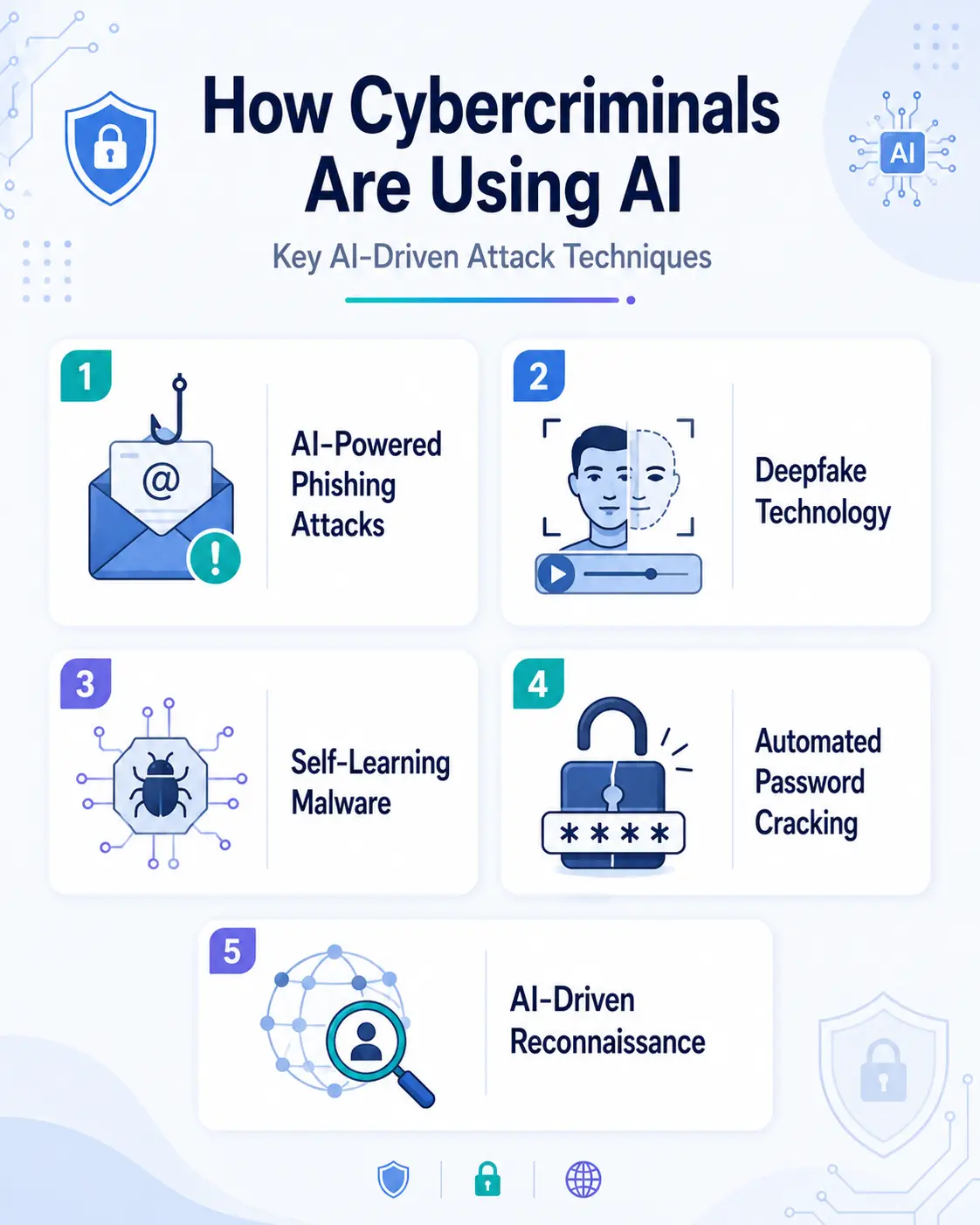
- AI-Powered Phishing Attacks: Personalized emails generated using NLP (Natural Language Processing)
- Deepfake Technology: Used for impersonation and social engineering attacks
- Self-Learning Malware: Malware that adapts its behavior to avoid detection
- Automated Password Cracking: Using machine learning to predict password patterns
- AI-Driven Reconnaissance: Scanning targets faster and more efficiently
How Ethical Hackers Are Fighting Back
Ethical Hackers are not behind; they are evolving faster with AI:
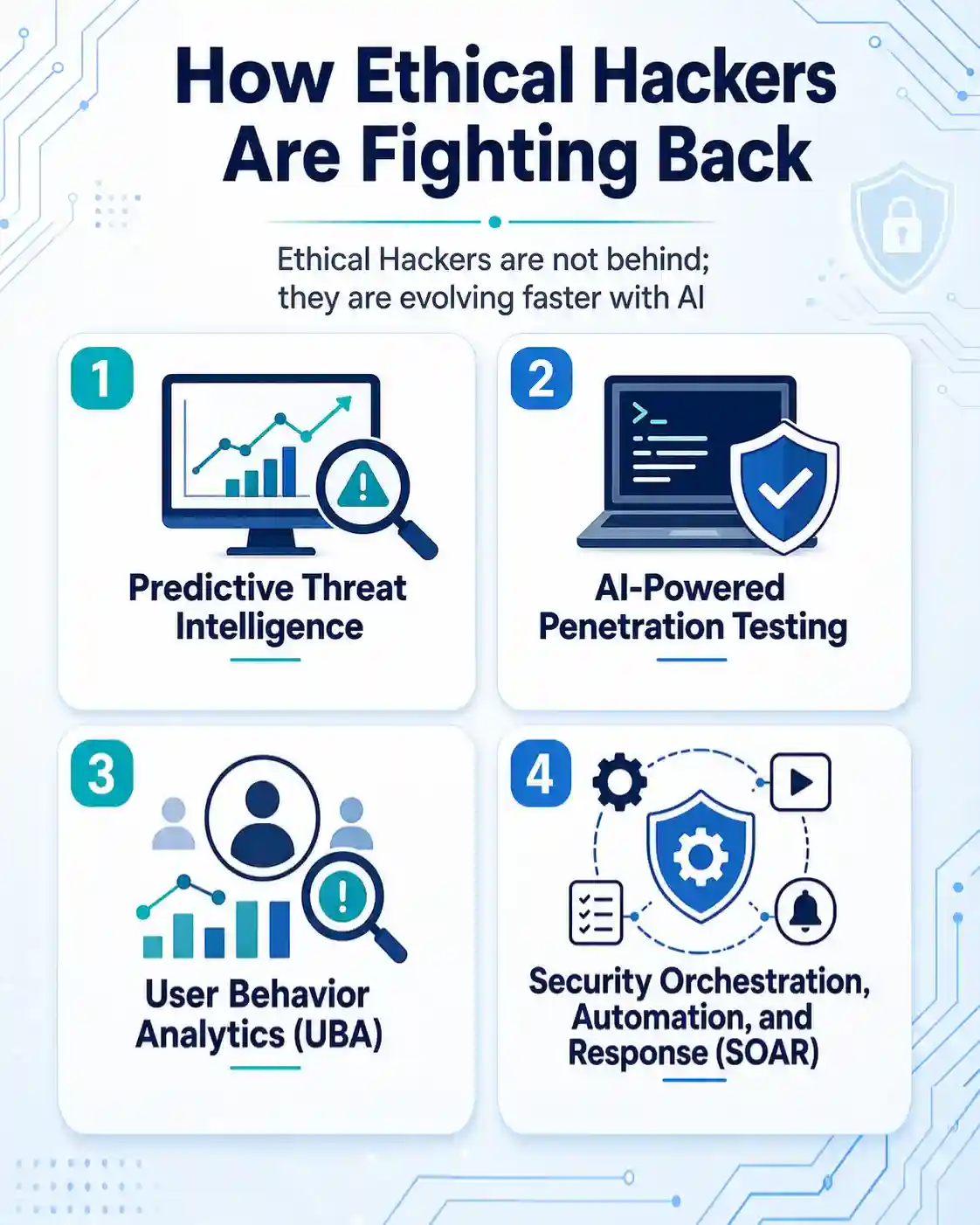
- Predictive Threat Intelligence: Identifying potential attack vectors before exploitation
- AI-Powered Penetration Testing: Prioritizing vulnerabilities and suggesting potential attack paths
- User Behavior Analytics (UBA): Detecting insider threats and anomalies
- Security Orchestration, Automation, and Response (SOAR): Automating incident response workflows
Key Benefits of AI in Ethical Hacking
- Faster Vulnerability Detection: AI-powered tools can scan networks, applications, and systems in real-time, identifying vulnerabilities much faster than manual testing methods.
- Predictive Threat Intelligence: AI analyzes historical data and patterns to predict potential cyberattacks, enabling Ethical Hackers to take proactive security measures.
- Real-Time Monitoring and Response: AI continuously monitors systems and can trigger instant responses to suspicious activities, significantly reducing response time.
- Automation of Repetitive Tasks: Tasks like vulnerability scanning, log analysis, and reporting are automated, allowing Ethical Hackers to focus on complex and strategic threats.
- Adaptive Learning Capabilities: Machine learning models evolve with new threats, making cybersecurity systems smarter and more resilient over time.
- Improved Accuracy and Reduced False Positives: AI enhances detection precision by minimizing false alerts, enabling security teams to prioritize real threats effectively.
Challenges and Risks of AI in Ethical Hacking
- Adversarial AI Attacks: Cybercriminals can manipulate AI models by feeding them malicious or misleading data, leading to incorrect threat detection or bypassing security systems.
- Bias in AI Models: Poorly trained AI models may produce biased or inaccurate results, affecting security decisions and risk assessments.
- Over-Reliance on Automation: Excessive dependence on AI tools may reduce human judgment and critical thinking, leading to missed complex or contextual threats.
- Skill Gap in Workforce: There is a lack of skilled professionals in AI and cybersecurity, hindering the effective implementation of AI-driven security.
- Data Privacy and Compliance Risks: AI systems require large datasets, which can expose sensitive information and create challenges in complying with regulations like GDPR or DPDP Act.
- High Implementation Cost: Deploying AI-based cybersecurity solutions can be expensive for small and medium-sized organizations.
Emerging Trends in Ethical Hacking with AI
- AI-Powered Red Teaming: Ethical Hackers are using AI to simulate advanced, real-world cyberattacks, helping organizations test and strengthen their defenses more effectively.
- Autonomous Security Operations (AI-SOC): AI-driven Security Operations Centers enable real-time threat detection, analysis, and response—significantly reducing reliance on manual intervention.
- AI Governance and Responsible Security: Organizations are focusing on securing AI systems themselves, ensuring compliance, transparency, and ethical use of AI in cybersecurity.
- AI in Cloud and Zero Trust Security: AI enhances cloud security and supports Zero Trust models by continuously verifying users and devices.
- Predictive Threat Intelligence: AI analyzes vast datasets to identify patterns and predict future cyber threats, enabling proactive security strategies.
- Behavioral Analytics and Insider Threat Detection: AI continuously monitors user behavior, detecting unusual patterns and stopping insider threats before they cause damage.
In Conclusion
Ethical hacking is evolving from manual security testing to AI-driven, proactive defense. While AI improves speed, accuracy, and automation, it also introduces risks such as adversarial attacks, privacy issues, and over-reliance on tools. The future of ethical hacking will belong to professionals who can combine traditional security skills with AI-powered techniques and strong human judgment.
CEH AI Certification Training with InfosecTrain
Ready to Become an AI-Powered Ethical Hacker?
The future of cybersecurity belongs to professionals who can combine ethical hacking skills with AI intelligence. If you want to stay ahead of evolving cyber threats and master real-world attack and defense techniques, now is the time to upgrade your skillset.
Join InfosecTrain’s CEH AI Certification Training and gain hands-on experience in:
- AI-powered penetration testing
- Real-world hacking simulations
- Advanced threat detection techniques
- Automation in cybersecurity
Learn from industry experts, work on practical labs, and build job-ready skills that organizations are actively looking for.

Secure your future in cybersecurity today!
Enroll in InfosecTrain’s CEH training now and take the first step toward becoming a cybersecurity expert!
TRAINING CALENDAR of Upcoming Batches For CEH v13 AI Training
| Start Date | End Date | Start - End Time | Batch Type | Training Mode | Batch Status | |
|---|---|---|---|---|---|---|
| 21-Nov-2026 | 20-Dec-2026 | 09:00 - 13:00 IST | Weekend | Online | [ Open ] | |
| 12-Dec-2026 | 24-Jan-2027 | 19:00 - 23:00 IST | Weekend | Online | [ Open ] | |
| 16-Jan-2027 | 21-Feb-2027 | 09:00 - 13:00 IST | Weekend | Online | [ Open ] | |
| 20-Feb-2027 | 28-Mar-2027 | 19:00 - 23:00 IST | Weekend | Online | [ Open ] | |
| 13-Mar-2027 | 18-Apr-2027 | 09:00 - 13:00 IST | Weekend | Online | [ Open ] |
Frequently Asked Questions
What is ethical hacking in the age of AI?
Ethical hacking using AI involves identifying and preventing cyber threats faster through automation, predictive analytics, and intelligent security tools.
How is AI transforming ethical hacking?
AI automates security tasks, improves threat detection, enables predictive analysis, and shifts ethical hacking from a reactive to a proactive approach to cybersecurity.
Can AI replace Ethical Hackers?
No, AI supports Ethical Hackers but cannot replace human judgment, creativity, and decision-making required for complex cybersecurity challenges.
What are the risks of AI in ethical hacking?
Risks include adversarial attacks, data privacy issues, bias in AI models, over-reliance on automation, and high implementation costs.
What is AI-powered penetration testing?
AI-powered penetration testing uses automation and machine learning to simulate attacks and identify vulnerabilities more efficiently than manual methods.
What is the future of ethical hacking with AI?
Ethical hacking will become more predictive, automated, and AI-driven through advancements such as AI-SOC, red teaming, and intelligent threat detection.