Holiday Skills Carnival:
 Buy 1 Get 1 Offer
Days
Hours
Minutes
Seconds

Practical DevSecOps Training in Kota

Read Reviews

InfosecTrain’s Practical DevSecOps course in Kota provides a comprehensive, hands-on learning experience in implementing DevSecOps practices within Docker and Kubernetes environments, specifically emphasizing Spring Boot applications. This course blends theoretical knowledge with immersive labs and a compelling Spring Boot application demonstration to ensure a profound understanding of DevSecOps principles and best practices.

Watch Intro Video

Course Highlights

  • 45-Hour LIVE Instructor-Led Training
  • Scenario-based Practical Approach
  • 6+ Intermediate Learning Projects Covered
  • Immersive Learning
  • Hands-on Projects for Each Tool
  • Learn from Industry Experts
  • Career Guidance and Mentorship
  • 40+ Open-source Tools
  • Access to Recorded Sessions

Accredited By

Choose your Preferred Learning Mode

ON DEMAND TRAINING

Learn on Your Own Time
1-to-1 learning
Customized Solutions

Contact US

ONLINE TRAINING

Flexibility, Convenience & Time Saving
More Effective
Learning Cost Savings

Classes starting from

5th Sep: Weekend

15th Sep: Weekday

ENROLL NOW Preferred

CORPORATE TRAINING

Anytime, Anywhere – Across The Globe
Hire A Trainer
At Your Own Pace
Customized Corporate Training

Contact US For Business

you were looking for your convenient time & date

REQUEST A BATCH

Course Description

AI-Powered Practical DevSecOps Training from InfosecTrain has been meticulously crafted to equip participants with comprehensive knowledge and hands-on expertise in implementing DevSecOps practices within modern Docker and Kubernetes environments. This program emphasizes the use of AI-assisted security, automation, and intelligent decision-making to strengthen CI/CD pipelines and software supply chains. Learners gain practical experience in integrating security controls, policy enforcement, and AI-driven insights across the software development lifecycle. The course combines strong theoretical foundations with immersive hands-on labs, enabling participants to apply DevSecOps and AI principles effectively in real-world, enterprise-scale environments.


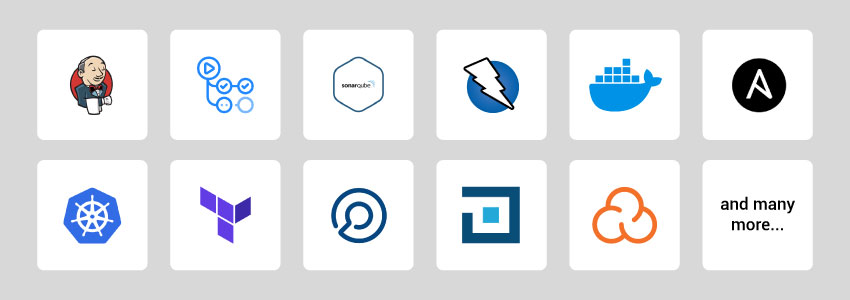
Tools

Target Audience

  • DevOps Engineers
  • Security Engineers
  • Software Engineers
  • System Administrators
  • Architects and Product Managers
  • Developers
  • Testers
  • Cloud Architects
  • Cloud Infrastructure Specialists
  • Platform Engineers
  • Site Reliability Engineers (SREs)
  • Cloud Security Engineers

Pre-Requisite

  • Basic knowledge of Linux command-line usage, containerization concepts, and general DevOps practices
  • Technical background or B.E/B.Tech degree

GET A FREE DEMO CLASS

For
Captcha*
9 + 81 =
loader-infosectrain

Course Objectives

Upon successful completion of the training, participants will be able to:

  • Understand DevSecOps principles, benefits, and challenges in modern software pipelines
  • Familiarize with Docker and Kubernetes for container and workflow management
  • Implement CI/CD pipelines with integrated security and automation
  • Perform vulnerability scanning, testing, and AI-assisted security checks in DevSecOps
  • Utilize tools for identifying code, infrastructure, and AI model vulnerabilities
  • Secure Kubernetes networking, communication, and AI/LLM deployment endpoints
  • Authenticate and authorize Kubernetes API Server and AI service access
  • Monitor Kubernetes clusters and AI pipelines for security incidents
  • Manage secrets and sensitive data, including AI model keys and credentials
  • Learn popular secrets management tools like HashiCorp Vault and integrate with AI pipelines
  • Explore AI-assisted DevSecOps workflows, prompt hygiene, and AI code security
  • Understand security orchestration and automated compliance in hybrid AI-DevSecOps environments

Course Content

  • Module 1: Introduction to the Basics
    • What is DevOps?
    • What is Continuous Integration (CI) and Continuous Deployment (CD)?
    • DevOps vs DevSecOps vs Rugged DevOps
    • Why traditional DevOps is not enough
    • Introduction to DevSecOps
    • Benefits of DevSecOps for enterprises
    • DevSecOps lifecycle and shared responsibility model
  • Module 2: Introduction to the Tools
    • Version Control
      • Git fundamentals
      • GitHub repository structure, branching, pull requests
    • CI/CD Platforms
      • GitHub Actions
      • Jenkins (overview and comparison)
    • Security & Automation Tools Overview
      • OWASP ZAP
      • Ansible
      • Docker
      • Kubernetes
      • InSpec
    • Toolchain architecture for DevSecOps pipelines
  • Module 3: Software Component Analysis (SCA) in CI/CD Pipeline
    • Introduction to Software Composition Analysis (SCA)
    • Risks from open-source dependencies
    • Dependency vulnerabilities and license risks
    • Integrating SCA into CI pipelines
  • Tools Used for SCA
    • OWASP Dependency-Check
    • RetireJS
    • Safety
  • Demo / Hands-On
    • Scan application dependencies
    • Identify vulnerable libraries
    • Fail CI pipeline based on severity
  • Intermediate Project – 1
    • Implement SCA scanning in a CI pipeline with policy-based failure
  • Module 4: Static Application Security Testing (SAST) in CI/CD Pipeline
    • Introduction to Static Application Security Testing (SAST)
    • Shift-left security principles
    • Code-level vulnerability detection
    • Managing false positives
  • Tools Used for SAST
    • SpotBugs
    • SonarQube
    • SonarCloud
  • Demo / Hands-On
    • Run SAST scans in CI
    • Analyze and triage findings
    • Enforce quality gates
  • Intermediate Project – 2
    • Secure application code using SAST with enforced quality gates
  • Module 5: Dynamic Application Security Testing (DAST) in CI/CD Pipeline
    • Introduction to Dynamic Application Security Testing (DAST)
    • Black-box testing concepts
    • DAST vs SAST vs SCA
  • Tools Used for DAST
    • OWASP ZAP
  • Demo / Hands-On
    • Automated ZAP scans
    • Baseline vs full scans
    • Interpreting runtime vulnerabilities
  • Intermediate Project – 3
    • Integrate automated DAST into CI/CD pipeline
  • Module 6: Infrastructure as Code (IaC) and Its Security
    • Introduction to Infrastructure as Code
    • Security risks in IaC
    • IaC misconfigurations and cloud attack vectors
  • Tools Used for IaC
    • Docker
    • Ansible
    • Terraform
  • Demo / Hands-On
    • Build infrastructure using IaC
    • Identify insecure configurations
    • Secure IaC pipelines
  • Intermediate Project – 4
    • Secure infrastructure provisioning using IaC best practices
  • Module 7: Compliance, Audit & Policy as Code
    • Introduction to Policy as Code
    • Compliance automation concepts
    • Mapping infrastructure to compliance standards
    • CIS Benchmarks overview
  • Tools Used for Compliance / Audit as Code
    • InSpec
    • OpenSCAP
  • Demo / Hands-On
    • Implement compliance profiles
    • Generate audit reports
    • Continuous compliance checks
  • Intermediate Project – 5
    • Build a compliance-as-code pipeline with automated reports
  • Module 8: Vulnerability Management
    • Introduction to Vulnerability Management
    • Vulnerability lifecycle
    • Risk-based prioritization
    • DevSecOps vulnerability workflows
  • Tools Used for Vulnerability Management
    • DefectDojo
  • Demo / Hands-On
    • Ingest findings from SAST, SCA, DAST
    • Triage and manage vulnerabilities
    • Track remediation status
  • Intermediate Project – 6
    • Centralized vulnerability management using DefectDojo
  • Module 9: Software Supply Chain Security & SLSA Fundamentals
    • Introduction to Software Supply Chain Security
    • Real-world supply chain attacks
    • Overview of SLSA (Supply-chain Levels for Software Artifacts)
    • SLSA levels and trust boundaries
    • Provenance and attestations
    • SBOM concepts (SPDX & CycloneDX)
    • Introduction to VEX
  • Module 10: Signing & Verification with Sigstore
    • Why artifact signing matters
    • Key-based vs keyless signing
    • Sigstore architecture overview
    • Cosign, Fulcio, Rekor concepts
  • Demo / Hands-On
    • Generate SBOMs
    • Sign container images using cosign
    • Verify signatures and attestations in CI
  • Module 11: CI/CD Hardening Deep-Dive
    • CI/CD threat landscape
    • OWASP Top 10 CI/CD Risks
    • Common pipeline attack vectors
    • Securing GitHub Actions workflows
  • Key Topics
    • Pinning third-party actions
    • Least-privilege GitHub tokens
    • Input sanitization
    • Secrets exposure prevention
    • OIDC-based authentication
  • Hands-On
    • Exploit an insecure workflow
    • Harden and secure the pipeline
  • Module 12: Container & Kubernetes Security
    • Container security fundamentals
    • Kubernetes threat model
    • Cluster-level and workload-level risks
    • Kubernetes Goat overview
  • Hands-On
    • Container hardening
    • Kubernetes security testing
    • CIS benchmark validation
  • Module 13: Kubernetes Admission Policies (Policy Enforcement)
    • Why “shift-left” is not enough
    • Admission controllers overview
    • Policy enforcement at deploy time
  • Tools Used
    • Kyverno
    • OPA Gatekeeper
  • Hands-On
    • Enforce:
      • No latest images
      • Non-root containers
      • Signed images only
      • SBOM and vulnerability attestations
    • Block non-compliant deployments
  • Module 14: Secrets Management at Scale
    • Why secrets remain a top security risk
    • Secrets in CI/CD and Kubernetes
    • Rotation, auditing, and least privilege
  • Tools Used
    • HashiCorp Vault
    • External Secrets Operator
  • Hands-On
    • Integrate Kubernetes with external secret managers
    • Automatic secret rotation and auditing
  • Module 15: Evidence & Attestation (SSDF Alignment)
    • Introduction to NIST Secure Software Development Framework (SSDF – SP 800-218)
    • SSDF practice groups (PO, PS, PW, RV)
    • Evidence collection in DevSecOps pipelines
    • Mapping tools and pipelines to SSDF controls
    • Overview of CISA Secure Software Development Attestation
  • Hands-On
    • Create SSDF evidence artifacts
    • Dry-run CISA attestation using pipeline outputs
  • Module 16: (Elective) AI in DevSecOps
    • AI and GenAI in the SDLC
    • Risks of AI-assisted development
    • OWASP Top 10 for LLM Applications
    • NIST AI Risk Management Framework
    • Prompt injection and data leakage
    • Securing AI-generated code
  • Hands-On
    • Secure AI usage policy
    • Prompt hygiene and guardrails
    • CI checks for AI-generated code

Final Capstone Project
Integrating All the Tools into a Single Secure CI/CD Pipeline

  • Capstone Objectives
    • End-to-end DevSecOps pipeline
    • SAST, SCA, DAST integration
    • SBOM generation
    • Artifact signing and verification
    • Kubernetes admission enforcement
    • Secrets management
    • Vulnerability management
    • SSDF evidence pack

Need customized curriculum Talk to Advisor

Here What people are saying about InfosecTrain

Why InfosecTrain

Guaranteed* to run Courses

4 hrs/day in Weekday/Weekend

Customized Training

Technical Support Post Training

Access to the recorded session

Accredited Instructors

TOP