What is the ISO Family of Standards?
Quick Insights:
The ISO family of standards provides internationally recognized frameworks that ensure quality, security, efficiency, and safety across industries. Covering critical areas such as Quality Management (ISO 9001), Information Security (ISO 27001), Risk Management (ISO 31000), and AI Governance (ISO 42001), these non-mandatory standards help organizations streamline operations, manage risks, ensure regulatory compliance, and build global market credibility. Implementing ISO frameworks enables businesses to build stakeholder trust and operate consistently in an evolving global economy.
Remember the last time you bought a product and saw the label “ISO-certified”? You probably did not give it much thought, but that small label carries a huge impact. In today’s global economy, where quality, security, and efficiency determine success, ISO standards are the foundation of global consistency. According to the ISO, more than 25,000 International Standards have been published, covering industries from manufacturing and healthcare to cybersecurity and Artificial Intelligence (AI).
Organizations that implement ISO management system standards often improve operational efficiency, strengthen regulatory compliance, and enhance customer confidence through standardized processes and continual improvement. Governments and multinational corporations worldwide rely on ISO to ensure product safety, streamline trade, and build consumer trust. International standards support a significant share of global trade by enabling interoperability, quality, and regulatory compliance.
ISO standards touch nearly every aspect of our lives, whether it is ensuring your smartphone does not overheat, making sure your online data stays secure, or guaranteeing that the food on your plate meets hygiene regulations. So, what exactly is the ISO family of standards, and why should businesses and consumers alike care?
What is the ISO Family of Standards?
The ISO standards are internationally recognized guidelines and global frameworks developed by the International Organization for Standardization. These standards ensure that products, services, and processes across industries meet internationally agreed-upon benchmarks for quality, safety, and efficiency.
ISO standards are designed to:
- Improve quality and consistency across businesses.
- Enhance customer trust through certification.
- Promote international trade by setting common global benchmarks.
- Ensure regulatory compliance in different industries.
ISO standards are not legally mandatory, but many governments and industries require compliance for operational credibility.
How ISO Standards Work?
ISO standards are established through international collaboration among industry experts. Once a standard is proposed, it undergoes a rigorous review, drafting, and voting process before publication. Organizations implementing certifiable ISO management system standards, such as ISO 9001 and ISO 27001, can apply for certification through accredited third-party certification bodies.
Categories of ISO Standards
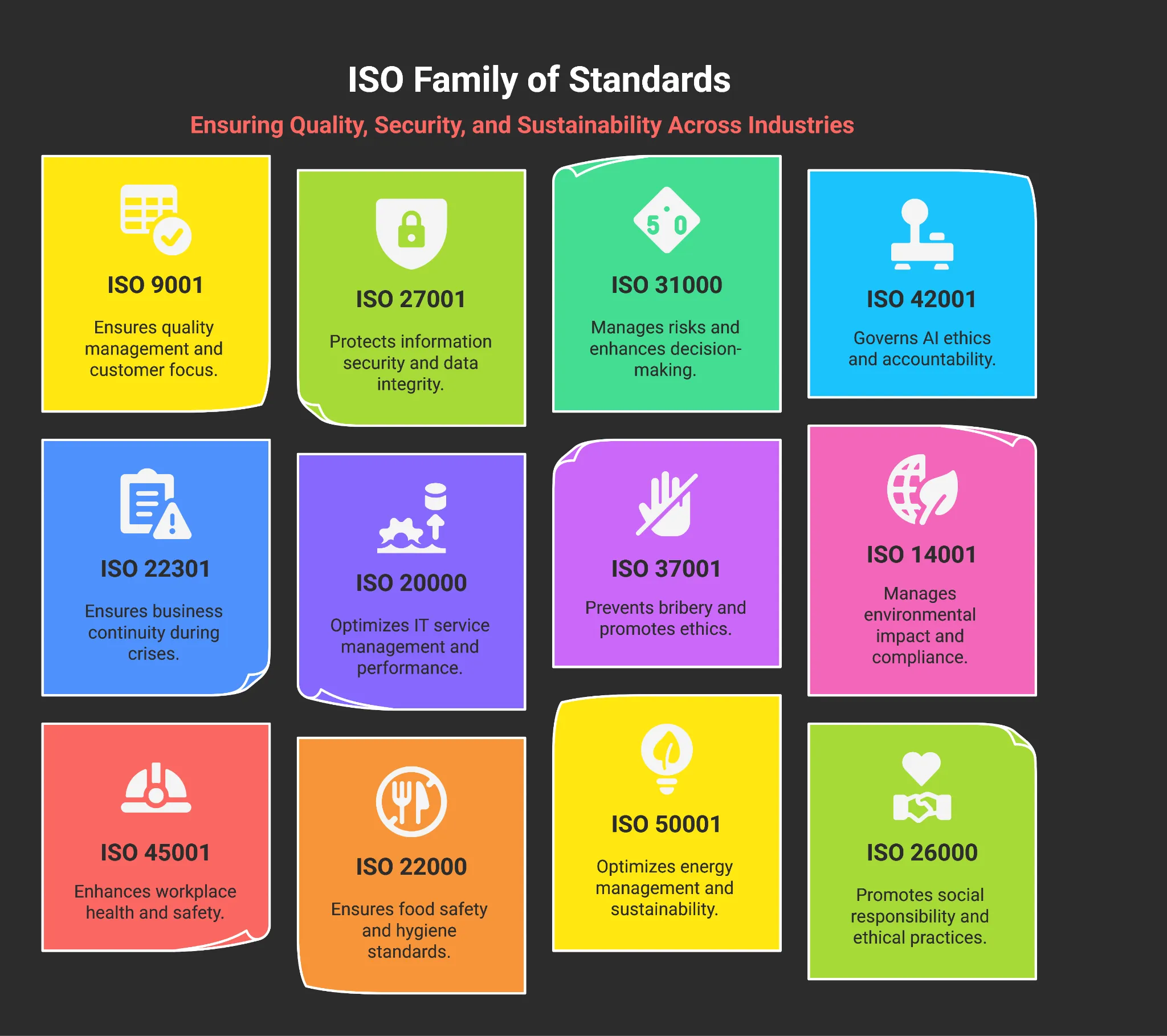
ISO standards cover almost every industry, ensuring everything from product quality to workplace safety. But instead of looking at them as just rules, think of them as game-changers that help businesses thrive, reduce risks, and gain customer trust. Let’s dive into some of the most important ISO standard categories and why they matter.
1. ISO 9000 Family: Quality Management
If there’s one ISO standard that businesses swear by, it is ISO 9001. It is like a blueprint for running a company that customers trust. Whether you are managing a small startup or a multinational corporation, ISO 9001 ensures your processes are efficient, customer-focused, and continuously improving. Companies that adopt ISO 9001 often see fewer defects, better employee engagement, and stronger customer loyalty. ISO 9001 remains the world’s most widely adopted quality management standard, helping organizations improve quality, customer satisfaction, and business credibility across more than 170 countries.
2. ISO 27000 Family: Information Security Management
Imagine your company getting hit by a cyberattack, customer data stolen, operations disrupted, and your reputation shattered. That is where ISO 27001 comes in; it empowers enterprises to secure critical assets, fortify defenses against cyber threats, and maintain strict adherence to international security frameworks. With cyber threats growing every day, adopting ISO 27001 is not just smart; it is essential. Businesses that follow it build trust with customers, knowing their data is safe.
3. ISO 31000: Risk Management
Every business faces risks, from financial downturns to operational hiccups. ISO 31000 does not just help you react; it helps you proactively identify, assess, and manage risks before they become major issues. Whether a bank manages financial risks or a healthcare facility prepares for emergencies, ISO 31000 creates a culture of risk-aware decision-making, saving businesses from costly surprises.
4. ISO 42001: Artificial Intelligence Management
AI is transforming industries, but with great power comes great responsibility. ISO 42001 ensures that AI systems are transparent, accountable, and free from bias. Whether it is an AI-driven medical diagnosis tool or an automated financial advisor, businesses using AI need clear guidelines to prevent ethical risks and ensure fair decision-making. As AI adoption grows, ISO 42001 will become the backbone of responsible AI governance.
5. ISO 22301: Business Continuity Management
Disruptions can strike anytime, such as natural disasters, cyberattacks, or supply chain failures. ISO 22301 helps businesses prepare for the unexpected by ensuring they have solid continuity plans in place. Whether it is a hospital ensuring patient care during a power outage or a bank maintaining financial transactions during a crisis, this standard keeps operations running smoothly. Companies that adopt ISO 22301 do not just survive disruptions; they thrive by building resilience and customer confidence.
6. ISO 20000: IT Service Management
In a world where businesses rely on technology, downtime and poor IT service can cripple operations. ISO 20000 sets the benchmark for delivering reliable, efficient IT services, whether it is an in-house IT team or a managed service provider. By ensuring smooth IT operations, reducing incidents, and improving response times, this standard helps companies keep their tech running seamlessly. The result? Better customer satisfaction, stronger cybersecurity, and a competitive edge in the digital age.
7. ISO 37001: Anti-Bribery Management
Corruption destroys reputations and drains businesses of resources. ISO 37001 helps organizations prevent bribery by implementing strict controls, fostering transparency, and ensuring ethical business practices. Whether it is a multinational corporation dealing with global supply chains or a small business securing government contracts, this standard builds trust by proving a commitment to integrity. In a world where ethical business matters more than ever, ISO 37001 is a game-changer.
8. ISO 14000 Family: Environmental Management
Beyond being a mere buzzword, sustainability is now essential, and ISO 14001 guides companies in effectively cutting their carbon emissions, minimizing waste, and complying with strict environmental regulations. Whether a factory optimizes its water usage or a retail giant cuts down packaging waste, ISO 14001 provides the framework for businesses to go green while saving costs. The result? A win-win for both the planet and the bottom line.
9. ISO 45001: Occupational Health and Safety
Workplace accidents do not just harm employees; they hurt businesses too. ISO 45001 ensures safer work environments by identifying risks, enforcing protective measures, and promoting a culture of health and safety. From construction sites to corporate offices, this standard is the gold standard for keeping employees safe and businesses legally compliant.
10. ISO 22000: Food Safety Management
Food safety is not just for restaurants; it affects the entire supply chain. ISO 22000 ensures that food production meets stringent hygiene and safety regulations, preventing contamination and ensuring consumer trust. Whether it is a farm, a food processing plant, or a grocery store, businesses that follow ISO 22000 help keep food safe from farm to fork.
11. ISO 50001: Energy Management
With rising energy costs, businesses must focus on reducing waste, improving efficiency, and lowering their carbon footprint. ISO 50001 helps organizations optimize their energy use, whether it is a manufacturing plant lowering electricity consumption or a corporate office cutting heating costs. It is good for the planet and great for business profitability.
12. ISO 26000: Social Responsibility
In today’s world, consumers and employees expect businesses to do more than just make money; they want ethical practices, fair labor, and sustainability. ISO 26000 provides guidelines for Corporate Social Responsibility (CSR), helping companies build ethical supply chains, promote fair wages, and support community initiatives. It is not about compliance; it is about doing the right thing and building a brand people respect.
Why Do Businesses and Organizations Need ISO Standards?
Implementing ISO standards is a strategic choice that can:
- Increase customer trust by showcasing a commitment to quality and security.
- Streamline operations through standardized processes.
- Reduce risks by implementing best practices.
- Ensure compliance with global and local regulations.
- Facilitate international trade by adhering to common benchmarks.
ISO Training with InfosecTrain
The ISO family of standards plays a fundamental role in shaping industries, ensuring quality, security, and efficiency. Whether you are running a small business, managing a multinational corporation, or simply a consumer, ISO standards impact your daily life more than you realize. As industries evolve, ISO continues to set the gold standard, helping businesses stay competitive and compliant in an ever-changing global market.
If you are looking to gain a competitive edge and master ISO standards like ISO 27001, ISO 31000, and ISO 42001, InfosecTrain’s expert-led training programs can help. With hands-on learning, real-world case studies, and industry-recognized certifications, you will be equipped to implement and manage ISO frameworks effectively.
So, the next time you see “ISO-certified,” you will know it is more than just a label; it is a mark of trust and excellence.

TRAINING CALENDAR of Upcoming Batches For ISO 27001 Lead Auditor Training
| Start Date | End Date | Start - End Time | Batch Type | Training Mode | Batch Status | |
|---|---|---|---|---|---|---|
| 28-Nov-2026 | 27-Dec-2026 | 09:00 - 13:00 IST | Weekend | Online | [ Open ] | |
| 13-Dec-2026 | 30-Jan-2027 | 09:00 - 13:00 IST | Weekend | Online | [ Open ] | |
| 09-Jan-2027 | 14-Feb-2027 | 19:00 - 23:00 IST | Weekend | Online | [ Open ] | |
| 14-Feb-2027 | 27-Mar-2027 | 09:00 - 13:00 IST | Weekend | Online | [ Open ] | |
| 13-Mar-2027 | 11-Apr-2027 | 19:00 - 23:00 IST | Weekend | Online | [ Open ] |
Frequently Asked Questions
What is the ISO family of standards?
The ISO family of standards consists of internationally agreed-upon guidelines developed by the International Organization for Standardization. They establish benchmarks for quality, safety, security, and operational efficiency across various industries worldwide.
Is ISO certification legally mandatory for all businesses?
No, ISO standards are generally voluntary. However, many industry regulations, government bodies, and international contracts require specific ISO certifications as a prerequisite for doing business.
What is the difference between ISO 9001 and ISO 27001?
ISO 9001 focuses on Quality Management Systems (QMS) to ensure consistent product and service quality. ISO 27001 focuses on Information Security Management Systems (ISMS) to protect sensitive organizational data and manage cyber risks.
How does an organization become ISO-certified?
An organization implements the specific ISO requirements and conducts internal audits. It then undergoes a formal assessment by an accredited third-party certification body to verify compliance.
What is ISO 42001, and why is it important for modern organizations?
ISO 42001 is the international standard for Artificial Intelligence Management Systems (AIMS). It provides a structured framework to govern the ethical, transparent, and responsible development and deployment of AI technologies.