How to Prepare for the CPENT AI Exam?
Quick Insights:
The CPENT AI exam is a practical, performance-based certification designed for professionals seeking to develop advanced penetration testing expertise. To prepare effectively, learners should understand the exam structure, strengthen their technical foundations, practice in labs, master enumeration, work on pivoting and hidden networks, use AI-assisted pentesting responsibly, and focus on professional report writing from the beginning. Guided online training can also help learners follow a structured preparation path and improve their hands-on readiness.
Cybersecurity has moved far beyond basic vulnerability scanning. Today’s attackers use automation, AI-assisted reconnaissance, stealthy lateral movement, exploit chaining, and advanced evasion techniques to compromise enterprise environments. This is why organizations need Penetration Testers who can think beyond checklists and perform real-world offensive security assessments.
EC-Council’s Certified Penetration Testing Professional, commonly known as CPENT AI, is an advanced, hands-on certification designed for professionals seeking to master enterprise-level penetration testing, AI-assisted offensive techniques, exploit development, pivoting, Active Directory attacks, IoT testing, and professional report writing.
What is CPENT AI?
EC-Council’s Certified Penetration Testing Professional (CPENT) is a high-level certification course for Penetration Testers. This certification is designed to help experienced cybersecurity professionals build advanced, practical penetration testing skills. Unlike basic ethical hacking programs, CPENT AI focuses on realistic attack scenarios in which candidates must test segmented networks, web applications, APIs, Active Directory environments, Windows and Linux systems, perimeter defenses, IoT devices, and hidden network segments. This certification offers hands-on instruction in various approaches, techniques, and penetration testing principles, enabling students to grasp real-world dynamics and solve real-world security challenges.
CPENT AI Course Outline
The CPENT AI curriculum comprises 14 modules covering the major stages and disciplines of professional penetration testing.
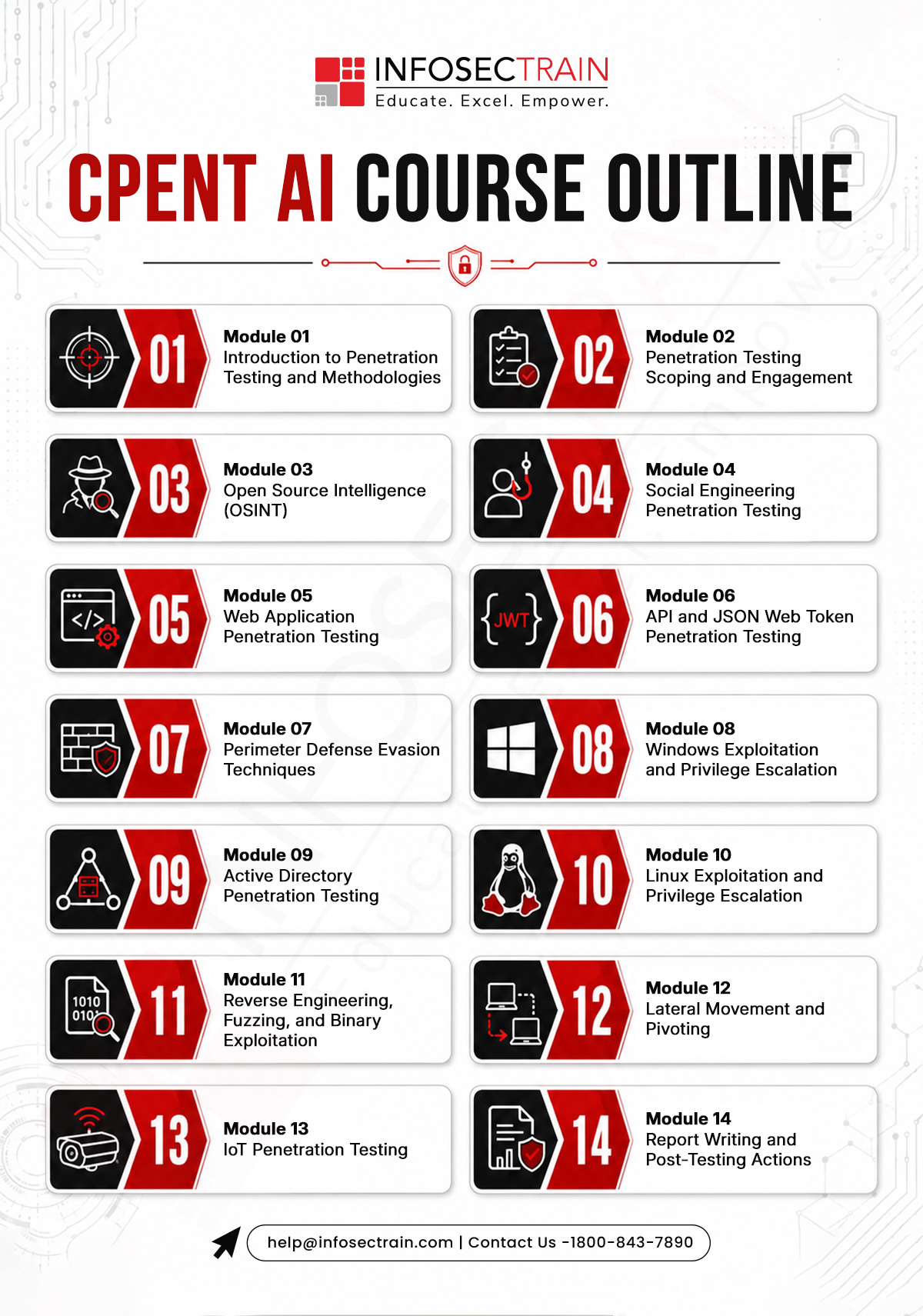
Additional self-study areas may include OT SCADA Security Training, cloud penetration testing, database penetration testing, wireless penetration testing, mobile device penetration testing, scripting, and Metasploit practice.
Pre-requisites
Learners should have a basic understanding of cybersecurity, networking, operating systems, and security fundamentals. Familiarity with ethical hacking, penetration testing basics, Linux, Windows, and common security tools is recommended. CEH or equivalent knowledge is helpful but not mandatory for training.
CPENT AI Exam Information
The CPENT AI exam is 100% practical and performance-based.
| Exam Name | Certified Penetration Testing Professional |
| Exam Code | CPENT / 312-39 |
| Duration | You can choose from: 1. One 24-Hour Session2. Two 12-Hour Sessions |
| Passing Score | Score between the required cut score and 89% to earn the CPENT
Score 90% or above to earn CPENT + LPT (Master) |
| Exam Format | 100% Practical, Performance-Based |
| Languages | English |
| Delivery | Online, remotely proctored |
Note: The CPENT AI exam can lead to two certification outcomes. Candidates who meet the applicable passing score earn CPENT, while those who score 90% or above earn both CPENT and LPT (Master).
Who Should Get CPENT AI Certification?
This course is suitable for:
- Ethical Hackers
- Penetration Testers
- Red Team Professionals
- VAPT Analysts and Engineers
- Security Testers
- Application Security Professionals
- Network Server Administrators
- Firewall Administrators
- System Administrators
- Security Consultants
- Cybersecurity Engineers
- Risk Assessment Professionals
- Professionals preparing for advanced offensive security roles
CPENT AI is not designed as a beginner-level certification. It is open to professionals with an information security background, CEH certification, or equivalent knowledge; candidates attempting the exam directly must have at least 2 years of information security experience.
How to Prepare for the CPENT AI Certification Exam?
Success in the CPENT AI exam requires structured preparation, consistent hands-on practice, disciplined documentation, and effective time management. The following steps can help you build an exam-ready preparation strategy.
1. Understand the Exam Structure First
Before beginning your preparation, become familiar with the exam format, duration, practical environment, scoring criteria, and report submission requirements. Review the certification objectives, curriculum modules, prerequisites, and expected outcomes.
Because CPENT AI is a lengthy performance-based exam, technical knowledge alone is not enough. You also need endurance, time-management skills, documentation discipline, and the ability to remain calm while solving complex challenges.
2. Identify Your Skill Gaps and Create a Study Plan
Before starting intensive preparation, evaluate your current practical abilities and identify the areas that need the most improvement. Instead of studying every topic equally, use a self-assessment to develop a preparation plan tailored to your strengths and weaknesses.
Create a weekly plan that includes technical learning, lab practice, revision, reporting exercises, and timed mock assessments. Review your progress regularly and adjust the plan as your skills improve.
3. Strengthen Your Core Technical Knowledge
Once you have identified your skill gaps, strengthen the technical knowledge required to work confidently in advanced penetration testing environments. Focus on:
- Networking protocols
- TCP/IP
- Linux and Windows administration
- Web application security
- API security
- Vulnerability assessment
- Exploitation basics
- Privilege escalation
- Common penetration testing tools
- Scripting basics
CEH or equivalent knowledge is helpful, but practical exposure is even more important.
4. Review the Official CPENT AI Curriculum
Use the official CPENT AI course material, exam objectives, labs, and curriculum as the foundation of your preparation. These resources clarify the certification’s scope and the skills candidates are expected to demonstrate.
You may supplement official resources with:
- Cyber ranges
- Technical walkthroughs
- Webinars
- White papers
- Bootcamps
- CTF challenges
- Community discussions
Make sure all resources are up to date and aligned with the latest CPENT AI curriculum. Avoid exam dumps and unauthorized materials, as they do not develop the practical abilities required for a performance-based assessment and may violate certification policies.
5. Practice in Labs, Not Just Notes
CPENT AI is a practical exam, so most of your preparation should involve hands-on work. Spend consistent time working on labs, vulnerable machines, cyber ranges, and CTF-style scenarios. CPENT AI learning environment includes 110+ advanced labs, 50+ penetration testing tools, live cyber ranges, and CTF challenges. Focus on understanding why an attack works, not just how to run a command.
6. Master Enumeration
Enumeration is one of the most important skills for CPENT AI. Practice identifying open ports, services, versions, misconfigurations, weak credentials, exposed directories, SMB shares, web endpoints, and internal network clues. Good enumeration helps you find the right attack path rather than guessing at random.
7. Practice Complete Attack Chains
Do not learn tools separately. Practice the full penetration testing flow: reconnaissance, enumeration, exploitation, privilege escalation, pivoting, evidence collection, and reporting. The goal is not just to know a tool, but to understand when, why, and how to use it in a real-world scenario.
8. Focus on Pivoting and Hidden Networks
CPENT AI may test your ability to move through segmented environments. Practice port forwarding, tunneling, proxychains, routing through compromised hosts, internal network discovery, lateral movement basics, and credential reuse. Start pivoting practice early because it takes time to build confidence.
9. Learn AI-Powered Pentesting Responsibly
Since CPENT AI includes AI-powered penetration testing concepts, learn how AI can support recon planning, script review, payload explanation, report drafting, and attack-path analysis. But do not depend blindly on AI. Always validate commands, outputs, findings, and recommendations manually.
10. Practice Reporting from Day One
Report writing is not an afterthought. It is part of the exam mindset. CPENT AI candidates must submit their penetration testing report within seven days of completing their final exam session.
During your preparation, practice documenting target details, vulnerability descriptions, steps to reproduce, screenshots, proof of exploitation, business impact, severity, and remediation. A strong report should look like a professional penetration testing deliverable that a client or security team can understand and act upon.
11. Consider Guided Online Training
Candidates who need a structured preparation path may consider enrolling in an instructor-led online training program. Guided training can provide access to updated course material, practical labs, expert instruction, exam-focused guidance, mentoring, and doubt-clearing support.
Online training is especially useful if you want to improve your practical skills in areas like enumeration, exploitation, privilege escalation, pivoting, AI-assisted pentesting, and report writing.
InfosecTrain’s CPENT AI certification training helps learners follow a structured preparation plan and practice advanced penetration testing techniques across realistic enterprise environments.
12. Final Advice for CPENT AI Exam Day
The CPENT AI exam is long, practical, and demanding. On exam day, stay calm and follow a structured approach.
Keep these points in mind:
- Read the instructions carefully
- Track every target and finding
- Take screenshots as evidence
- Document commands and outputs
- Allocate your time across targets, domains, and reporting activities.
- Do not get stuck too long on one target
- Validate every exploit
- Record findings, commands, evidence, and remediation notes throughout the exam.
- Keep your methodology clean and repeatable
The exam is not only about hacking systems. It is about proving that you can perform a professional penetration test under realistic conditions.
In Conclusion
Preparing for the CPENT AI exam requires strong fundamentals, consistent hands-on practice, and a clear understanding of real-world penetration testing workflows. By focusing on labs, enumeration, pivoting, AI-assisted testing, and report writing, learners can build the confidence and practical skills needed for the exam and advanced offensive security roles.
CPENT AI Training with InfosecTrain
Preparing for CPENT AI requires the right balance of technical depth, hands-on practice, guided mentoring, and exam-focused strategy. InfosecTrain’s CPENT AI Training is designed to help learners build practical penetration testing skills across modern enterprise environments.
The training helps learners understand advanced penetration testing methodology, AI-assisted testing workflows, web and API security testing, Active Directory attacks, Windows and Linux exploitation, perimeter defense evasion, IoT penetration testing, exploit development, pivoting, and report writing.
Frequently Asked Questions
What is CPENT AI?
CPENT AI is EC-Council’s advanced practical penetration testing certification that validates real-world offensive security, AI-assisted testing, exploit development, pivoting, and reporting skills.
Is CPENT AI a practical exam?
Yes. CPENT AI is a 100% practical, performance-based exam conducted in a live cyber range environment.
Is CPENT AI suitable after CEH?
Yes. CPENT AI is a strong next step after CEH, as it builds on ethical hacking fundamentals to advance to hands-on penetration testing.
Does CPENT AI help with real-world VAPT skills?
Yes. CPENT AI helps learners build practical VAPT skills by covering reconnaissance, vulnerability identification, exploitation, privilege escalation, perimeter defense evasion, reporting, and remediation-focused documentation.
Will CPENT AI help me learn Active Directory attacks?
Yes. CPENT AI includes Active Directory penetration testing concepts such as AD reconnaissance, enumeration, password attacks, credential extraction, privilege escalation, lateral movement, and AI-assisted AD enumeration strategies.
Is report writing important in CPENT AI?
Yes. Report writing is a critical part of CPENT AI because the certification evaluates not only technical exploitation skills but also the ability to document findings professionally.