How to Pass the CRAGE Certification?
Quick Insights:
The EC-Council Certified Responsible AI Governance & Ethics (CRAGE) exam validates your ability to operationalize AI governance, manage risk, and maintain compliance across the AI lifecycle. Success requires mastering key frameworks (NIST AI RMF, ISO/IEC 42001, EU AI Act), understanding core domains like AI threat modeling and ethics, and managing your time effectively across 100 scenario-based questions in 180 minutes.
Passing the EC-Council Certified Responsible AI Governance & Ethics (CRAGE) exam requires a solid grasp of AI technology, regulatory compliance, risk management, and governance frameworks. Organizations increasingly demand professionals who can operationalize responsible AI practices, align systems with standards like ISO/IEC 42001 and the NIST AI Risk Management Framework (AI RMF), and satisfy global regulations like the EU AI Act.
This guide outlines the essential steps and study strategies you need to prepare for and pass the CRAGE exam on your first attempt.
Master Core AI Governance Frameworks and Regulations
- NIST AI Risk Management Framework (AI RMF): Learn the four core functions Govern, Map, Measure, and Manage and understand how to apply them across different stages of the AI system life cycle. Pay attention to how NIST categorizes trustworthiness characteristics like safety, explainability, and privacy.
- ISO/IEC 42001: Study the world’s first AI Management System (AIMS) Focus on organizational controls, context definition, risk assessments, continuous improvement loops, and policies required for an audit-ready AI program.
- EU AI Act & Global Regulations: Understand risk-based classification (unacceptable risk, high risk, specific transparency risk, and minimal risk) and compliance obligations for general-purpose AI (GPAI) models. Compare these binding mandates with voluntary guidelines to recognize key differences.
Focus on Key Knowledge Domains
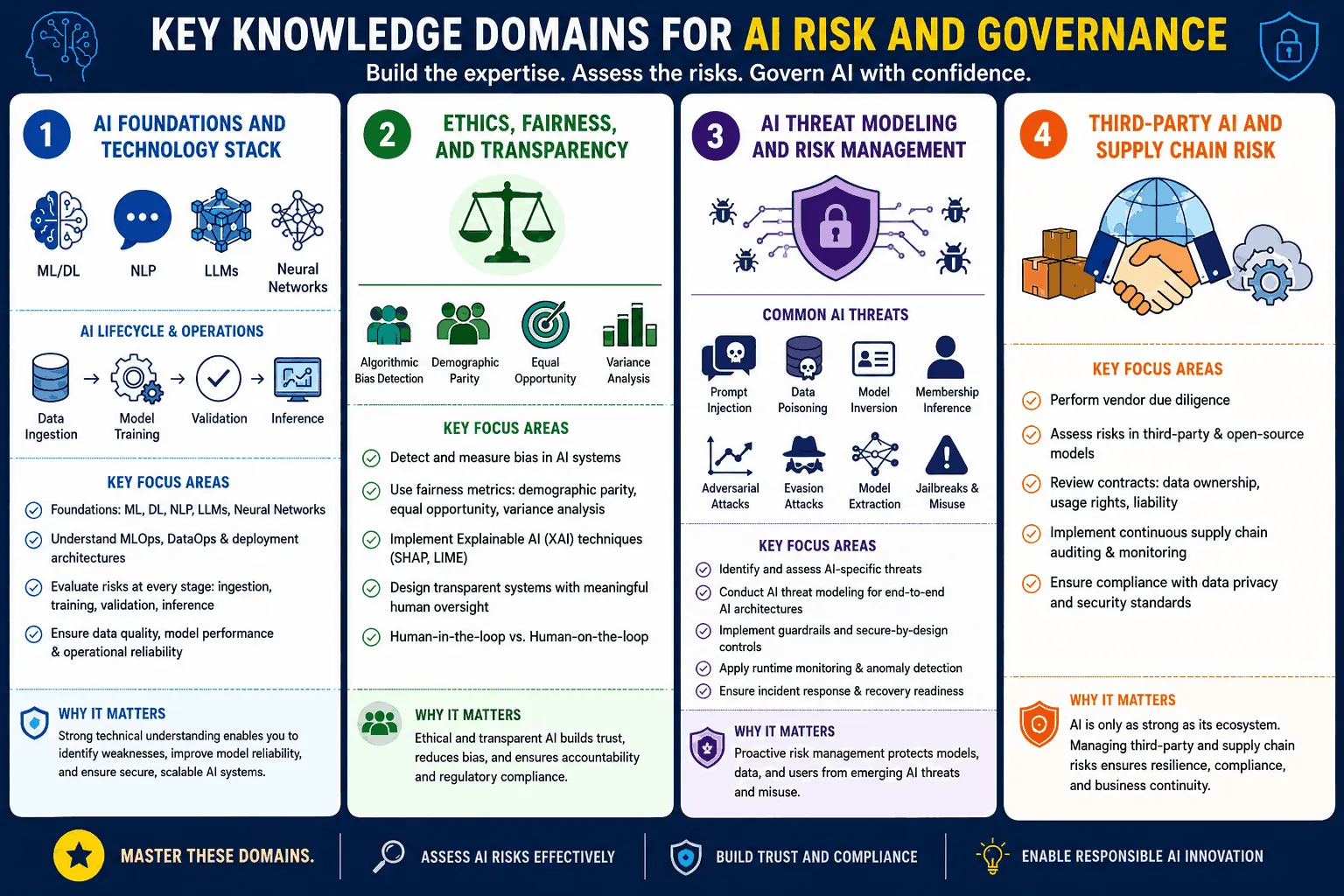
- AI Foundations and Technology Stack
Review the fundamentals of Machine Learning (ML), Deep Learning (DL), Natural Language Processing (NLP), Large Language Models (LLMs), and Neural Networks. Understand the operational flow of MLOps, DataOps, and deployment architectures to evaluate risks at each stage of data ingestion, model training, validation, and inference.
- Ethics, Fairness, and Transparency
Study algorithmic bias detection, demographic parity, equal opportunity metrics, and variance analysis. Learn how to implement Explainable AI (XAI) techniques (such as SHAP and LIME) and design transparent systems that maintain meaningful human oversight (human-in-the-loop vs. human-on-the-loop).
- AI Threat Modeling and Risk Management
Examine AI-specific security vulnerabilities, such as prompt injection, data poisoning, model inversion, membership inference, and adversarial attacks. Learn how to conduct threat modeling specifically for AI architectures, implement guardrails, and execute runtime monitoring controls to mitigate operational risks.
- Third-Party AI and Supply Chain Risk
Understand vendor due diligence, open-source model risks, third-party model risk assessments, contract governance, data ownership rights, and continuous supply chain auditing.
Build a Structured Study Plan
- Step 1: Review the Official Courseware & Blueprint
Go through the official EC-Council CRAGE Course modules systematically. Pay close attention to scenario-based examples where governance decisions directly impact legal liability, operational performance, or organizational reputation.
- Step 2: Create Comparison Tables
Build summary matrices comparing global regulations (e.g., EU AI Act vs. NIST AI RMF vs. ISO 42001) and risk assessment tools. Mapping these concepts side-by-side helps reinforce subtle distinctions tested in the exam.
- Step 3: Practice Scenario-Based Questions
The CRAGE exam evaluates your ability to apply concepts in practical scenarios rather than simple memorization. Practice answering questions that ask you to select the best governance control, legal remedy, or risk mitigation strategy for a given enterprise scenario.
Apply Proven Exam-Day Strategies
- Pace Yourself: With 180 minutes for 100 questions, you have 1.8 minutes per question. Do not spend more than 2 minutes on any single item during your first pass.
- Identify Keywords: Look for key phrases in the question stem such as primary objective, first step, most effective control, or compliance requirement.
- Use the Process of Elimination: Rule out options that advocate non-standard practices, lack human oversight, prioritize speed over compliance, or violate core privacy principles.
- Review Flagged Questions: Flag ambiguous questions and return to them after completing the straightforward items. Trust your instincts on your initial choices unless you find clear evidence in the question stem that you misread it.
Conclusion
Navigating the complexities of AI ethics, risk management, and global regulatory frameworks requires both technical knowledge and strategic oversight. Thorough preparation on core domains and exam-day strategies will position you for success on the C|RAGE certification. Take the next step in advancing your AI governance career by joining the CRAGE Certification Training with InfosecTrain.

Frequently Asked Questions
What key frameworks are covered on the CRAGE exam?
It primarily covers the NIST AI Risk Management Framework (AI RMF), ISO/IEC 42001 (AIMS), and regulatory mandates like the EU AI Act.
What core knowledge domains are tested?
The exam tests AI Foundations & Tech Stack, Ethics & Fairness, AI Threat Modeling & Risk Management, and Third-Party/Supply Chain Risk.
What is the exam format and duration?
It features 100 multiple-choice questions with a total time limit of 180 minutes (3 hours).
How should I prepare for scenario-based questions?
Study official courseware, create framework comparison matrices, and practice applying the best governance controls to real-world enterprise scenarios.
What is the best exam-day time management strategy?
Pace yourself at approximately 1.8 minutes per question, use the process of elimination, and flag complex items to review at the end.