How Does NLP Help in Detecting Phishing Emails?
Quick Insights:
Traditional email security filters fail to catch modern phishing attacks that lack obvious red flags. Natural Language Processing (NLP), a branch of AI split into Natural Language Understanding (NLU) and Natural Language Generation (NLG), bridges this gap by analyzing the intent, emotion, and context of incoming emails. By detecting psychological urgency, uncovering brand impersonation using Named Entity Recognition (NER), profiling sender writing habits through stylometry, and processing full sentence context via Transformer models (like BERT), NLP stops sophisticated phishing and Business Email Compromise (BEC) attacks in real time.
Phishing attacks no longer rely on obvious spelling mistakes and crude links. Cybercriminals now craft sophisticated social engineering campaigns that mimic trusted colleagues, banks, and service providers. Traditional security filters that rely on blacklists and keyword rules frequently miss these refined attacks. Natural Language Processing (NLP) bridges this gap by enabling security systems to read, understand, and analyze the context and intent of human language inside every incoming email.
What is NLP?
Natural Language Processing (NLP) is a field of artificial intelligence (AI) that allows computers to comprehend, interpret, and generate human language in both text and spoken forms.
While computers natively process structured data like spreadsheets and code, human language is unstructured, ambiguous, and heavily dependent on context. NLP bridges this gap by combining computational linguistics (rule-based modeling of language) with machine learning and deep learning models.
Primary Components of NLP
- Natural Language Understanding (NLU): Focuses on comprehension, extracting intent, sentiment, entities, and context from input text or speech (e.g., determining that an email is asking for a wire transfer).
- Natural Language Generation (NLG): Focuses on creation, producing coherent, contextually appropriate human language text or speech from structured data or prompts (e.g., drafting a summary or generating a chatbot response).
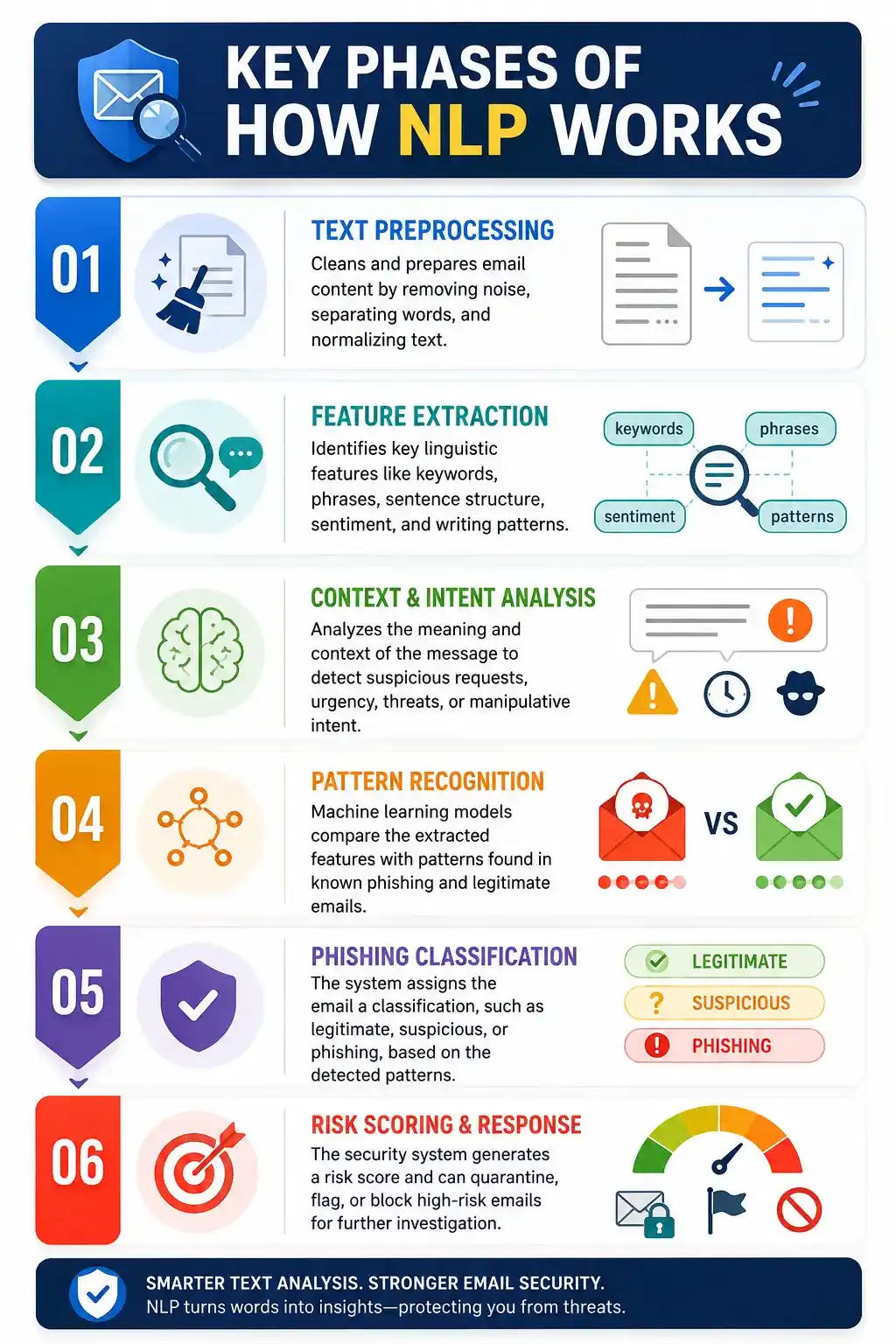
How Does NLP Detect Phishing Emails?
1. Analyzing Tone and Urgency
- Psychological Manipulation: Phishing emails exploit emotions such as fear, panic, or curiosity by creating artificial urgency around threats like account suspensions or financial penalties.
- Sentiment & Intent Analysis: NLP models evaluate emotional tone and message intent rather than relying on isolated spam keywords.
- Pattern Recognition: Algorithms detect high-risk linguistic pairings, such as an urgent demand combined with a severe consequence, and flag the email for inspection.
2. Detecting Brand Impersonation and Spoofing
- Impersonation Tactics: Attackers mimic trusted brands such as Microsoft, Google, or PayPal by tweaking domain names or email display names.
- Named Entity Recognition (NER): NLP uses NER to extract organization names, personal contacts, and job titles from the email body and headers.
- Cross-Verification: The system cross-references extracted entities against the sender address and domain records to spot mismatches.
3. Profiling Writing Style (Stylometry)
- BEC Exploitation: Business Email Compromise (BEC) attacks impersonate executives or vendors to request fraudulent wire transfers, often without links or attachments.
- Behavioral Profiles: NLP applies stylometric analysis to build sender profiles by analyzing sentence length, vocabulary, punctuation, and phrasing.
- Anomaly Detection: If an email claiming to be from a CEO differs from that individual’s established writing style, the system flags it as a potential impersonation attempt.
4. Understanding Context with Transformer Models
- Evolving Threats: Modern attacks bypass static keyword filters by using synonyms or disguising malicious links behind legitimate landing pages.
- Bidirectional Context: Transformer models such as BERT evaluate full sentence context by analyzing words in relation to one another.
- Intent vs. Context: Deep learning algorithms distinguish between benign and malicious uses of identical phrases based on the surrounding context.
Conclusion
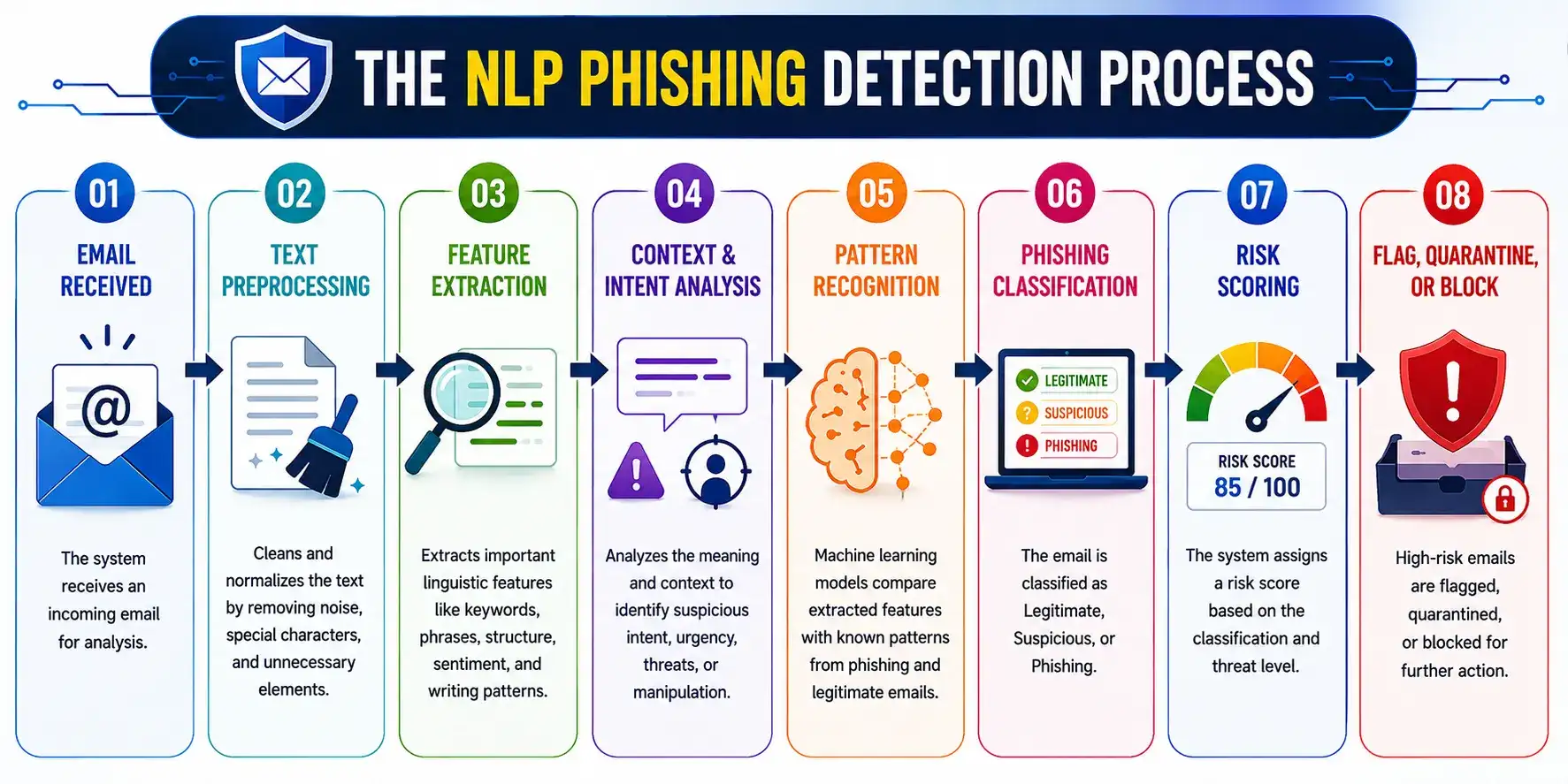
Natural Language Processing (NLP) elevates email security beyond traditional rule-based filters by analyzing sentiment, identifying brand impersonation, profiling writing styles, and assessing semantic context to stop sophisticated phishing attacks in real time. Combining these advanced techniques enables organizations to proactively detect emerging, AI-generated social engineering threats before they reach user inboxes.
To gain hands-on expertise in implementing AI-driven threat detection strategies, explore the Cybersecurity AI Foundation Program with InfosecTrain.

TRAINING CALENDAR of Upcoming Batches For Cybersecurity AI Foundation Program
| Start Date | End Date | Start - End Time | Batch Type | Training Mode | Batch Status | |
|---|---|---|---|---|---|---|
| 14-Nov-2026 | 20-Dec-2026 | 19:00 - 23:00 IST | Weekend | Online | [ Close ] | |
| 05-Dec-2026 | 10-Jan-2027 | 09:00 - 13:00 IST | Weekend | Online | [ Open ] | |
| 09-Jan-2027 | 14-Feb-2027 | 19:00 - 23:00 IST | Weekend | Online | [ Open ] | |
| 27-Feb-2027 | 04-Apr-2027 | 19:00 - 23:00 IST | Weekend | Online | [ Open ] |
Frequently Asked Questions
Why do traditional spam filters miss modern phishing attacks?
Legacy filters rely on static keywords and known malicious links, whereas modern phishing uses clean, AI-generated text and social engineering that bypass rule-based blocklists.
What is the difference between NLU and NLG in email security?
NLU (Understanding) analyzes incoming emails to detect threats and intent, while NLG (Generation) creates automated security alerts and warning banners for users.
How does NLP catch BEC attacks without links or attachments?
NLP uses stylometric analysis to compare a sender's writing style, like vocabulary and sentence structure, against their historical baseline to spot impersonations.
How do Transformer models like BERT improve phishing detection?
Transformer models analyze full sentence context bidirectionally, allowing them to distinguish between legitimate billing notices and unsolicited malicious requests.
Can NLP detect AI-generated phishing emails?
Yes, NLP security models identify AI-written threats by cross-referencing domain metadata, psychological pressure tactics, and subtle semantic anomalies.