90-Day Data Privacy Implementation Roadmap: A Step-by-Step Guide
Quick Insights:
A 90-Day Data Privacy Implementation Roadmap breaks a large compliance effort into three manageable phases. In the first 30 days, assess current practices, build a personal data inventory, assign privacy responsibilities, and identify legal requirements and risks under laws like the GDPR and India’s DPDP Act. In days 31 to 60, put controls in place by updating policies, applying safeguards such as access controls and encryption, setting up consent and individual rights processes, reviewing vendors, and training employees. In the final 30 days, test the controls, run an internal privacy audit, rehearse breach response, and track performance to plan ongoing improvements. Ninety days won’t solve every privacy challenge, but it gives organizations a strong, practical foundation for long-term compliance.
Think about what happens when a customer shares their personal information with a business. Their details might first be collected through a website form, then stored in a CRM, shared with a marketing platform, and passed on to other third-party tools. Now, imagine that the same customer asks the company to delete their data. How can the company be sure that the information has been removed from every system where it exists?
This is one of the major challenges of managing data privacy. Organizations need to know what personal data they collect, where they store it, why they use it, and who can access it. Privacy laws, including the GDPR and India’s Digital Personal Data Protection (DPDP) Act, 2023, have made it even more important for organizations to manage personal information responsibly. However, knowing what needs to be done and knowing where to start are two different things. Should you begin with data mapping, privacy risk assessments, policy updates, or employee training?
A 90-Day Data Privacy Implementation Roadmap gives organizations a clear starting point. Instead of trying to address every privacy requirement at once, it divides the work into practical steps over three months. This helps businesses identify gaps in their current practices, focus on the most important risks, put necessary privacy controls in place, and build a foundation for managing data privacy over the long term.
Why Do Organizations Need a 90-Day Data Privacy Roadmap?
Privacy gaps do not always involve hackers or major security incidents. Sometimes a marketing team collects information it does not need. A recruitment platform retains job applicant records longer than intended. A former employee still has access to a customer database. Or a vendor transfers personal information to another service provider without adequate oversight. Such situations show why data privacy cannot be managed through policies alone. A well-planned implementation roadmap offers several advantages.
1. Defines Clear Responsibilities
Data privacy involves multiple teams, including IT, legal, HR, and operations. A roadmap clarifies who’s responsible for managing data, implementing safeguards, and monitoring compliance.
2. Identifies High-Risk Activities
Some types of personal data need greater protection than others. A roadmap helps organizations identify sensitive data and prioritize areas that carry higher privacy risks.
3. Supports Regulatory Compliance
A roadmap helps organizations turn privacy requirements into practical actions, from managing consent and protecting personal data to handling individual rights requests.
4. Reduces Data Exposure
Collecting more data than necessary or keeping it indefinitely creates avoidable risks. Regular data reviews, retention policies, and access controls help limit exposure.
5. Makes Privacy Management Easier
With clear processes and assigned responsibilities, teams can handle data requests, vendor assessments, and privacy incidents without unnecessary delays.
A 90-day roadmap gives organizations a clear starting point to address privacy gaps and build better data handling practices.
90-Day Data Privacy Implementation Roadmap
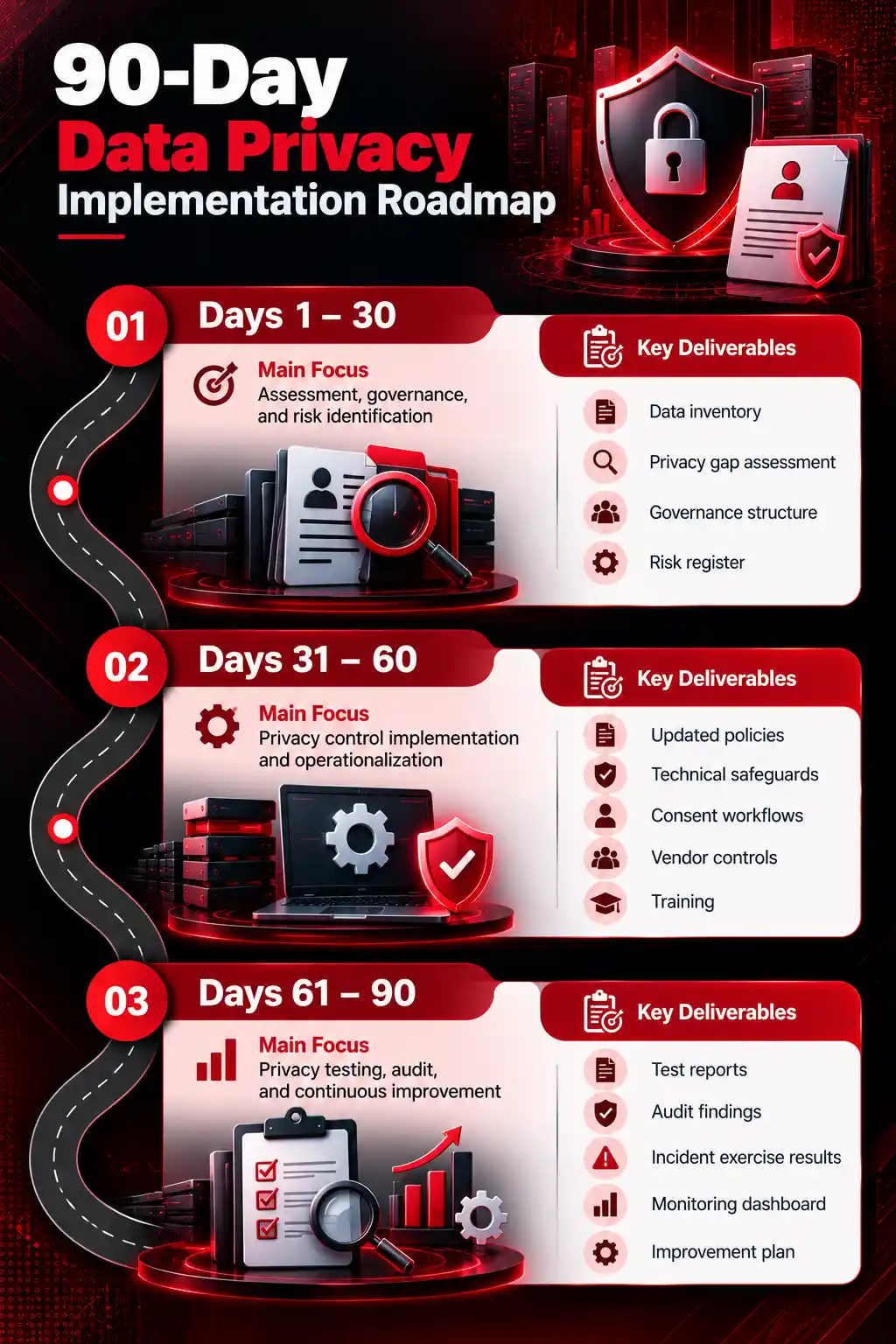
Phase 1: Days 1–30 | Privacy Assessment and Risk Identification
The first month is about understanding how personal data is collected, stored, used, and shared across the organization.
Before making changes, organizations need a clear picture of their existing privacy practices and the areas requiring attention.
Step 1: Assess Current Data Privacy Practices
Start by reviewing how different departments handle personal information. The assessment should identify:
- Types of personal data collected from customers, employees, and vendors
- Reasons for collecting and processing personal information
- Legal grounds or conditions for processing data
- Storage locations, including cloud services and internal systems
- Existing privacy policies, consent procedures, and retention rules
- Third parties with access to personal information
- Security measures currently used to protect data
Speak with employees from IT, HR, marketing, legal, procurement, and other relevant departments.
For example, a company may have a policy requiring the deletion of inactive customer records after a specified period. However, the marketing team might still retain those records in an older database. Such differences between documented policies and actual practices need to be identified early.
Step 2: Prepare a Personal Data Inventory
Once the initial assessment is complete, prepare an inventory of personal information held by the organization. The inventory should record what information is collected, why it is needed, where it is stored, who can access it, and how long it is retained.
Next, map how personal data moves between departments, applications, cloud platforms, and vendors. Pay special attention to sensitive information, unnecessary data collection, duplicate records, and international data transfers. A complete data inventory makes it easier to identify privacy risks and decide where stronger controls are needed.
Step 3: Assign Privacy Responsibilities
Data privacy should not be handled by the IT department alone. Establish a privacy team with representatives from Legal, Compliance, IT, Information Security, HR, Procurement, and relevant business functions. Appoint a Privacy Program Owner and, where legally required, a Data Protection Officer (DPO).
Clearly define who is responsible for maintaining policies, reviewing risks, handling privacy requests, managing incidents, and reporting issues to management. A RACI matrix can help establish these responsibilities and prevent confusion when privacy issues arise.
Step 4: Review Legal Requirements and Identify Risks
Identify the privacy regulations that apply to the organization’s activities, such as the GDPR or India’s Digital Personal Data Protection (DPDP) Act. Review existing practices against relevant legal requirements, including:
- Lawful processing and transparency
- Consent and withdrawal procedures
- Individual privacy rights
- Data retention and deletion
- International data transfers
- Third-party data processing
- Personal data breach management
Next, assess risks such as unauthorized access, accidental disclosure, excessive collection, and unnecessary data retention.
Evaluate each risk based on its likelihood, potential impact, and applicable legal obligations. Some processing activities may also require a Data Protection Impact Assessment (DPIA).
What Should Be Completed by Day 30?
By the end of the first month, organizations should have:
- Privacy gap assessment
- Personal data inventory and data flow map
- Defined privacy responsibilities
- Regulatory requirements checklist
- Privacy risk register
- Action plan for the next 30 days
These findings provide the starting point for implementing privacy controls.
Phase 2: Days 31–60 | Implement Privacy Controls
The second month focuses on fixing the gaps identified during the assessment. This includes updating policies, improving access controls, managing consent, reviewing vendors, and training employees.
Step 5: Update Privacy Policies and Procedures
Review existing privacy documents and update them according to applicable regulations and business practices. Important policies and procedures include:
- Personal data collection and use
- Privacy notices
- Data classification and handling
- Data retention and secure deletion
- Access control
- Third-party data processing
- Personal data breach response
- Individual rights requests
Avoid policies that are difficult for employees to understand or follow.
For example, instead of simply instructing employees to dispose of personal information securely, explain the approved deletion methods and the teams responsible for carrying them out.
Involve legal, IT, security, and business teams before approving updated policies.
Step 6: Apply Technical and Organizational Controls
Introduce safeguards based on the risks identified during the first month.
Common privacy controls include:
- Role-Based Access Control (RBAC): Restrict access according to job responsibilities.
- Multi-Factor Authentication (MFA): Add protection against unauthorized account access.
- Least-Privilege Access: Give employees only the permissions necessary for their work.
- Encryption: Protect personal information during storage and transmission.
- Data Masking and Pseudonymization: Reduce unnecessary exposure of identifiable information.
- Audit Logging: Maintain records of relevant data access and system activities.
- Secure Deletion: Remove information when it is no longer required.
Privacy requirements should also be considered when designing or changing systems, rather than being addressed only after deployment.
Step 7: Set Up Consent and Privacy Rights Processes
Depending on the applicable law, individuals may have rights to access, correct, delete, or otherwise manage their personal information. Organizations should establish a clear process for handling these requests. The process must explain how requests are received, how identity is verified, who reviews them, applicable response deadlines, and how completed requests are recorded.
For example, when a customer requests deletion of their personal data, the responsible team should know which systems must be checked and whether any legal retention requirements apply.
Where consent is required, organizations should clearly explain why information is collected and provide appropriate ways to withdraw consent.
Maintain records of consent and related requests.
Step 8: Review Third-Party Privacy Risks
Vendors may process significant amounts of customer or employee information on behalf of an organization. Review suppliers according to the information they handle, their access privileges, and the services they provide.
Key activities include:
- Checking data processing agreements
- Reviewing vendor security and privacy practices
- Confirming data processing responsibilities
- Assessing international transfer requirements
- Defining breach notification obligations
- Establishing data return and deletion procedures
Consider a payroll provider handling employee bank account details. The organization should know how that information is protected, who can access it, and how the provider would report a data breach.
Step 9: Train Employees on Privacy Responsibilities
Privacy policies are useful only when employees understand how to follow them. Provide training based on employees’ daily responsibilities.
For example:
- HR teams should know how to protect employee records.
- Marketing teams should understand consent and customer preferences.
- Developers should follow privacy-by-design practices.
- Customer support teams should recognize and forward privacy requests.
- IT and security teams should understand breach reporting procedures.
Use practical situations and short exercises rather than relying entirely on presentations. Privacy checks should also become part of employee onboarding, vendor assessments, project approvals, and system changes.
What Should Be Completed by Day 60?
By this stage, organizations should have:
- Updated privacy policies
- Technical and organizational safeguards
- Consent and privacy rights handling procedures
- Improved vendor privacy reviews
- Employee privacy training
- Records showing which controls have been implemented
Some issues may remain unresolved, but high-priority risks should have clear owners and action plans.
Phase 3: Days 61–90 | Privacy Testing, Audit, and Improvement
The final month focuses on verifying whether privacy measures work as intended. Having a policy or security tool in place does not mean personal information is adequately protected. Organizations need to test their procedures, review evidence, and correct weaknesses.
Step 10: Test Privacy Controls
Test the safeguards introduced during the second month. Important areas include:
- Access Controls: Check whether employees can access only authorized information.
- Data Deletion: Confirm that personal data is removed from relevant systems when required.
- Consent: Test whether consent preferences and withdrawals are correctly recorded and applied.
- Retention: Verify that information is not kept longer than permitted or necessary.
- Vendor Controls: Check whether agreed privacy requirements are being followed.
For example, a deletion test may show that customer information has been removed from the CRM but still exists in an email marketing platform. This indicates a gap between connected systems that needs to be corrected.
Record the expected outcome, actual result, identified issue, and corrective action for every test.
Step 11: Conduct an Internal Privacy Audit
An internal privacy audit checks whether the organization follows its policies and applicable legal requirements. Where possible, the audit should be performed by people who were not directly responsible for implementing the controls. Review evidence such as:
- Data inventories and processing records
- Privacy policies and procedures
- Consent and privacy request logs
- User access reviews
- Privacy risk assessments and DPIAs
- Vendor agreements
- Employee training records
- Incident response documentation
Compare the evidence with defined audit requirements.
For example, if company policy requires quarterly user access reviews but several departments have missed them, the issue should be recorded as an audit finding. Assign responsibility and a deadline for correcting each finding.
Step 12: Test the Data Breach Response Plan
Organizations must be prepared to respond when personal information is lost, exposed, altered, or accessed without authorization. Conduct a tabletop exercise involving legal, privacy, IT, security, communications, and relevant business teams.
Use a realistic situation, such as an employee accidentally emailing confidential customer records to the wrong recipient. Check whether the teams can:
- Identify and report the incident
- Determine which information was affected
- Assess the possible impact on individuals
- Contain the incident and preserve evidence
- Identify applicable notification requirements
- Communicate with affected individuals when required
- Document the incident and corrective actions
Breach notification rules differ by jurisdiction.
For example, under the GDPR, organizations generally must notify the relevant supervisory authority within 72 hours of becoming aware of a personal data breach when it is likely to pose a risk to individuals’ rights and freedoms.
The exercise should identify weaknesses before an actual incident occurs.
Step 13: Monitor Privacy Performance
Privacy management requires regular reviews, even after the initial implementation period. Establish a few useful Key Performance Indicators (KPIs) to track progress.
| Privacy Metric | What to Monitor |
| Data inventory coverage | Percentage of relevant systems documented |
| Privacy requests | Requests completed within applicable deadlines |
| High-risk findings | Critical privacy issues still unresolved |
| Employee training | Percentage of relevant employees trained |
| Vendor assessments | High-risk vendors reviewed |
| Privacy incidents | Number and severity of reported incidents |
| Corrective actions | Issues resolved within agreed deadlines |
Review these results regularly and share significant findings with management. The purpose is to identify problems early and make informed decisions about improvements.
Step 14: Plan the Next Stage of Privacy Improvements
The first 90 days establish the foundation of a privacy program, but the work does not end there. Use findings from audits, testing, incident exercises, and employee feedback to prepare an improvement plan for the next three to six months.
Possible activities include:
- Improving automated personal data discovery
- Strengthening consent management systems
- Reducing unnecessary data retention
- Reviewing additional vendors
- Conducting further privacy impact assessments
- Scheduling regular privacy training and policy reviews
New technologies and changes to business processes should also trigger privacy reviews.
For example, before introducing an AI-powered customer support platform, assess whether personal information entered into prompts could be stored, shared with vendors, or exposed through generated responses. Address these concerns before the platform is introduced.
What Should Be Completed by Day 90?
By the end of the roadmap, organizations should have:
- Documented privacy control test results
- Internal privacy audit findings
- Tested data breach response procedures
- Updated privacy risk and corrective action registers
- Privacy performance metrics
- An improvement plan for the next implementation period
These records help management understand what has been achieved, which risks remain, and what needs further attention.
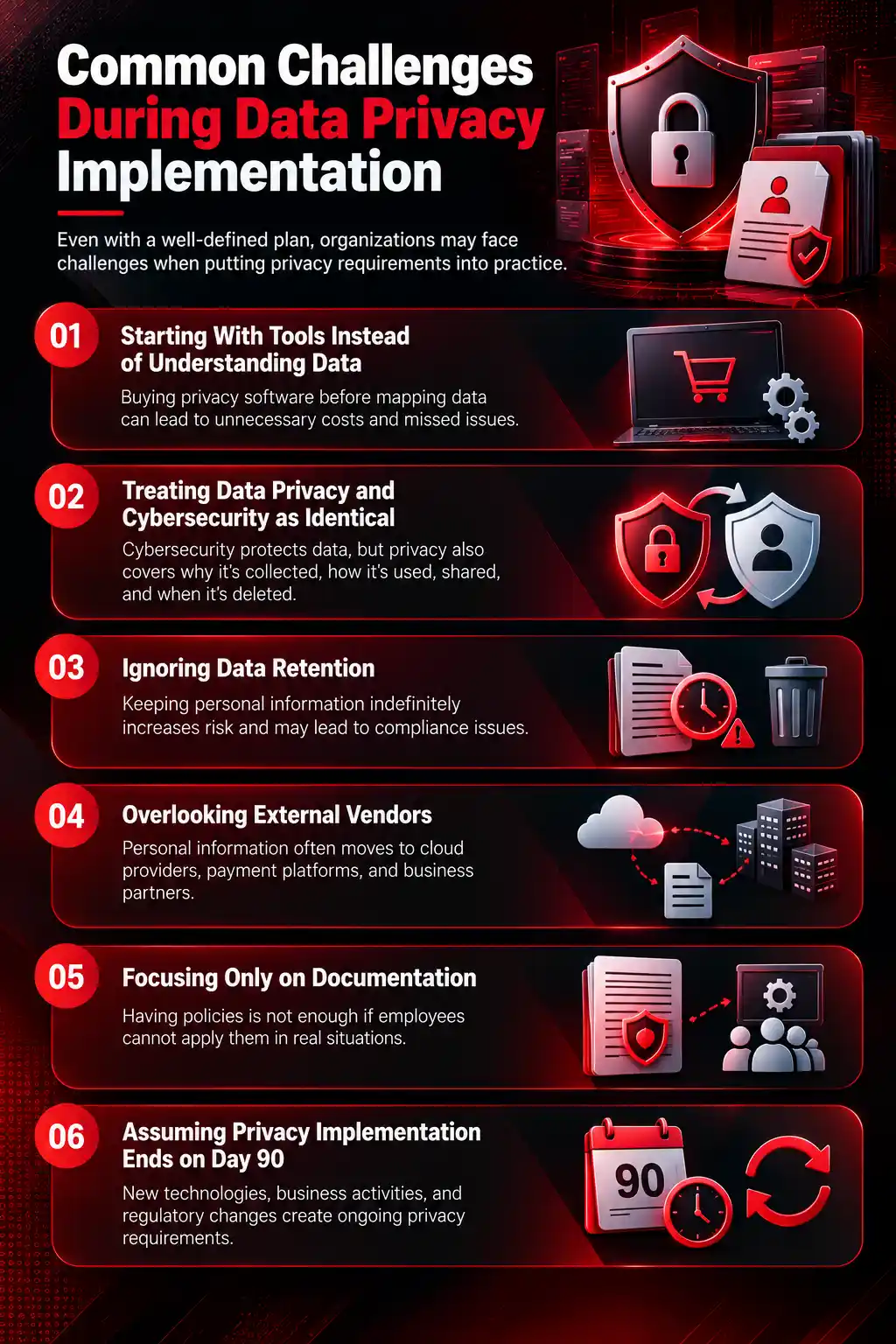

Conclusion
Building a strong data privacy program starts with understanding what personal data your organization handles, how it’s used, and the risks involved. A 90-Day Data Privacy Implementation Roadmap provides a practical approach to getting started. The first 30 days focus on assessing data and identifying risks, the next 30 days on implementing policies and safeguards, and the final 30 days on testing controls, training employees, and preparing for ongoing monitoring.
While 90 days won’t solve every privacy challenge, they can help organizations make meaningful progress toward long-term compliance.
Don’t wait for a regulatory audit or data breach to uncover gaps in your privacy practices. Start by identifying your biggest risks, assigning clear responsibilities, and taking the first steps toward a stronger privacy program today.
Build Practical Data Privacy Skills with InfosecTrain
Understanding data privacy regulations is essential. Knowing how to apply them in real organizational environments is what makes the difference.
Whether you’re an aspiring Data Protection Officer, a cybersecurity professional, a compliance manager, or someone responsible for protecting personal information, implementation-focused training can help you develop the skills needed to support privacy programs.
InfosecTrain’s data privacy training programs can help professionals build knowledge in areas such as:
- GDPR and DPDP regulatory requirements
- Data privacy governance and compliance
- Privacy risk assessments and DPIAs
- Personal data discovery and mapping
- Data Protection Officer responsibilities
- Privacy policies and individual rights management
- Data breach response and privacy controls
Explore relevant programs such as DPO Hands-on Training, CIPP/E, CIPM, AND CIPT.
Frequently Asked Questions
What is a 90-Day Data Privacy Implementation Roadmap?
It's a three-month plan that helps businesses set up or improve their data privacy practices. It covers data mapping, risk assessments, privacy policies, security controls, and compliance reviews.
Can a company achieve full data privacy compliance in 90 days?
It depends on the company's size, existing security practices, and legal requirements. Many important tasks can be completed in 90 days, but full compliance may take longer.
What should a company do in the first 15 days?
Start by identifying applicable privacy laws, assigning responsibilities, reviewing existing policies, and finding major privacy risks.
What is the role of a Data Protection Officer in the roadmap?
A Data Protection Officer (DPO), where required, advises on privacy requirements, monitors compliance, supports risk assessments, and communicates with regulators when needed.
Which privacy regulations should companies consider?
Depending on where they operate and whose data they handle, companies may need to follow GDPR, India's DPDP Act and Rules, CCPA/CPRA, or industry-specific privacy laws.
Why is data mapping important?
Data mapping shows what personal data your company collects, where it's stored, who can access it, and how it's shared. This helps identify privacy risks and gaps.
What is a Data Protection Impact Assessment (DPIA)?
A DPIA helps identify privacy risks before starting certain data processing activities. Under GDPR, it's required when processing is likely to pose a high risk to people's rights and freedoms.
What privacy controls should be implemented within 90 days?
Common controls include encryption, access restrictions, secure authentication, data retention rules, consent management where needed, and procedures for handling data breaches.
How does the DPDP Act affect Indian businesses?
India's DPDP Act and Rules introduce privacy responsibilities covering personal data handling, notices, consent, security safeguards, and individual rights. Businesses need to check which requirements apply and when they take effect.
How can small businesses improve data privacy in 90 days?
Start by listing the personal data you collect, limiting access, updating privacy notices, reviewing vendors, setting data deletion rules, and training employees.