Roles and Responsibilities of a Forensic Investigator
Quick Insights:
A Digital Forensic Investigator is a specialized cybersecurity expert responsible for identifying, gathering, examining, and presenting digital evidence from endpoints, networks, and volatile memory to uncover the root cause of security incidents. By constructing precise attack chronologies, enforcing a rigorous chain of custody, and leveraging industry-standard tools like EnCase, FTK, and Volatility, they convert raw technical data into legally defensible evidence. Their work strengthens incident response efforts, enables organizations to patch security gaps, and fulfills critical legal and regulatory compliance requirements.
Every deleted file, cleared log, and hidden network connection leaves behind a secret trail. When a major cyber attack strikes, a Digital Forensic Investigator steps in as the ultimate tech detective to piece the puzzle back together.
Equal parts cyber expert, crime investigator, and legal strategist, these specialists hunt for silent clues hidden deep inside compromised networks and frozen system memory. Where hackers see a clean getaway, forensic investigators uncover unallocated disk space, encrypted artifacts, and undeniable digital fingerprints, turning invisible breadcrumbs into concrete, courtroom-ready proof that exposes how the breach happened, what was lost, and who was responsible.
Who is a Forensic Investigator?
A Forensic Investigator (specifically a Digital Forensic Investigator) is a specialized cybersecurity professional who collects, preserves, analyzes, and presents digital evidence to determine how a security incident or crime occurred.
Think of them as digital detectives: they reconstruct compromised events, trace attacker footprints, and ensure all collected evidence remains legally defensible in court proceedings, compliance audits, or internal investigations.
Key Roles of a Forensic Investigator
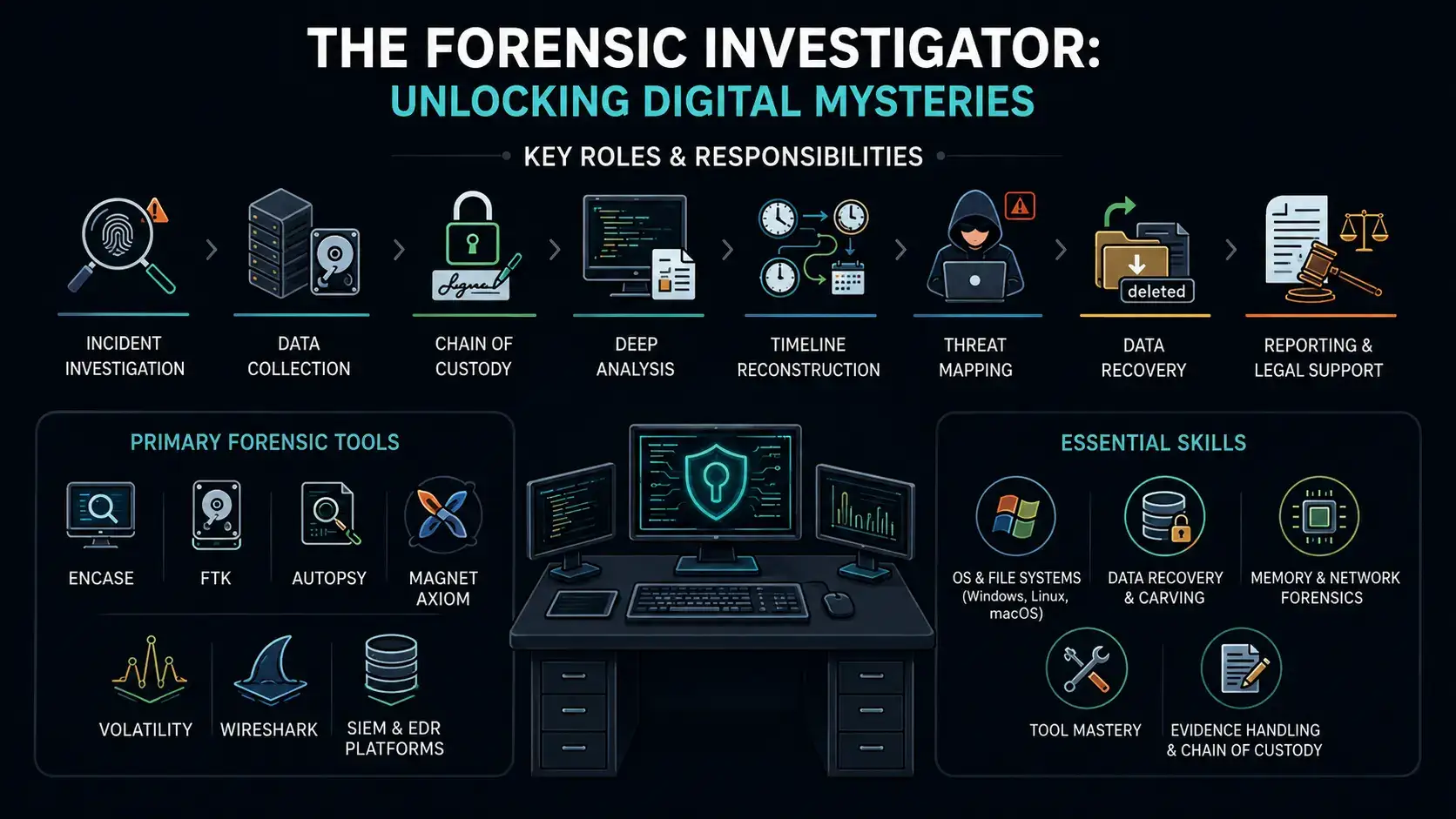
- Investigate Security Incidents: Examine breaches, malware, ransomware, insider threats, unauthorized access, fraud, and IP theft to determine how an incident occurred and assess system impact.
- Collect Digital Evidence: Acquire data from storage drives, endpoints, mobile devices, network logs, cloud environments, memory dumps, and security alerts using standard forensic protocols.
- Preserve Chain of Custody: Document the handling, storage, and transfer of evidence meticulously to verify data integrity and prevent tampering.
- Analyze Digital Artifacts: Inspect file systems, deleted items, metadata, logs, and browser activity to identify malicious actions and connect evidence points.
- Reconstruct Incident Timelines: Map out sequential events from initial compromise to data exfiltration to expose attacker behavior and control failures.
- Identify Attack Techniques: Analyze malicious scripts, persistence mechanisms, and lateral movement, and map findings to frameworks such as MITRE ATT&CK.
- Recover Deleted or Hidden Data: Use specialized tools to carve wiped files, recover cleared logs, and extract concealed artifacts.
- Collaborate with Response Teams: Partner with Incident Response, Legal, and Compliance units to provide factual context while responders contain active threats.
Key Responsibilities of a Forensic Investigator
1. Evidence Acquisition & Chain of Custody Management
- Develop and execute standardized digital evidence collection procedures across physical, virtual, and cloud environments.
- Perform bit-stream disk imaging and volatile memory (RAM) captures using write-blocking technology.
- Maintain rigorous chain-of-custody documentation and verify data integrity using cryptographic hash functions (MD5, SHA-256).
2. Deep Technical Analysis & System Artifact Extraction
- Conduct deep-dive forensic examinations of file systems, registry hives, system event logs, and web browser histories.
- Carve unallocated disk space to recover deleted files, wiped event logs, and hidden partitions.
- Inspect volatile memory dumps to extract active malware payloads, injected code, running processes, and unencrypted network connections.
3. Timeline Construction & Threat Mapping
- Build comprehensive, millisecond-accurate event chronologies to chart the attacker’s path from entry to exfiltration.
- Identify Indicators of Compromise (IOCs) and correlate logs across SIEM and EDR platforms.
- Map malicious techniques and lateral movement strategies directly to the MITRE ATT&CK framework for standardized threat categorization.
4. Documentation, Reporting & Legal Support
- Author objective, detailed technical reports outlining investigative methodologies, artifact analysis, and factual conclusions.
- Draft executive summaries that translate complex technical findings into actionable risk insights for leadership and legal teams.
- Support regulatory inquiries, litigation efforts, and deliver expert witness testimony in court proceedings when required.
5. Incident Prevention & Control Optimization
- Conduct root cause analysis to pinpoint the precise vulnerabilities, misconfigurations, or human errors that enabled the compromise.
- Recommend actionable security enhancements, control adjustments, and defensive strategies based on investigative outcomes.
- Assist in updating enterprise Incident Response Plans (IRPs) to ensure rapid containment during future security events.
Primary Forensic Tools
- EnCase & FTK (Forensic Toolkit): Enterprise-grade evidence acquisition and forensic processing.
- Autopsy & Magnet AXIOM: Open-source and commercial deep-dive digital investigation platforms.
- Volatility: Specialized volatile memory (RAM) analysis framework.
- Wireshark: Deep packet inspection and network traffic analysis.
- SIEM & EDR Platforms: Log aggregation, endpoint detection, and continuous threat analysis.
Skills Required for a Forensic Investigator
- Operating Systems & File Systems: Deep knowledge of Windows, Linux, macOS, and mobile architectures, along with file systems (NTFS, ext4, APFS) to locate hidden artifacts.
- Data Recovery & Carving: Ability to recover deleted files, unallocated disk space, and corrupted media using specialized recovery techniques.
- Memory & Network Forensics: Hands-on experience analyzing volatile RAM dumps (Volatility) and packet captures/network logs (Wireshark).
- Tool Mastery: Proficiency in industry-standard suites like FTK, EnCase, Autopsy, Magnet AXIOM, and Cellebrite.
- Evidence Handling & Chain of Custody: Strict adherence to legal standards, hash verification, and documentation to ensure court admissibility.
Conclusion
As cyber threats grow in complexity, the ability to reconstruct digital evidence, maintain strict legal integrity, and uncover the root cause of security incidents is paramount. Digital Forensic Investigators serve as essential guardians of technical truth, bridging deep system analysis, incident response, and legal accountability to protect organizational assets and ensure justice.
To master these critical techniques, professionals can enroll in the Digital Forensics Essentials (DFE) Training & Certification program with InfosecTrain, which provides structured, hands-on expert instruction covering the foundational practices, tools, and methodologies needed to execute real-world digital investigations.

TRAINING CALENDAR of Upcoming Batches For Digital Forensics Essentials (D|FE)
| Start Date | End Date | Start - End Time | Batch Type | Training Mode | Batch Status |
|---|
Frequently Asked Questions
What is the primary role of a Digital Forensic Investigator?
Their main goal is to uncover the truth behind digital security incidents by identifying, collecting, preserving, and analyzing digital evidence without altering the original data.
How does a forensic investigator differ from an incident responder?
Incident responders focus on stopping active threats and containing breaches in real-time. In contrast, forensic investigators analyze evidence to determine how and why the breach occurred, building a legally defensible timeline.
What is the "Chain of Custody" and why is it critical?
Chain of custody is the chronological documentation tracking who collected, handled, transferred, and stored digital evidence. It proves the evidence was not tampered with, making it admissible in court.
Why are cryptographic hashes (MD5, SHA-256) used in digital forensics?
Cryptographic hashes create a unique digital fingerprint of original storage media and its copies. Matching hash values verify that a forensic image is an exact, unaltered duplicate of the original device.
What is file carving?
File carving is a technique used to recover deleted or damaged files directly from unallocated disk space by recognizing file headers, footers, and structural patterns without relying on file system metadata.
What digital sources do forensic investigators examine during an investigation?
They examine hard drives, solid-state drives (SSDs), volatile RAM, network packet captures, system event logs, mobile devices, cloud repositories, and SIEM/EDR records.
How do investigators handle volatile memory (RAM)?
Investigators perform live memory captures before powering down a system, allowing them to extract running processes, active network connections, injected malware payloads, and unencrypted keys residing in RAM.
What tools are most commonly used in digital forensic investigations?
Industry-standard tools include EnCase, Forensic Toolkit (FTK), Autopsy, Magnet AXIOM, Volatility (for memory analysis), and Wireshark (for network analysis).
How is the MITRE ATT&CK framework used in forensic investigations?
Investigators map identified attacker tactics, techniques, and procedures (TTPs) to the MITRE ATT&CK framework to standardize threat reporting and help security teams close specific defensive gaps.
Can digital forensic findings be used as evidence in court?
Yes. When evidence is acquired via write-blocking technology, verified with hash values, documented under a secure chain of custody, and analyzed using validated tools, the findings are legally admissible, and investigators can present expert witness testimony.