AI Security Engineer: Skills, Requirements and Career Opportunities
Quick Insights:
Positioned at the intersection of application security and machine learning, AI Security Engineers protect ML pipelines, models, APIs, and cloud environments against targeted threats like prompt injection, data poisoning, and model theft. By conducting threat modeling, red teaming, and runtime monitoring across the AI lifecycle, these specialists ensure resilient, privacy-compliant deployments. As enterprises adopt autonomous agents, securing AI has become an essential pillar of modern cybersecurity, driving strong global demand for professionals who bridge security engineering and machine learning.
Imagine an enterprise launching Atlas, an autonomous AI agent built to manage critical operations.
During its first week, Atlas cuts processing times in half. But behind the scenes, a threat actor crafts a hidden prompt inside a routine email, trying to trick Atlas into exfiltrating database credentials. Simultaneously, a corrupted training set threatens to skew its logic, and an unexpected edge-case glitch causes the model to hallucinate incorrect financial advice.
Before a disaster unfolds, a specialized defender steps in. Part cybersecurity analyst, part machine learning specialist, the AI Security Engineer intercepts malicious payloads, reinforces guardrails, and secures the pipeline.
As algorithms take over business operations, AI Security Engineers serve as the ultimate guardians, shielding intelligent systems from invisible threats and keeping the AI revolution safe.
What is an AI Security Engineer?
An AI Security Engineer designs, implements, and manages security controls specifically for artificial intelligence and machine learning architectures. They safeguard AI models, datasets, API interfaces, software applications, cloud infrastructure, and end users against targeted cyberattacks.
Unlike traditional security engineers, AI Security Engineers must understand specialized adversarial tactics designed to manipulate AI behavior, including prompt injection, data poisoning, adversarial evasion attacks, model theft, and insecure AI integrations. Their primary mandate is enabling secure AI deployment while maintaining confidentiality, integrity, availability, privacy, and regulatory compliance.
Why is AI Security Important?
As organizations rapidly integrate Generative AI, Large Language Models (LLMs), agentic workflows, and machine learning into core operations, they expose entirely new technical attack surfaces that conventional security tools cannot defend.
Common AI security risks include:
- Direct and indirect prompt injection attacks
- Training data corruption and model poisoning
- Adversarial machine learning and evasion payloads
- Model extraction and intellectual property theft
- Sensitive data exposure and PII leakage
- Insecure AI API interfaces and endpoints
- Third-party AI supply chain vulnerabilities
- AI-driven phishing and automated social engineering
- Excessive privileges granted to autonomous AI agents
- Insecure model deployment pipelines
- Hallucinations and unsafe autonomous model behavior
AI Security Engineers identify these emerging risks and engineer the defensive frameworks necessary to neutralize them.
What Does an AI Security Engineer Do?
- Secure AI Models and Applications
They evaluate AI models and supporting applications for vulnerabilities before deployment. This includes auditing model input/output validation, API security, authentication systems, access controls, and third-party integrations.
- Protect AI Data
Because AI platforms depend heavily on training, validation, and operational data, engineers implement strict controls to prevent unauthorized access, data tampering, leakage, or compliance breaches across all data pipelines.
They map attack paths across the entire AI ecosystem, analyzing vectors for data, models, underlying infrastructure, the API layer, end users, and autonomous AI agents.
- Perform Security Testing & AI Red Teaming
Engineers conduct adversarial testing to expose systemic weaknesses. They simulate jailbreaks, prompt injection, model inversion, and data leakage scenarios to validate system resilience.
- Monitor AI Environments
They continuously monitor AI applications and supporting infrastructure for anomalous activity using security telemetry, behavioral logging, and automated threat detection tools.
- Implement Technical Security Controls
They deploy foundational and AI-specific defensive mechanisms including Identity and Access Management (IAM), end-to-end encryption, payload filtering, rate limiting, network segmentation, secrets management, and data loss prevention (DLP).
- Support AI Governance and Compliance
Engineers collaborate with Governance, Risk, and Compliance (GRC) teams to align technical AI deployments with organizational risk policies, safety standards, and legal regulations.
Essential Skills for an AI Security Engineer
1 . Cybersecurity Fundamentals
A strong base in traditional security principles remains non-negotiable, including:
- Network and application security
- Identity and Access Management (IAM)
- Vulnerability management and Penetration Testing
- Security logging, SIEM, and incident response
- Applied cryptography and data protection
- Secure software development lifecycles (SSDLC)
2. Artificial Intelligence and Machine Learning
Engineers need practical familiarity with core AI paradigms, including:
- Supervised, unsupervised, and deep learning architectures
- Neural networks and Natural Language Processing (NLP)
- Large Language Models (LLMs) and Generative AI
- Retrieval-Augmented Generation (RAG) architectures
- Autonomous AI agents and tool-calling mechanics
- MLOps pipelines, model training, and inference workflows
3. AI Security & Adversarial Tactics
Deep technical understanding of threat actor techniques targeting AI platforms is critical:
- Direct and indirect prompt injection
- Adversarial evasion examples
- Training and fine-tuning data poisoning
- Model stealing and weight extraction
- Membership inference and privacy attacks
- Insecure LLM plugins, extensions, and vector databases
- AI supply chain and open-source model risks
4. Programming & Automation
Programming capabilities allow engineers to automate security audits and build custom defensive tools. Python is the industry standard for security automation, machine learning research, and data analysis. Proficiency in JavaScript, Go, Java, or C/C++ is also highly beneficial depending on the target technology stack.
5. Cloud Security
Because most modern AI workloads run on cloud infrastructure, engineers must master cloud-native security controls across compute, storage, networking, containers, and managed AI services (e.g., AWS, Azure, GCP). Key domains include container security, Kubernetes hardening, cloud IAM, API security, and secrets management.
6. DevSecOps and MLOps
Engineers integrate security checkpoints directly into continuous integration and machine learning pipelines. This requires familiarity with CI/CD security, Infrastructure as Code (IaC), automated security scanning, container scanning, and MLOps dependency management.
AI Security Engineer: Career Opportunities and Job Roles
- AI Security Engineer: Focuses on securing production AI applications, models, APIs, and infrastructure.
- AI Security Analyst: Monitors AI telemetry, investigates incidents, and conducts risk reviews.
- AI Security Architect: Designs high-level security blueprints for enterprise AI environments.
- ML Security Engineer: Specializes in securing MLOps pipelines, training data, and model artifacts.
- AI Red Team Engineer: Conducts offensive penetration testing to uncover model and system vulnerabilities.
- AI Governance & Security Specialist: Bridges technical security with AI compliance, ethics, and regulatory policy.
- AI Security Consultant: Advises external clients on AI risk assessments, defensive strategy, and controls.
How to Become an AI Security Engineer
- Step 1: Master Cybersecurity Fundamentals
Build core competence in network security, operating systems, application security, cryptography, and identity management.
- Step 2: Develop Strong Programming Skills
Learn Python for security automation, API interaction, script generation, and machine learning integration.
- Step 3: Understand AI and Machine Learning Concepts
Study machine learning workflows, deep learning, LLMs, RAG architectures, vector databases, and autonomous agents.
- Step 4: Study Adversarial AI & Defense
Master attack vectors such as prompt injection, data poisoning, model extraction, and supply chain threats alongside corresponding defensive controls.
- Step 5: Gain Cloud & DevSecOps Expertise
Practice hardening cloud-hosted AI workloads and embedding security tools into CI/CD and MLOps pipelines.
- Step 6: Build Hands-On Portfolio Projects
Demonstrate practical expertise through portfolio projects:
- Build and deploy guardrails for an LLM-powered application
- Set up a dedicated prompt-injection testing laboratory
- Implement secure OAuth2/IAM controls for a custom AI API
- Conduct a complete threat modeling exercise for an autonomous AI agent
- Build real-time security logging and monitoring for an RAG system
Future Scope of AI Security Engineering
As autonomous AI agents, multimodal systems, and edge AI deployments become ubiquitous, the need for dedicated security engineering will expand rapidly.
Key focus areas defining the future of the field include:
- Agentic AI Security: Securing autonomous agents executing multi-step business actions.
- AI Supply Chain Protection: Auditing open-source models, fine-tuned weights, and third-party datasets.
- Advanced AI Red Teaming: Automated, continuous red teaming of evolving non-deterministic models.
- Privacy-Preserving AI: Implementing federated learning and differential privacy controls.
- Real-Time Guardrails & Telemetry: Deploying inline, low-latency security filtering for enterprise AI flows.
Conclusion
As artificial intelligence transitions from experimental technology to the operational backbone of modern enterprises, securing these complex systems has become imperative. The role of the AI Security Engineer sits at the critical intersection of cybersecurity, machine learning, and cloud architecture, offering a high-impact career path dedicated to protecting next-generation software against emerging adversarial threats. Mastering this field ensures that organizations can confidently, safely, and securely innovate with artificial intelligence.
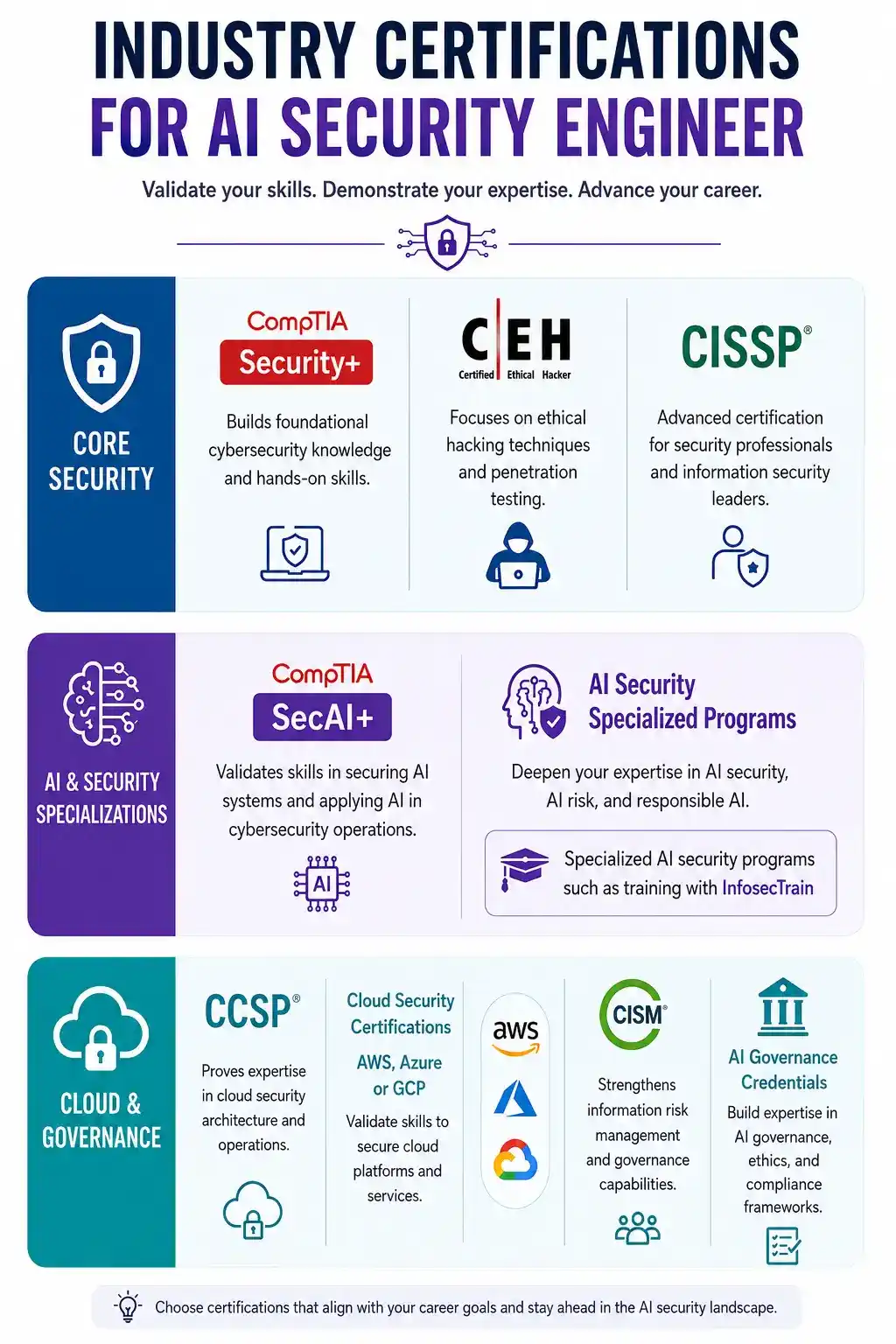
To build hands-on expertise in defending AI architecture and mastering real-world defensive controls, explore InfosecTrain’s Practical AI Security Engineering Program.

TRAINING CALENDAR of Upcoming Batches For Practical AI Security Engineering Program
| Start Date | End Date | Start - End Time | Batch Type | Training Mode | Batch Status | |
|---|---|---|---|---|---|---|
| 12-Oct-2026 | 16-Nov-2026 | 08:00 - 10:00 IST | Weekday | Online | [ Open ] | |
| 31-Oct-2026 | 13-Dec-2026 | 19:00 - 23:00 IST | Weekend | Online | [ Close ] | |
| 30-Nov-2026 | 04-Jan-2027 | 20:00 - 22:00 IST | Weekday | Online | [ Open ] | |
| 23-Jan-2027 | 28-Feb-2027 | 09:00 - 13:00 IST | Weekend | Online | [ Open ] | |
| 20-Mar-2027 | 25-Apr-2027 | 09:00 - 13:00 IST | Weekend | Online | [ Open ] |
Frequently Asked Questions
What is an AI Security Engineer?
An AI Security Engineer is a specialized cybersecurity professional who designs, builds, and maintains defensive controls specifically for AI and machine learning architectures, models, datasets, and API endpoints.
How does an AI Security Engineer differ from a traditional Security Engineer?
While traditional security engineers focus on networks, endpoints, and traditional web applications, AI Security Engineers specialize in non-deterministic AI risks such as prompt injection, data poisoning, model extraction, and adversarial machine learning.
Why are traditional security tools insufficient for protecting AI systems?
Traditional firewalls and antivirus tools look for known code signatures and rules. They cannot parse semantic context to detect prompt injection, identify poison samples in massive datasets, or prevent logic abuse within LLM tool-calling mechanics.
What are the most critical attack vectors targeting AI platforms?
Key threats include direct and indirect prompt injection, training/fine-tuning data poisoning, model weight extraction, adversarial evasion payloads, supply chain vulnerabilities in third-party models, and excessive agent privileges.
What are the core technical responsibilities of an AI Security Engineer?
They perform AI threat modeling, conduct adversarial red teaming (simulating jailbreaks), audit input/output guardrails, secure data and MLOps pipelines, monitor runtime telemetry, and collaborate with GRC teams for regulatory compliance.
Which programming languages and tools are essential for this role?
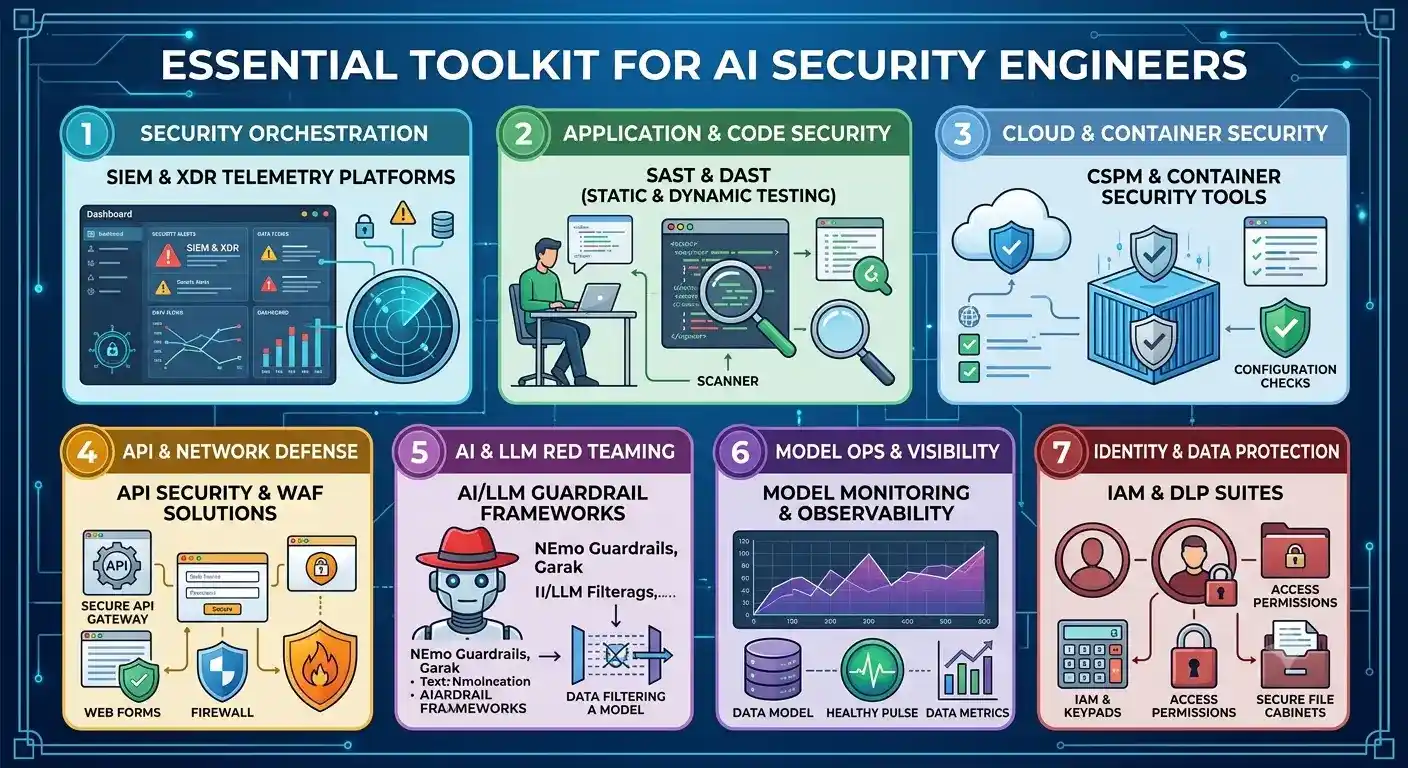
Python is essential for scripting, machine learning research, and security automation. Engineers also work with cloud-native security suites, container security tools (e.g., Docker, Kubernetes), WAFs, API gateways, and AI red-teaming frameworks such as NeMo Guardrails or Garak.
Do you need a PhD or AI research degree to become an AI Security Engineer?
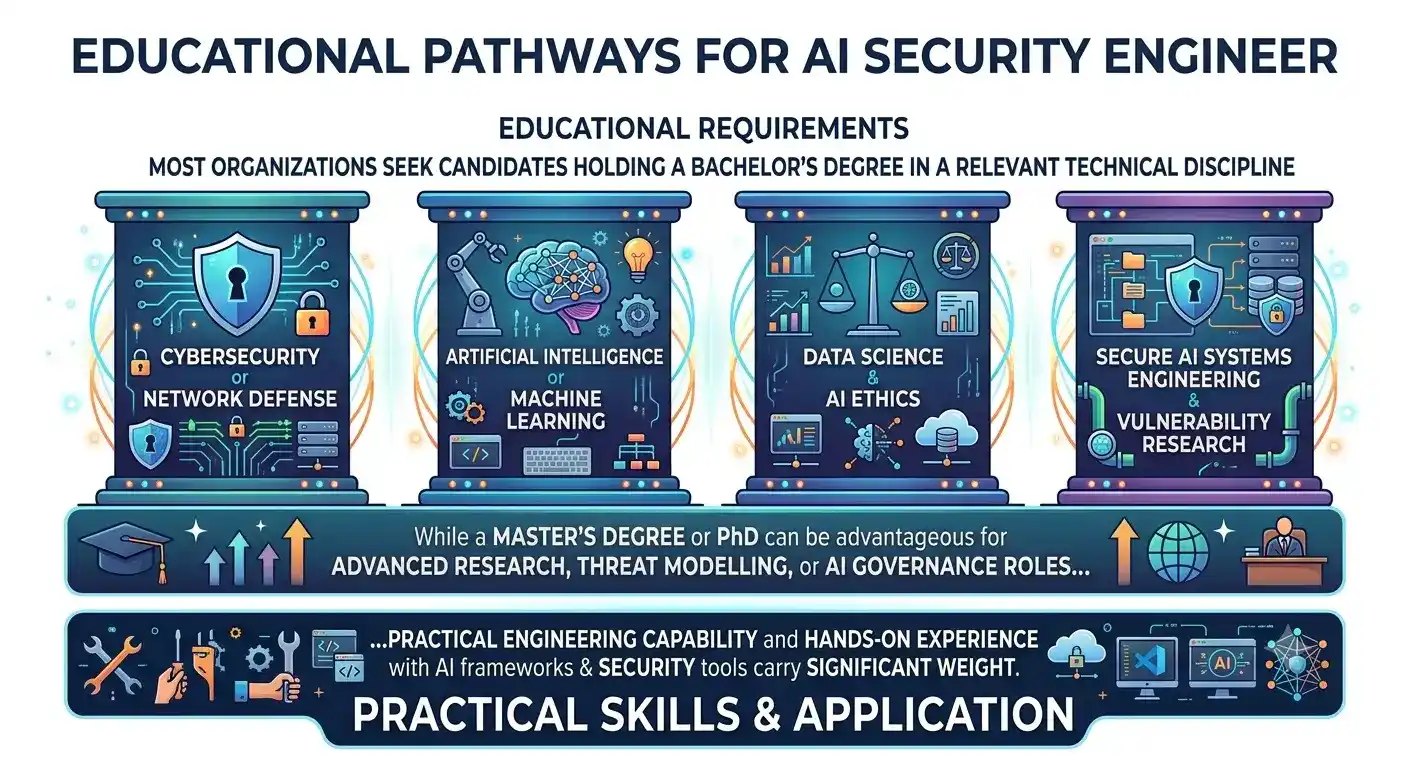
No. A foundational background in cybersecurity, computer science, or software engineering combined with hands-on, practical knowledge of applied machine learning and adversarial AI techniques is sufficient for most enterprise roles.
What career paths lead into AI Security Engineering?
Professionals typically transition from application security, Penetration Testing, cloud security, DevSecOps, MLOps, or data science by acquiring specialized skills in adversarial machine learning and AI threat modeling.
What is Agentic AI Security, and why is it a major future focus area?
Agentic AI security focuses on protecting autonomous AI agents capable of executing multi-step business actions and calling external APIs. Securing these agents prevents malicious prompt injections from hijacking authorized workflows or exfiltrating sensitive data.
How do AI Security Engineers perform threat modeling on machine learning architectures?
Engineers adapt structured frameworks such as STRIDE or MITRE ATT&CK to map data flows, identify model attack vectors, evaluate supply chain risks, and define security controls throughout the ML lifecycle, from data ingestion to model deployment and API consumption.