Cybersecurity and Ethical Hacking After 12th: A Complete Career Guide
Quick Insights:
Cybersecurity after 12th is open to students from PCM, Commerce, Arts, Humanities, and PCB backgrounds, although course eligibility may vary. Learners can choose from B.Tech, B.Sc., BCA, diplomas, certifications, and practical bootcamps based on their goals. A strong career begins with computer fundamentals, Linux, networking, cybersecurity concepts, and basic scripting. Students should practice only in authorized labs, cyber ranges, CTFs, and virtual environments. They can later specialize in ethical hacking, SOC operations, cloud security, digital forensics, GRC, IAM, or AI security. Building projects, completing internships, and creating a practical portfolio can improve job opportunities. Certifications can validate knowledge, but they cannot replace hands-on skills and consistent practice. Overall, success in cybersecurity depends on structured learning, ethical conduct, curiosity, and continuous skill development.
Finishing 12th can feel exciting and confusing. You may enjoy computers, problem-solving, technology, or understanding how digital systems work, but choosing the right career path is not always easy. If cyberattacks, digital investigations, security tools, or ethical hacking interest you, cybersecurity may be worth exploring.
You do not have to wait until graduation to begin. Students can start learning computer fundamentals, networking, Linux, cybersecurity concepts, and safe lab practices immediately after 12th grade. However, a real cybersecurity career is not built by downloading a few tools or watching random tutorials. It requires a structured roadmap, consistent practice, responsible conduct, and a clear understanding of where different courses lead.
So, how to start a career in cybersecurity and Ethical hacking after 12th? Some students choose B. Tech, B.Sc., or BCA. Others combine a broader degree with certifications, bootcamps, projects, and internships. This guide explains the available cybersecurity courses after 12th, the skills beginners should build, the specializations they can explore, and the steps needed to move from curiosity to employability.
Cybersecurity vs. Ethical Hacking
| Aspect | Cybersecurity | Ethical Hacking |
| Definition | Protects systems, networks, and data | Tests systems for vulnerabilities |
| Scope | Broad field with many roles | Specialized area within cybersecurity |
| Focus | Prevention, monitoring, response | Finding and reporting weaknesses |
| Activities | SOC, IAM, cloud security, GRC, and incident response | Penetration testing, vulnerability assessment, and red teaming |
| Legal Aspect | Must follow organizational policies and laws | Requires explicit authorization and a defined testing scope |
| Career Fit | Multiple technical and non-technical interests | Learners who enjoy testing, research, and problem-solving |
Can You Pursue Cybersecurity After 12th?
Yes. Students from PCM, Commerce, Arts, Humanities, PCB, and other backgrounds can pursue cybersecurity after Class 12. However, course eligibility varies by institution and program.
PCM students usually have more technical degree options, such as B.Tech in Cybersecurity, Computer Science, or IT. Students from other streams can explore BCA, B.Sc. IT, selected cybersecurity programs, diplomas, certifications, and skills-based training. Not having Mathematics may limit some engineering options, but it does not preclude a career in cybersecurity.
Cybersecurity also includes non-coding areas such as GRC, privacy, audit, policy, IAM, security awareness, and third-party risk. The key is to separate course eligibility from career possibility.
Suggested Roadmaps
PCM: Degree → Networking and Linux → Cybersecurity fundamentals → Labs → Certification → Projects → Internship
Commerce, Arts, Humanities, or PCB: IT fundamentals → Networking → Cybersecurity basics → Choose a technical or governance path → Certification → Projects → Internship
Without Mathematics: Choose an eligible program → Build computing and networking skills → Practice in legal labs → Specialize → Apply for internships
Without a Cybersecurity Degree: Pursue BCA, B.Sc. IT, Computer Science, or another suitable degree while learning cybersecurity through labs, projects, and certifications.
Applications of Cybersecurity and Ethical Hacking
Cybersecurity and ethical hacking are used across industries to protect digital systems, sensitive data, applications, and business operations from cyber threats.
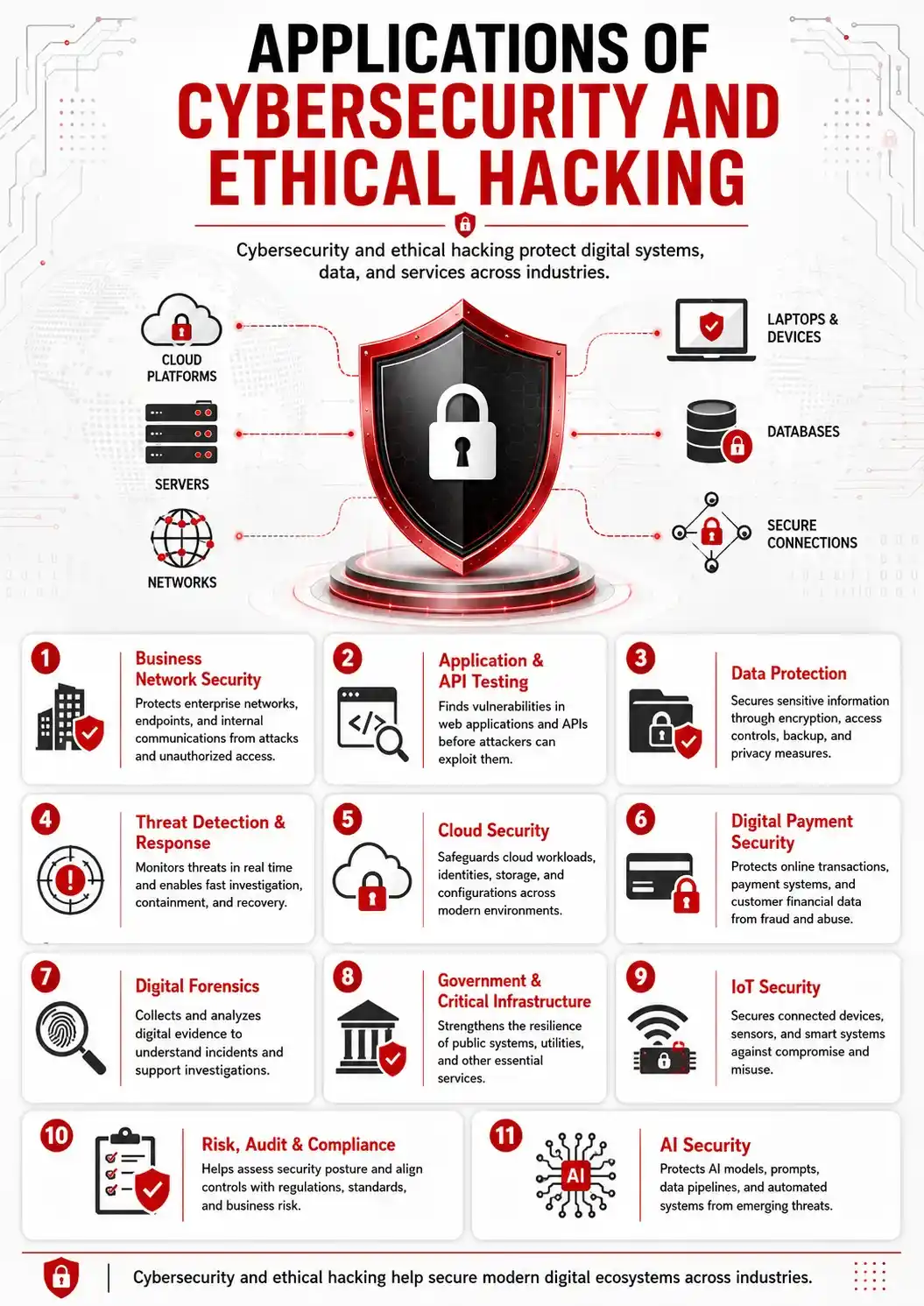
These applications make cybersecurity and ethical hacking essential across banking, healthcare, government, education, e-commerce, manufacturing, telecommunications, and other digital industries.
Cybersecurity Courses After 12th
Students searching for cybersecurity courses after 12th will usually find four main options: degrees, diplomas, certifications, and practical training programs.
Degree programs
Common degree routes include:
- B.Tech in Cybersecurity
- B.Tech in Computer Science with a cybersecurity specialization
- B.Sc. in Cybersecurity
- B.Sc. in Information Technology
- BCA with a cybersecurity specialization
- B.Sc. in Digital Forensics
- Bachelor’s degree in Computer Science
A degree offers structured academic learning, assessments, projects, and possible placement support. Under the UGC’s Curriculum and Credit Framework for Undergraduate Programs, institutions may offer flexible three-year and four-year undergraduate pathways. The exact structure, specialization, eligibility, and exit options can vary by university, so students should check the official program details before applying.
Diploma and Advanced Diploma programs
Diplomas may suit students who want focused learning in a shorter period. Before enrolling, check the program’s recognition, curriculum, instructors, lab access, and expected outcomes. A shorter duration does not guarantee job readiness.
Beginner Certifications
A beginner certification can provide structure and validate foundational knowledge, but it should be supported by networking skills, Linux practice, labs, projects, and the ability to explain what you have learned.
Bootcamps and Practical Training
A practical bootcamp can provide guided labs, case studies, assignments, and mentor support. Choose programs that teach foundations before tools, provide legal practice environments, and help learners understand both attack and defense.
Degree vs. Certification vs. Bootcamp
These routes should not be treated as direct replacements for one another.
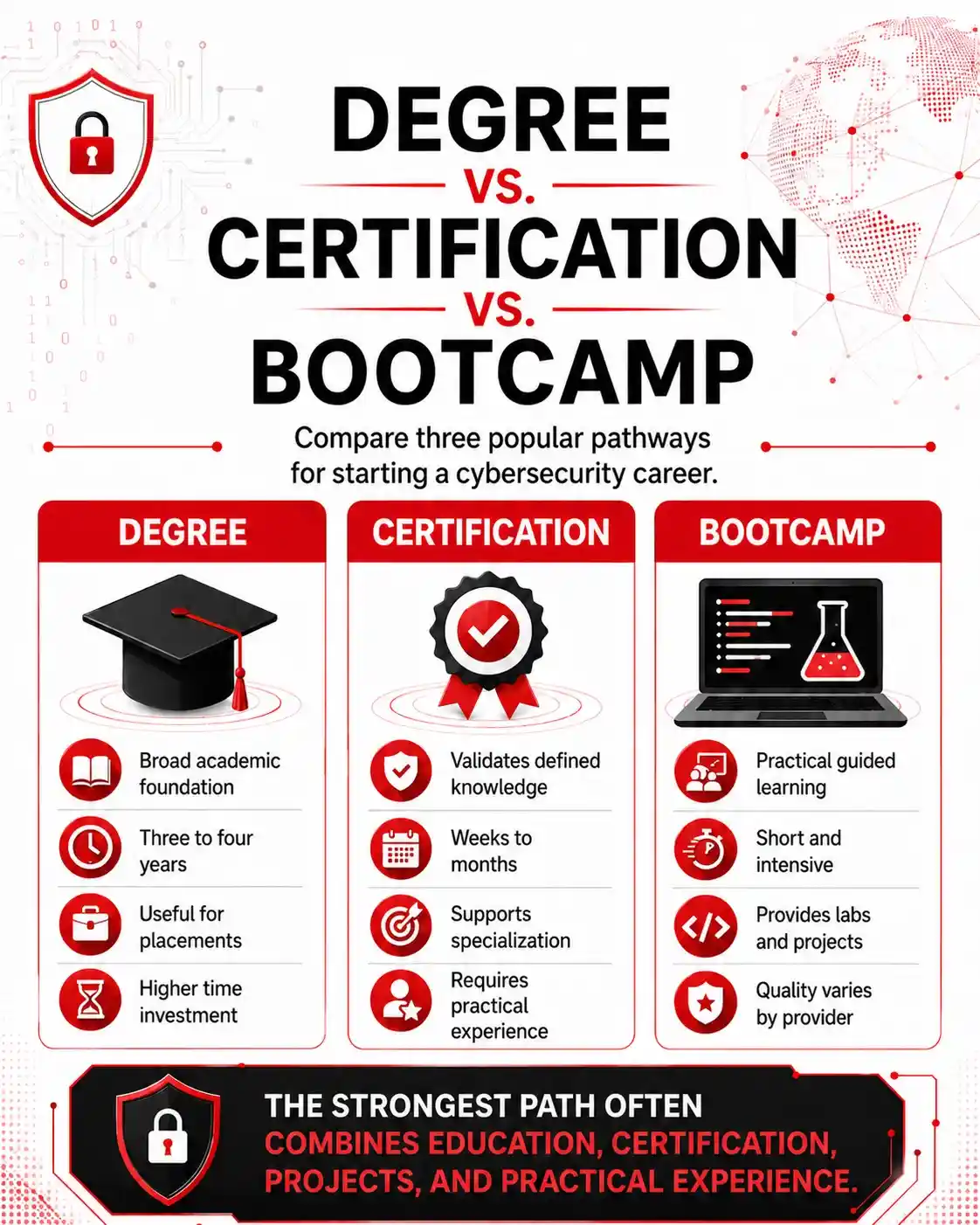
For many students, the strongest approach is a combination: pursue a suitable degree or diploma, add one relevant certification, practice regularly, build projects, and apply for internships.
A Step-by-Step Cybersecurity Roadmap After 12th
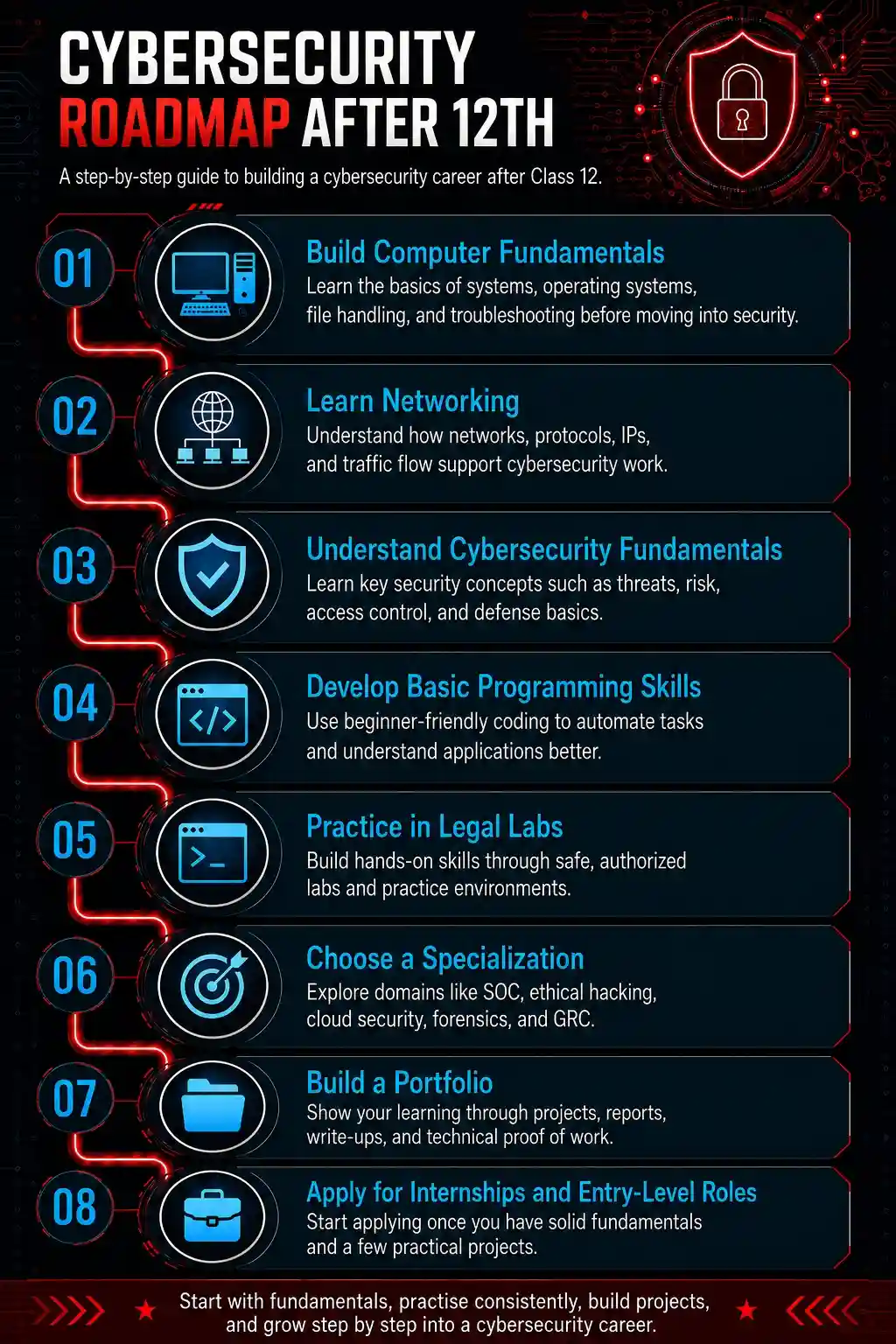
Stage 1: Build Computer Fundamentals
Before learning security, understand what you are trying to secure.
- Computer hardware and operating systems
- Windows and Linux basics
- File systems
- Command-line fundamentals
- Basic troubleshooting
These skills become essential in system hardening, investigations, and lab work.
Stage 2: Learn Networking
Networking is a core cybersecurity foundation. Study:
- TCP/IP
- IP addresses and subnetting
- DNS, DHCP, and HTTP
- Routers, switches, and firewalls
- VPNs and common Network protocols
Aim to understand what happens after a user enters a website address, how devices receive IP addresses, why ports matter, what firewalls control, and how packet captures reveal activity. This makes Wireshark, Nmap, firewalls, and SIEM platforms much easier to understand.
Stage 3: Understand Cybersecurity Fundamentals
Study threats, vulnerabilities, risks, exploits, and security controls. Learn how malware, phishing, social engineering, credential attacks, and insecure configurations affect organizations.
Important topics include:
- Threats and vulnerabilities
- Malware and phishing
- Authentication and authorization
- Access control
- Encryption and hashing
- Backups and recovery
- Security operations
- Incident response
- Risk and compliance
Stage 4: Develop Basic Programming Skills
You do not need to become an expert developer. Basic programming can help you automate tasks, understand applications, read code, analyze data, and build simple scripts.
Useful Coding and Scripting Technologies:
- Scripting: Python, Bash, PowerShell
- Web Fundamentals: HTML, CSS, JavaScript
- Databases and Queries: SQL
Start with logic, variables, conditions, loops, functions, files, and error handling. Build small projects instead of memorizing syntax.
Stage 5: Practice in Legal Labs
Cybersecurity skills must be developed through practical experience, but practice should always occur in safe and authorized environments.
Students can practice safely using:
- Virtual machines
- Deliberately vulnerable applications
- Capture-the-flag challenges
- Network simulators
- Guided cyber ranges
- Home lab environments
Stress that testing should only be performed on systems the learner owns or has explicit permission to assess.
Stage 6: Choose a Specialization
Cybersecurity is too broad to master all at once. After learning the fundamentals, explore different paths before choosing where to specialize. Possible paths:
- SOC and blue team
- Ethical hacking and penetration testing
- Digital forensics and incident response
- Cloud security
- Application security
- Governance, risk, and compliance
- Identity and access management
- Threat intelligence
- Malware analysis
- AI security
Stage 7: Build a Portfolio
A portfolio gives employers evidence of your learning, particularly when you do not yet have professional experience.
Students can showcase:
- Lab reports
- Vulnerability assessment reports
- Security hardening checklists
- Incident investigation exercises
- GitHub projects
- CTF achievements
- Technical blogs
- Home lab documentation
Stage 8: Apply for Internships and Entry-Level Roles
Do not wait until you feel like an expert. Apply when you have reliable foundations, a few projects, and the ability to explain your work honestly.
Create a one-page cybersecurity resume covering:
- Technical skills
- Practical labs
- Projects
- Certifications
- Relevant education
- CTF participation
- Volunteer or internship experience
Optimize your LinkedIn profile with a clear headline, concise summary, project links, certifications, and useful posts about what you are learning.
Which Cybersecurity Career Is Right for You?
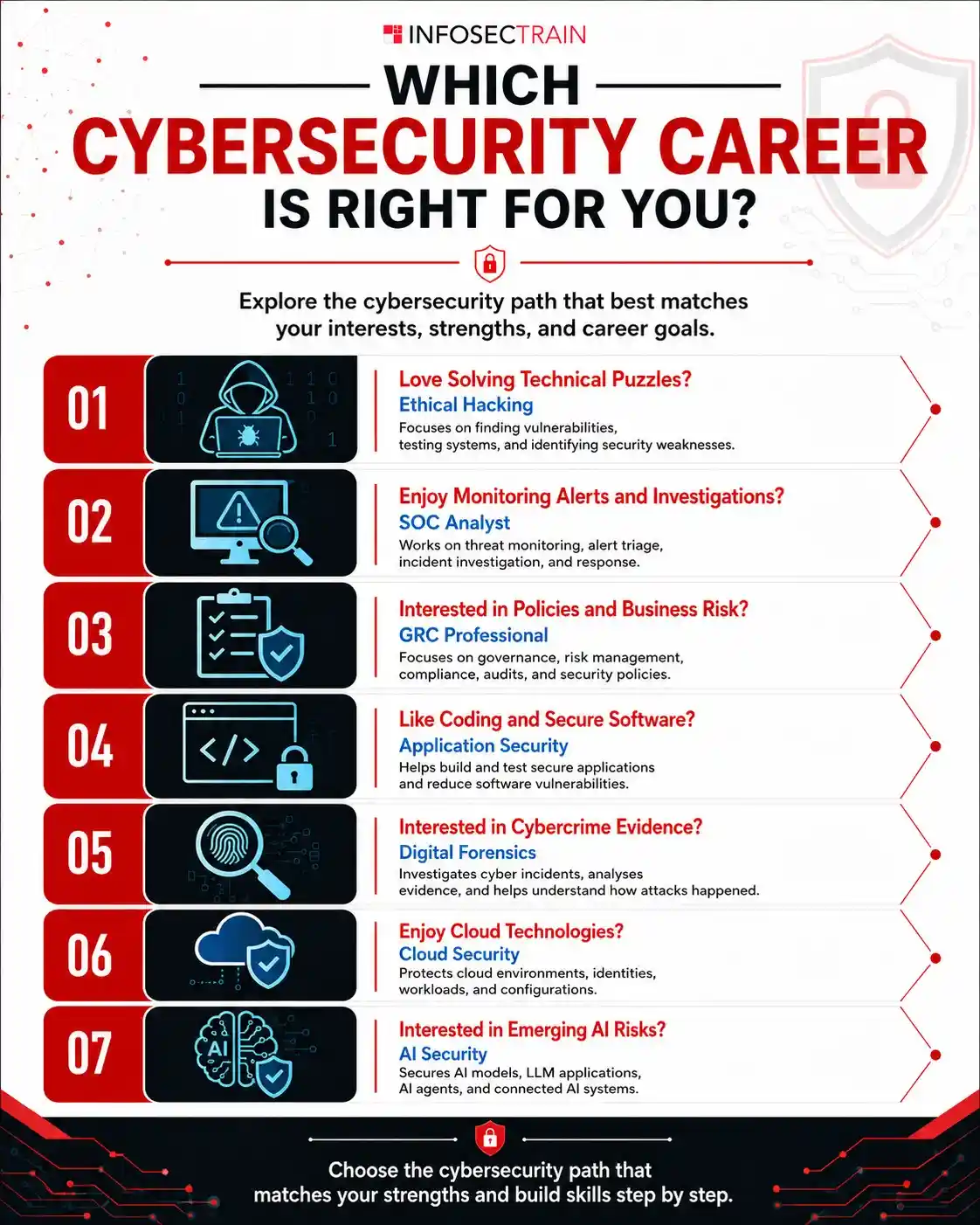
Choose based on the work you enjoy, not only the job title that sounds the most exciting.
Cybersecurity Roles After 12th and Graduation
Immediately after 12th, most learners should focus on education, labs, internships, apprenticeships, and foundational roles rather than expecting a senior security position.
Early opportunities may include:
- Cybersecurity Intern
- SOC Intern
- IT Support Trainee
- Network Support Trainee
- GRC Intern
- Security Operations Trainee
After building stronger skills or completing graduation, common entry-level roles include:
- Junior SOC Analyst
- Cybersecurity Analyst
- Junior Penetration Tester
- Vulnerability Assessment Analyst
- Information Security Analyst
- IAM Analyst
- Junior GRC Analyst
- Cloud Security Associate
- Digital Forensics Associate
With experience, professionals may progress into threat hunting, incident response, security engineering, penetration testing, red teaming, application security, cloud security, consulting, architecture, management, or CISO-level leadership.
Cybersecurity Salary
Cybersecurity salaries vary significantly depending on the role, location, employer, industry, experience, education, certifications, portfolio quality, and practical capabilities.
As a current market reference, Glassdoor reported an average base salary of approximately $6,630 per year for Cybersecurity Analysts in India in July 2026, with a typical range of around $4,300 to $9,710 per year. These figures should not be treated as guaranteed fresher salaries, as compensation varies by experience level, employer, job role, and location.
Freshers may receive lower or higher offers depending on their skills and the role. Product-based companies, specialized cybersecurity firms, and global organizations may offer higher packages, while internships, apprenticeships, and trainee roles may start at lower salaries.
Tools Beginners Can Learn
Beginners should start with a few essential tools in each category rather than trying to learn too many at once.
- Operating systems: Linux and Windows
- Networking: Wireshark and Cisco Packet Tracer
- Security testing: Nmap and Burp Suite Community Edition
- Vulnerability assessment: Open-source scanners and legal lab platforms
- Version control: Git and GitHub
- Virtualization: VirtualBox or VMware
- SIEM exposure: Beginner-friendly monitoring and log-analysis labs
Note: All cybersecurity and security-testing tools should only be used in environments that you own or are explicitly authorized to assess.
Conclusion
Students from different academic streams can begin studying cybersecurity after 12th by choosing an eligible educational path and learning in the correct sequence. Start with computers, Linux, networking, and security fundamentals. Practice only in legal environments, document your work, build a portfolio, and explore specializations before deciding where to focus.
A degree provides structure, a certification validates knowledge, and a bootcamp can accelerate practical learning. None is a shortcut. Consistent practice, ethical conduct, curiosity, and communication turn learning into a career.
Start Your Cybersecurity Journey with the Right Skills
A successful cybersecurity career begins with strong fundamentals, practical experience, and a learning path aligned with your goals. Whether you are interested in ethical hacking, SOC operations, cloud security, digital forensics, GRC, or AI security, the right training can help you move forward with clarity and confidence.
Explore InfosecTrain’s beginner-to-advanced cybersecurity training programs and learn through expert-led sessions, hands-on labs, real-world scenarios, and certification-focused guidance.
Ready to build your career in cybersecurity after 12th?
Explore Cybersecurity Courses and take your first step toward becoming a skilled cybersecurity professional.
Frequently Asked Questions
Can I study cybersecurity after 12th?
Yes. You can pursue cybersecurity through a degree, diploma, certification, bootcamp, or self-learning path after 12th.
Which cybersecurity course is best after 12th?
It depends on your eligibility and career goals. B.Tech, B.Sc., and BCA are common degree options, while certifications and bootcamps can support practical learning.
Is coding compulsory for cybersecurity?
No, coding is not compulsory for every cybersecurity role. However, basic knowledge of Python, Bash, PowerShell, JavaScript, or SQL can be helpful.
What is the eligibility for cybersecurity courses after 12th?
Eligibility varies by program. Some B.Tech courses require PCM, while BCA, B.Sc., diploma, and certification programs may have broader requirements.
How many years does a cybersecurity course take?
A bachelor’s degree generally takes three to four years. Diplomas, bootcamps, and certifications may take a few weeks to two years.
What are the fees for cybersecurity courses after 12th?
Fees depend on the institution, course type, duration, labs, and certification costs. Compare the curriculum and practical training before enrolling.
What salary can a cybersecurity fresher expect?
Fresher salaries vary by role, location, company, skills, and internship experience. Practical knowledge and a strong portfolio can improve opportunities.
Is ethical hacking legal?
Yes, but only when performed with explicit permission and within an approved scope. Testing systems without authorization may be illegal.
Is a degree compulsory to become an Ethical Hacker?
No. Skills, certifications, labs, and projects can also help you enter the field, although a degree may improve access to internships and placements.
Which certification should a beginner pursue first?
Start with a foundational certification, such as ISC2 CC or Cisco CCST Cybersecurity, before moving on to advanced credentials.
Can I become an Ethical Hacker immediately after 12th?
You can start learning immediately, but becoming job-ready requires networking, Linux, cybersecurity fundamentals, legal lab practice, and projects.
What job roles can I get after studying cybersecurity?
Common entry-level roles include SOC Analyst, Cybersecurity Analyst, Junior Penetration Tester, IAM Analyst, GRC Analyst, and Vulnerability Analyst.
Is cybersecurity difficult for beginners?
It can feel challenging initially, but it becomes easier when learned step by step, starting with computers, networking, Linux, and security fundamentals.
Should I choose B.Tech, B.Sc., or BCA for cybersecurity?
Choose B.Tech for an engineering-focused path, B.Sc. for a science-oriented route, and BCA for a computing and application-focused foundation.