What is AI Security A Beginner’s Guide for 2026
Quick Insights:
AI security protects the complete AI ecosystem, including models, data, prompts, applications, infrastructure, tools, and users. It helps prevent threats such as prompt injection, data poisoning, model theft, sensitive data leakage, and unsafe AI actions. Organizations must secure AI throughout its lifecycle, including development, deployment, monitoring, and incident response. Strong access controls, input and output validation, data governance, and continuous testing are essential. AI systems should also be monitored for unusual behavior and misuse. Human oversight remains important, especially for high-risk decisions. The key takeaway is to treat AI as a complete system, not as an isolated technology.
Artificial intelligence is changing how organizations work. Businesses now use AI to write content, analyze data, detect fraud, generate code, answer customer questions, support security teams, and automate everyday operations. However, as AI systems gain access to sensitive data and business tools, they also introduce new security risks.

What happens when someone manipulates an AI model? Can an AI chatbot accidentally reveal confidential information? What if an AI agent performs an action it was never supposed to perform?
These questions are at the heart of AI security. AI security helps organizations protect artificial intelligence systems from attacks, manipulation, misuse, data leakage, and operational failure. It combines traditional cybersecurity practices with controls designed specifically for machine learning, generative AI, large language models, and AI agents.
What is AI Security?
AI security involves protecting AI systems, models, data, applications, infrastructure, and users from unauthorized access, manipulation, misuse, leakage, disruption, and other security risks.
In simple terms, it means making sure that:
- Attackers cannot secretly change how an AI system behaves
- Sensitive information is not exposed through prompts or responses
- Training data and AI models remain protected
- AI-generated outputs are checked before they affect other systems
- AI applications only perform actions they are authorized to perform
- Security teams can find, investigate, and respond to AI-related incidents
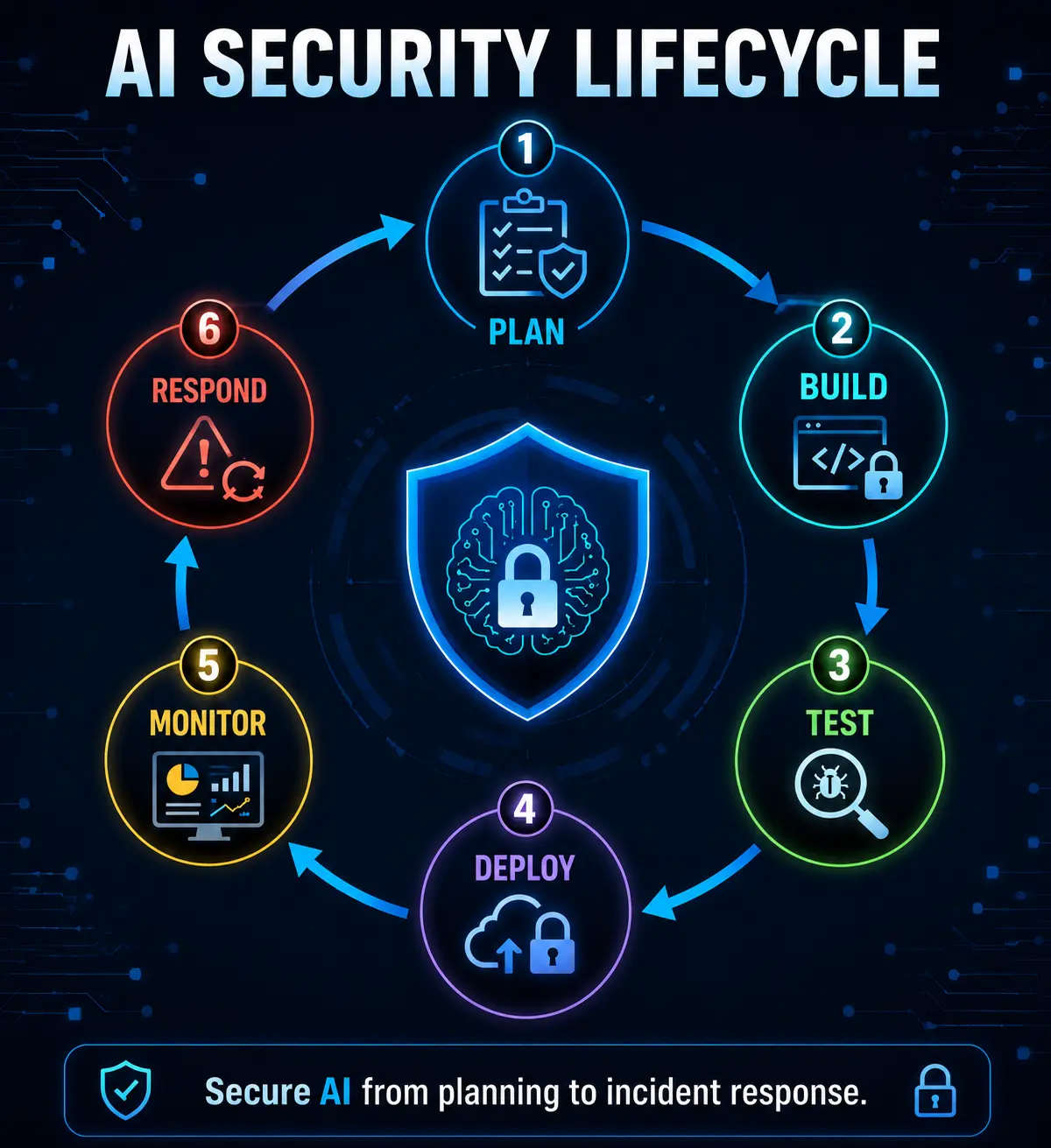
AI security is a combination of governance, secure development, access control, testing, monitoring, incident response, and human oversight.
AI Security vs. AI for Cybersecurity
These two ideas are connected, but they are not the same.
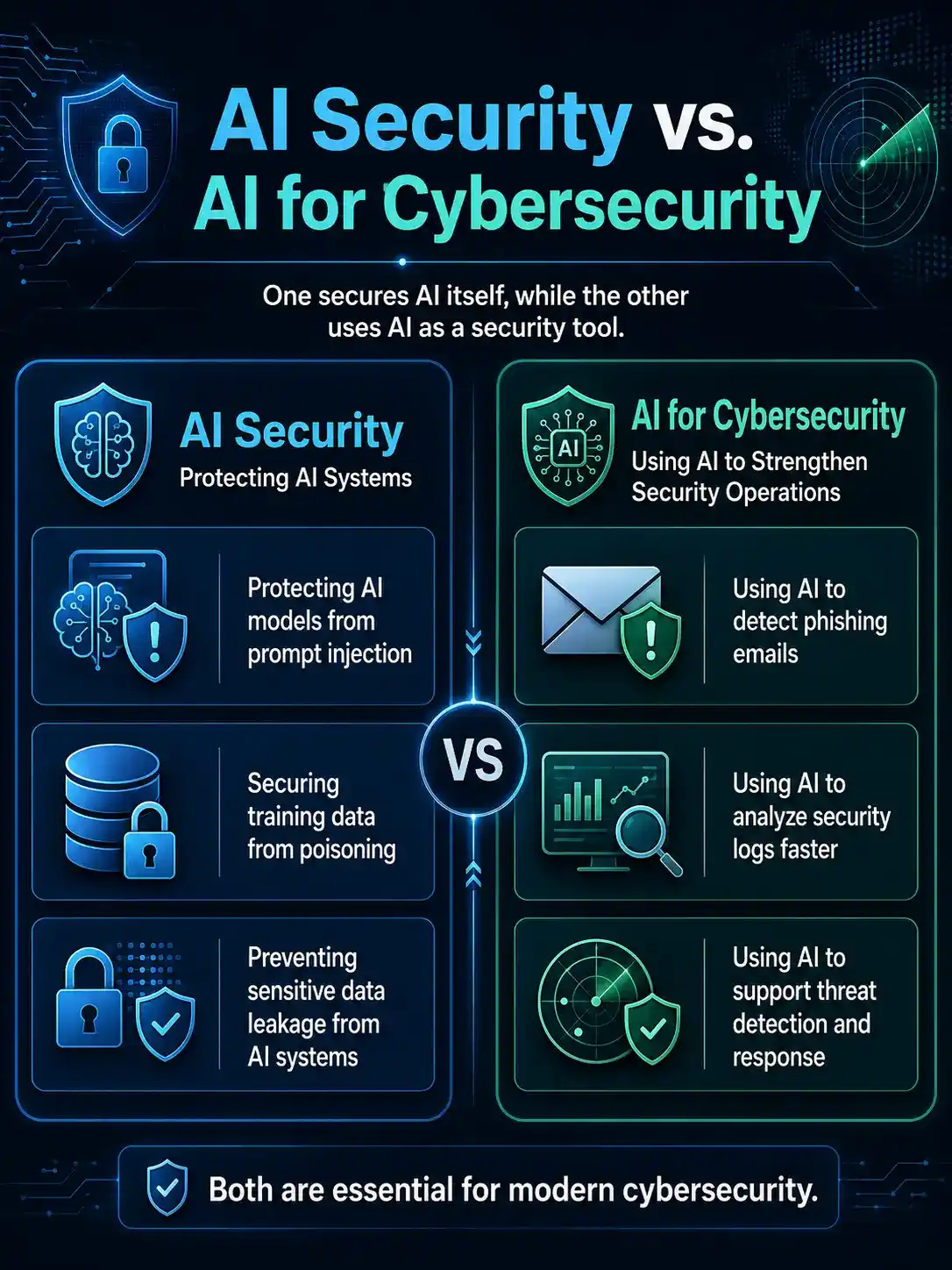
AI Security
AI security means protecting AI systems themselves.
For example, an organization may need to prevent attackers from poisoning an AI model’s training data, stealing its model, injecting malicious prompts, or manipulating an AI agent into performing an unauthorized action.
AI for Cybersecurity
AI for cybersecurity means using AI to improve security operations.
Security teams may use AI to:
- Analyze logs
- Identify suspicious activity
- Detect phishing emails
- Prioritize vulnerabilities
- Investigate malware
- Summarize security alerts
- Automate parts of incident response
A mature AI security strategy must address both areas: organizations need to use AI safely while also protecting AI-powered systems from attack.
Why is AI Security Important?
Traditional applications usually follow instructions written directly into their code. AI systems behave differently. Their responses may depend on training data, prompts, user context, retrieved documents, model settings, and external tools. This creates new attack surfaces.
Consider an AI assistant that can read emails, access customer records, and schedule meetings. A malicious instruction hidden inside an email could attempt to make the assistant ignore its original rules, reveal private information, or perform an unauthorized action. This type of risk is not adequately managed by securing the login page alone. The organization must also protect the model’s instructions, retrieved data, tool permissions, outputs, and decision-making workflow.
What Does AI Security Protect?
AI security covers the complete AI lifecycle rather than focusing only on the final model.
1. Training and Business Data
AI systems depend on data. That may include public information, internal documents, customer records, source code, financial data, images, conversations, and operational logs. Security controls must protect this data from:
- Unauthorized access
- Manipulation
- Theft
- Accidental exposure
- Unapproved use
- Malicious data injection
Poor-quality or compromised data can affect how an AI model learns and behaves.
You can also explore: How to Protect AI Training Data from Cyber Threats?
2. AI Models
AI model is the component that recognizes patterns and generates predictions or responses. It may be developed internally, downloaded from an open-source platform, or accessed through an external provider. Attackers may try to steal the model, copy its behavior, alter its parameters, discover confidential information about its training data, or force it to produce harmful results.
3. Prompts and System Instructions
Generative AI applications often use system prompts to define how a model should behave. Applications may also send user prompts, retrieved documents, conversation history, and hidden instructions to the model. These instructions need protection because attackers may attempt to override them, extract them, or insert conflicting commands.
4. AI Applications and APIs
An AI model is usually only one part of a larger application. The surrounding system may include APIs, databases, web interfaces, authentication services, cloud platforms, plugins, and business tools. Traditional application-security weaknesses can still affect these components. AI-specific vulnerabilities may then increase the possible impact.
5. Vector Databases and Retrieval Systems
Many AI applications use Retrieval-Augmented Generation, commonly called RAG, to find relevant information from documents before generating a response. Weak access controls, untrusted documents, insecure embeddings, or poor separation between users can expose sensitive information or influence the model’s answers. OWASP identifies vector and embedding weaknesses as a major risk for LLM and generative AI applications.
6. AI Agents and Connected Tools
AI agents can perform tasks beyond simply generating text. They may search the internet, execute code, access files, send messages, update records, or interact with business applications. The ability to act makes security especially important. An agent should never receive more access than it genuinely requires.
7. AI Outputs
AI-generated content should be treated as untrusted until it has been validated. A model might generate incorrect code, unsafe commands, fabricated information, malicious links, or improperly formatted data. When an application sends these outputs directly into another system, a simple model error can become a security incident. This is why even fully deployed AI models still need human review, often supported by tools like an AI detector, across businesses, schools, and workplaces.
Common AI Security Threats
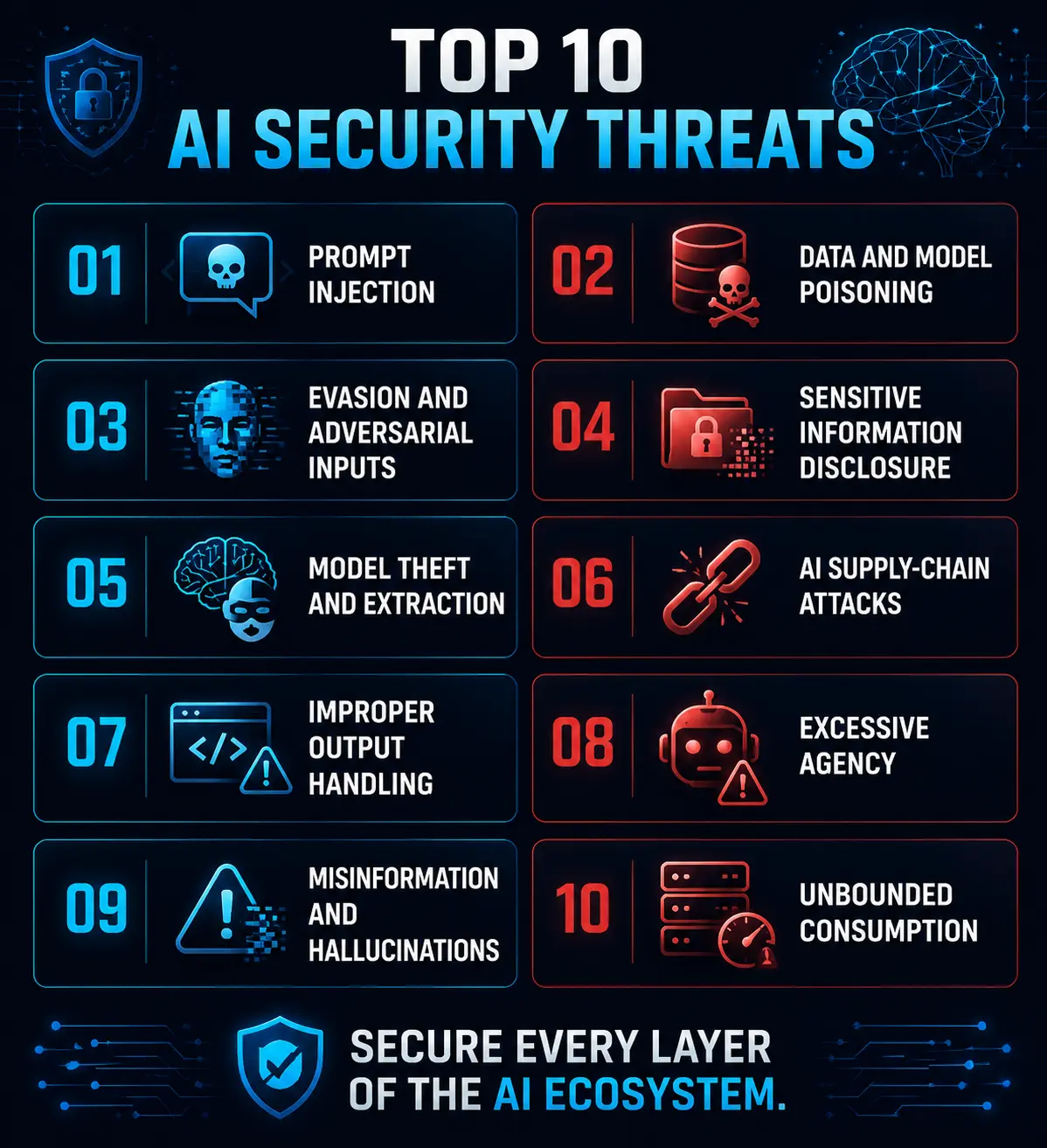
1. Prompt Injection
Prompt injection occurs when malicious or misleading instructions influence an AI model’s behavior. An attacker may directly enter a harmful prompt or hide instructions inside a document, email, image, or webpage processed by the application. The risk becomes more serious when the AI can access confidential information or connected tools.
2. Data and Model Poisoning
Poisoning happens when an attacker introduces harmful or misleading information into training data, fine-tuning data, embeddings, or model updates. The goal may be to reduce accuracy, create hidden backdoors, influence specific predictions, or make the model behave incorrectly under certain conditions.
3. Evasion and Adversarial Inputs
In an evasion attack, an attacker carefully changes an input so that the AI system makes the wrong decision. The change may be difficult for a person to notice, but it may be significant enough to confuse the model. Such attacks can affect image recognition systems, malware detectors, spam filters, biometric systems, and other machine learning applications.
4. Sensitive Information Disclosure
AI applications may accidentally expose personal information, internal documents, source code, credentials, system prompts, or conversation history. This can happen because of weak access controls, unsafe prompts, poor data separation, or overly broad retrieval permissions.
5. Model Theft and Extraction
An AI model may represent significant intellectual property and development cost. Attackers may repeatedly query a model to understand, copy, or reproduce its behavior. They may also attempt to steal model files, weights, configurations, training information, or proprietary prompts through compromised infrastructure or insecure endpoints.
6. AI Supply-Chain Attacks
Modern AI applications depend on many external components, including:
- Pre-trained models
- Open-source libraries
- Datasets
- Plugins
- APIs
- Cloud services
- Model repositories
- Development frameworks
A compromised dependency, an untrusted model, a vulnerable library, or a manipulated dataset can introduce risk to the entire application.
7. Improper Output Handling
Passing AI-generated output directly into another system without validation can be dangerous. For example, an application may ask a model to generate database queries, HTML, commands, or software code. Passing that output directly into another system without validation could lead to injection attacks, unauthorized actions, or system compromise.
8. Excessive Agency
Excessive agency occurs when an AI system has more permissions or autonomy than necessary. An AI assistant designed to summarize customer records should not also have unrestricted permission to delete or modify them.
9. Misinformation and Hallucinations
AI models can produce responses that sound confident but are incomplete, misleading, or incorrect. This becomes a security concern when users or automated systems make important decisions based on those responses. Incorrect threat intelligence, fabricated legal guidance, unsafe code, or false incident details can create serious consequences.
10. Unbounded Consumption
AI services require computing resources. Attackers may send large, complex, or repeated requests to consume processing capacity, increase operational costs, slow down the application, or deny service to legitimate users.
AI Security Best Practices
1. Maintain an AI Inventory
Organizations should identify all approved AI tools, models, datasets, applications, providers, APIs, plugins, and agents. The inventory should record who owns each system, what data it accesses, and what actions it can perform.
2. Assess AI Risks Early
Evaluate security risks before deploying an AI system. A basic public chatbot does not require the same controls as an AI system that handles financial data, medical records, production infrastructure, or customer decisions.
3. Apply Strong Data Governance
Organizations should understand where AI data comes from, who owns it, how it is used, who can access it, and how long it is retained. Sensitive data should be minimized, encrypted when appropriate, and removed when no longer required.
4. Use Least-Privilege Access
Users, applications, models, and AI agents should receive only the permissions necessary to complete their tasks. High-impact actions should require explicit human approval.
5. Validate Inputs and Outputs
Treat user prompts, uploaded files, retrieved content, and AI responses as untrusted. Use input filtering, output validation, secure encoding, approved commands, context isolation, and content checks based on the use case.
6. Secure the AI Supply Chain
Use AI models, datasets, libraries, and plugins from trusted sources. Verify their origin and integrity, test them in controlled environments, and monitor dependencies for newly discovered vulnerabilities.
7. Conduct AI Red Teaming
AI red teaming tests systems from an attacker’s perspective. Security teams attempt to manipulate the model, bypass controls, extract sensitive information, exploit connected tools, and identify unsafe behavior before real attackers do.
8. Continuously Monitor AI Systems
Monitor unusual prompts, suspicious tool calls, data leakage, policy violations, resource consumption, and changes in model performance. AI systems should be monitored throughout their operational lifecycle.
9. Prepare for AI Security Incidents
AI incident-response plans should cover poisoned data, stolen models, exposed prompts, unsafe agent actions, compromised providers, and manipulated outputs. Teams should know how to contain, investigate, recover, and safely disable an affected AI service.
In Conclusion
AI security protects the entire AI ecosystem, not just the model, but also its data, prompts, infrastructure, tools, outputs, and users. The key is to treat AI as a complete system. Organizations should understand where AI is used, what it can access, and what risks could arise if it fails or is manipulated. Strong governance, access controls, secure development, continuous testing, monitoring, and human oversight are essential for using AI safely and responsibly.
Build Practical AI Security Skills with InfosecTrain
AI security cannot be learned through theory alone. Professionals need to understand how AI systems are built, where they can be attacked, and how security controls work across the complete AI lifecycle. InfosecTrain’s Cybersecurity AI Foundation Program helps beginners understand AI fundamentals, cybersecurity use cases, common attacks, defensive controls, and AI governance. Experienced professionals can advance to the Practical AI Security Engineering Program, which covers AI threat modeling, adversarial attacks, model and data security, LLM guardrails, AI red teaming, secure deployment, monitoring, and supply-chain risks.
Explore InfosecTrain’s AI security training programs and build the skills needed to secure modern intelligent systems.

TRAINING CALENDAR of Upcoming Batches For Cybersecurity AI Foundation Program
| Start Date | End Date | Start - End Time | Batch Type | Training Mode | Batch Status | |
|---|---|---|---|---|---|---|
| 03-Oct-2026 | 15-Nov-2026 | 09:00 - 13:00 IST | Weekend | Online | [ Open ] | |
| 09-Jan-2027 | 14-Feb-2027 | 19:00 - 23:00 IST | Weekend | Online | [ Open ] | |
| 27-Feb-2027 | 04-Apr-2027 | 09:00 - 13:00 IST | Weekend | Online | [ Open ] |

TRAINING CALENDAR of Upcoming Batches For Practical AI Security Engineering Program
| Start Date | End Date | Start - End Time | Batch Type | Training Mode | Batch Status | |
|---|---|---|---|---|---|---|
| 31-Oct-2026 | 13-Dec-2026 | 19:00 - 23:00 IST | Weekend | Online | [ Close ] | |
| 09-Jan-2027 | 14-Feb-2027 | 09:00 - 13:00 IST | Weekend | Online | [ Open ] | |
| 27-Feb-2027 | 04-Apr-2027 | 19:00 - 23:00 IST | Weekend | Online | [ Open ] |
Frequently Asked Questions
What is AI security in simple words?
AI security means protecting AI systems from attacks, manipulation, data leakage, theft, misuse, and failure. It covers AI models, data, applications, prompts, infrastructure, and connected tools.
Is AI security part of cybersecurity?
Yes. AI security is a specialized area of cybersecurity that addresses both traditional security risks and AI-specific threats such as prompt injection, model poisoning, and adversarial attacks.
What is the most common generative AI security risk?
Prompt injection is one of the most widely recognized generative AI risks. It occurs when malicious instructions cause an AI system to ignore its intended rules or perform unsafe actions.
Can AI reveal confidential information?
Yes. AI applications can expose confidential information through responses, logs, connected databases, retrieved documents, or poorly configured access controls.
What is AI red teaming?
AI red teaming involves testing an AI system like an attacker. It helps identify vulnerabilities, unsafe behaviors, information leakage, and weaknesses in model or application controls.
How can beginners start learning AI security?
Beginners should learn cybersecurity fundamentals, networking, application security, cloud security, data protection, and basic AI concepts. They can then progress to LLM security, AI threat modeling, adversarial machine learning, and AI red teaming.
