How to Become a CISSP Expert?
Quick Insights:
Becoming a CISSP expert takes more than passing an exam. You need five years of paid experience in at least two of the eight CISSP domains. A qualifying degree or a credential on ISC2’s current approved list can waive one year. Alternatively, you can pass first and become an Associate of ISC2, with six years to complete the experience. The path runs from building cybersecurity fundamentals and gaining hands-on experience, through structured training and the CAT exam (up to 3 hours, 100-150 questions, 700 out of 1,000 to pass), to ISC2 endorsement within nine months of passing. To stay certified, you then earn 120 CPE credits every three years and pay the annual maintenance fee.
Protecting an organization’s information isn’t just about installing security tools or preventing cyberattacks. It also involves understanding risks, making the right security decisions, and ensuring that people, processes, and technology work together. This is where experienced cybersecurity professionals play an important role.
As businesses adopt new technologies, they need professionals who can look beyond technical issues and manage security across the organization. This requires a good understanding of security policies, risk management, network protection, and compliance.
One certification that can help professionals advance in this field is the Certified Information Systems Security Professional (CISSP). It is designed for professionals who want to build on their cybersecurity experience and take on greater responsibilities. It can help open doors to senior positions in security management, architecture, consulting, and leadership. But what does it take to become a CISSP expert?
What is a CISSP Expert?
CISSP experts strengthen cutting-edge information security systems by protecting data from unauthorized access and infringement. They are responsible for identifying security risks, developing security policies, designing secure architectures, evaluating security controls, and ensuring that cybersecurity practices support organizational objectives.
Their responsibilities may include:
- Developing and implementing enterprise cybersecurity strategies.
- Identifying, assessing, and managing information security risks.
- Designing secure networks, systems, and cloud architectures.
- Establishing identity and access management (IAM) controls.
- Managing security operations and incident response processes.
- Supporting regulatory compliance and security governance.
- Evaluating emerging risks related to AI, cloud services, and third-party technologies.
- Aligning cybersecurity investments with business requirements.
CISSP experts with a lot of experience are frequently regarded as the best professionals for protecting sensitive data in an organization.
How to Become a CISSP Expert?
In terms of knowledge and skills, CISSP experts are at the top of the cybersecurity game. To become a CISSP expert, one must have a solid understanding of information systems, networks, and cybersecurity trends. A graduate degree in Information Technology (IT), Computer Science (CS), or a related field is desirable to be a CISSP expert. You can explore the below-mentioned steps to become a CISSP expert.
1. Build Strong Foundation in Cybersecurity:
To become a CISSP expert, you must first become familiar with the current cybersecurity landscape and understand key tools to evaluate and manage security protocols in information processing systems. Gain an understanding of cybersecurity fundamentals, threat actor attacks, mitigation, security policies, secure architecture, wireless networks, network security controls, security testing, and more.
Since CISSP covers both technical and managerial aspects of information security, professionals should be familiar with how security technologies, processes, and policies work together. In 2026, cybersecurity professionals should also understand modern security approaches such as Zero Trust Architecture, AI-related security risks, and security automation.
2. Gain the Required Experience:
CISSP experts are not entry-level professionals. To qualify for full CISSP certification, candidates must have at least five years of cumulative paid work experience in two or more of the CISSP CBK’s eight domains. ISC2 allows a maximum one-year experience waiver, through either an eligible post-secondary degree or a credential on ISC2’s approved waiver list, but not both. A waiver can reduce the experience requirement to four years.
Additionally, anyone who does not have the needed experience to become a CISSP expert but passes the CISSP exam can become an Associate of (ISC)2. After that, the (ISC)2 Associate will have six years to complete the five years of experience required.
3. Get Entry-Level Cybersecurity Certifications:
If you don’t have enough relevant job experience or a firm knowledge of cybersecurity concepts to become a CISSP expert, CompTIA offers entry-level A+, Network+, and Security+ certifications. With that foundation in place, you can apply for a security-related job and gain some much-needed IT experience.
Consider seeking the (ISC)2 Systems Security Certified Practitioner (SSCP) certificate if you’ve been working in IT security for a year or two. The SSCP is a precursor to the CISSP, covering many of the same issue categories, even though it is not an official prerequisite.
However, foundational certifications should not be considered a substitute for the practical experience required for full CISSP certification.
4. Get Yourself Certified:
The best way to demonstrate your expertise is to gain a professional badge. So, to become a CISSP expert, you need to clear the CISSP certification exam. CISSP is a worldwide recognized certification for IT security professionals. Obtaining this credential verifies an individual’s knowledge and abilities in the field of information security. It enhances one’s credibility and makes it easier for the candidate to land a better job with a higher pay-grade. A CISSP certification is also a requirement for many high-level security roles.
Domains of CISSP
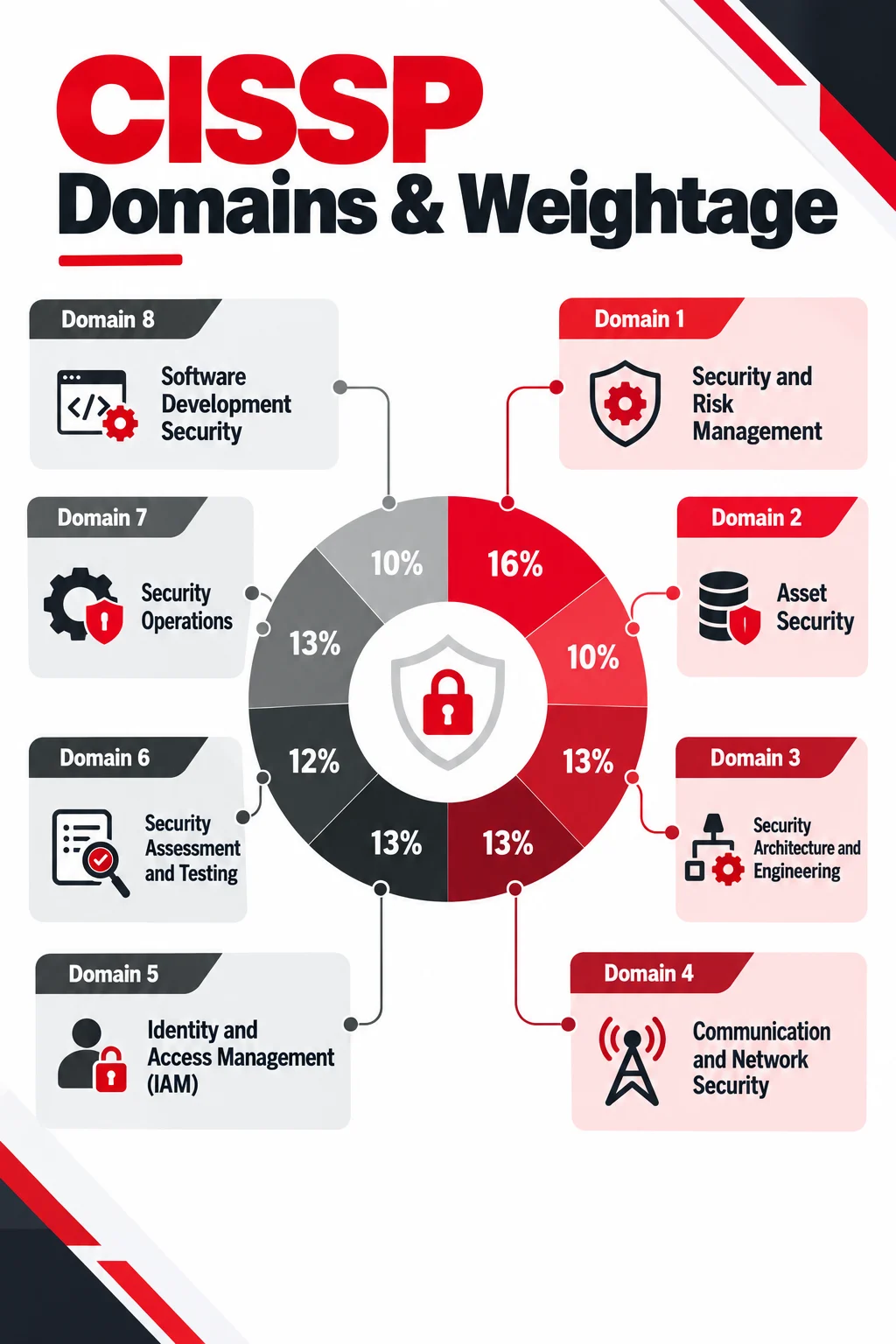
Each domain addresses a different aspect of enterprise information security.
CISSP Exam Details
| Exam Name | Certified Information Systems Security Professional (CISSP) |
| Exam Format | Computerized Adaptive Testing (CAT) |
| Exam Duration | Up to 3 hours |
| Number of Items | 100-150 |
| Question Types | Multiple-choice and advanced innovative items |
| Passing Score | 700 out of 1000 points |
| Language | English, Chinese, Japanese, German, and Spanish |
| Testing Center | (ISC)2 Authorized Pearson VUE Testing Centers |
Source: ISC2 Official CISSP Exam Outline
5. Enroll in Professional CISSP Training: Preparing independently for CISSP can be challenging because the syllabus covers a wide range of technical, managerial, and governance-related concepts. Enrolling in a training course is one of the most effective ways to prepare for the CISSP certification exam. Instructor-led programs, such as InfosecTrain’s CISSP Certification Training course, offer structured learning and expert guidance to help you understand key cybersecurity concepts and how they apply to real-world situations.
An effective training program should include:
- Complete coverage of all eight CISSP domains
- Instructor-led explanations of complex security concepts
- Practical scenarios and real-world cybersecurity examples
- Domain-wise practice questions and mock examinations
- Guidance on exam strategies and time management
- Updated learning materials aligned with the official exam outline
- Opportunities to clarify doubts and strengthen weaker subject areas
6. Complete the CISSP Endorsement Process:
Passing the CISSP exam does not automatically grant you full CISSP certification. After you receive confirmation that you passed the exam, you must complete ISC2’s certification application and endorsement process. To obtain the certification, you must:
- Submit the certification application through ISC2
- Provide details of their qualifying professional experience
- Get your work experience verified by an ISC2-certified professional whose certification is active and in good standing.
- Agree to follow the ISC2 Code of Ethics
- Complete the certification approval process and pay the applicable Annual Maintenance Fee
If a candidate does not know an eligible ISC2-certified professional, ISC2 can act as the endorser after reviewing the required documentation.
Candidates must complete the certification application process within nine months of passing the exam. Once the application is approved and the membership requirements are fulfilled, the candidate receives the CISSP credential.
7. Maintain Your CISSP Certification and Continue Learning:
Becoming CISSP-certified is not the final stage of professional development. To maintain an active CISSP certification, professionals must meet ISC2’s Continuing Professional Education (CPE) requirements.
Current requirements include:
- Earning 120 CPE credits during each three-year certification cycle, including the required security-related credits.
- Paying the applicable Annual Maintenance Fee, currently US$135.
- Continuing to comply with the ISC2 Code of Ethics.
CPE credits can be earned through eligible activities such as professional training, cybersecurity conferences, webinars, research, and other educational activities.
CISSP Certification Training with InfosecTrain
Preparing for the CISSP examination requires a structured approach, a clear understanding of cybersecurity concepts, and the ability to apply security principles to real-world situations. InfosecTrain offers CISSP Certification Training Course designed to help security professionals strengthen their technical and managerial knowledge across all eight CISSP domains. The training includes instructor-led sessions, domain-wise exam practice, online test simulations, and scenario-based learning to support effective preparation. Participants can also benefit from flexible learning options, recorded sessions for revision, and post-training support.

TRAINING CALENDAR of Upcoming Batches For CISSP Training
| Start Date | End Date | Start - End Time | Batch Type | Training Mode | Batch Status | |
|---|---|---|---|---|---|---|
| 14-Nov-2026 | 20-Dec-2026 | 19:00 - 23:00 IST | Weekend | Online | [ Open ] | |
| 07-Dec-2026 | 25-Dec-2026 | 07:00 - 12:00 IST | Weekday | Online | [ Close ] | |
| 12-Dec-2026 | 24-Jan-2027 | 10:00 - 14:00 IST | Weekend | Online | [ Open ] | |
| 09-Jan-2027 | 14-Feb-2027 | 19:00 - 23:00 IST | Weekend | Online | [ Open ] | |
| 13-Feb-2027 | 21-Mar-2027 | 09:00 - 13:00 IST | Weekend | Online | [ Open ] | |
| 13-Mar-2027 | 18-Apr-2027 | 19:00 - 23:00 IST | Weekend | Online | [ Open ] |
Frequently Asked Questions
Can a beginner take the CISSP exam?
Yes. Anyone can sit the CISSP exam. If you pass without the required work experience, you become an Associate of ISC2 and have up to six years to gain the experience needed for full certification.
Does CISSP certification expire?
CISSP certification follows a three-year renewal cycle. You must earn the required CPE credits and pay the Annual Maintenance Fee to keep it active.
Do you need programming skills to become a CISSP expert?
No, programming isn't required for CISSP. However, basic knowledge of secure coding, software vulnerabilities, and application security can be helpful.
Can a network engineer become a CISSP expert?
Yes, network engineers can pursue CISSP by building their knowledge of risk management, security governance, and other cybersecurity domains.
Can IT audit experience help you qualify for CISSP certification?
Yes, your IT audit experience can count if your job responsibilities fall under at least two CISSP domains.
What is the difference between a CISSP-certified professional and a cybersecurity expert?
CISSP proves you meet certain knowledge and experience standards. Cybersecurity expertise comes from years of working on real security problems.
How can CISSP professionals stay relevant in the age of AI?
CISSP professionals can stay relevant by learning about AI security risks, cloud security, Zero Trust, and emerging cybersecurity threats.
Is CISSP certification worth it in 2027?
Yes, CISSP is worth considering in 2027, especially if you are planning to move into senior cybersecurity roles.
How can you gain practical cybersecurity experience for CISSP?
Working in network security, IT auditing, or security operations can help. You can also gain experience by investigating threats, assessing risks, and handling security incidents.
Can CISSP certification help you become a CISO?
Yes. CISSP can help professionals build the broad security knowledge needed for a Chief Information Security Officer (CISO) role. However, becoming a CISO also requires leadership experience, business understanding, strategic planning, financial management, and the ability to communicate cybersecurity risks to executives.