Anatomy of an AI System: Components, Architecture, and Security Risks
Quick Insights:
An AI system is much more than a model that produces answers. It is a connected stack of data, models, APIs, infrastructure, retrieval, agents, and security controls, and a weakness in any layer can put the whole system at risk. Attackers can poison training data, inject malicious prompts, exploit insecure APIs, steal models, or abuse agents with excessive permissions. Securing AI means protecting the entire architecture by mapping your attack surface, verifying every request, validating AI outputs, limiting agent permissions, and testing regularly. Understanding how an AI system is built is the first step to finding its weak points before attackers do.
AI is used in everything from chatbots and fraud detection to online shopping recommendations. But what goes on behind the scenes when these systems process information and produce results?
An AI system is more than an algorithm that produces answers. It combines data, models, computing infrastructure, software applications, and security controls that work together to produce outputs such as predictions, recommendations, or decisions. Think of it like a human body. The brain processes information, the senses collect signals, and different organs perform specific functions. Similarly, an AI system needs several connected components to receive information, process it, make predictions, and deliver meaningful results.
Understanding an AI system’s anatomy helps uncover potential security risks. From poisoned training data and insecure APIs to prompt injection and unauthorized access, vulnerabilities can appear at different stages. Knowing how these components work makes it easier to identify weaknesses and protect the system.
What Is an AI System?
An AI system is a machine-based system that processes inputs to generate outputs such as predictions, recommendations, decisions, or content in order to achieve specific objectives. It relies on computational techniques such as machine learning, NLP, generative AI, reinforcement learning, and other AI methods to identify patterns, interpret information, and perform tasks that typically require human intelligence.
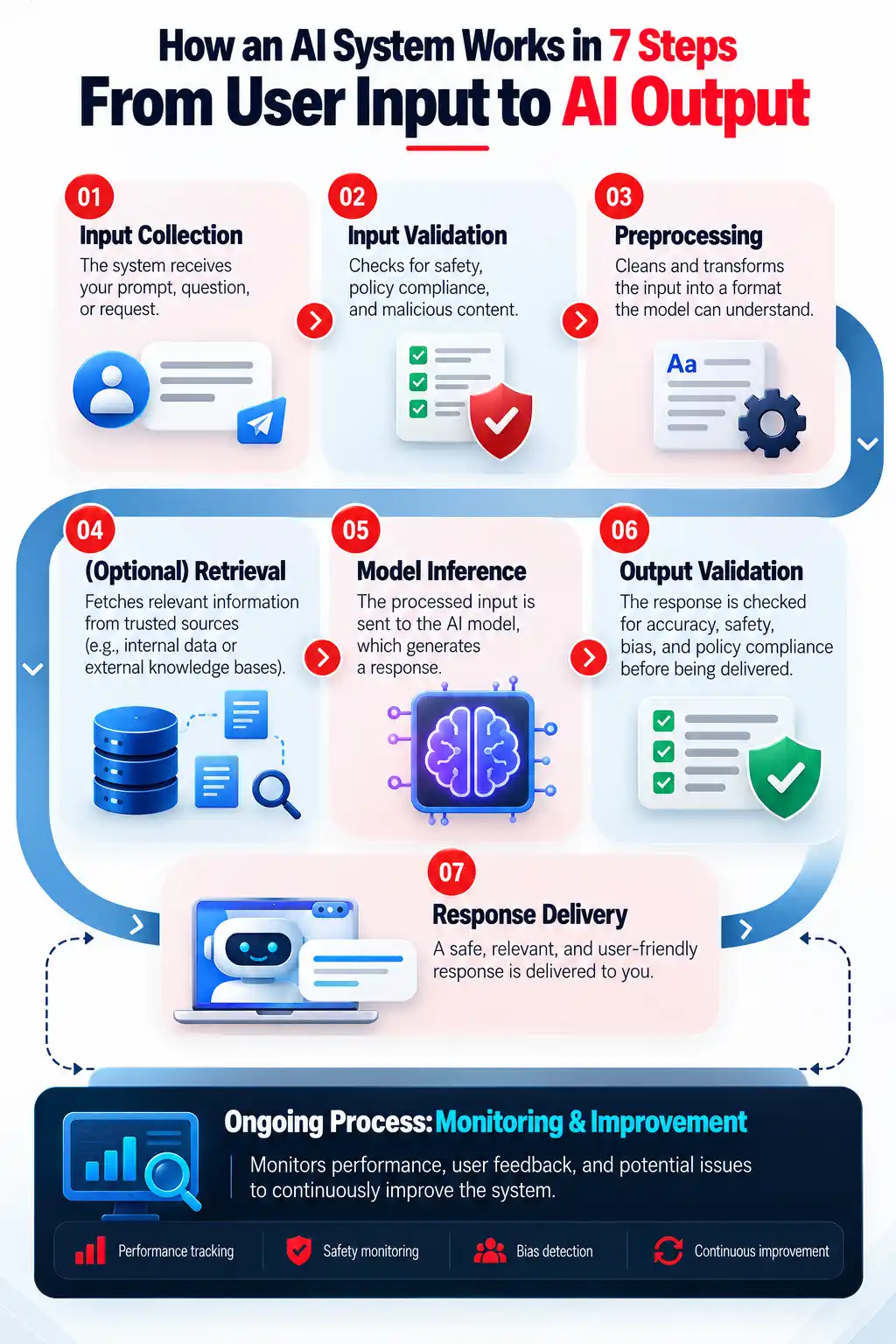
Importance of Understanding the Anatomy of an AI System
AI is now widely used in business operations. However, using AI without understanding how its components work together can lead to performance issues, security risks, and data exposure.
Understanding the anatomy of an AI system helps organizations:
- Identify Security Risks: Spot vulnerabilities in data pipelines, AI models, applications, and infrastructure that attackers could exploit.
- Protect Sensitive Data: Understand how information flows through the system and where security measures are needed.
- Improve AI Performance: Identify issues related to data quality, model accuracy, processing speed, and system reliability.
- Ensure Accountability: Define responsibilities, track AI activities, and maintain proper oversight throughout the AI lifecycle.
- Develop Secure AI Applications: Build security into every stage of AI development rather than addressing risks after deployment.
Understanding AI architecture helps organizations build systems that are secure, reliable, and easier to manage.
For cybersecurity professionals, this knowledge helps to identify which parts of an AI system an attacker could target, and what controls help them prevent the attack from succeeding.
You can explore the article: What are the Key Ethical Principles Every AI System Must Follow?
Core Components of an AI System
An AI system is more than just a model. It also needs data, computing resources, applications, and security controls to work properly. Each part has a specific job, and a security weakness in one area can affect the rest of the system.
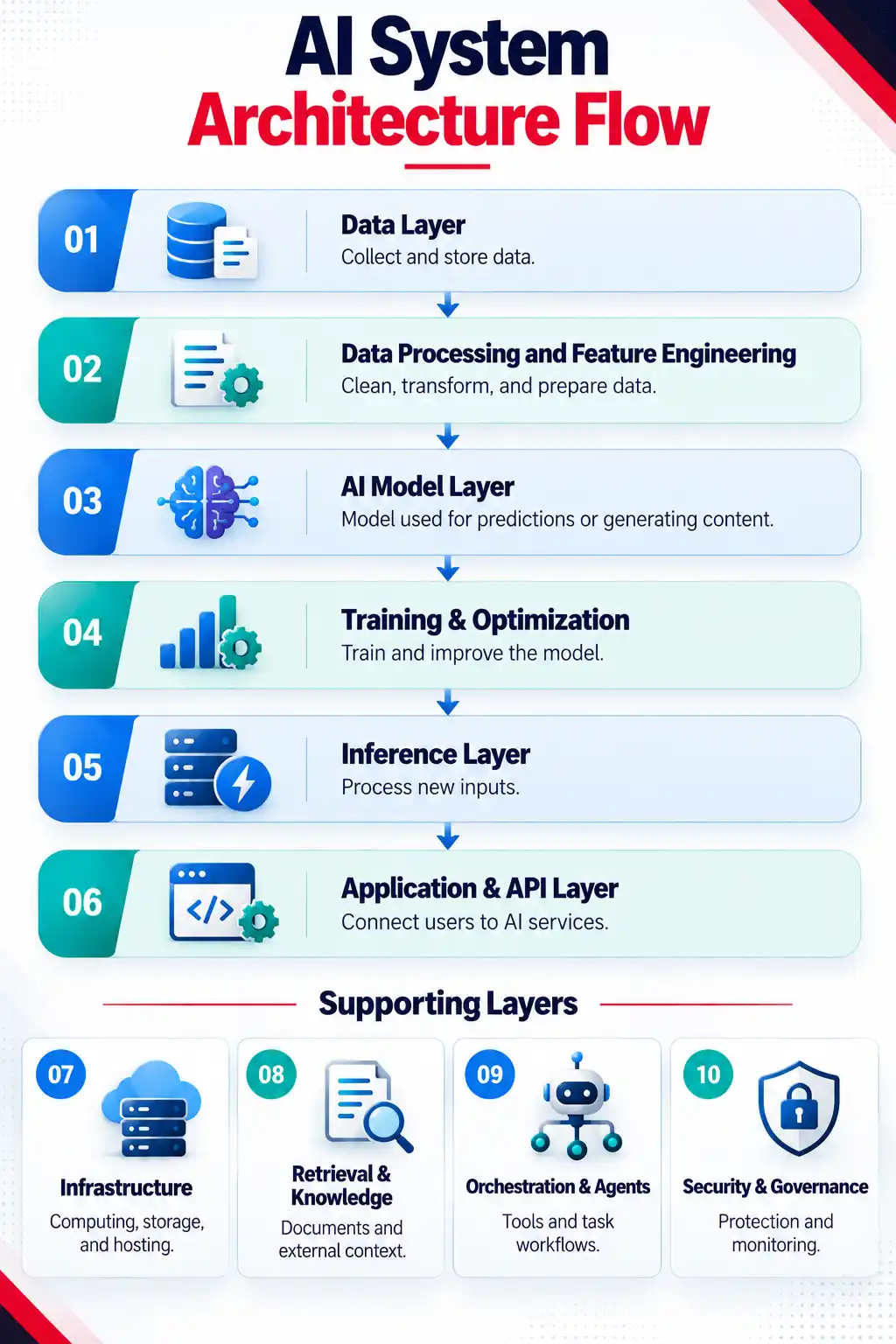
Let’s look at the 10 main components of an AI system:
1. Data Layer
Data is where an AI system starts. It can come from many sources, including text, images, videos, financial records, sensor readings, and application logs. Models use this information during training or when processing new requests.
For example, a bank might use past transaction records to train a fraud detection model. By looking at spending patterns, the model can learn to flag payments that seem unusual.
Key Functions
- Gather and store data from reliable sources
- Check data quality and organize records
- Keep track of where the data comes from
Security Risks
Someone who gains access to the dataset could change records to affect the model’s predictions. This is known as data poisoning. Data leaks and unauthorized access are also concerns, particularly when customer information is involved.
2. Data Processing and Feature Engineering Layer
Collected data often needs some work before a model can use it. There may be duplicate records, missing values, or information stored in different formats. The processing stage deals with these issues. In machine learning, it may also involve feature engineering, where you select or create useful details to help the model make predictions.
For example, a login monitoring system might look at the time of a login, the device being used, previous failed attempts, and changes in location. These details can help identify suspicious activity.
Key Functions
- Remove errors and standardize data
- Select features relevant to the task
- Prepare datasets for training and testing
Security Risks
An attacker with access to the processing pipeline could change the information before it reaches the model. In a fraud detection system, altered transaction details might cause suspicious activity to go unnoticed.
3. AI Model Layer
The model is the part of an AI system that works with the information it receives. Depending on how it’s designed, it can recognize patterns, classify data, make predictions, or generate content.
Different types of models are used for different jobs.
| AI Model Type | Common Applications |
| Supervised Machine Learning | Fraud detection, spam classification |
| Unsupervised Learning | Anomaly detection, customer segmentation |
| Deep Learning | Image recognition, speech processing |
| Large Language Models (LLMs) | Chatbots, summarization, code generation |
| Reinforcement Learning | Robotics, sequential decision-making |
For example, a spam filter examines incoming emails and uses a trained classification model to decide which messages are likely to be spam.
Key Functions
- Find patterns in data
- Predict outcomes or classify information
- Generate content or responses when needed
Security Risks
Attackers may try to fool models with specially designed inputs, steal model information, or interfere with training data. LLM-powered applications can also be affected by prompt injection, where malicious instructions try to influence the application’s behavior.
4. Training and Optimization Layer
A model needs training before it can perform its intended task. It learns from examples, checks where its predictions go wrong, and adjusts its parameters to improve its results. Developers also test and fine-tune models to see how well they handle new information.
For example, a model trained to detect malicious network traffic might initially flag normal activity as suspicious. Better examples and training adjustments can reduce these false alarms.
Key Functions
- Train and fine-tune models
- Check accuracy and performance
- Keep records of model versions
Security Risks
If someone tampers with the training data or tools, the model may learn misleading patterns. Stolen model files, compromised software dependencies, and unauthorized changes to training settings can create further problems.
5. Inference Layer
Once a model is trained, it can process information it hasn’t seen before. This process is called inference. It is what happens when you ask a chatbot a question, use an image recognition tool, or submit a transaction for fraud analysis.
For example, when you upload a photo to an image recognition app, the trained model examines it and predicts what objects are present.
Key Functions
- Accept and prepare new inputs
- Run the model to generate results
- Send results back to the application
Security Risks
Publicly accessible inference services can attract malicious requests. Attackers might overload them, try to extract information about a model, or submit inputs designed to produce incorrect results. Poor data controls may also expose sensitive information.
6. Application and API Layer
Most users interact with AI through websites, mobile apps, chatbots, or business software rather than accessing the model directly. The application handles what users see, while APIs carry requests and responses between the application and AI services.
For example, a customer support chatbot sends a customer’s question to a language model through an API. The model generates an answer, which the chatbot displays in the conversation.
Key Functions
- Handle user requests and responses
- Connect applications to AI services
- Manage authentication and user access
Security Risks
Weak authentication, insecure APIs, and missing permission checks can allow unauthorized users to access information or misuse services. Another risk is allowing an application to act on AI-generated output without checking whether it’s safe.
7. Infrastructure Layer
AI models need somewhere to run. The infrastructure layer supplies the servers, processors, storage, and network connections used for training and inference. Some companies run these systems on their own servers. Others use cloud platforms, especially when they need more computing power.
For example, a company running an AI chatbot for thousands of customers may use cloud-based GPU servers to handle incoming requests.
Key Functions
- Supply computing power and storage
- Host and deploy models
- Manage networking, logging, and system performance
Security Risks
An exposed API key or poorly configured cloud service could give an attacker access to the environment. Outdated software and insecure containers can also put stored data, models, and running applications at risk.
8. Retrieval and Knowledge Layer
Sometimes a model needs information that wasn’t available during training. This could be an updated company policy, a product manual, or records stored in an internal database. Retrieval-Augmented Generation (RAG) helps with this by finding relevant information and passing it to the model before it prepares an answer.
For example, an employee asks an internal chatbot how many days of annual leave they’re entitled to. The application searches the company’s HR policy documents and uses the relevant details to answer.
Key Functions
- Find information in documents and databases
- Retrieve content related to the user’s question
- Provide relevant context to the model
Security Risks
Without proper permission checks, a retrieval system might show confidential documents to the wrong person. Malicious instructions hidden inside retrieved files can also lead to prompt injection if the application doesn’t handle that content safely.
9. Orchestration and AI Agent Layer
Some AI applications need to do more than answer a question. They might search different sources, use external tools, run several tasks in sequence, or update another application. The orchestration layer coordinates these steps. AI agents may also be allowed to carry out actions, depending on what tools and permissions they’ve been given.
For example, an AI security assistant could check an alert, retrieve related system logs, prepare an incident summary, and open a ticket for a security analyst.
Key Functions
- Organize tasks across models and tools
- Connect AI services with external applications
- Control what actions agents can perform
Security Risks
An agent with too much access could expose private information or make changes outside its intended task. Attackers may also use malicious instructions to influence its decisions, making restricted permissions particularly important.
10. Security, Governance, and Monitoring Layer
Security doesn’t stop once an AI application is deployed. Organizations need to keep checking who can access it, how it’s being used, and whether its behavior changes over time. This work also involves setting clear responsibilities, maintaining security policies, and preparing for incidents.
For example, a security team might monitor an internal AI chatbot for unusual API requests, attempts to access restricted documents, and unexpected changes in model behavior.
Key Functions
- Control access and protect sensitive data
- Test models and monitor system activity
- Handle incidents and maintain security policies
Security Risks
Missing access controls, poor logging, and unclear responsibilities can make security problems harder to detect. If teams don’t review the system regularly, vulnerabilities may remain unnoticed as models, tools, and infrastructure change.
Knowing how these components fit together makes it easier to understand where AI systems can fail or be attacked. Not every application needs all 10 components as separate layers, but each is worth considering when planning AI security.
You can explore the article: What Security Risks are Associated with AI/ML Systems and how to mitigate them?
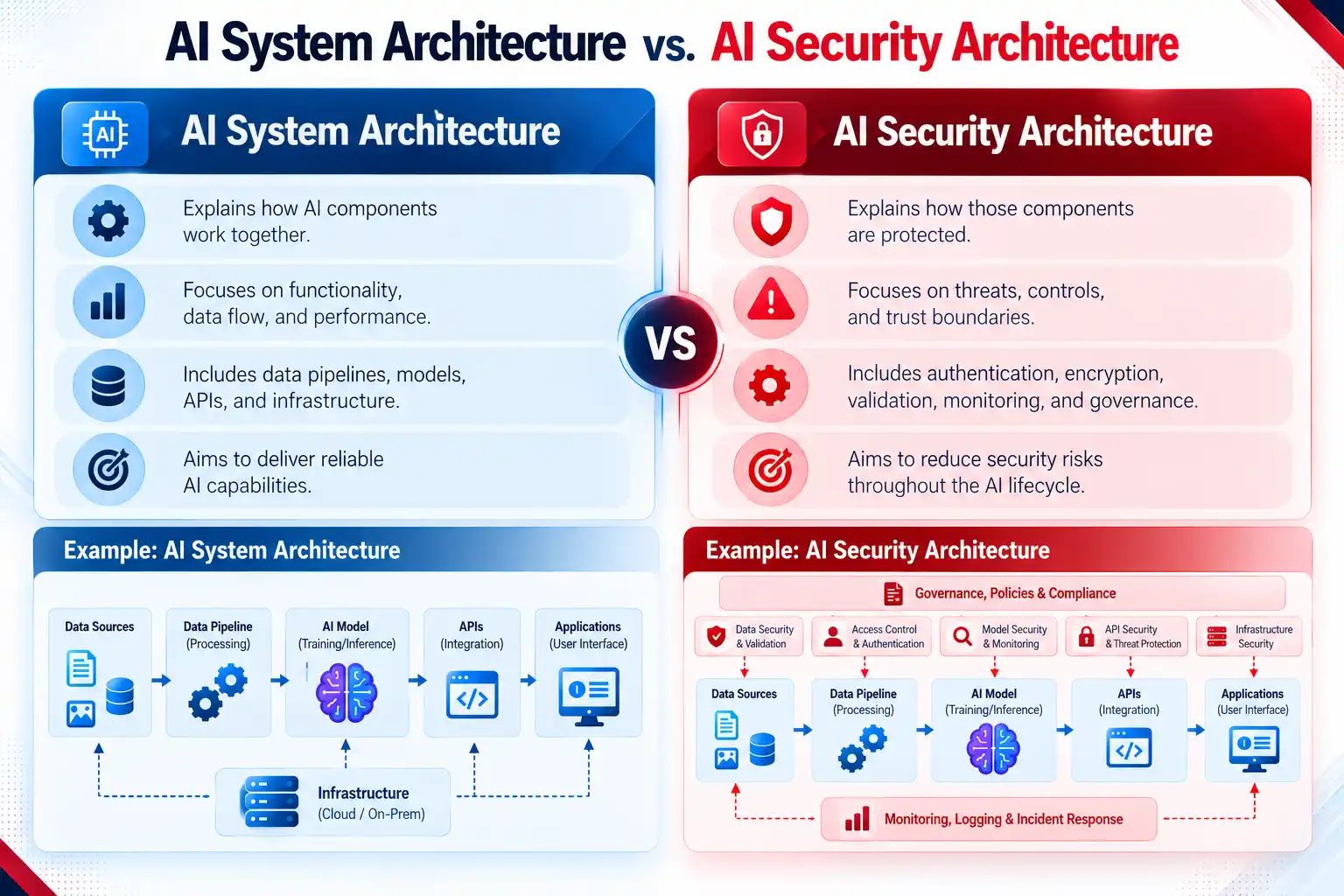
How to Build a Secure AI System Architecture
A secure AI system needs more than a well-protected model. The data it uses, the applications connected to it, and the infrastructure running it all need protection. Here are seven ways to reduce security risks.
1. Know Where Attacks Can Happen
Before securing an AI system, you need to know what’s connected to it. Check where the data comes from, how it’s processed, and which APIs or third-party tools have access. A single exposed API or poorly secured data pipeline could give attackers a way into the system.
2. Don’t Trust Everything by Default
Just because data comes from an internal system doesn’t mean it’s safe. Check who or what is requesting access and make sure they have permission. Apply the same checks to connected tools and services.
3. Keep Sensitive Data Safe
Use encryption and access controls to protect important information. Keep passwords and API keys out of training datasets, prompts, and logs. Only include personal information when necessary and make sure it’s properly protected.
4. Check AI Outputs Before Using Them
AI models can produce incorrect or unsafe results. Validate their outputs before allowing them to trigger sensitive actions. For example, a database query written by AI should be checked and executed with limited permissions.
5. Control What AI Agents Can Do
An AI agent shouldn’t have access to every tool or system. Give it only what it needs for its assigned task. For actions such as deleting files or changing user permissions, add a human approval step.
6. Test for Weaknesses Regularly
Security testing shouldn’t stop once the system goes live. Check for prompt injection, data leaks, weak access controls, and software vulnerabilities. Keep an eye on unusual activity so potential problems are caught early.
7. Make Security Responsibilities Clear
Decide who is responsible for managing the AI system, approving updates, and responding to incidents. Developers, security teams, and business owners should know what they need to handle.
Securing an AI system isn’t a one-time job. As models, data, and connected tools change, security controls need to be reviewed and updated too.
Conclusion
An AI system is far more than a model that predicts outcomes or generates text. Behind every AI-driven application is an interconnected architecture involving data collection, preprocessing, training, inference, APIs, infrastructure, and monitoring. Understanding the anatomy of an AI system helps developers build more reliable applications and enables cybersecurity professionals to identify threats before attackers exploit them.
As AI systems gain access to more sensitive information and business operations, secure architecture will become an increasingly important part of responsible AI adoption.
AI Security Architecture Training with InfosecTrain
Knowing how AI works is valuable. Knowing how to secure it is what makes that knowledge useful in a real-world cybersecurity environment. InfosecTrain’s AI Security Architecture Course helps learners explore how AI components, attack surfaces, security controls, and enterprise security considerations relate. The course provides an understanding of AI system architecture, how to identify emerging risks, and how to develop the technical foundation needed to approach AI security with confidence.

TRAINING CALENDAR of Upcoming Batches For AI Security Architecture Training
| Start Date | End Date | Start - End Time | Batch Type | Training Mode | Batch Status | |
|---|---|---|---|---|---|---|
| 12-Dec-2026 | 20-Dec-2026 | 10:00 - 14:00 IST | Weekend | Online | [ Open ] |
Frequently Asked Questions
What is the anatomy of an AI system?
The anatomy of an AI system covers its key components, including data, models, training, inference, applications, infrastructure, and security controls.
What are the main components of an AI system?
An AI system typically includes data processing, AI models, training, inference, application interfaces, and infrastructure. Advanced systems may also use external tools and AI agents.
How does an AI system work step by step?
An AI system receives input, processes the data, runs it through a trained model, and generates an output. Security controls help protect each stage.
What is the difference between an AI model and an AI system?
An AI model generates predictions or content, while an AI system includes the model, data pipelines, applications, infrastructure, and security controls.
Why is data important in AI system architecture?
AI models rely on data to learn and make predictions. Poor-quality or manipulated data can affect accuracy, introduce bias, and create security risks.
What is the role of the inference layer in AI?
The inference layer uses a trained AI model to process new inputs and generate outputs, such as chatbot responses or fraud detection results.
What is AI security architecture?
AI security architecture protects AI models, data, applications, and infrastructure through access controls, encryption, monitoring, and secure development practices.
What are the biggest security risks in AI systems?
Major risks include prompt injection, data poisoning, sensitive data leaks, insecure APIs, model theft, excessive agent permissions, and system vulnerabilities.
What is prompt injection in an AI system?
Prompt injections occur when malicious instructions in prompts, documents, or external content attempt to manipulate an AI system's behavior.
What is the difference between AI system architecture and traditional software architecture?
AI architecture builds on traditional software architecture by adding model training, inference, data management, evaluation, and AI-specific security controls.
How can organizations secure an AI system?
Organizations can protect AI systems with strong access controls, secure APIs, data validation, limited agent permissions, regular testing, and continuous monitoring.
Why should cybersecurity professionals learn AI security architecture?
It helps cybersecurity professionals identify AI-specific threats, assess vulnerabilities, secure AI applications, and respond effectively to attacks.