How Do I Choose a Cybersecurity Training Provider?
Quick Insights:
Choosing a cybersecurity training provider starts with knowing your career goal, since a future Pentester, SOC Analyst, and GRC Professional each need different training. From there, look closely at the course curriculum, trainer experience, and hands-on labs, and verify any claims of official authorization directly with the certification body. Check that the format fits your schedule and make sure the course offers real exam preparation and post-training support. Compare the full cost in writing, including exam vouchers, taxes, and refund terms, and be cautious about job guarantees. Finally, attend a demo session before enrolling to see whether the teaching style works for you.
You’ve finally decided to learn cybersecurity. Maybe you’re planning to switch careers, earn your first security certification, or move into a more specialized role. But when you search for training, you find dozens of websites all promising expert trainers, hands-on learning, and great career opportunities.
Every provider seems to offer the best training. Every course description sounds impressive. So, how do you know which one is actually worth your time and money?
Choosing a cybersecurity training provider isn’t simply about finding the cheapest course or the one with the most attractive website. It’s about finding a learning environment that helps you understand security concepts, develop practical skills, and confidently apply what you’ve learned. A good training provider can make complicated topics easier to understand. The wrong one can leave you with a certificate and very little confidence in your actual abilities. Let us explore how to choose the right cybersecurity training provider for your career goals.
How to Choose a Cybersecurity Training Provider
Let us look at the factors that really matter before you enroll.
1. Start With Your Cybersecurity Career Goals
Before comparing training institutes, ask yourself what you want to achieve via cybersecurity training. Cybersecurity is not a single job; it covers broad areas like security operations, ethical hacking, cloud security, risk management, security auditing, and several other specializations. Someone interested in becoming a PenTester needs different training then someone preparing for a GRC position.
Match your training to your goal:
- Complete Beginner: Networking, operating systems, and security basics
- Aspiring SOC Analyst: Monitoring, log analysis, SIEM tools, and incident investigation
- Ethical Hacking Enthusiast: Pentesting methods, Linux, networking, vulnerability assessment, and supervised labs
- Cloud Professional: Cloud security, identity and access management, and cloud certifications
- Experienced Professional: Advanced security management, architecture, risk, and leadership
Choose a provider that recommends the exact course by understanding your background.
2. Examine the Course Curriculum Carefully
Before enrolling, request the complete curriculum or look at their brochures.
Look beyond the list of topics. Check how deeply the course covers each subject and whether it reflects the knowledge and skills relevant to your intended role.
A well-structured cybersecurity curriculum should generally offer:
- Clear learning objectives
- Appropriate prerequisites
- Logical progression from fundamentals to advanced concepts
- Practical exercises or case studies
- Relevant tools, frameworks, and technologies
- Assessments to evaluate understanding
- Coverage aligned with the intended certification or job role
It is also important to check when the course material was last updated. As we know, security tools, attack techniques, and certification exam objectives change with new enhancements. A course based on outdated material may leave important gaps in your preparation.
For certification-focused training, compare the syllabus with the latest official exam outline.
Quick tip: Don’t choose a course simply because it covers more topics. A focused program that teaches essential skills properly may be more valuable than one that rushes through everything.
3. Check the Experience of the Cybersecurity Trainers
A complete and updated curriculum matters, but the instructor teaching it matters more. Imagine learning ethical hacking from someone who’s actually run the pen testing on the real system legally. They can explain how an exploit works, how a tester decides which vulnerability needs immediate action, and what to leave alone. That’s the kind of knowledge that makes cybersecurity training valuable.
When evaluating a training provider, check whether its instructors have:
- Relevant cybersecurity certifications
- Practical experience
- Experience with the tools covered in the course
- The ability to explain technical concepts clearly
- A teaching approach that encourages questions and discussion.
However, don’t judge trainers only by how many certifications appear beside their names. A strong instructor should be able to connect theory with workplace situations.
4. Look for Hands-On Cybersecurity Training, Not Just Theory
Suppose you watched 5-10 videos about network traffic analysis, but still feel confused when you open Wireshark for the first time. That is why hands-on exercises need serious attention.
Cybersecurity is a field where technical understanding becomes more useful when you can apply it. You need opportunities to investigate, configure, analyze, troubleshoot, and solve problems in a controlled environment.
For example, an ethical hacking training program shouldn’t stop at explaining what open ports or weak services look like. Ideally, it should give learners scan reports from a lab environment and ask them to decide which findings are worth exploiting and which are just noise.
That experience helps connect classroom learning with real security operations.
What to verify: Ask how many practical exercises are included, which tools you’ll use, whether labs are instructor-guided, and how long you’ll retain access.
5. Verify the Provider’s Industry Recognition and Authorization
You have probably seen training websites displaying certification logos and badges. But what do those logos actually mean?
Teaching a course that prepares you for a certification is not the same as being officially approved by the certification organization. For example, a provider can offer CISSP exam prep without being an official ISC2 Training Partner. That doesn’t mean the training is bad. It just means you shouldn’t assume the provider uses official ISC2 course materials or approved instructors.
In the same way, if a provider says it is an authorized EC-Council training center, verify that claim through EC-Council’s official channels.
Before enrolling:
- Make sure the approval or partnership they claim is still valid
- Confirm it on the certification body’s official website
- Ask if the course materials are official or made by the provider
- Ask if the exam voucher is included in the price
- Find out which organization gives you the final certificate
Important: A course-completion certificate is not necessarily the same as earning an industry certification. For example, completing a CISSP preparation course doesn’t automatically make you CISSP certified. Candidates must meet the certification body’s examination and applicable experience requirements.
6. Choose a Learning Format That Fits Your Schedule
The best cybersecurity course is only beneficial if you can attend it consistently. If you are working full-time or balancing personal commitments, learning flexibility can make a significant difference.
Cybersecurity training is commonly available in several formats.
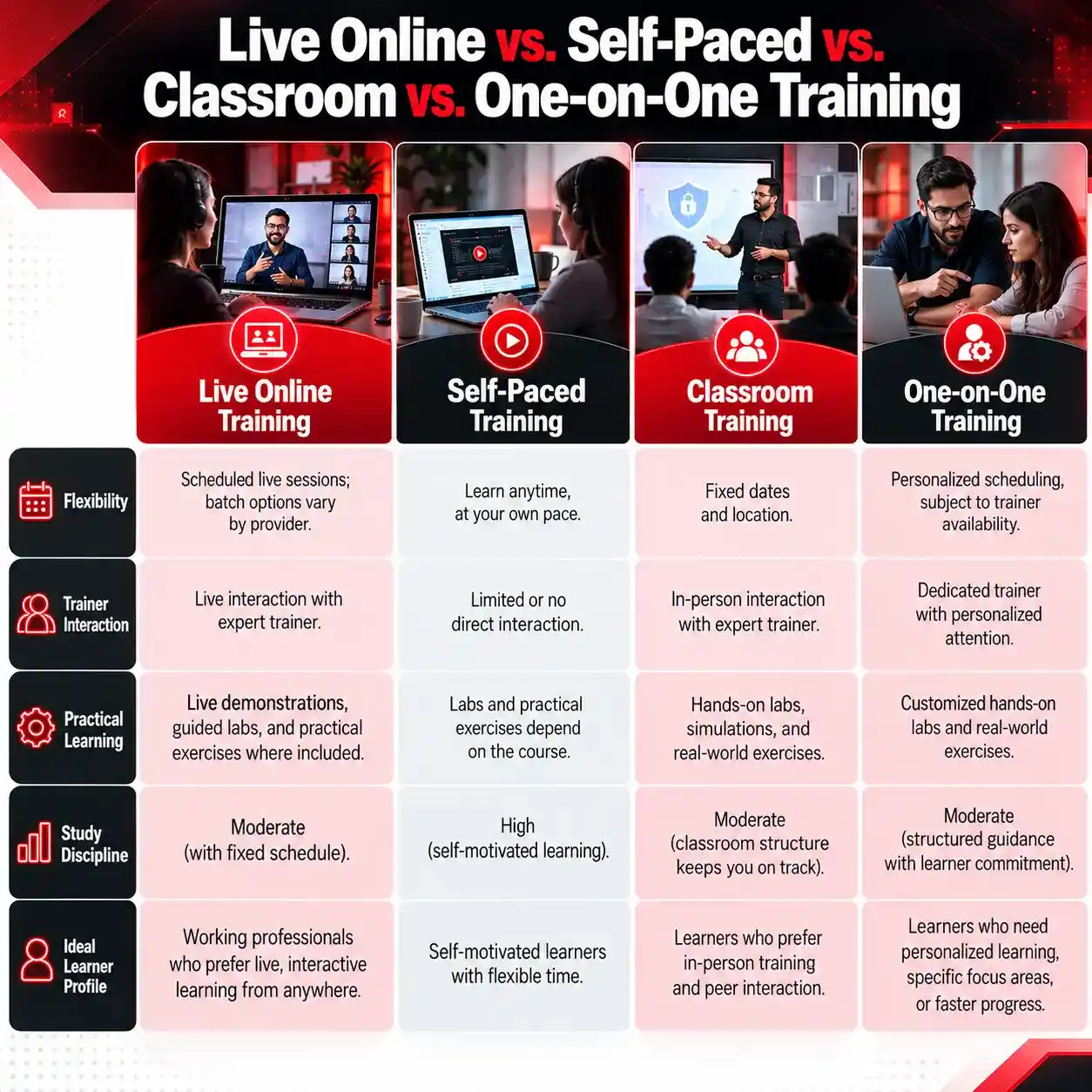
Before Choosing, Ask:
- Are recordings provided?
- Can missed classes be covered?
- Is the training delivered live or through prerecorded videos?
- What happens if the trainer or class schedule changes?
7. Read Student Reviews With a Critical Eye
Student reviews can tell you a lot about a cybersecurity training provider, but only if you know what to look for. A 4.5-star rating, even a 5-star rating without any explanation does not reveal much. A review describing how the instructor explained difficult concepts, handled questions, and supported practical exercises offers more useful information.
When researching training providers, look for feedback on:
- Trainer knowledge and communication
- Learning pace
- Lab quality and accessibility
- Responsiveness of student support
- Availability of recordings and study material
- Whether the course met the learner’s expectations
Check multiple sources, including independent review platforms and professional communities.
8. Evaluate Certification Exam Preparation and Learning Support
If your goal is to earn a cybersecurity certification, you will want training that helps you prepare for the actual exam. Good certification training is not just collecting pages covering exam topics. It should help you understand the key concepts, identify your weak areas, and practice applying knowledge.
Depending on the certification, useful learning resources may include:
- Topic-wise practice questions
- Mock examinations
- Revision sessions
- Scenario-based discussions
- Exam preparation guidance
- Study plans
- Instructor-led doubt-clearing sessions
Also, ask whether the training includes post-course doubt support and how long that support remains available.
9. Compare the Complete Training Cost
Choosing the cheapest cybersecurity course may seem like a good idea, but it’s important to know what you’re paying for. Some training providers include live classes, study materials, practical labs, and exam preparation in their fees. Others may charge extra for these services.
Before making a payment, find out exactly what the training fee covers. Make sure you check:
- Course fees
- Lab access and any restrictions
- Study materials
- Certification exam fees
- Taxes and additional charges
- Practice tests and assessments
- Exam retake or rescheduling fees
- Support after training
- Cancellation and refund policies
Quick tip: Request the complete fee structure in writing before enrolling.
10. Check Whether Career Guidance Is Available
Learning cybersecurity concepts and building a cybersecurity career are related, but they are not exactly the same thing. A learner may understand security fundamentals yet struggle to decide which job roles to pursue. Career guidance can help bridge that gap. Some training providers offer additional support such as:
- Cybersecurity career roadmap discussions
- Resume guidance
- Interview preparation
- Professional certification planning
- Advice on practical projects
- Guidance for building a technical portfolio
For a beginner, this might mean understanding the difference between a SOC Analyst role and a penetration testing role. For an experienced IT professional, it might involve identifying the skills needed to transition into cloud security.
However, be careful with employment-related promises.
Career guidance, interview assistance, placement support, and guaranteed employment are different things. Ask the provider to explain exactly what is included rather than relying on promotional phrases.
11. Look for Post-Training Support and Continued Learning
Suppose you have finished a cybersecurity course and, two to three weeks later, you are attempting a practical exercise. You may encounter an error, revisit your notes, and still can’t figure out what went wrong. That’s why the learning shouldn’t end with the final session. At that time, post-training support is what helps you in those moments.
Before enrolling, investigate whether the provider offers continued access to:
- Recorded sessions
- Study materials
- Practice environments
- Instructor or mentor support
- Doubt-clearing opportunities
- Relevant course updates
- Additional revision resources
Also check how long each resource remains available. There’s a big difference between receiving recordings for 30 days and retaining access for several months. Be sure to confirm the exact access terms for your chosen course.
12. Attend a Demo Session Before Making Your Decision
If you could test-drive a cybersecurity course before paying for it, wouldn’t that make your decision easier? That’s essentially what a demo session can offer. You get an opportunity to understand the teaching style, communication approach, and level of technical explanation.
During the session, observe a few things.
- Does the trainer explain difficult concepts in a way you can follow?
- Are examples relevant to practical cybersecurity work?
- Does the trainer encourage questions?
- Is the session interactive, or does it feel like someone reading slides?
- Can the trainer explain why a particular tool or security technique matters?
You don’t need to understand every technical detail during a demo; what matters is whether the teaching approach helps you learn. A demo session won’t reveal everything about a course, but it can help you avoid committing to a learning format that doesn’t suit you
What Makes a Good Cybersecurity Training Provider?
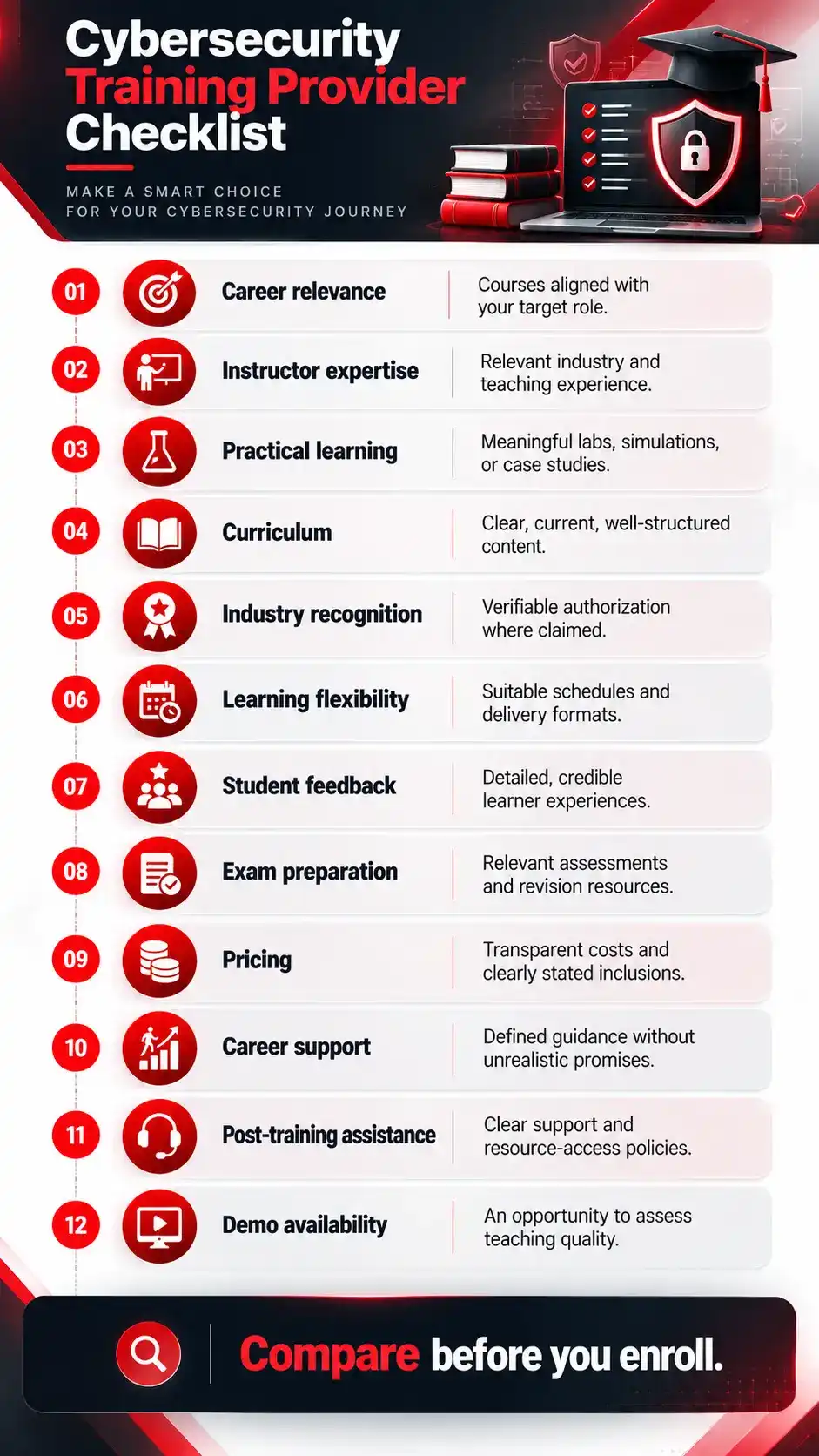
Common Mistakes to Avoid When Choosing Cybersecurity Training
Even motivated learners can make poor training decisions when they rush the process. Here are some common mistakes worth avoiding.
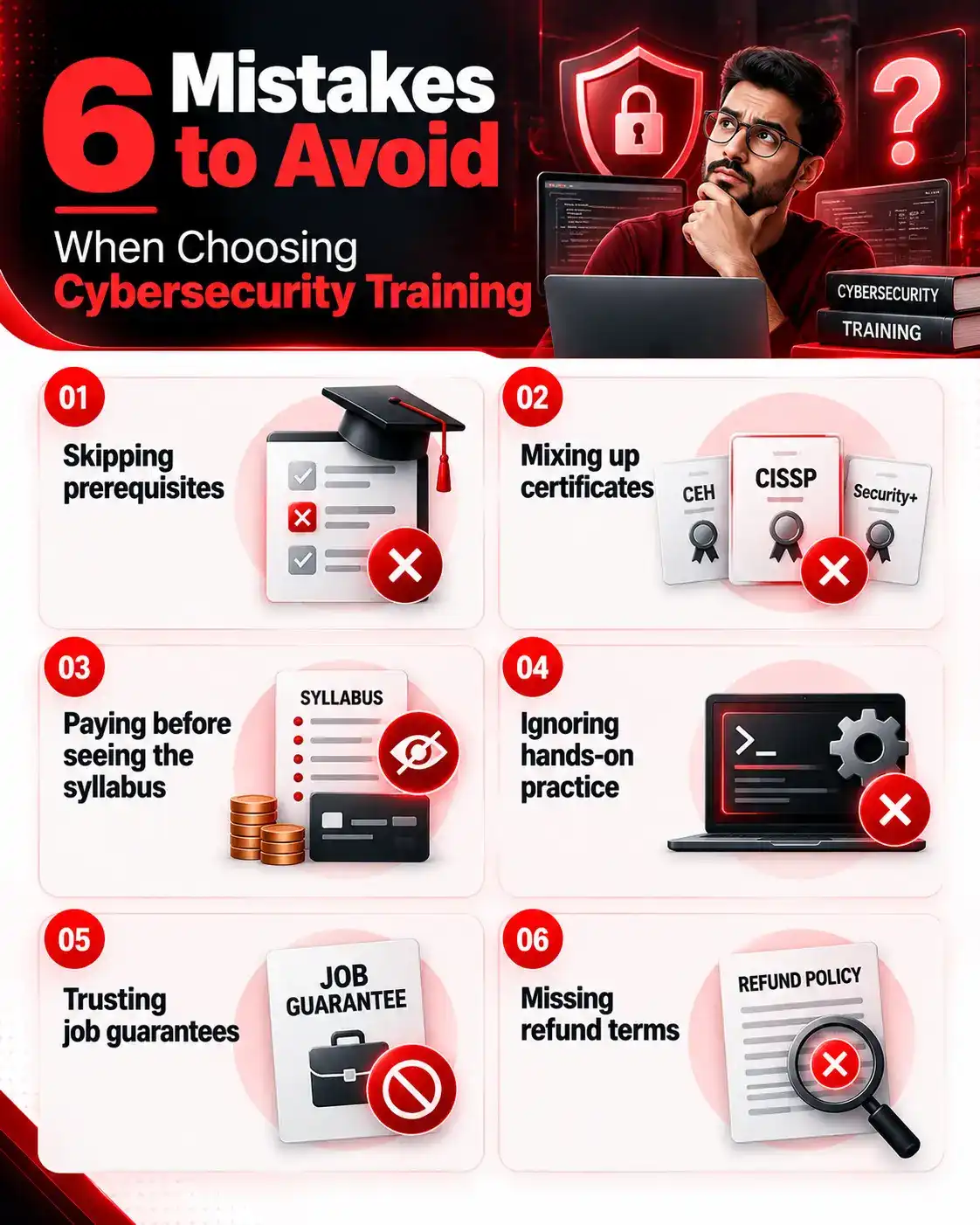
- Choosing a Certification Without Checking Prerequisites: Some advanced certifications are intended for professionals with significant relevant experience. Review eligibility requirements before registering.
- Confusing Course Completion with Professional Certification: Ask whether you’ll receive an attendance or completion certificate, an externally issued credential, or both.
- Paying Without Seeing the Syllabus: Course names alone don’t explain the actual depth of training, so check the complete syllabus before enrolling.
- Ignoring Practical Learning: If you’re pursuing a technical role, theoretical knowledge without relevant practice may leave you underprepared.
- Believing Unrealistic Job Guarantees: Treat promises of guaranteed salaries, immediate employment, or guaranteed exam results with caution.
- Overlooking Refund Policies: Read payment, cancellation, rescheduling, and refund terms before enrolling.
Conclusion
Choosing a cybersecurity training provider is not a decision you should make based on price, popularity, or marketing claims alone. Decide first what you want to achieve. Investigate who the instructor of the course is. Check whether the curriculum is relevant, whether practical learning is included, and whether you will have access to support when you need it.
And remember, a certificate alone won’t make you a cybersecurity expert. Understanding concepts, practicing regularly, staying curious, and developing real problem-solving skills are what help you progress.
Why Consider InfosecTrain for Cybersecurity Training?
Once you understand what to look for, the next step is finding a provider that provides courses relevant to your goals. InfosecTrain offers cybersecurity and information security training across areas such as cybersecurity fundamentals, ethical hacking, security operations, cloud security, governance, risk and compliance, data privacy, and auditing.
We offer live instructor-led programs, practical exercises, access to recorded sessions, career guidance, and post-training support. Professionals can also explore certification-focused and specialized courses based on their experience and intended career direction.
Frequently Asked Questions
How do I choose the best cybersecurity training provider?
Look for experienced trainers, updated courses, hands-on labs, student reviews, and certification support. Compare a few providers and attend a demo before enrolling.
What should I look for in a cybersecurity training course?
Choose a course with updated content, practical exercises, skilled instructors, and real-world examples that match your career goals.
Is online cybersecurity training as effective as classroom training?
Yes, online training can be equally effective when it includes live sessions and hands-on practice. Choose the format that suits your schedule and learning style.
Do I need an IT background to start cybersecurity training?
No, many beginner-friendly courses cover the basics. However, advanced courses may require some IT knowledge.
Which cybersecurity certification is best for beginners?
CompTIA Security+ and ISC2 Certified in Cybersecurity (CC) are popular starting points. Choose based on your career goals and experience.
How important is hands-on training in cybersecurity?
Hands-on training helps you use security tools, understand real-world threats, and develop practical skills needed for cybersecurity jobs.
How much does cybersecurity training cost?
Fees vary depending on the course, duration, certification, and training provider. Check what's included before enrolling.
Can cybersecurity training help me get a job?
Yes, it can improve your skills and job prospects. However, practical experience, projects, and interview preparation also matter.
Should I choose certification-based or skill-based cybersecurity training?
Certification-based training helps you earn credentials, while skill-based training builds practical knowledge. Combining both is often beneficial.
How long does it take to complete cybersecurity training?
Basic courses may take a few weeks, while advanced programs can last several months, depending on the course and your learning pace.