COASP Certification: Skills and Career Opportunities
Quick Insights:
The Certified Open AI Security Professional (COASP) certification prepares cybersecurity, architecture, and engineering specialists to defend modern AI systems against advanced attack vectors. Covering the end-to-end AI security lifecycle, it focuses on threat modeling, LLM hardening, MLOps security, data privacy, and incident response, qualifying professionals for roles like AI Security Engineer and AI Red Teamer. Furthermore, candidates gain practical experience identifying vulnerabilities across Retrieval-Augmented Generation (RAG) architectures, multi-agent systems, and third-party AI supply chains using frameworks like MITRE ATLAS and the OWASP Top 10 for LLMs.
As organizations rapidly integrate Artificial Intelligence into their core operations, securing AI systems against specialized threat vectors has become a top priority for cybersecurity teams. The Certified Open AI Security Professional (COASP) certification validates an engineer’s ability to secure AI architectures, defend large language models (LLMs), and implement robust defenses against AI-specific vulnerabilities.
This guide breaks down the core skills, key knowledge domains, and career opportunities associated with the COASP credential.
What is the COASP Certification?
The Certified Open AI Security Professional (COASP) credential equips cybersecurity practitioners, security architects, and developers with the practical skills needed to secure AI models and machine learning pipelines. Rather than focusing solely on traditional network or endpoint security, COASP concentrates on the unique attack surface introduced by modern AI implementations.
Holders of this certification demonstrate expertise in identifying AI vulnerabilities, conducting specialized threat modeling, and integrating security throughout the AI development lifecycle (MLOps/DevSecOps).
Key Skills You Gain from COASP
- AI Threat Modeling & Attack Vectors: Identify and exploit vulnerabilities unique to machine learning models, such as prompt injection, data poisoning, model inversion, and jailbreaking.
- LLM & Model Security: Implement security controls for large language models, including input sanitization, output filtering, and safe context handling.
- MLOps Security Integration: Secure data pipelines, training environments, model registries, and inference endpoints across CI/CD workflows.
- Data Privacy & Governance for AI: Enforce differential privacy, secure data aggregation, and minimize sensitive data exposure during model training and fine-tuning.
- AI Incident Response & Monitoring: Establish runtime guardrails, anomaly detection mechanisms, and audit logging to respond to real-time AI security incidents.
Core Domains Covered in the COASP Blueprint
- AI System Architecture and Vulnerability Assessment
Learn how AI models function under the hood from training to inference and assess vulnerabilities across data ingestion layers, vector databases, and neural network pipelines.
- Offensive AI Security & Attack Techniques
Master practical exploitation techniques used by threat actors, including direct and indirect prompt injection, adversarial attacks, membership inference, and model extraction.
- Defensive Controls, Guardrails, and Mitigation
Design and implement robust countermeasures, such as API rate limiting, system prompts fortification, guardrail tools, and secure orchestration frameworks.
- AI Supply Chain and Third-Party Model Risk
Evaluate risks associated with open-source models, pre-trained weights, third-party APIs, and compromised training data repositories.
Career Opportunities for COASP-Certified Professionals
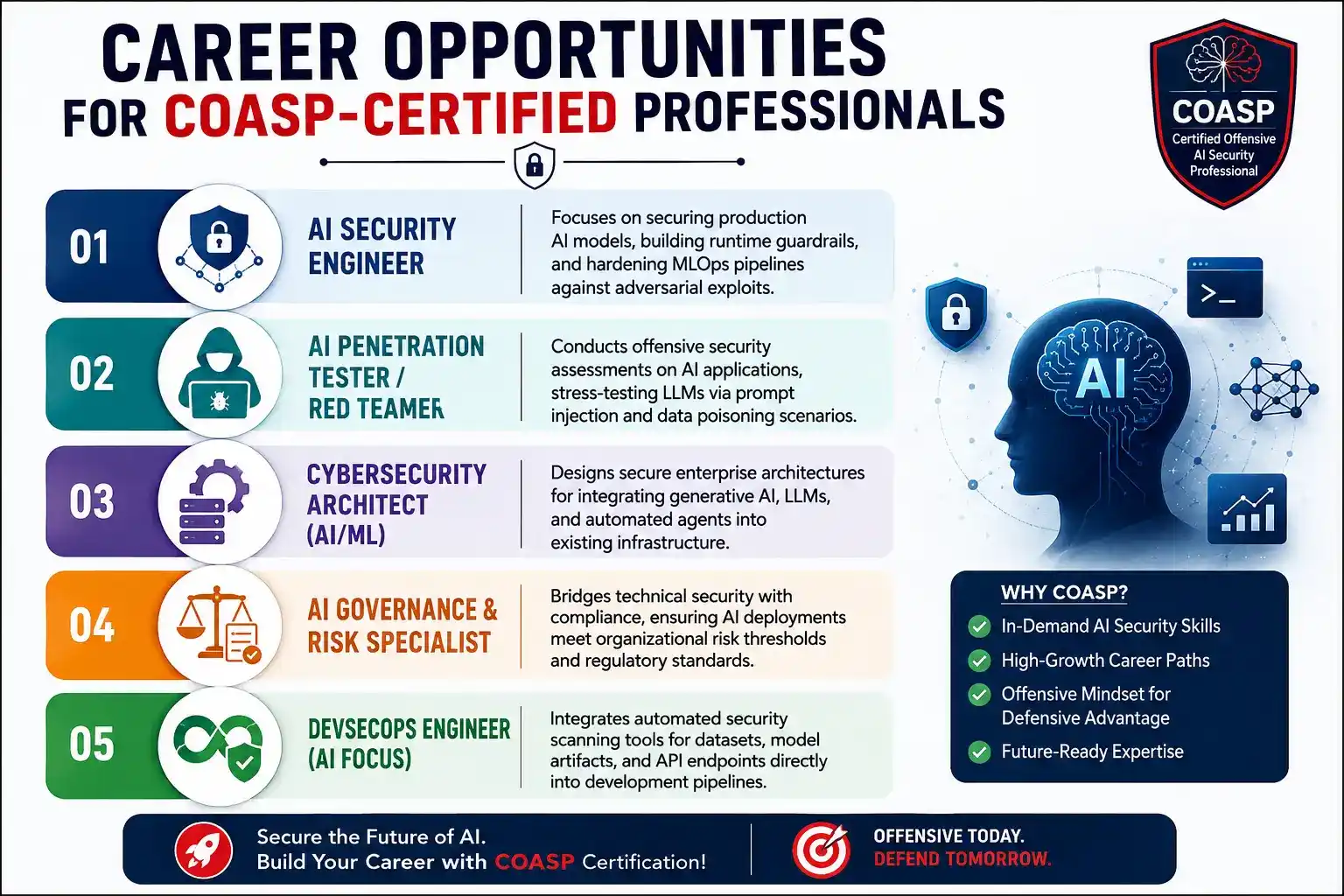
- AI Security Engineer: Focuses on securing production AI models, building runtime guardrails, and hardening MLOps pipelines against adversarial exploits.
- AI Penetration Tester / Red Teamer: Conducts offensive security assessments on AI applications, stress-testing LLMs via prompt injection and data poisoning scenarios.
- Cybersecurity Architect (AI/ML): Designs secure enterprise architectures for integrating generative AI, LLMs, and automated agents into existing infrastructure.
- AI Governance & Risk Specialist: Bridges technical security with compliance, ensuring AI deployments meet organizational risk thresholds and regulatory standards.
- DevSecOps Engineer (AI Focus): Integrates automated security scanning tools for datasets, model artifacts, and API endpoints directly into development pipelines.
How to Prepare for the COASP Exam
- Build Strong Fundamentals: Ensure you understand basic Machine Learning workflows, REST APIs, Python scripting, and standard cybersecurity principles.
- Review OWASP for LLMs: Master the OWASP Top 10 for Large Language Model Applications to understand the most critical security risks facing modern AI applications.
- Get Hands-on Practice: Practice setting up guardrails, testing prompt injections, and inspecting model parameters in a lab environment.
- Follow Official Courseware: Complete structured training modules to align your knowledge with the exam blueprint and domain weightings.
Conclusion
Securing AI technology is one of the fastest-growing fields in modern cybersecurity. Earning the COASP certification validates your technical ability to defend enterprise AI systems, mitigate adversarial attacks, and build secure AI-driven applications. To gain expert-led, hands-on training for this certification, consider enrolling in the COASP training course with InfosecTrain.

Frequently Asked Questions
Why is traditional cybersecurity insufficient for protecting enterprise AI systems?
Traditional cybersecurity focuses on network perimeters and endpoints, whereas AI security must address specialized attack surfaces like data ingestion layers, vector databases, LLM context windows, and MLOps pipelines.
What is the role of an AI Red Teamer or Penetration Tester?
An AI Red Teamer conducts offensive security assessments on AI applications by stress-testing LLMs and model pipelines using specialized exploitation techniques like prompt injection, jailbreaking, and data poisoning.
How does the COASP certification address AI supply chain security?
COASP teaches professionals how to evaluate risks linked to open-source models, pre-trained weights, third-party API integrations, and compromised training data repositories.
What are the key defensive controls implemented by COASP-certified professionals?
Professionals learn to deploy API rate limiting, system prompt fortification, input/output sanitization filters, runtime guardrails, and automated anomaly detection across AI workflows.
How can DevSecOps engineers benefit from earning the COASP credential?
It equips DevSecOps engineers with the skills to integrate automated security scanning for datasets, model artifacts, vector databases, and API endpoints directly into continuous CI/CD pipelines.