Solution Architect vs. Security Architect
Quick Insights:
The Solution Architect bridges the gap between business challenges and technical implementation by designing highly efficient, scalable, and cost-effective digital highways that drive organizational growth. Simultaneously, the Security Architect stress-tests these layouts against hackers, data leaks, and compliance violations, building the vital defensive frameworks, encryption standards, and identity controls needed to safeguard digital assets. While the Solution Architect focuses on speed, functionality, and performance metrics, the Security Architect prioritizes risk mitigation, zero-trust architectures, and global regulatory standards.
The morning sun hits the digital blueprint table at a fast-growing enterprise. Two different minds lean over the same system design.
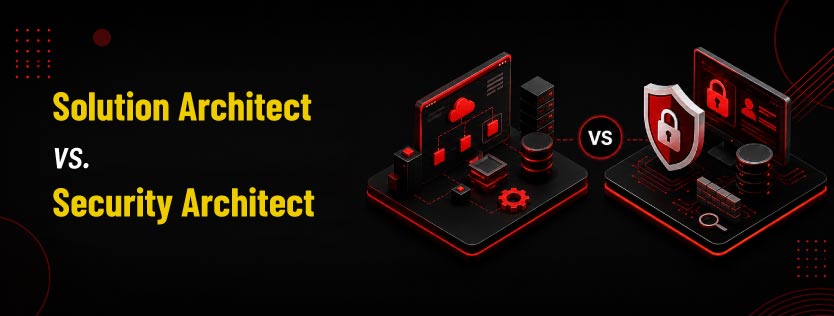
The Solution Architect looks at the layout and sees a possibility. Look at this flow, they say. Users can log in seamlessly, data moves instantly between cloud servers, and the system automatically scales up to handle millions of requests. It’s fast, efficient, and fits the budget perfectly. Their job is to build a high-performance digital highway that drives business growth.
The Security Architect looks at the same layout and sees risk. It is fast, they note. But what happens if an attacker intercepts that data mid-transit? How do we prevent a data leak if a user’s credentials are stolen? And are we encrypting everything to the required standard? Their job is to build the guardrails, checkpoints, and defensive walls that keep that highway safe.
This is the core of modern IT infrastructure. The Solution Architect builds for speed, functionality, and scale, while the Security Architect builds for resilience, defense, and trust. Without the Security Architect, even the most advanced system may remain vulnerable to threats, data breaches, and compliance failures.
Who is a Solution Architect?
A Solution Architect (SA) bridges the gap between business problems and technology solutions. They take a high-level business requirement, such as migrating our customer portal to the cloud, and decide exactly which technologies, frameworks, and infrastructure will make it happen.
Solution Architects focus on the big picture. They ensure that a system is scalable, reliable, and cost-effective.
Key Responsibilities of a Solution Architect
- Defining the Tech Stack: Selecting the right databases, programming languages, cloud services, and software frameworks that align with the project goals.
- Designing Scalable Architecture: Engineering systems that handle fluctuating user traffic, ensure high availability, and accommodate future business growth.
- Managing System Integration: Ensuring new software applications communicate seamlessly with existing legacy systems without breaking existing workflows.
- Balancing Budgets and Timelines: Designing practical systems that the organization can realistically afford to build, maintain, and deliver on schedule.
- Guiding Development Teams: Translating high-level architectural blueprints into clear, actionable technical requirements for software engineers and DevOps teams.
Essential Skills for a Solution Architect
- Cloud Architecture & Infrastructure: Deep expertise in cloud platforms (such as AWS, Azure, or Google Cloud), microservices architecture, and modern deployment models.
- Strategic Business Acumen: The ability to understand corporate goals, calculate Return on Investment (ROI), and align technical decisions with business outcomes.
- Communication & Stakeholder Management: The skill to explain complex technical designs to non-technical executives while clearly defining requirements for development teams.
- Software Engineering & DevOps Knowledge: A solid foundation in software development practices, continuous integration/continuous deployment (CI/CD) pipelines, and system automation.
- Analytical Problem-Solving: The capacity to evaluate competing technologies, foresee integration bottlenecks, and troubleshoot systemic architectural risks before they impact production.
Who is a Security Architect?
A Security Architect views the world through a lens of risk mitigation. If the Solution Architect builds the system, the Security Architect stress-tests it against hackers, data leaks, and compliance violations.
They design the security frameworks, policies, and defense-in-depth strategies that protect an organization’s digital assets.
Key Responsibilities of a Security Architect
- Designing Defense-in-Depth Frameworks: Establishing multi-layered security controls across networks, endpoints, and applications so that if one line of defense fails, others protect the asset.
- Conducting Threat Modeling & Risk Assessments: Proactively analyzing system architectures to identify potential vulnerabilities, simulate attack vectors, and mitigate risks before deployment.
- Enforcing Identity & Access Management (IAM): Designing strict protocols and zero-trust architectures to ensure that only authenticated and authorized users access specific enterprise resources.
- Ensuring Regulatory & Standards Compliance: Aligning the organization’s security posture with global standards and legal frameworks such as ISO 27001, NIST, GDPR, or PCI-DSS.
- Guiding Incident Response & Security Operations: Developing blueprint strategies for breach containment, vulnerability management, and post-incident recovery to ensure business continuity.
Essential Skills for a Security Architect
- Network & Infrastructure Security: Deep technical knowledge of firewalls, encryption protocols (like TLS/SSL), intrusion detection/prevention systems (IDS/IPS), and secure network zoning.
- Cloud Security Architecture: Expertise in securing cloud-native environments (AWS, Azure, or GCP), understanding shared responsibility models, and managing container and microservices security.
- Risk Management & Governance Frameworks: Proficiency in translating abstract security standards (NIST, CIS Controls) into actionable technical requirements and evaluating business risk.
- Cryptography & Data Protection: Strong understanding of symmetric/asymmetric encryption, hashing algorithms, key management systems, and data loss prevention (DLP) strategies.
- Analytical Threat Intelligence: The ability to think like an adversary, analyze emerging cyber threat landscapes, and reverse-engineer potential attack methodologies to patch gaps before they are exploited.
Solution Architect vs. Security Architect
| Feature | Solution Architect | Security Architect |
| Core Focus | Functionality & Business Value: Designs systems to solve business problems and ensure smooth integration | Protection & Compliance: Designs defense mechanisms to secure data, systems, and networks against threats |
| Main Goal | Build a scalable, cost-effective, and operational system | Mitigate risk, prevent breaches, and ensure regulatory alignment |
| Key Question | Does this application meet performance and budget requirements? | Where are the vulnerabilities and how do we protect them? |
| Top Certifications | AWS Certified Solutions Architect, TOGAF, Azure Architect | CISSP, CISM, CCSP, SABSA |
| Common Deliverables | High-level design documents, data flow diagrams, technology stack selection reports | Threat models, security policies, cryptographic standards, incident response playbooks |
Conclusion
A successful enterprise requires both speed and safety. The Solution Architect builds the functional digital highway to drive business growth, while the Security Architect installs the guardrails and checkpoints to defend it. True resilience happens when these two roles collaborate from day one, ensuring systems are both highly efficient and fiercely protected.
Master these defensive skills firsthand with Security Architecture hands-on training at InfosecTrain, where you will build threat models and deploy zero-trust frameworks in live environments.

TRAINING CALENDAR of Upcoming Batches For Security Architecture Training
| Start Date | End Date | Start - End Time | Batch Type | Training Mode | Batch Status | |
|---|---|---|---|---|---|---|
| 14-Nov-2026 | 06-Dec-2026 | 09:00 - 13:00 IST | Weekend | Online | [ Open ] |
Frequently Asked Questions
Can a Solution Architect also act as a Security Architect?
In smaller organizations, a Solution Architect may take on security responsibilities. However, in large enterprises, Security Architecture is a specialized discipline that requires expertise in threat modeling, cryptography, governance, and risk management
At what stage of a project should the Security Architect get involved?
From day one. Early involvement enables a Security by Design approach, embedding defense mechanisms directly into the foundational blueprint and preventing expensive, late-stage security fixes.
Which certifications are most valuable for these respective roles?
Solution Architects typically pursue the AWS Certified Solutions Architect, Azure Solutions Architect Expert, and TOGAF certifications. Security Architects favor industry standards like CISSP, CCSP, and SABSA.
How do the daily deliverables differ between the two roles?
Solution Architects deliver high-level design blueprints, technology stack selections, and integration reports. Security Architects deliver threat models, risk assessments, identity management frameworks, and incident playbooks.
Which career path is right for me?
Choose Solution Architecture to focus on system building, cloud integration, and business functionality. Choose Security Architecture to focus on ethical hacking, data protection, compliance, and outsmarting cyber adversaries.