 AI Powered Course
Become an AI-Powered SOC Analyst
Advanced AI SOC Analyst Certification Training



Training Course Highlights

48-Hour Instructor-led Training

40+ Tools and Real-world SOC Case Studies

Hands-On Labs: Log Analysis, Threat Intelligence & Response Using AI

SOC Fundamentals, AI for Cybersecurity & SIEM-Based & Threat Detection

AI-driven Alert Classification & Anomaly Detection

Exposure to SIEM, EDR & Open-source LLM Models

Career Guidance & Mentorship

Access to Recorded Sessions

* Conditions Apply
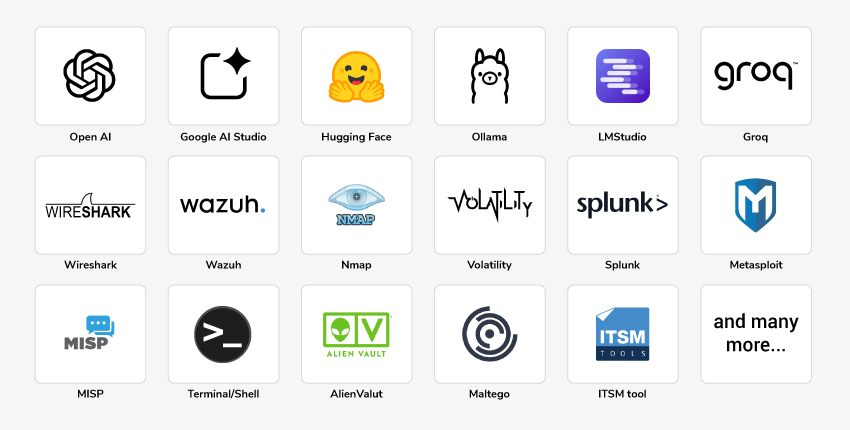
SOC Analyst Tools Covered
Advanced AI SOC Analyst Certification Training- An Overview
The Advanced AI SOC Analyst Certification Training bridges the gap between traditional SOC operations and modern AI-driven security workflows, enabling faster detection, reduced false positives, and improved incident response efficiency. It demonstrates how modern SOCs leverage AI to speed detection, reduce false positives, perform automated investigation, and improve response accuracy. The program explains SOC functions, network security foundations, threat intelligence, log analysis, vulnerability assessment, phishing & malware analysis, and AI-driven responses. Participants gain practical experience through guided labs using SIEM tools, AI models, and real security datasets.
Course Curriculum
- Module 1: Introduction to SOC
- What is a SOC?
- Definition, role in cybersecurity defense
- SOC structures: Centralized, Distributed, Virtual SOCs
- SOC Analyst Roles
- L1: Monitoring, triage, escalation
- L2 & L3: Deep investigation, threat hunting, forensics
- Key SOC Functions
- Log monitoring, alert triage, threat detection, incident response
- SOC Maturity Model
- From reactive → proactive → predictive SOC
- Common SOC Tools
- SIEM, EDR, Threat Intel Platforms, Open-Source Security Analyst oriented models
- What is a SOC?
- Module 2: Introduction to AI for Cybersecurity
- What is AI?
- AI vs ML vs DL vs NLP vs LLM
- Predictive AI vs Generative AI
- Why AI in Cybersecurity?
- Reducing false positives, handling large datasets, automated response
- AI in SOC – Use Cases
- Log summarization, phishing detection, anomaly detection
- AI-driven report generation, automated playbooks
- AI Limitations in SOC
- Hallucinations, bias, explainability, data privacy concerns
- Open-Source and Free-Tier AI Tools
- Free Tier proprietary LLMs, Ollama, LMStudio, Hugging Face models
- What is AI?
- Lab:
- Run an LLM locally (Phi-3 Mini / Mistral via Ollama) → ask it to summarize sample Windows Event logs and
classify alerts.
- Run an LLM locally (Phi-3 Mini / Mistral via Ollama) → ask it to summarize sample Windows Event logs and
- Module 3: Network Security & Threat Landscape
- Basics of Networking for SOC
- OSI model, TCP/IP, ports & protocols
- Common attacks (DDoS, brute force, phishing, ransomware)
- Case studies of famous attacks
- Threat Intelligence
- Threat intelligence types
- IOC (Indicators of Compromise)
- MITRE ATT&CK for SOC Analysts
- AI in Threat Intel
- Using AI to summarize threat feeds
- AI-assisted correlation of IOCs
- Basics of Networking for SOC
- Lab:
- Gathering Threat Intel feeds using AI.
- Capture sample PCAP in Wireshark → use Python + AI model to identify anomalies
- Module 4: AI in Vulnerability Management & Assessment
- Vulnerability Management Basics
- What is a vulnerability? CVE, CVSS, exploitability
- VM lifecycle: Scan → Assess → Prioritize → Remediate → Report
- Tools overview: Nessus (pro), OpenVAS (free), Nmap + NSE scripts
- SOC Analyst role vs. vulnerability management team
- AI in Vulnerability Assessment
- AI for CVE explanation: simplify technical CVEs into analyst-friendly notes
- AI for prioritization: map severity + exploitability + asset criticality
- AI for remediation recommendations: patch, config change, or mitigation
- AI in report drafting for management/non-technical audience
- Vulnerability Management Basics
- Lab:
- OpenVAS/NMAP Scan + AI Explanation
- AI-Generated Vulnerability Report
- Module 5: SIEM & AI-Assisted Log Analysis
- SIEM Fundamentals
- Architecture, log sources, parsing, correlation rules
- Popular tools: Splunk, ELK
- Challenges in Log Analysis
- High volume, repetitive patterns
- AI Integration
- AI for log summarization and anomaly detection
- ChatGPT prompt engineering for SIEM queries
- AI-driven “Explain this log” and “Generate query”
- SIEM Fundamentals
- Lab:
- AI-powered analysis of Windows Event Logs (4624, 4625, 4670, etc.)
- Using AI to generate Splunk queries and summarize alerts
- Parse Suricate logs to elk via filebeat and use AI model to detect network Attack (Malicious Log
detector to generate alerts)
- Module 6: Phishing, Malware, and Insider Threats
- Phishing
- Types (email, smishing, vishing, spear phishing, whaling)
- Real case studies (Norfund, Colonial Pipeline)
- Malware
- Introduction to Malware
- Types of Malware
- Malware Family Naming
- Behavioral detection vs signature-based detection
- Insider Threats
- Privilege misuse, data exfiltration patterns
- AI in Detection
- AI-based phishing email detection
- AI chatbot for suspicious email reporting
- AI in malware recognition
- Phishing
- Lab:
- AI-based phishing email classification
- AI for static malware analysis
- Module 7: Incident Response with AI
- IR Lifecycle
- Preparation → Detection → Containment → Eradication → Recovery → Lessons Learned
- AI in IR
- AI-guided playbooks
- Automating IOC enrichment (IP/URL/domain lookups)
- AI-assisted RCA (Root Cause Analysis)
- IR Lifecycle
- Lab:
- Using AI to Assist in Phishing Incident Response
- Network Traffic Analysis using Wireshark + AI
Course Objectives
You will be able to:
- Build foundational SOC analysis skills with AI
- Use AI for alert triage, log summaries and investigations
- Detect phishing, analysing malware and anomalies with AI support
- Automate vulnerability reporting and IOC enrichment
- Assist in IR workflows using AI models
- Enhance SOC productivity with AI-driven tools
Tools Covered
Target Audience
- Aspiring SOC Analysts (L1)
- Cybersecurity beginners entering SOC roles and aiming to use AI tools effectively
- Junior Security Analysts working with logs and alerts
- IT professionals transitioning into SOC operations
- Fresh graduates aiming for entry-level SOC positions
Pre-requisites
- Basic understanding of networking & cybersecurity fundamentals
- Familiarity with Windows/Linux basics
- Suitable for beginners with no SOC or AI background
Exam Details
| Exam Name | AI Powered SOC |
| Exam Duration | 6 hours |
| Number of Questions | 50 |
| Exam Format | MCQ+Practicals |
| Passing Score | 80% |
| Exam Language | English |
| Testing Mode | Online |
Disclaimer: This is an InfosecTrain Certified Program, and all examinations and certifications are conducted and awarded solely by InfosecTrain.
Advanced AI SOC Analyst Certification Training Calendar

Can't Find a Suitable Schedule? Talk to Our Training Advisor!
Choose Your Preferred Learning Mode
 1-TO-1 TRAINING
- Customized Schedule
- Learn at Your Dedicated Hour
- Instant Clarification of Doubts
- Guaranteed to Run
 ONLINE TRAINING
- Flexible, Convenient & Time Saving
- Highly Interactive
- Affordable Yet Effective
- Guaranteed to Run
 CORPORATE TRAINING
- Anytime, Anywhere - Across The Globe
- Hire a Trainer
- Your Schedule, Your Pace
- Customized for Your Team

Our Expert Course Advisors


Why Choose InfosecTrain?

Learn from certified trainers and industry experts

Learn AI-enhanced SOC workflows for modern detection needs

Immerse in scenario-based learning across SOC domains

Best Quality Training with Best Price Guarantee

Gain hands-on experience with SIEM, AI models, and real datasets

Build confidence for SOC analyst (L1/L2) roles

Updated curriculum aligned with latest SOC deployments

Choose Flexible Learning options including weekend batches
Benefits of Advanced AI SOC Analyst Certification Training

Get global recognition

Maximize your earning potential

Earn the status of a Senior SOC Analyst

Advanced career growth

Become a part of an esteemed community
Average Salary Range for SOC-Related Roles

Confused if this is the right course for you?
Words Have Power
This SOC Analyst training is outstanding. The instructor's delivery is excellent, and as a beginner, I found it incredibly valuable for learning cybersecurity fundamentals.

Sahaya Seelan
UAEThe SOC Analyst Hands-on Training covered all the essential fundamentals and tools I was looking for. The practical, hands-on examples provided great insight into the functionality of core SOC tools. I also appreciated the recorded sessions and shared documents.

Douglas Amorim Pereira de Arruda
UAEI have learned the most about cyber security (SOC Analyst) from this organization. Our trainer, in particular, has given me the greatest advice and knowledge. Best Regards to the entire InfosecTrain team.

Dipendra Singh Mourya
NepalImpressed with the trainer’s details in explanation and his knowledge. He kept the class engaging, and I never felt bored or at a slow pace. He also gave enough time to complete the tasks and check back on the doubts. Thanks for this training.

Tariq Aziz Mohammed
IndiaSuccess Speaks Volumes

Get a Sample Certificate
Frequently Asked Questions
What is the Advanced AI SOC Analyst certification training?
Who should enroll in this AI-enabled SOC analyst certification?
- Aspiring SOC Analysts (L1)
- Cybersecurity beginners entering SOC roles and aiming to use AI tools effectively
- Junior Security Analysts working with logs and alerts
- IT professionals transitioning into SOC operations
- Fresh graduates aiming for entry-level SOC positions
What AI tools and techniques are covered in the SOC Analyst training?
Do I need prior SOC or cybersecurity experience to join this course?
How does AI improve threat detection and incident response in a SOC?
Will I get hands-on labs with AI-driven SOC automation tools?
Does the training include real-world attack simulations and case studies?
What career roles can I pursue after completing this course?
How do I enroll in the Advanced AI SOC Analyst certification training?
- Visit the InfosecTrain website, www.infosectrain.com, and navigate the Advanced AI SOC Analyst certification training course page.
- Fill out the registration form.
- You will receive a confirmation email with further instructions.
- Book your free demo with the Expert.