Training Course Highlights

40-Hour Instructor-led Online Training

CompTIA Authorized Partner

Access to Recorded Sessions

98% Pass Rate

24x7 Post-Training Support

Certified Trainers

Scenario-based Learning

Telegram Group for Exam Support

Security+ - An Overview
InfosecTrain's CompTIA Security+ SY0-701 course delivers a thorough and guided learning journey, led by experts in the field. The training encompasses five crucial domains essential for mastering information security. Participants will explore fundamental security concepts, threats, vulnerabilities, mitigations, security architecture, security operations, and security program management.
This comprehensive course integrates practical exercises and hands-on labs to enhance participants' skills, guaranteeing their readiness for the SY0-701 certification exam. By immersing themselves in real-world scenarios, participants gain practical insights, ensuring a robust understanding and proficiency in the intricate landscape of information security.
- Domain 1: General Security Concepts (12%)
- 1.1 Compare and contrast various types of security controls.
- Categories
- Technical
- Managerial
- Operational
- Physical
- Control types
- Preventive
- Deterrent
- Detective
- Corrective
- Compensating
- Directive
- Categories
- 1.2 Summarize fundamental security concepts
- Confidentiality, Integrity, and Availability (CIA)
- Non-repudiation
- Authentication, Authorization, and Accounting (AAA)
- Authenticating people
- Authenticating systems
- Authorization models
- Gap analysis
- Zero Trust
- Control Plane
- Adaptive identity
- Threat scope reduction
- Policy-driven access control
- Policy Administrator
- Policy Engine
- Data Plane
- Implicit trust zones
- Subject/System
- Policy Enforcement Point
- Control Plane
- Physical security
- Bollards
- Access control vestibule
- Fencing
- Video surveillance
- Security guard
- Access badge
- Lighting
- Sensors
- Infrared
- Pressure
- Microwave
- Ultrasonic
- Deception and disruption technology
- Honeypot
- Honeynet
- Honeyfile
- Honeytoken
- 1.3 Explain the importance of change management processes and the impact to security
- Business processes impacting security operation
- Approval process
- Ownership
- Stakeholders
- Impact analysis
- Test results
- Backout plan
- Maintenance window
- Standard operating procedure
- Technical implications
- Allow lists/deny lists
- Restricted activities
- Downtime
- Service restart
- Application restart
- Legacy applications
- Dependencies
- Documentation
- Updating diagrams
- Updating policies/procedures
- Version control
- Business processes impacting security operation
- 1.4 Explain the importance of using appropriate cryptographic solutions
- Public key infrastructure (PKI)
- Public key
- Private key
- Key escrow
- Encryption
- Level
- Full-disk
- Partition
- File
- Volume
- Database
- Record
- Transport/communication
- Asymmetric
- Symmetric
- Key exchange
- Algorithms
- Key length
- Level
- Tools
- Trusted Platform Module (TPM)
- Hardware security module (HSM)
- Key management system
- Secure enclave
- Obfuscation
- Steganography
- Tokenization
- Data masking
- Hashing
- Salting
- Digital signatures
- Key stretching
- Blockchain
- Open public ledger
- Certificates
- Certificate authorities
- Certificate revocation lists (CRLs)
- Online Certificate Status Protocol (OCSP)
- Self-signed
- Third-party
- Root of trust
- Certificate signing request (CSR) generation
- Wildcard
- Public key infrastructure (PKI)
- 1.1 Compare and contrast various types of security controls.
- Domain 2: Threats, Vulnerabilities, and Mitigations (22%)
- 2.1 Compare and contrast common threat actors and motivations
- Threat actors
- Nation-state
- Unskilled attacker
- Hacktivist
- Insider threat
- Organized crime
- Shadow IT
- Attributes of actors
- Internal/external
- Resources/funding
- Level of sophistication/capability
- Motivations
- Data exfiltration
- Espionage
- Service disruption
- Blackmail
- Financial gain
- Philosophical/political beliefs
- Ethical
- Revenge
- Disruption/chaos
- War
- Threat actors
- 2.2 Explain common threat vectors and attack surfaces
- Message-based
- Short Message Service (SMS)
- Instant messaging (IM)
- Image-based
- File-based
- Voice call
- Removable device
- Vulnerable software
- Client-based vs. agentless
- Unsupported systems and applications
- Unsecure networks
- Wireless
- Wired
- Bluetooth
- Open service ports
- Default credentials
- Supply chain
- Managed service providers (MSPs)
- Vendors
- Suppliers
- Human vectors/social engineering
- Phishing
- Vishing
- Smishing
- Misinformation/disinformation
- Impersonation
- Business email compromise
- Pretexting
- Watering hole
- Brand impersonation
- Typosquatting
- Message-based
- 2.3 Explain various types of vulnerabilities
- Application
- Memory injection
- Buffer overflow
- Race conditions
- Time-of-check (TOC)
- Time-of-use (TOU)
- Malicious update
- Operating system (OS)-based
- Web-based
- Structured Query Language injection (SQLi)
- Cross-site scripting (XSS)
- Hardware
- Firmware
- End-of-life
- Legacy
- Virtualization
- Virtual machine (VM) escape
- Resource reuse
- Cloud-specific
- Supply chain
- Service provider
- Hardware provider
- Software provider
- Cryptographic
- Misconfiguration
- Mobile device
- Side loading
- Jailbreaking
- Zero-day
- Application
- 2.4 Given a scenario, analyze indicators of malicious activity
- Malware attacks
- Ransomware
- Trojan
- Worm
- Spyware
- Bloatware
- Virus
- Keylogger
- Logic bomb
- Rootkit
- Physical attacks
- Brute force
- Radio frequency identification (RFID) cloning
- Environmental
- Network attacks
- Distributed denial-of-service (DDoS)
- Amplified
- Reflected
- Domain Name System (DNS) attacks
- Wireless
- On-path
- Credential replay
- Malicious code
- Distributed denial-of-service (DDoS)
- Application attacks
- Injection
- Buffer overflow
- Replay
- Privilege escalation
- Forgery
- Directory traversal
- Cryptographic attacks
- Downgrade
- Collision
- Birthday
- Password attacks
- Spraying
- Brute force
- Indicators
- Account lockout
- Concurrent session usage
- Blocked content
- Impossible travel
- Resource consumption
- Resource inaccessibility
- Out-of-cycle logging
- Published/documented
- Missing logs
- Malware attacks
- 2.5 Explain the purpose of mitigation techniques used to secure the enterprise
- Segmentation
- Access control
- Access control list (ACL)
- Permissions
- Application allow list
- Isolation
- Patching
- Encryption
- Monitoring
- Least privilege
- Configuration enforcement
- Decommissioning
- Hardening techniques
- Encryption
- Installation of endpoint protection
- Host-based firewall
- Host-based intrusion prevention system (HIPS)
- Disabling ports/protocols
- Default password changes
- Removal of unnecessary software
- 2.1 Compare and contrast common threat actors and motivations
- Domain 3: Security Architecture (18%)
- 3.1 Compare and contrast security implications of different architecture models
- Architecture and infrastructure concepts
- Cloud
- Responsibility matrix
- Hybrid considerations
- Third-party vendors
- Infrastructure as Code (IaC)
- Serverless
- Microservices
- Network infrastructure
- Physical isolation
- Air-gapped
- Logical segmentation
- Software-defined networking (SDN)
- On-premises
- Centralized vs. decentralized
- Containerization
- Virtualization
- IoT
- Industrial control systems (ICS)/supervisory control and data acquisition (SCADA)
- Real-time operating system (RTOS)
- Embedded systems
- High availability
- Cloud
- Considerations
- Availability
- Resilience
- Cost
- Responsiveness
- Scalability
- Ease of deployment
- Risk transference
- Ease of recovery
- Patch availability
- Inability to patch
- Power
- Compute
- Architecture and infrastructure concepts
- 3.2 Given a scenario, apply security principles to secure enterprise infrastructure
- Infrastructure considerations
- Device placement
- Security zones
- Attack surface
- Connectivity
- Failure modes
- Fail-open
- Fail-closed
- Device attribute
- Active vs. passive
- Inline vs. tap/monitor
- Network appliances
- Jump server
- Proxy server
- Intrusion prevention system (IPS)/intrusion detection system (IDS)
- Load balancer
- Sensors
- Port security
- 802.1X
- Extensible Authentication Protocol (EAP)
- Firewall types
- Web application firewall (WAF)
- Unified threat management (UTM)
- Next-generation firewall (NGFW)
- Layer 4/Layer 7
- Secure communication/access
- Virtual private network (VPN)
- Remote access
- Tunneling
- Transport Layer Security (TLS)
- Internet Protocol Security (IPSec)
- Software-defined wide area network (SD-WAN)
- Secure access service edge (SASE)
- Selection of effective controls
- Infrastructure considerations
- 3.3 Compare and contrast concepts and strategies to protect data
- Data types
- Regulated
- Trade secret
- Intellectual property
- Legal information
- Financial information
- Human and non-human-readable
- Data classifications
- Sensitive
- Confidential
- Public
- Restricted
- Private
- Critical
- General data considerations
- Data states
- Data at rest
- Data in transit
- Data in use
- Data sovereignty
- Geolocation
- Data states
- Methods to secure data
- Geographic restrictions
- Encryption
- Hashing
- Masking
- Tokenization
- Obfuscation
- Segmentation
- Permission restrictions
- Data types
- 3.4 Explain the importance of resilience and recovery in security architecture
- High availability
- Load balancing vs. clustering
- Site considerations
- Hot
- Cold
- Warm
- Geographic dispersion
- Platform diversity
- Multi-cloud systems
- Continuity of operations
- Capacity planning
- People
- Technology
- Infrastructure
- Testing
- Tabletop exercises
- Fail over
- Simulation
- Parallel processing
- Backups
- Onsite/offsite
- Frequency
- Encryption
- Snapshots
- Recovery
- Replication
- Journaling
- Power
- Generators
- Uninterruptible power supply (UPS)
- High availability
- 3.1 Compare and contrast security implications of different architecture models
- Domain 4: Security Operations (28%)
- 4.1 Given a scenario, apply common security techniques to computing resources
- Secure baselines
- Establish
- Deploy
- Maintain
- Hardening targets
- Mobile devices
- Workstations
- Switches
- Routers
- Cloud infrastructure
- Servers
- ICS/SCADA
- Embedded systems
- RTOS
- IoT devices
- Wireless devices
- Installation considerations
- Site surveys
- Heat maps
- Installation considerations
- Mobile solutions
- Mobile device management (MDM)
- Deployment models
- Bring your own device (BYOD)
- Corporate-owned, personally enabled (COPE)
- Choose your own device (CYOD)
- Connection methods
- Cellular
- Wi-Fi
- Bluetooth
- Wireless security settings
- Wi-Fi Protected Access 3 (WPA3)
- AAA/Remote Authentication Dial-In User Service (RADIUS)
- Cryptographic protocols
- Authentication protocols
- Application security
- Input validation
- Secure cookies
- Static code analysis
- Code signing
- Sandboxing
- Monitoring
- Secure baselines
- 4.2 Explain the security implications of proper hardware, software, and data asset management
- Acquisition/procurement process
- Assignment/accounting
- Ownership
- Classification
- Monitoring/asset tracking
- Inventory
- Enumeration
- Disposal/decommissioning
- Sanitization
- Destruction
- Certification
- Data retention
- 4.3 Explain various activities associated with vulnerability management
- Identification methods
- Vulnerability scan
- Application security
- Static analysis
- Dynamic analysis
- Package monitoring
- Threat feed
- Open-source intelligence (OSINT)
- Proprietary/third-party
- Information-sharing organization
- Dark web
- Penetration testing
- Responsible disclosure program
- Bug bounty program
- System/process audit
- Analysis
- Confirmation
- False positive
- False negative
- Prioritize
- Common Vulnerability Scoring System (CVSS)
- Common Vulnerability Enumeration (CVE)
- Vulnerability classification
- Exposure factor
- Environmental variables
- Industry/organizational impact
- Risk tolerance
- Confirmation
- Vulnerability response and remediation
- Patching
- Insurance
- Segmentation
- Compensating controls
- Exceptions and exemptions
- Validation of remediation
- Rescanning
- Audit
- Verification
- Reporting
- Identification methods
- 4.4 Explain security alerting and monitoring concepts and tools
- Monitoring computing resources
- Systems
- Applications
- Infrastructure
- Activities
- Log aggregation
- Alerting
- Scanning
- Reporting
- Archiving
- Alert response and remediation/validation
- Quarantine
- Alert tuning
- Tools
- Security Content Automation Protocol (SCAP)
- Benchmarks
- Agents/agentless
- Security information and event management (SIEM)
- Antivirus
- Data loss prevention (DLP)
- Simple Network Management Protocol (SNMP) traps
- NetFlow
- Vulnerability scanners
- Monitoring computing resources
- 4.5 Given a scenario, modify enterprise capabilities to enhance security
- Firewall
- Rules
- Access lists
- Ports/protocols
- Screened subnets
- IDS/IPS
- Trends
- Signatures
- Web filter
- Agent-based
- Centralized proxy
- Universal Resource Locator (URL) scanning
- Content categorization
- Block rules
- Reputation
- Operating system security
- Group Policy
- SELinux
- Implementation of secure protocols
- Protocol selection
- Port selection
- Transport method
- DNS filtering
- Email security
- Domain-based Message Authentication Reporting and Conformance (DMARC)
- DomainKeys Identified Mail (DKIM)
- Sender Policy Framework (SPF)
- Gateway
- File integrity monitoring
- DLP
- Network access control (NAC)
- Endpoint detection and response (EDR)/extended detection and response (XDR)
- User behavior analytics
- Firewall
- 4.6 Given a scenario, implement and maintain identity and access management
- Provisioning/de-provisioning user accounts
- Permission assignments and implications
- Identity proofing
- Federation
- Single sign-on (SSO)
- Lightweight Directory Access Protocol (LDAP)
- Open authorization (OAuth)
- Security Assertions Markup Language (SAML)
- Interoperability
- Attestation
- Access controls
- Mandatory
- Discretionary
- Role-based
- Rule-based
- Attribute-based
- Time-of-day restrictions
- Least privilege
- Multifactor authentication
- Implementations
- Biometrics
- Hard/soft tokens
- Security keys
- Factors
- Something you know
- Something you have
- Something you are
- Somewhere you are
- Implementations
- Password concepts
- Password best practices
- Length
- Complexity
- Reuse
- Expiration
- Age
- Password managers
- Passwordless
- Password best practices
- Privileged access management tools
- Just-in-time permissions
- Password vaulting
- Ephemeral credentials
- 4.7 Explain the importance of automation and orchestration related to secure operations
- Use cases of automation and scripting
- User provisioning
- Resource provisioning
- Guard rails
- Security groups
- Ticket creation
- Escalation
- Enabling/disabling services and access
- Continuous integration and testing
- Integrations and Application programming interfaces (APIs)
- Benefits
- Efficiency/time saving
- Enforcing baselines
- Standard infrastructure configurations
- Scaling in a secure manner
- Employee retention
- Reaction time
- Workforce multiplier
- Other considerations
- Complexity
- Cost
- Single point of failure
- Technical debt
- Ongoing supportability
- Use cases of automation and scripting
- 4.8 Explain appropriate incident response activities
- Process
- Preparation
- Detection
- Analysis
- Containment
- Eradication
- Recovery
- Lessons learned
- Training
- Testing
- Tabletop exercise
- Simulation
- Root cause analysis
- Threat hunting
- Digital forensics
- Legal hold
- Chain of custody
- Acquisition
- Reporting
- Preservation
- E-discovery
- Process
- 4.9 Given a scenario, use data sources to support an investigation
- Log data
- Firewall logs
- Application logs
- Endpoint logs
- OS-specific security logs
- IPS/IDS logs
- Network logs
- Metadata
- Data sources
- Vulnerability scans
- Automated reports
- Dashboards
- Packet captures
- Log data
- 4.1 Given a scenario, apply common security techniques to computing resources
- Domain 5: Security Program Management and Oversight (20%)
- 5.1 Summarize elements of effective security governance
- Guidelines
- Policies
- Acceptable use policy (AUP)
- Information security policies
- Business continuity
- Disaster recovery
- Incident response
- Software development lifecycle (SDLC)
- Change management
- Standards
- Password
- Access control
- Physical security
- Encryption
- Procedures
- Change management
- Onboarding/offboarding
- Playbooks
- External considerations
- Regulatory
- Legal
- Industry
- Local/regional
- National
- Global
- Monitoring and revision
- Types of governance structures
- Boards
- Committees
- Government entities
- Centralized/decentralized
- Roles and responsibilities for systems and data
- Owners
- Controllers
- Processors
- Custodians/stewards
- 5.2 Explain elements of the risk management process
- Risk identification
- Risk assessment
- Ad hoc
- Recurring
- One-time
- Continuous
- Risk analysis
- Qualitative
- Quantitative
- Single loss expectancy (SLE)
- Annualized loss expectancy (ALE)
- Annualized rate of occurrence (ARO)
- Probability
- Likelihood
- Exposure factor
- Impact
- Risk register
- Key risk indicators
- Risk owners
- Risk threshold
- Risk tolerance
- Risk appetite
- Expansionary
- Conservative
- Neutral
- Risk management strategies
- Transfer
- Accept
- Exemption
- Exception
- Avoid
- Mitigate
- Risk reporting
- Business impact analysis
- Recovery time objective (RTO)
- Recovery point objective (RPO)
- Mean time to repair (MTTR)
- Mean time between failures (MTBF)
- 5.3 Explain the processes associated with third-party risk assessment and management
- Vendor assessment
- Penetration testing
- Right-to-audit clause
- Evidence of internal audits
- Independent assessments
- Supply chain analysis
- Vendor selection
- Due diligence
- Conflict of interest
- Agreement types
- Service-level agreement (SLA)
- Memorandum of agreement (MOA)
- Memorandum of understanding (MOU)
- Master service agreement (MSA)
- Work order (WO)/statement of work (SOW)
- Non-disclosure agreement (NDA)
- Business partners agreement (BPA)
- Vendor monitoring
- Questionnaires
- Rules of engagement
- Vendor assessment
- 5.4 Summarize elements of effective security compliance
- Compliance reporting
- Internal
- External
- Consequences of non-compliance
- Fines
- Sanctions
- Reputational damage
- Loss of license
- Contractual impacts
- Compliance monitoring
- Due diligence/care
- Attestation and acknowledgement
- Internal and external
- Automation
- Privacy
- Legal implications
- Local/regional
- National
- Global
- Data subject
- Controller vs. processor
- Ownership
- Data inventory and retention
- Right to be forgotten
- Legal implications
- Compliance reporting
- 5.5 Explain types and purposes of audits and assessments
- Attestation
- Internal
- Compliance
- Audit committee
- Self-assessments
- External
- Regulatory
- Examinations
- Assessment
- Independent third-party audit
- Penetration testing
- Physical
- Offensive
- Defensive
- Integrated
- Known environment
- Partially known environment
- Unknown environment
- Reconnaissance
- Passive
- Active
- 5.6 Given a scenario, implement security awareness practices
- Phishing
- Campaigns
- Recognizing a phishing attempt
- Responding to reported suspicious messages
- Anomalous behavior recognition
- Risky
- Unexpected
- Unintentional
- User guidance and training
- Policy/handbooks
- Situational awareness
- Insider threat
- Password management
- Removable media and cables
- Social engineering
- Operational security
- Hybrid/remote work environments
- Reporting and monitoring
- Initial
- Recurring
- Development
- Execution
- Phishing
- 5.1 Summarize elements of effective security governance
- Develop a comprehensive understanding of foundational security concepts and principles that serve as the cornerstone of cybersecurity.
- Learn to identify, assess, and mitigate various threats, vulnerabilities, and risks that can compromise the security of digital environments.
- Master the principles and practices of designing, implementing, and managing a robust security architecture that can withstand diverse cyber threats.
- Gain expertise in day-to-day security operations, including incident response, monitoring, and safeguarding critical assets.
- Acquire the knowledge and skills required to oversee and manage a security program effectively, ensuring compliance, governance, and the protection of valuable data.
- Network Analysts
- Security Engineers and Consultants
- Security Analysts
- IT Auditors/Penetration Testers
- CompTIA A+ and CompTIA Network+
- It is recommended to have at least 2 years of experience in IT administration with a focus on security, hands-on experience with technical information security, and broad knowledge of security concepts.
| Exam Code | SY0-701 | |
| Number of Questions | Maximum of 90 Questions | |
| Exam Format | Multiple Choice and Performance-Based | |
| Exam Duration | 90 Minutes | |
| Passing Score | 750 (on a scale of 100-900) | |
| Languages | English, Japanese, Portuguese, and Spanish | |
Security+ Training Calendar
| Batch Date | Batch Type | Training Mode | Batch Status |
Looking for a customized training?
Can't Find a Suitable Schedule? We Can Help You Customize

Choose Your Preferred Learning Mode

- Customized Schedule
- Learn at Your Dedicated Hour
- Instant Clarification of Doubts
- Guaranteed to Run

- Flexible, Convenient & Time Saving
- Highly Interactive
- Affordable Yet Effective
- Guaranteed to Run

- Anytime, Anywhere - Across The Globe
- Hire a Trainer
- Your Schedule, Your Pace
- Customized for Your Team
Security+ Corporate Training
Upskill Your Entire Team on Cybersecurity

Our Expert Course Advisors
Why Choose InfosecTrain?

Learn from certified trainers and industry experts

Practice with case studies, flash cards, mind maps & quizzes

Immerse in scenario-based learning across all Security+ domains

Best Quality Training with Best Price Guarantee

Conquer the exam and achieve success with 98% Pass Rate

Prepare to excel with mock tests, exam tips, and real-world examples

Updated curriculum aligned with the latest Security+ SY0-701

Choose Flexible Learning options including weekend batches
Success Speaks Volumes

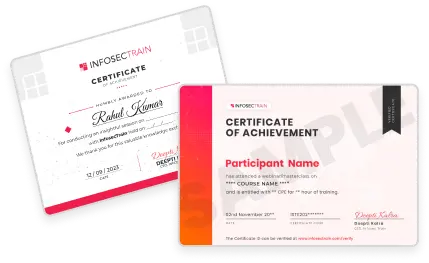
Get a Sample Certificate
Benefits of Security+ Certification

Get global recognition

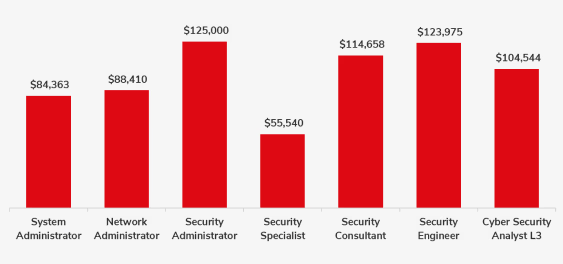
Maximize your earning potential

Earn the status of a cybersecurity expert

Advanced career growth

Become a part of an esteemed community

Words Have Power
The CompTIA Security+ course content was very good. The instructor has thorough
knowledge regarding the course, and particularly, all the concepts were clear during the
class, which I really liked. Thank you so much.

Tushar Kaushik
Ireland
The Comptia Sec+ training session with InfosecTrain was good and the trainer’s knowledge
was awesome. I could clearly understand everything that he taught. I would definitely
recommend InfosecTrain to others.

Lingannapeta Viart Chary
SingaporeIt was a pleasure to talk to the support team for coordinating the workshop
for Security+. She helped me in clarifying how the workshop works. The instructor helped
explain the topics related to cybersecurity in a visual manner as well.

Anuroop Giri
United States
It gave me good, hands-on insights on pentesting, and the recordings shared by the
trainer are helping me to sync in the knowledge. Absolutely good course for the ones
planning to start their journey in cybersecurity.

Prasanth Geddam
IndiaFrequently Asked Questions
There are two options available for taking the exam.Online testing: In online testing, you can give the exam from any location as per your convenience. A good internet connection and a device having a webcam will be required. In-person testing: In case, due to some reasons you are not able to take an online test, then CompTIA provides you testing options at any of Pearson VUE testing centers located across the globe.
Need Help? Reach Us.